Hereditary and/or traditional rights of control over temple wealth and administration (continued)
In the decades after Independence, in the democratic, socialistic and secular republic of India, successive elected governments of the State of Tamil Nadu realized the enormous potential for extracting great and steady revenue-streams and wealth — not to mention enormous leverage in electoral politics — from Hindu temples by retaining and replicating the British legacy system of administrative control over them.
The size and value of the “village and temple economy” of both India and the State were set to grow exponentially in a free and aspirational country. Therefore temples were far too valuable to be left to small community-based private and hereditary trustees to manage them. Thus came the modern State striding into the domain of the Church….
The old British administration-model for temples got perpetuated in newer Constitutional versions of it. And in their new, more republican avatars, the new legislations destroyed the traditional order that had been in vogue for centuries and under which trustees of local village-communities had served as custodians and curators of the Hindu temple.
************************
To understand the true extent to which the hereditary system of “miraasi/archaka” trustee-system in temples got destroyed in the years after Indian Independence, — especially in the State of Tamil Nadu where a majority of Sri Vaishhnavas/“ubaya-vedaantin” communities lived — one will have to scour and pore thoroughly into tomes of dense legal literature and turbid judicial judgments available in the public domain on many a vexing matter of unresolved, unreconciled dispute relating to temple-management and governmental interference into it today. It is outside the scope and purview of this book to detail those legal disputes. All that however is certainly needed is to summarize plainly four major landmark judgements of the Supreme Court of India delivered over the last 50 years. They have impacted the hereditary-system of temple management very significantly and adversely. Far from securing a new deal and a new fair and just system of administration in Hindu temples, the verdicts of the Court have only ended up creating more confusion, more heartburn and ever more litigation in the matter of how temples today function for the Hindu laity and priesthood.
The four Supreme Court verdicts known by their popular, easy-to-recall monikers are: (a) Shirur Mutt case (b) Tirumalai Archaka case (c) Sabhanayagam case and (d) Sabarimala case.
To go into the minutiae of the above three cases would be not only tedious but also wholly unwarranted here. Hence what is reproduced below in the following passages, almost verbatim, is only that which is very relevant and important to note in those case-laws in so far as they pertain to the history of the “ubaya-vedaantins”. That should be quite sufficient to give the reader a broad idea of the utter mess and mayhem that many of Constitutional provisions — their interpretation and application — have wreaked upon the age-old temple administrative practices in India… And it will also help one’s understanding of how the affairs and welfare of their own great temples in Tamil Nadu and Andhra Pradesh, and to a lesser extent in Karnataka, effectively slipped away from the hands of the Sri Vaishnava community.
****************************
The Court’s ruling in the Shirur Mutt case created a specious division in the nature and class of duties and functions within a temple administration. The division was labelled as “purely religious or ritual functions and duties” and “wholly secular and not integrally religious functions‘.
Such a doctrine of division of duties inside a temple created a wedge between “archakas/miraasi” duties and other so-called “non-religious” duties and functions which henceforth the government could step in to perform through its own appointed statutory and regulatory agents. This ruling effectively destroyed the whole ancient “miraasi” and hereditary archaka system in one fell swoop. And it created and opened up enormous space inside the temple for the State to begin interfering into the domain in temples which traditionally had been in the hands of religious trustees and curators of the local community. A deep schism was thus engendered and institutionalized within the whole temple ecosystem.
The Court by way of pious preamble made the following observation:
QUOTE: ….a law which takes away the right of administration from the hands of a religious denomination altogether and vests it in any other authority would amount to a violation of the right guaranteed under Article 26 of the Constitution of India. A religious sect or denomination has the undoubted right guaranteed by the Constitution to manage its own affairs in matters of religion and this includes the right to spend the trust property or its income for the religious purposes and objects indicated by the founder of the trust or established by the usage obtaining in a particular institution. To divert the trust properties or funds for purposes which a statutory authority or official or even a court considers expedient or proper although the original objects of the founder can still be carried out, is an unwarrantable encroachment on the freedom of religious institutions in regard to the management of their religious affairs. The religious freedom is guaranteed by the Constitution so the intervention of the Government in the administration of religious institution through the Statutory Boards may seem paradoxical.
The Government cannot in the guise of better administration takeover even the best administered temple for the purpose of managing the temple without justification. That would be certainly in violation of Article 26(b) of the Constitution. While the legislature could seek to regulate the administration, it must always leave the administration to the denomination“. UNQUOTE
*******************************
However, the Court also went on to propound a rather strange doctrine which effectively rendered nugatory the guarantees given in regard to the matter of religious freedom as described above:
QUOTE:
The right to manage its own affairs in matters of religion, which is given by Clause (b), the next two clauses of Article 26 guarantee to a religious denomination the right to acquire and own property and to administer such property in accordance with law. the administration of its property by a religious denomination has thus been placed, on a different footing from the right to manage its own affairs in matters of religion. The latter is a fundamental right which no Legislature can take away, whereas the former can be regulated by laws which the Legislature can validly impose. It is clear, therefore, that questions merely relating to administrator, institution are not matters of religion to which Clause (b) of the Article applies.
What Article 25(2)(a) contemplates is not regulation by the station of religious practices as such, the freedom of which is guaranteed by the Constitution except when they run counter to public order, health and morality but regulation of activities which are economic, commercial or political in their character though they are associated with religious practices.
By the very nature of things it would be extremely difficult, if not impossible, to define the expression “religion” or “matters of religion” or “religious beliefs or practice”. Right to religion guaranteed by Articles 25 and 26 is not absolute or unfettered right to propagate religion which is subject to legislation by the State limiting or regulating every non-religious activity. The right to observe and practice rituals and right to manage in matters of religion are protected under these Articles. But right to manage the Temple or endowments is not integral to religion or religious practice or religion as such which is amenable to statutory control. These secular activities are subject to State regulation but the religion and religious practices which are integral part of religion are protected. It is well settled law that administration, management and governance of the religious institution or endowment are secular activities and the State could regulate then by appropriate legislation.
Therefore, while on one hand, the religious rights in terms of Article 25 are to be protected and on the other hand, maladministration, financial irregularities by any religious institution has to be taken serious note of in the larger interest of temple discipline itself. The state has to draw a balance in maintaining temple disciplines/temple administration in terms of the Constitution of India.
UNQUOTE
It was clear from the wording of the above Court verdict that the honorable judges had based it upon two main presumptions, both of which are indeed seriously questionable from the standpoint of historical hindsight.
The first presumption was that the traditional order of hereditary “miraasi/archaka” management of temples was universally corrupt, maladministered and against “public order, health and morality“. It made one wonder if the Court’s presumption was founded on true empirical evidence drawn from all the 648, 907 temples in the country.
The second presumption of the Court was that of good faith on the part of the State i.e. elected State governments would possess the requisite sagacity and self-restraint to “maintain balance” always between “temple religious disciplines” and “temple administration” and would thus ensure smooth and seamless functioning of all temples within an institutional framework of the Indian Constitution. This presumption too came to be, tragically, very wrong, for, the State neither intended nor acted in good faith to keep Church and State harmoniously separated. It acted in fact, as will be explained in the next Part, to use the Constitutional ruling in the Shirur Mutt case to brazenly encroach upon the religious domain only to usurp the rights of hereditary priesthood in many temples.
Such brazenness was seen in the two other cases viz. the Tirumalai Archaka case and the Sabhanayagam case.
***********************************
In Tamil Nadu, there was a very important reason for continued retention of the British legacy system of temple-administrative control. A temple-ecosystem portrayed as being dominated by the Tamil Brahmin (“high-caste”) community came in very handy, politically and electorally for the Dravidian Movement of Periyar and the DMK to wage its war on what it called as the Aryan-Brahmin-Sanskrit blight, cultural and political domination. It served as a very convenient, readymade political platform for the ongoing struggle for political power that Dravidian Movement was engaged with in the State. From such a platform the strident Dravidian political parties like the DK and DMK — who in their relentless campaigns were able to invoke repeatedly and leverage cynically in letter and spirit the Indian Constitution (specifically Articles such as 17, 21, 25 and 26: Fundamental Right to Equality, to Religion etc.) — were able to quite easily legitimize their virulent propagation of “anti-Brahmin, anti-Aryan, anti-Sanskrit” ideology and dogma. By waging a relentless campaign aimed at wresting control over “Brahmin-infested” temples, muttams and charitable institutions, they knew that in time they would succeed in more effectively and widely broadcasting to the Tamil electorate the cherished ideals of Dravidianism viz.: “a casteless society, social justice and a welfare state” in Tamil Nadu.
It was thus that the Tamil Nadu HR & CE Act, through an amendment to it made in in 1954, abolished the hereditary rights of Brahmin priesthood. Then again, in 1971, the then DMK government under Chief Minister M. Karunanidhi further amended the updated Tamil Nadu Hindu Religious Endowments Act to abolish the concept of hereditary appointments for priests (Archakas) in temples in the State. The amendment was challenged in the Supreme Court, which however took the side of the government. The observations of the Court in the course of delivering its judgement in that case are worth reproducing below:
QUOTE: It is true that a priest or an Archaka when appointed has to perform some religious functions but the question is whether the appointment of a priest is by itself a secular function or a religious practice. The Archaka has never been regarded as a spiritual head of any institution. He may be an accomplished person, well versed in the Agamas and rituals necessary to be performed in a temple but he does not have the status of a spiritual head. Then again the assumption made that the Archaka may be chosen in a variety of ways is not correct. The Dharam-karta or the Shebait makes the appointment and the Archaka is a servant of the temple….
Even the position of the hereditary Archaka of a temple is that of a servant subject to the disciplinary power of the trustee. The trustee can enquire into the conduct of such a servant and dismiss him for misconduct. As a servant he is subject to the discipline and control of the trustee as recognized by the… principal Act….which provides “all office-holders and servants attached to a religious institution or in receipt of any emolument or perquisite therefrom shall, whether the office or service is hereditary or not, be controlled by the trustee and the trustee may, after following the prescribed procedure, if any, fine, suspend, remove or dismiss any of them for breach of trust, incapacity, disobedience of orders, neglect of duty, misconduct or other sufficient cause”.
That being the position of an Archaka, the act of his appointment by the trustee is essentially secular. He owes his appointment to a secular authority. Any lay founder of a temple may appoint the Archaka….That the son of an Archaka or the son’s son has been continued in the office from generation to generation does not make any difference to the principle of appointment and no such hereditary Archaka can claim any right to the office…. the fact that in some temples the hereditary principle was followed in making the appointment would not make the successive appointments anything but secular. …. the choice of the trustee in the matter of appointment of an Archaka is no longer limited by the operation of the rule of next-in-line of succession in temples where the usage was to appoint the Archaka on the hereditary principle. The trustee is not bound to make the appointment on the sole ground that the candidate, is the next-in-line of succession to the last holder of office”. UNQUOTE
*************************
In the State of Andhra Pradesh, the government, through its Act 30 of 1987, likewise promulgated the Andhra Pradesh Charitable and Hindu Religious Institutions and Endowments Act, which annulled all the rights and emoluments accrued in cash or kind to the Miraasis, including their share in prasadam, hundi and revenues from sevas. The most profoundly affected were the twelve Miraasi families of the Tirumala- Tirupathi temple. By a stroke of the mighty pen of the Justice of the Court, they lost a combined yearly estimated income of US $909,000!
The case was argued for and on behalf of the archakas of the Tirumala Temple very persuasively by the legal luminary and doyen, K.Parasaran (himself a practicing and devout Sri Vaishnava) but the Supreme Court bench was unconvinced about the traditional and time-honored principle of granting hereditary rights, privileges and entitlements to archakas on the basis of “miraasi” system. The gravamen of the Court’s judgement (http://JUDIS.NIC.IN) is worth reproducing below in the following few passages:
QUOTE:
“It is … contended that as per rules laid down in Agmas, the archaka of particular denomination alone is entitled to enter sanctum sanctorum and touch the image of God. A touch by a person of different denomination defiles the image of God. Therefore, persons belonging to that particular family, sect or denomination alone are entitled to perform pooja or ceremonial rituals of daily worship and that the abolition of hereditary right amounts to interference with the religion offending Article 25(1).
“Ex facie the argument being attractive, we had put a pointed question to Shri. Parasaran that when with the advancement of education and the liberty of a person to pursue liberal higher education of his choice to improve his excellence, persons born in a particular sect or denomination acquire liberal education and migrate, as is usual, to a foreign country and settle themselves in profitable avocation, and no other person from that particular family, sect/sub-sect or denomination having knowledge, proficiency and accomplishment is available, what would happen to the preference of rituals in that particular temple?
“The counsel, after due consideration, was frank to submit that in that eventuality the management of the institution has to seek a suitable person from outside the family, sect/subsect or denomination.
With increased modern facilities for liberal higher education and learning and ample opportunities to improve excellence to seek advantageous avocation, a child in traditional Vedic family may not fall in line with father to practise his “archakatwam” (priesthood), avocation or services and no one can compel him to do so.
Therefore, what would be relevant is not that the candidate who seeks to serve as an archaka must be from that family etc., but must be an accomplished person in Agama rules having faith and devotion in that form of worship and also proficiency to perform rituals and rites, ceremonial rituals appropriate to the temple according to its customs, usages, Sampradayams etc.
In other words, the faith and belief in the religion, customs, usages or Sampradayams in that particular Agamas and proficiency in performance of the rituals to the image of God in those particular rituals are conditions precedent to be eligible to hold office of the archaka. One who fulfils those pre-conditions is eligible to be considered and appointed to the office of archaka or other similar offices.
The regulation of this secular activity, therefore, does not offend any faith or belief in the performance of those duties by a person other than one hailing from the family, sect/sub-sect or denomination hither to performing the same…..We, therefore, hold that abolition of hereditary principle under Section 34 is not violative of either Article 25(1) or 26(b) of the Constitution.”
UNQUOTE
*******************************
The Court went even further! It totally redefined the traditional role and identity of the “miraasi/archaka” in temples in ruling that:
QUOTE:
“…..though the archaka is an acomplished person, well-versed in the Agamas and rituals necessary to be performed in a temple, he does not have the status of a head of the temple. ….He is a servant of the temple. …..
“… the status of hereditary archaka of a temple is that of a servant, subject to the disciplinary power of the trustee who would enquire into his conduct as servant and would be entitled to take disciplinary action against him for misconduct. As a servant, archaka is subject to the discipline and control of the trustee. …..
The archaka is the holder of an office attached to a religious institution and he receives emoluments and perks according to t he procedure therein…. his appointment is essentially a secular act. He owes his appointment to a secular authority. Any lay founder of a temple may appoint an archaka. The …Manager of temple exercises essentially a secular function in choosing and appointing the archaka. Continuance of an archaka by succession to the office from generation to generation does not make any difference to the principle of appointment. No such hereditary archaka can claim any right to the office. Though after appointment the archaka performs worship, it is no ground to hold that the appointment is either religious practice or a matter of religion.
It would thus be clear that though archaka is normally a well-versed and accomplished person in the Agamas and rituals necessary to be performed in a temple, he is the holder of an office in the temple. He is subject to the disciplinary power of a trustee or an appropriate authority prescribed in the regulations or rules or the Act. He owes his existence to an order of appointment – be it in writing or otherwise. He is subject to the discipline at par with other members of the establishment. Though after appointment, as an integral part of the daily rituals, he performs worship in accordance with the Agamas Sastras, it is no ground to hold that his appointment is either a religious practice or a matter of religion. It is not an essential part of religion or matter of religion or religious practice. Therefore, abolition of the hereditary right to appointment under Section 34 is not violative of either article 25(1) or 26(b) of the Constitution.
UNQUOTE
******************************
In time, thus, both in the States of Tamil Nadu and Andhra Pradesh — where most of the great temples of the Sri Vaishnavas were situated — it was the HR&CE Commissioner who was the government appointed chief administrator and regulator of temples and who in turn packed the Board of Trustees of temples with members (designated as “fit persons“) who were handpicked by himself. The Trustees in turn then appointed temple Executive Officers who, finally, it was that wielded local authority under law to appoint and discipline ‘archakas‘!
Hypothetically speaking, if one were to imagine this ruling of the Court being applied to the Catholic Church, it would conceivably simply mean that the appointment and supervision of a village or town parish would effectively be in the hands of the local municipal governor…. and not the bishop.
*****************************
The matter however did not end there nor did it reach finality at that point in the tortuous legal wrangles that continued plaguing the administration of temples for years and years thereafter.
To confound matters even more than as they were, a further complication was added by the Court when it propounded and introduced into the debate a rather strange legalistic concept which further muddied the already turbid nature of the issue. That concept in legal jargon was called “Denomination“. It soon went on to become a kind of abstruse legal figment in its own right. It also emerged as the basis upon which a fine but contentious distinction, hitherto never conceived in the Hindu faith, was made between caste, sect and “denomination“.
Very soon in temples like Chidambaram Nataraja Temple, Puri Jagannath Temple, Kanchipuram, Tirumala and others, the question cropped up: Which groups of priesthood can be said to be a “denomination‘? Are the Chidamabaram “podu diksheetars” a denomination? Are the “Thathaacharyas” of Kanchipuram or descendants of “Uttama Nambi” of Sri Rangam a “denomination”? Are the “achaarya purushas” of Tirumala Temple a “denomination”? Are the “Paandas” of Puri Temple a “denomination”?
What exactly is the meaning of the term “religious denomination” in legal parlance? From the record of a Supreme Court Judgment Order dt. 19 March 1996 (issued in the Tirumalai Archaka case), one gets only a vague and amorphous sense in regard to whom the term really applies. The Court observed the following:
QUOTE:
Only qualified archaka is entitled to step inside the
sanctum sanctorum (“garbhagriha”) after observing daily
discipline imposed upon him by the Agamas. It is his sole
duty to perform daily rituals and ceremonies according to
Agama prescriptions touching the Deity. Touch of the image
of the Deity by any other person would defile the idol.
Therefore, the Agama assigns that duty to the archaka alone
as part of religious practice. He performs Archana and other
services on behalf of the “Severities” or worshippers. The
services of archaka, therefore, are integrally and
inseparably connected with the performance of daily rituals
in pooja (worship) to the Deity.
Consequently, devotees of the respective Vaishnavite or
Saivite temples alone are entitled to be archakas in the
respective temples. In a Saivite temple, a Vaishnavite
cannot be an archaka and vice versa, though there is no bar
for them worshipping either Deity as a lay worshipper.
Therefore, any other archaka is not competent to do pooja in
Vaishnavite temple according to Vaikhanasa Agama Shastra.
This is the general rule applicable to all the temples. Even
among vaishnavitas there is further distinction between
pancharatra and vaikhanasa system of performing rites. It
is, therefore, clear that archaka of a temple, besides being
proficient in the rituals appropriate to the worship of the
particular Deity according to Agamas, must also belong to a
particular denomination. Thereby, archaka occupies an
important place in religious part of temple worship.
The principle of heredity thereby became part of
usage.
The management of the temple prior to the statutory
intervention was in the hands of Dharmakartas (Pedda
Jeengar). Equally, there classes of persons like Chinna
Jeengar, Acharya, Purrushas and Gamekars were in charge of
making prasadams, like Laddu and doing other forms of
services like maintenance of the temple by shepherd
community and other local communities, are part of the
hereditary system.
All of them are given certain rights known as “Mirasi
rights”. they earn their livelihood through these mirasi
rights which include lands given by the temple for
performance of services. Besides, archakas have shares out of
the offerings made to the temple, while persons in charge of
preparing prasadams will get percentage of share out of the
sale of prasadams. All persons in charge of various
activities of the temple succeed hereditarily. The right of management was acquired by birth and every person born in
the respective classes is entitled to a share in the
perquisites incidental to management. The temple is managed
by these persons by turns among them. Dharamkarthas and
archakas had framed rules for management of the temple. Even
after the statutory take-over of the management by the
Endowment Department or Government, custody of the
properties, particularly jewels, remained with archakas and
the custody changed hands to each family according to turns
from time to time. Head priest remained in charge of doing
pooja for a particular period; when his family got the
charge once in four years or eight years, he would be in
charge of all the valuables. Though the value of the
jewellery and other valuables of the temple was of several
crores, there was never any complaint of any sort regarding
their custody and management of the jewellery and other
valuables. All the functions done by archakas constitute an
integral and inseparable part of the management of the
temples and religious ritual practices and usages. Even the
food offerings and preparation of Prasadams, i.e., Dittam,
are part of the religious practice evolved in the temple and
are to be prepared by persons well versed in the Agama
Shastras.
UNQUOTE
The legal figment called “denomination” ended up in the ensuing years — nine long years in fact! — giving rise and cause to only even more vexatious litigation in matters related to the rights of hereditary priesthood and religious worship in Hindu temples.
*******************************
The Court then went on to issue a so-called clarification (in the later Sabhanayagam case relating to the Chidambaram temple) which too however made matters no less blurry and ambivalent.
It was held that with regard to appointing “archakas” (priests and head-priests) even if they are non-hereditary, it should confirm to the “usage” prevalent in the said temple. The usage prevalent referred to the particular Agama that was used in the temple to regulate the conduct of its rituals, practices and affairs. And if the “usage” was that Archakas were appointed from a given “denomination, sect or group”, the hereditary principle had to be followed! Any person, irrespective of caste and creed, would be eligible for appointment so far as he belongs to the particular denomination of the temple.
To many people of the Hindu faith in the country, the ruling was utterly baffling! It was as though the learned judges of the courts were speaking from both sides of their mouths! It was perceived to be a case of “what one hand giveth the other taketh away”! This confusion in fact seemed to arise from the very phrasing of the language used by the Court in an Order which said:
QUOTE:
The institution of temple should be in conformity with
the Agamas co-existing with the institution of temple
worship. Construction of temple and the institution of
archakas simultaneously came into existence. The temples are
constructed according to the Agama Shastra. In accordance
with the Agama Shastra, archaka as professional man, attends
on idols. He is associated with existence of temple over
centuries as part of its establishment. The authority of
Agama is judicially recognized in several precedents of
various courts including this Court. Agamas are treaties of
ceremonial law dealing with matters such as construction of
temples, installation of idols therein and conducting
worship of the Deity. Agamas relate to the Shiva temples.
The Agamas of Vaishnavas are Pancharatra Agamas containing
elaborate rules regulating how the temple should be
constructed, whereat the principal Deity is to be
consecrated, where the other Devatas (idols) are to be
installed and place where worshippers should stand and
worship the Deity. Though Agamas prescribed class
discriminatory placement for worship in the temples, it
became obsolete after the advent of the Constitution in
India which, by Articles 14, 15, 17, 21, 25 and 26,
prohibits discrimination on grounds only of caste, class,
sect etc.
UNQUOTE
**************************
A committee was formed then by the Tamil Nadu State government to review the Court verdict. It made known its findings promptly and quite categorically, and stated that the learned judges had misapplied their minds in the case. So in May 2006, the DMK government in power took up yet again the issue of priests appointments .
Relying on an earlier 2002 judgement (in what was referred to as the Adhithayan case, where the apex court held that there was no justification for insisting that persons of a particular caste alone could conduct temple rituals), the State issued a GO (government order) making any person with “requisite qualification and training” eligible for appointment in temples as archaka.
The GO was hailed by the entire political class in Tamil Nadu as having given effect to “right of equality” above every other consideration of law and doctrine.
******************************
By the middle of the second decade of the 21st century CE, the matter in Tami Nadu then also turned gender-specific!
The question was that if “right of equality” was the paramount objective of freeing temples from the hereditary and traditionally patriarchic system of priesthood, “what about women serving as archakas?”
The question now of appointing women as archakas even in Agama-compliant temples in Tamil Nadu raised its head in 2019. The Minister for Hindu Temples and Religious and Charitable Institutions soon thereafter announced that along with around 200 archakas of all castes (not otherwise designated as denominations) having been trained in Agama saastra in government-sponsored institutions (and to be later appointed as priests in temples), the women in Tamil Nadu — who as a class could be designated neither by caste or a denomination — could also be trained to become temple Archakas if they aspired to be so employed in exercise of their right to equality under the Indian Constitution.
By the year 2020, Hindu outfits and even prominent Hindu religious leaders, bowing finally to the dictates of what the Court and the State Government had ruled, started welcoming as “politically correct” the initiative to appoint aspirants belonging to all Hindu communities as “archakas/miraasis“. The event to led to the appointment orders to 208 appointees as archakas in Tamil Nadu temples who included “Bhattacharyas,” “Odhuvars” Poojaris and technical and office assistants who were recruited after due process.
Pontiff Kundrakudi Ponnambala Adigalar, spiritual Saivite leader, Shantalinga Marudhachala Adigalar, Hindu Religious and Charitable Endowments Minister P K Sekar Babu, Health Minister Ma Subramanian, Municipal Administration Minister K N Nehru, top HR & CE and government officials all participated in a grand public ceremony staged to inaugurate the program of “democratizing” the vocations of “archakas/miraasis”. While most temples have Brahmin priests, there are also many shrines and temples in Tamil Nadu today where people belonging to several other castes officiate as archakas.
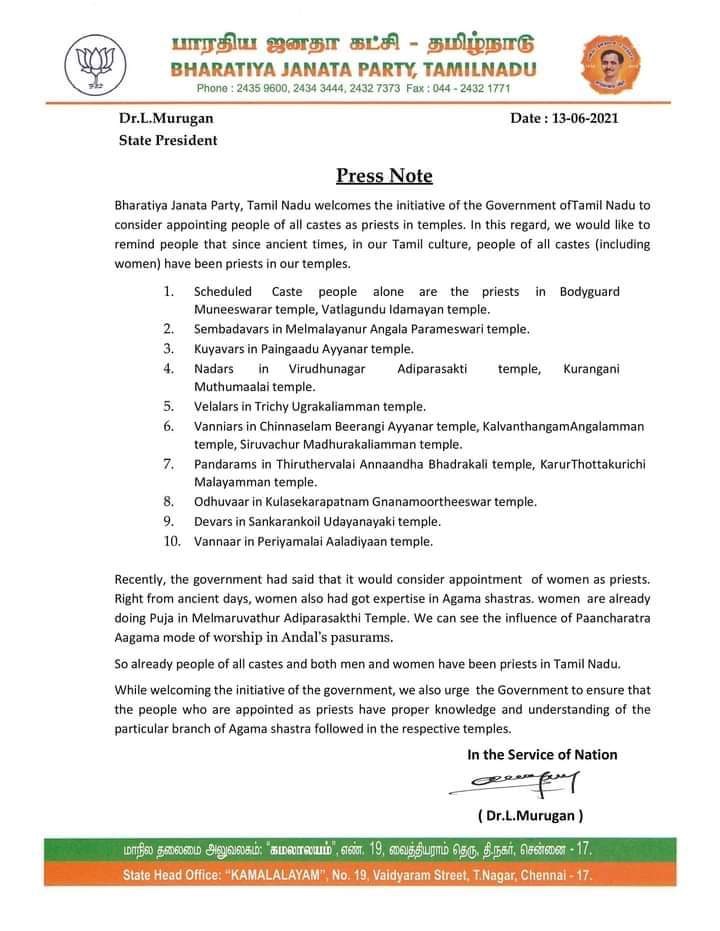
In fact even the Hindu Nationalist political party, the Bharatiya Janata Party (with its strident Hindutva ideology) which was in power in the Central Government of India, advised its local party-office in Tamil Nadu to issue a public proclamation in support of the Court’s ruling on the government orders:
*****************************
The story did not however end there… since a new twist in the tale already preceded the above events!
The government order (GO) which was issued by then Dravida Munnetra Kazhagam (DMK) regime had allowed “any Hindu” with “requisite qualification and training” to become an archaka in Tamil Nadu where hitherto only members belonging to either a certain caste or denomination were qualified. The Order was challenged before the Supreme Court during the course of hearings in what became the celebrated Sabarimala case. After hearing extensive arguments over the previous nine long years, the court held (in 2018) that priests can be appointed only in consonance with the Agamas wherever applicable, but also went on say that constitutional parameters and non-discrimination should also be respected. Two important aspects had to adjudicated on.
On the one hand, to ascertain if the government order violated the freedom of religion enshrined in the Constitution by being invasive in essential practices vital for the survival of the particular religion.
Second, it had to ascertain if the Agamas, which the petitioners insisted had to be devotedly followed in the appointment of priests, violated Articles 14 and 15 (right to equality) and 17 (abolition of untouchability). Article 17 came into play as Agamas invoke the concept of defilement and pollution of the idols in case its rules are violated and it clearly states untouchability in India stands abolished and its practice in any form is forbidden.
The Court accepted the fact that Agama rules for archaka appointments are not always necessarily caste-based since even some sections of Brahmins are not allowed to enter the sanctum sanctorum for the performance of pujas. But for a certain religious “denomination”, the more important eligibility criteria for priesthood, is more sharply defined, such as membership in a particular gothra. So, the Chief Justice averred that “denominations” are not necessarily caste- or class-based and hence if the Agama laid down that only a member of such “denomination” was eligible to serve as temple archaka, then that would not be violative of Article 14, 15 or 17.
It was thus that on the strength of the above Supreme Court judgement, in fact, today in the Chidambaram Nataraja Temple in Tamil Nadu, only members of the Chidambaram Deekshita denomination continue to be eligible to serve as its archakas in the sanctum.
*************************
In Andhra Pradesh too, the situation emerged no differently as in Tamil Nadu. A Miraasi family member living yards away from the Govindarajaswamy Temple in Tirupati was interviewed in camera by a journalist who reported it as below: https://www.hinduismtoday.com/magazine/june-1996/1996-06-court-decree-retires-tirupati-temple-s-hereditary-priests/ :
QUOTE:
“Sitting in their traditionally decorated hall lined with photos of their forefathers and Lord Venkataramana, I got a glimpse of the orthodox aristocratic lifestyle they (the “miraasi archakas” lead. They were understandably unhappy about the decision. “How can the court take away a religious right guaranteed as a fundamental right in the constitution? They seem to have set their eyes on the money the Mirasisare getting, forgetting the service that is being rendered. This is indirect looting,” roars a visibly annoyed Mrs. Srimathi, and advocate and wife of a Miraasi.
“It was the dedication and hard work of our forefathers that has developed the temple which now attracts millions of devotees everyday. We have been performing the rituals with unstinted orthodoxy and sincerity as prescribed by the shastras.Now the government wants to keep us out,” accuses Sri Sreenivasan, a Miraasi of the Acharyapurusha class.
“All archakas, gamekars and other temple workers will now be put through a selection process to assess their competence and knowledge of the requisite shastras.They will have to pass stringent proficiency requirements either through a guru or elder at home, or by attending any of the schools imparting Vedic education. The court has concluded that the legislature is competent to define qualifications for archakasand to conduct examinations to approve them.
“Not everyone agrees. “A child from an archaka family learns from an early age, listening to the Vedasand Prabandhamsbeing recited at home–it is in his genes. You cannot convert this traditional knowledge into stereotyped book education,“…. “All these years these Iyengars have been performing the pujas without compromising traditions. It is they who have increased the power of the temple. If they are removed and replaced, people will stop visiting the temple–they will lose faith“. Obviously, it is a conflict between church and state, faith and finance.
“The State has also been directed to determine the conditions of service, scale of pay and other emoluments for employees, relative to the income of the temple. This has generated debate on the efficacy of such a system”.
UNQUOTE
********************************
Critics to this day, whether faithful Hindus or Dravidianists, both rail against the Court’s legal doctrine of Denomination as being fraught with uncertainty. It causes consternation in the minds of all Hindus with regard to rights of the community to manage temples on its own. The Dravidianists however protest that it only translates into the age old system of priestly “archaka” appointments once again getting restricted to the community of Brahmins and allows for the re-entry of a “quasi-miraasi system” via the back-door.
The entire sorry and messy situation as it exists today in the Hindu temples of Tamil Nadu has been summed very accurately Prof. Ramesh of IIM-Bangalore (ibid) with this comment below:
QUOTE: The long term replacement of the old system with the present system of
patronage and spoils have led to a void, making it difficult to recreate the structure. It is now a fait accompli and is now projected as if there is no viable alternative. The post-independence government instead of building on the strengths of the old systems sought to completely override the system, and in the process completely undermined and eroded the institution of temples. The moment the control of temples came under Government, the people lost sense of ownership for these”. UNQUOTE
The Dravidianist ideologues of the DMK in the State of Tamil Nadu however even today disagree deeply and vehemently: https://www.thehindu.com/opinion/op-ed/a-case-for-state-control-of-hindu-temples/article66313240.ece .
QUOTE: “Much of the campaign to “free temples” feeds off the misconception that control of temples by the state is against the principle of secularism. However, the fundamentals of Indian secularism are different from those of western jurisdictions where state and church are totally separate. In India, the freedom to freely profess, practice, and propagate religion (Article 25 of the Constitution) is subject to the power of the state to make laws on the secular aspects of religion. The framers of our Constitution conferred powers to the state to exercise limited control over religious affairs by virtue of Article 25(2). Dr. B.R. Ambedkar observed that religion should not be given a “vast, expansive jurisdiction so as to cover the whole of life and to prevent the legislature from encroaching upon that field” and that the liberty we have is “to reform our social system, which is so full of inequities,… inequalities, discriminations… which conflict with our fundamental rights.” Over the years, the Supreme Court has held in a number of cases that the Constitution only protects practices that are essentially religious and does not preclude the power of the state to make laws on the secular, economic, political or financial aspects of religion. By virtue of such judicial precedents, governments have undertaken significant reforms. Supervisory state control over temples to the extent that it does not affect essential religious practices must be regarded as an inviolable aspect of the basic structure of the Constitution.
The Supreme Court has upheld laws such as the TN HR&CE Act and found them to operate within the constitutionally permissible framework of regulating the secular aspects of the Hindu religion. The framers of our Constitution emphasized the need for social reform in religion. And so, any effort to “free Hindu temples” can only be regarded as an attempt to redefine secularism and ultimately rewrite the fundamentals of our Constitution.
****************************
In final analysis all that can be said is only this: the British colonial legacy of temple governance, Dravidian ideology championing so-called “anti-Aryan casteless social justice”, the enactment of several laws and statute by the State that made possible intrusion into temple administration, the dynamics of caste-based, divisive electoral politics in India, and the utter political pusillanimity of 20th century, “baby-boomer” generations of Tamil Brahmin communities….. all indeed did combine to be collective cause and pretext for India’s Constitution to become the principal driving and enabling force in Indian society which “threw out the baby with the bathwater” in what otherwise was nobly intended to be effort aimed at realizing “old older changeth yielding place to new”….!
The Judges of the Supreme Court , Chief Justices M/s Nariman and Chandrachud categorically stated that the Constitution of India is the country’s only “holy book” and is holier than the Hindu Agama derived from the Vedas. Their Lordships made it clear to the People of India.. or rather to the majority Hindus of India… that it is the writ of the Supreme Court which will prevail over all other laws, even those of the Hindu temple called Agama: “Let every person remember that the “holy book” is the Constitution of India, and it is with this book in hand that the citizens of India march together as a nation, so that they may move forward in all spheres of human endeavor to achieve the great goals set out by this “Magna Carta” or Great Charter of India“.
The guiding light of India, the Constitution of India said, was the Magna Carta… and no longer would it be Veda, Agama or the Manu Smriti….
And the same Judiciary further issued a dire warning to the Executive of the day — i.e. State Governments — not to forget its “non-negotiable obligation” :
QUOTE:
“…to enforce the judgments of this Court. The duty to do so arises because it is necessary to preserve the rule of law. If those whose duty it is to comply were to have a discretion on whether or not to abide by a decision of the court, the rule of law would be set at naught.”
“Today, it is no longer open to any person or authority to openly flout a Supreme Court judgment or order, given the constitutional scheme as stated by us hereinabove.…Let it be said that whoever does not act in aid of our judgment, does so at his peril – so far as Ministers, both Central and State, and MPs and MLAs are concerned, they would violate their constitutional oath to uphold, preserve, and defend the Constitution of India”.
UNQUOTE
*********************************
(to be continued)
Sudarshan Madabushi