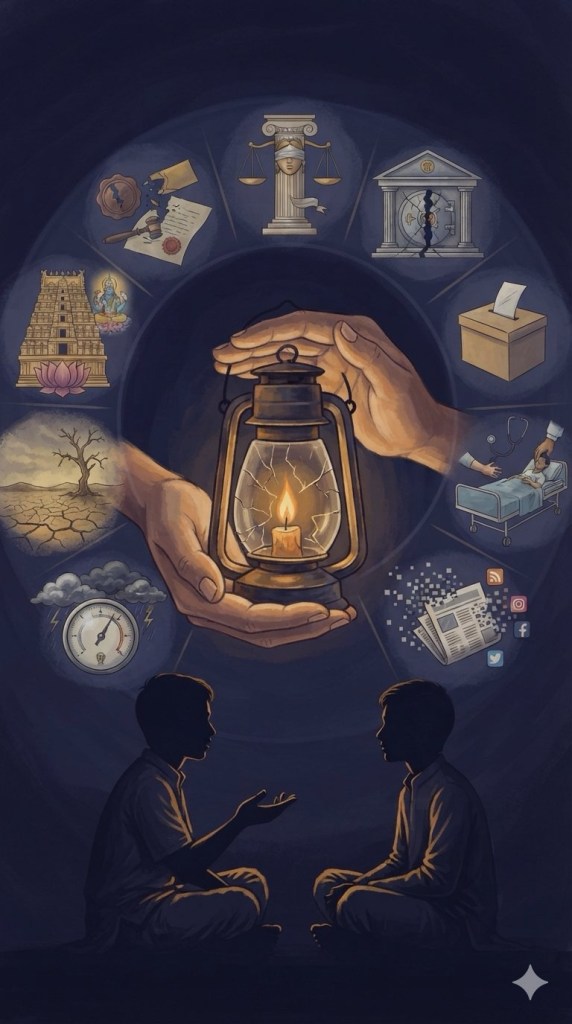
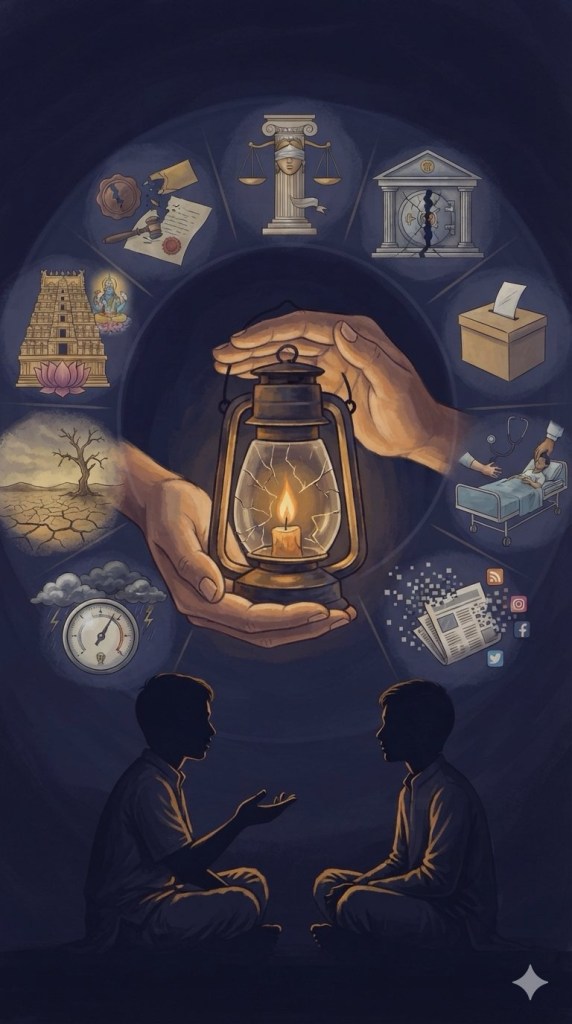
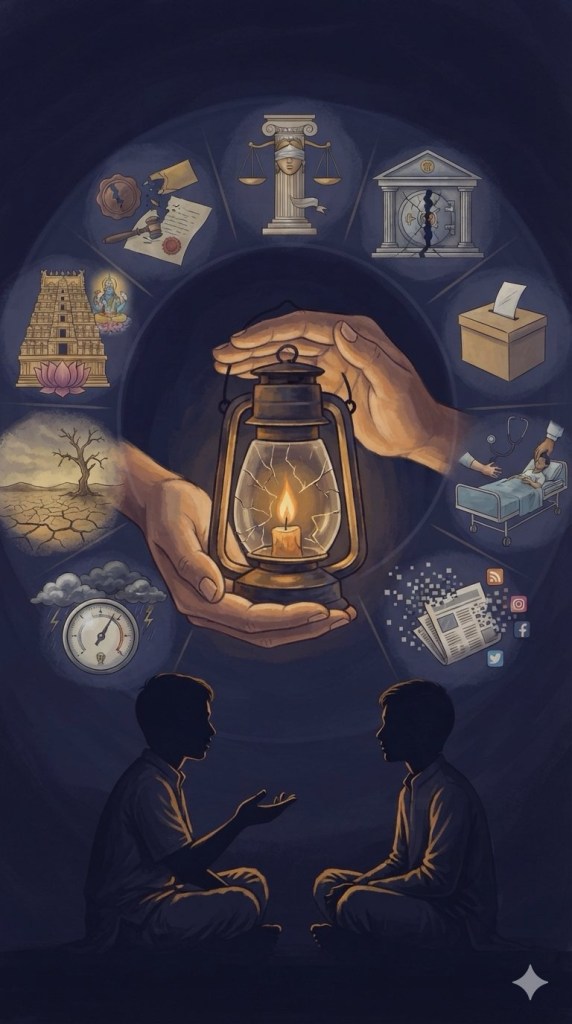
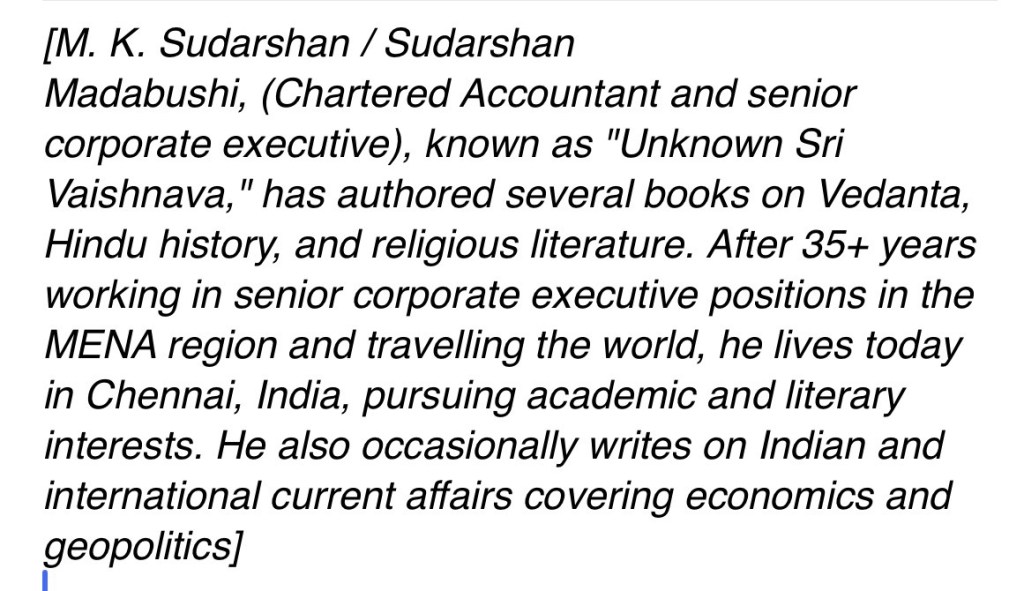
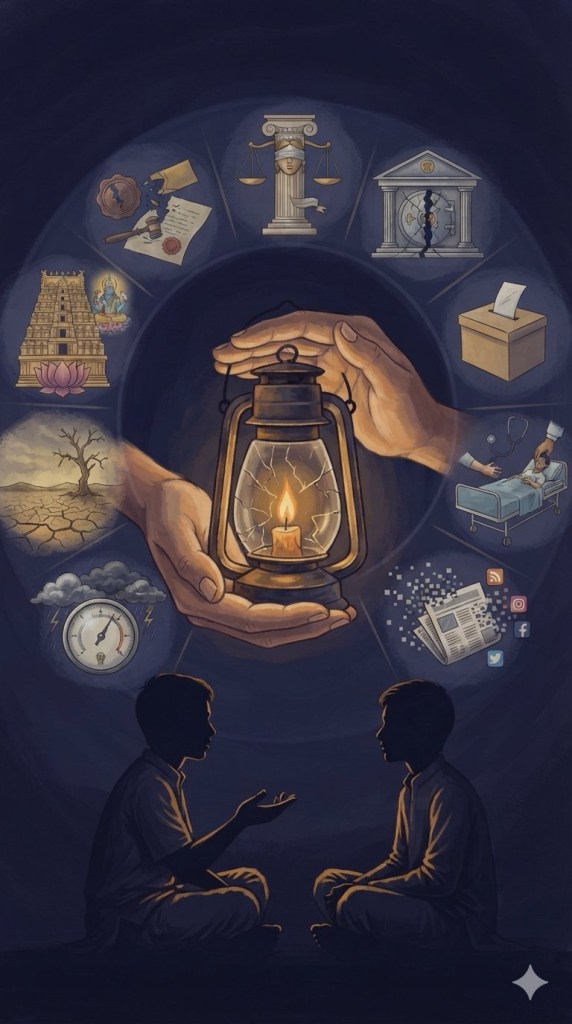
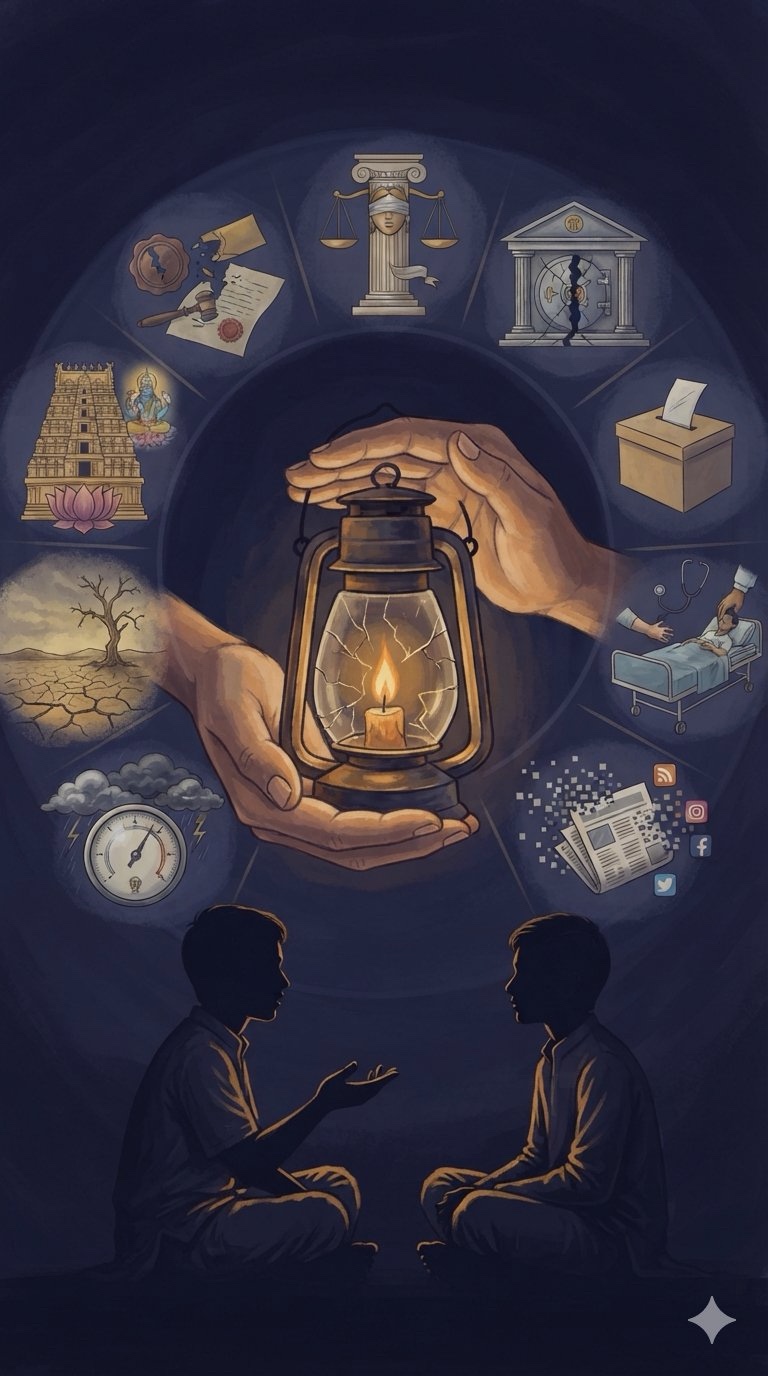
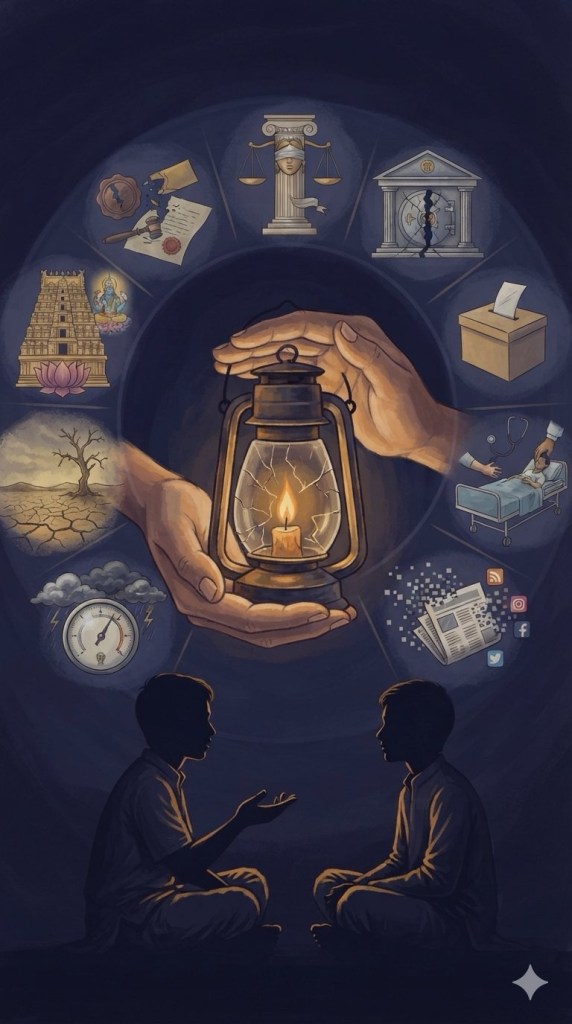
Ānanda: Madhava, suppose trust continues to decline. Suppose people cease to believe governments, banks, courts, hospitals, journalists, and priests. Can institutions still survive?
Madhava: They can survive. But they may survive only as shells.
Ānanda: What do you mean?
Madhava: An institution has two bodies: its structure and its spirit. The structure consists of law, office, building, budget, and procedure. The spirit is the willingness of people to cooperate with it willingly. When trust dies, the structure may remain, but the spirit departs.
Ānanda: Then what holds it together?
Madhava: Fear, habit, self-interest, and force. The citizen obeys because punishment is costly. The employee complies because salary is necessary. The patient visits the hospital because there is no alternative. But obedience is not trust.
Ānanda: So institutions become prisons rather than shelters.
Madhava: Or machines rather than communities. They process people; they no longer protect them.
Ānanda: You once said trust is the counter-force to entropy. Why entropy?
Madhava: In the physical world, entropy describes the tendency of ordered systems to move toward disorder. In human society, distrust performs a similar work. It breaks cooperation into self-defence. It turns neighbours into rivals, institutions into fortresses, and public life into suspicion.
Ānanda: But is not some distrust necessary? Should we trust a tyrant, a fraudster, or a careless surgeon?
Madhava: Certainly not. Distrust is not evil when it is proportionate. It is the immune system of a society. The disease begins when distrust becomes universal, indiscriminate, and self-fulfilling.
Ānanda: How does it become self-fulfilling?
Madhava: The citizen who expects corruption may evade rules. The official who expects evasion becomes rigid. The journalist who expects outrage manufactures outrage. The bank that expects fraud adds surveillance. Each side confirms the other’s suspicion. Soon everyone is defending himself against everyone else.
Ānanda: And the cost?
Madhava: Enormous. More lawyers, more auditors, more passwords, more police, more contracts, more verification. Cooperation becomes expensive. The poor suffer first, because they cannot afford protection.
Ānanda: So distrust is a tax?
Madhava: A hidden tax upon every human relationship. Trust reduces the cost of cooperation; distrust multiplies it.
Ānanda: Then why do institutions not reform themselves?
Madhava: Because reform often requires the very trust that has been lost. To reform, an institution must admit failure. To admit failure, it must believe the public will not destroy it for honesty. But a distrustful public often punishes honesty more severely than concealment.
Ānanda: A cruel circle.
Madhava: Yes, but not an unbreakable one. Institutions have survived catastrophes before. They survive when enough people within them choose fidelity over advantage.
Ānanda: You place great weight upon individuals.
Madhava: Because institutions do not act; persons act through institutions. A clerk who refuses a bribe, a judge who rules against power, an official who tells the truth—these are not sentimental exceptions. They are seeds of institutional renewal.
Ānanda: But one honest clerk cannot redeem a corrupt system.
Madhava: No. But a corrupt system is not redeemed by one cynical citizen either. The question is which accumulation will grow: the habit of betrayal or the habit of fidelity.
Ānanda: You speak as though trust were a discipline.
Madhava: It is. Like health, it cannot be commanded into existence. It must be practised.
Ānanda: Then perhaps the institution’s first duty is not to demand trust, but to become worthy of it.
Madhava: And the citizen’s first duty is not to surrender to cynicism, but to remain capable of recognising trustworthiness when it appears.
Ānanda: Otherwise the honest and the dishonest become indistinguishable.
Madhava: Yes. And when that happens, entropy has won—not by destroying institutions, but by making them empty.
Ānanda: Madhava, you said the media may report the collapse of trust. But can a mirror report on its own cracks?
Madhava: A mirror does not need to be flawless to show that something is broken. But it must at least admit that it too is made of glass.
Ānanda: That is the problem. Modern media presents itself as the conscience of the public, yet it is commercial. It sells attention. It needs conflict, scandal, fear, and novelty. Can such an institution speak honestly about trust?
Madhava: It can, but only if it knows its own temptations. The moment the media believes itself to be above suspicion, it becomes precisely what it condemns.
Ānanda: But is not the commercial structure itself the corruption? If truth does not sell, will truth survive?
Madhava: Truth has never been guaranteed by markets. In every age, it has needed patrons, institutions, communities, and courageous individuals. The question is not whether commerce exists; it is whether commerce is allowed to become the final judge of what may be said.
Ānanda: And today?
Madhava: Today, attention is currency. The more outrage, the more engagement. The more engagement, the more revenue. A system built upon attention will always be tempted to make anger more profitable than understanding.
Ānanda: Then journalism becomes theatre.
Madhava: Sometimes. But do not confuse the theatre with the whole stage. There are still reporters who verify, editors who resist pressure, and publications that issue corrections at cost to themselves. They may be fewer; they may be quieter. But they exist.
Ānanda: Yet people increasingly receive news through social media, search engines, and now artificial intelligence. They no longer meet the journalist; they meet a feed.
Madhava: That is the deeper crisis. A newspaper may err, but it has a name, an editor, a correction column, and a history. A feed has none of these. It offers fragments without responsibility.
Ānanda: So trust declines not only because institutions lie, but because the space between the citizen and the institution has filled up with intermediaries.
Madhava: Yes. The citizen once asked, “Who says this?” Now the citizen asks, “What does the algorithm show me?” And the algorithm does not answer; it merely arranges.
Ānanda: Then the media’s credibilitydeficit is also an accountabilitydeficit.
Madhava: Exactly. Trust requires someone who can be questioned. A faceless system cannot be trusted; it can only be endured.
Ānanda: But —forgive me, Madhava—if the media cannot be trusted, how can it help rebuild trust?
Madhava: There is no need to seek forgiveness between friends, Ānanda. And the answer is: by becoming trustworthy in small, visible ways. By correcting errors promptly. By distinguishing fact from opinion. By refusing to amplify what it cannot verify. By remembering that its first loyalty is not to the advertiser, the party, or the platform, but to truth.
Ānanda: That sounds like an ideal.
Madhava: It is an ideal, but not an impossible one. Every profession lives between its ideal and its temptation. The physician is tempted by fees, the judge by power, the scholar by reputation, the journalist by attention. The question is whether the profession possesses an inner discipline stronger than its temptation.
Ānanda: And if it does not?
Madhava: Then it may survive commercially and die morally. It will have audiences, but no authority.
Ānanda: A mirror that shows every face except its own.
Madhava: Yes. And such a mirror eventually becomes useless even for others.
Ānanda: Then what should the citizen do?
Madhava: Read slowly. Cross-examine. Seek the source. Reward correction. Refuse the intoxication of certainty. And remember that the purpose of news is not to confirm one’s anger, but to enlarge one’s understanding.
Madhava: That is the whole of it. Trust cannot be demanded by a headline. It must be earned by a life.
Ānanda: Perhaps the media’s first duty is not to be believed, but to be worthy of belief.
Ānanda: Madhava, I have been reading about something called the “Edelman Trust Barometer”. It is often quoted when people discuss the decline of trust in governments, businesses, media, and voluntary organisations.
Madhava: And what is it, exactly?
Ānanda: It is an annual global survey conducted by Edelman, a large international public-relations and communications firm. Each year, it asks tens of thousands of people across many countries how much they trust four broad sectors: government, business, media, and NGOs. It also explores anxieties about employment, technology, misinformation, climate, and social division.
Madhava: So it is a thermometer of public opinion.
Ānanda: More or less. It tells us what people say they trust, how far that trust extends, and whether it is rising or falling. But that is precisely what troubles me.
Madhava: Why?
Ānanda: Because the Barometer is produced by a public-relations firm. Edelman advises corporations, governments, and institutions on reputation, communication, and crisis management. Can a firm that profits from managing trust credibly measure the collapse of trust?
Madhava: You are suspicious of the physician who profits from the illness he diagnoses.
Ānanda: Exactly. Is there not a conflict of interest?
Madhava: There may be. But let us be fair before we condemn. A survey may be conducted carefully even by an interested party. The proper questions are: Was the sample large and representative? Were the questions clear? Are the methods disclosed? Can others examine the data and test the conclusions?
Ānanda: And can they?
Madhava: To a limited extent. Edelman publishes its methodology, sample sizes, countries surveyed, and broad findings. But it is not an independent academic body, and its underlying data are not always available for full outside scrutiny. So it should be read with respect, but also with caution.
Ānanda: Then what does the Barometer actually measure?
Madhava: It measures reported perception. It tells us that people say they distrust an institution. It does not prove that the institution is morally corrupt, nor does it prove that it is trustworthy. A government may be distrusted because it has failed; it may also be distrusted because opponents have successfully poisoned public opinion.
Ānanda: So it measures the public mood, not the truth.
Madhava: Precisely. It is a barometer of legitimacy, not a verdict on virtue. A barometer tells you that a storm is approaching. It does not tell you whether the storm is just.
Ānanda: But there is another difficulty. The Barometer is reported by the media. And the media itself is commercial. It needs attention, conflict, and audience loyalty. Can a compromised messenger credibly report on compromised institutions?
Ānanda: And if the media is untrustworthy, every report of distrust becomes another reason for distrust.
Madhava: You are circling a real paradox: the instrument that measures trust is itself embedded in the economy of reputation making.
Madhava: That is the spiral. But do not let the spiral become an excuse for intellectual laziness. “All media is corrupt” is not an insight; it is a way of avoiding discrimination.
Ānanda: What do you mean?
Madhava: There is a difference between a newspaper that names its reporters, publishes corrections, separates news from advertisement, and accepts criticism—and an anonymous social-media account that repackages rumours for engagement. Both may be called “media,” but they do not deserve the same trust.
Ānanda: Yet even a serious newspaper depends on owners, advertisers, subscriptions, and political pressures.
Madhava: Of course. Every human institution is shaped by its conditions of survival. The question is whether it possesses mechanisms to resist those pressures: editorial independence, transparency, correction, accountability, and a public larger than its own tribe.
Ānanda: And if it does not?
Madhava: Then its readers must become its auditors. In a free society, trust cannot be passive. It must remain vigilant.
Ānanda: So we should not reject the Barometer outright?
Madhava: No. Read it as one reads a fever chart. It may reveal that the social body is ill. But do not ask the thermometer to cure the fever.
Ānanda: And who cures it?
Madhava: Those who change their conduct. Institutions become trustworthy not by commissioning surveys, but by keeping promises when keeping them is costly.
Ānanda: You always return to conduct.
Madhava: Because trust is not a feeling that can be marketed. It is a habit of truthfulness, proven over time.
Ānanda: Then perhaps the Barometer’s greatest value is unintended: it reminds us that no institution can outsource its integrity to a measurement.
Madhava: Yes. A barometer may detect the storm. Only righteousness can still it.
Nine Dialogues on Trust, Betrayal, and Mahāviśvāsam
Ānanda: Madhava, I have been turning over a small phrase printed on American currency: In God We Trust. It struck me as strange. A society that places these words on its money seems, at the same time, to have lost faith in nearly every institution around it.
Madhava: Perhaps it is not so strange, Ānanda. When people cease to trust one another, they may reach for a trust that lies beyond human failure.
Ānanda: But look at the world. Governments are doubted. Banks are doubted. Judges, doctors, journalists, priests, scientists, technology companies—all are viewed with suspicion. We speak of a “trust deficit” as though it were a shortage of grain or fuel.
Madhava: And perhaps it is a shortage of a subtler kind. A deficit of trust does not appear in ledgers, but it affects every transaction of life.
Ānanda: How so?
Madhava: Consider the farmer who sows before he reaps. He trusts the rain, the soil, the seasons, and the buyer who will one day purchase his crop. Consider the patient who places his body in a physician’s hands. Consider the citizen who pays tax, obeys law, and accepts the verdict of a court even when it goes against him. Each act rests upon a quiet wager: I make myself vulnerable because I believe the other will not betray that vulnerability.
Ānanda: You make trust sound like the foundation beneath everything.
Madhava: It is. Remove it, and every institution becomes a fortress. People still obey, but they obey out of fear, habit, or compulsion—not because they believe.
Ānanda: Then where did this deficit begin? I wonder sometimes whether it goes back to the biblical story of Adam and Eve.
Madhava: Tell me what you have in mind.
Ānanda: In the Book of Genesis, God places Adam and Eve in a garden and permits them to eat from every tree except one: the tree of the knowledge of good and evil. A serpent approaches Eve and asks, in effect, “Did God really say you must not eat from that tree?” Eve replies that they may not touch it, lest they die. The serpent then says, “You will not surely die,” and suggests that eating will make them like God, knowing good and evil.
Madhava: And then?
Ānanda: They eat the fruit. Their eyes are opened. They realise they are naked, feel shame, and hide from God. When God asks what they have done, Adam blames Eve, and Eve blames the serpent.
Madhava: So the story is not merely about the eating of a fruit.
Ānanda: No. It is about the questioning of a trust. God had given them a command; the serpent makes them doubt whether God’s word was truthful or benevolent. Once that doubt enters, disobedience follows.
Madhava: That is why the story has endured. It is not merely an ancient tale about two people in a garden. It is a mirror. In every age, human beings receive a trust, begin to suspect the giver, seek security on their own terms, and then hide from the consequences.
Ānanda: But can we really blame two figures in an ancient story for the distrust of our own time?
Madhava: No. We should not treat the story as a genetic curse passed mechanically through generations. It is better understood as a parable of the human condition. Each generation repeats the movement: we are given trust, we fear its demands, and we seek safety on our own terms.
Ānanda: Then the “original sin” is not simply disobedience.
Madhava: In that reading, it is the death of trust in the heart. The Catechism of the Catholic Church puts it strikingly: Adam and Eve, tempted by the serpent, allowed their trust in their Creator to die, and then misused their freedom.
Ānanda: But our own tradition also speaks of illusion, desire, and ego. Is there a parallel?
Madhava: There is. The serpent’s question—“Did God really say?”—is not very different from the inner voice that asks, “Can the Lord really be relied upon? Can dharma really protect? Is surrender not weakness?” The external form changes; the inner movement is familiar.
Ānanda: Yet I hesitate to call all distrust evil. Should we trust a tyrant, a fraudster, or a careless physician?
Madhava: Certainly not. Distrust has its place. It is the immune system of society. We need discernment, scrutiny, and the courage to question power. The disease begins when distrust becomes universal and indiscriminate—when we decide that no one and nothing can be trusted.
Ānanda: Then what is the difference between healthy suspicion and the trust deficit?
Madhava: Healthy suspicion asks, “Show me the evidence.” The trust deficit says, “I will believe no one, because everyone has failed me.” The first protects society. The second dissolves it.
Ānanda: You speak as though trust were a discipline.
Madhava: It is. Like health, it cannot be commanded into existence. It must be practised: by keeping small promises, admitting errors, honouring commitments, and refusing to exploit another’s vulnerability.
Ānanda: And if others fail us?
Madhava: Then trust must become discerning. We need not trust blindly; but neither should we allow one betrayal to make us incapable of recognising fidelity when it appears.
Ānanda: So the story of Eden does not end in despair?
Madhava: No. It begins the human vocation: to live among broken promises and still become capable of keeping one.
Ānanda: Perhaps that is why the serpent’s question still echoes across the ages: “Did God really say…?”
Madhava: Yes. And every generation must answer it—not merely with words, but with a life that makes trust credible again.
Nine Dialogues on Trust, Betrayal, and Mahāviśvāsam
byM. K. Sudarshan
October 23, 2026: Chennai, India
Trust is the first thing we surrender—and the last thing we learn to rebuild. In God We Trust may be less a declaration of faith than humanity’s confession: we no longer know whom to cling to when the rain sets in.
A nine-day dialogue on the death of trust—and its possible resurrection.
A Series Introduction
We live in an age that speaks endlessly of trust—and practises it with increasing difficulty.
Governments ask for trust while citizens question their motives. Banks ask for trust while memories of financial betrayal remain fresh. Doctors, judges, journalists, priests, scientists, technology companies, and even the weather forecast are asked to prove themselves before they are believed. The ballot box asks the loser to trust the process; the patient asks the stranger in a white coat to touch the most intimate facts of his life; the depositor asks an invisible institution to safeguard his earnings.
We call the result a “trust deficit.” But perhaps it is more than that. Perhaps it is the mother of all deficits: the deficit that makes every other deficit harder to remedy. Trade deficits, budget deficits, food and energy deficits, deficits of well-being and happiness—all require cooperation among parties who no longer fully believe one another.
Even the climate now seems to suffer from a predictability deficit. The old rhythms of nature, on which human life once rested with a certain confidence, have become uncertain. And uncertainty breeds anxiety; anxiety breeds suspicion; suspicion makes cooperation more difficult.
This series of nine dialogues — which I will be posting one a day, starting tomorrow Oct 24 over the succeeding 9 consecutive days — all arose from a simple but unsettling question:
“How did the world come to suffer so widely from a deficit of trust?”
Was it a consequence of the primal breach of trust narrated in the story of Adam and Eve? Was the first sin not merely disobedience, but the collapse of confidence in God’s word? And if so, has human history ever ceased to repeat that original movement—receiving trust, doubting it, grasping at certainty, and then hiding from the consequences?
The dialogues that follow are set in an imaginary Vedic university in South India. Two students meet there: Ānanda, restless, sceptical, poetic, and wounded by the betrayals of the modern world; and Madhava, calm, learned, and steeped in Vedānta and the Sri Vaishnava tradition.
Ānanda does not speak as a cynic for the pleasure of cynicism. He speaks for all of us who have watched institutions demand trust while failing to deserve it. Madhava does not offer easy consolation. He tests Ānanda’s despair, distinguishes distrust from wisdom, and gradually leads the conversation toward a more demanding question:
“Can trust be rebuilt after betrayal—or must we learn a humbler, more discerning form of reliance?”
The 9 dialogues move through the modern landscape of public-relations surveys, commercial media, institutional decay, and social entropy. But they also move inward, toward the old spiritual insight that human beings cannot ultimately be their own refuge.
The series ends in the Sri Vaishnava doctrine of prapatti—self-surrender—and in mahāviśvāsam: the soul’s great, unshakeable trust in the saving grace of Sriman Nārāyaṇa.
This is not a denial of the world’s betrayals. It is a refusal to allow betrayal to become the final truth of human existence.
Perhaps trust is indeed a “candle in the wind”. But even a candle can light another candle. And perhaps, from many small flames faithfully preserved, a dawn becomes possible.
Author’s Note:
These 9 dialogues were not composed in a calm, academic frame of mind. They emerged from questions that had been moving through my mind throughout the nine days of the Navarathri festival that has just concluded.
Navarathri is a festival of the Divine Mother: nine nights of worship, remembrance, and inner preparation. It is also, in its deeper meaning, a passage through struggle toward clarity—the movement from darkness toward light, from fragmentation toward wholeness.
As the festival proceeded, I found myself thinking less about celebration and more about trust: trust in God, trust in institutions, trust between human beings, and the strange modern condition in which we are asked to trust powers we can neither fully understand nor hold accountable.
The questions came unbidden.
Why does the modern world speak so much of a “trust deficit”?
Why do institutions that exist only because people once trusted them now struggle to command belief?
Why does the media, which claims to speak for the public, itself suffer from a credibility deficit?
Why do we place the words “In God We Trust” upon our currencies and public monuments, while finding it increasingly difficult to trust one another in ordinary life?
And then came the harder question: if human trust is so fragile, is God worthy of Man’s trust? If yes, why?
It was in the course of these Navarathri reflections that the Sri Vaishnava idea of mahāviśvāsam came to feel central. In the doctrine of prapatti, or self-surrender, mahāviśvāsam is not naïve optimism. It is the soul’s unshakeable confidence that, having surrendered itself to Sriman Nārāyaṇa, it will not be abandoned.
That thought did not, of course, dissolve the world’s betrayals. It did not make corruption, falsehood, cruelty, or institutional failure any less real. But it changed their final significance. They became wounds within a larger story, not the whole story.
These nine dialogues are therefore offered as a Navarathri meditation—on the death of trust in our public life, and on the possibility of its resurrection through truthfulness, accountability, discernment, and ultimately surrender to the Divine.
They are dialogues, not verdicts. Ānanda’s doubts are my doubts; Madhava’s responses are my attempts to think beyond them. If the series has a single underlying conviction, it is this:
The death of trust is not overcome by demanding belief. It is overcome when human beings, and the institutions they create, once again become worthy of belief.
And when they do not, the soul must still find a refuge deeper than fear.
That refuge, in the Sri Vaishnava tradition, is the Lord’s grace.
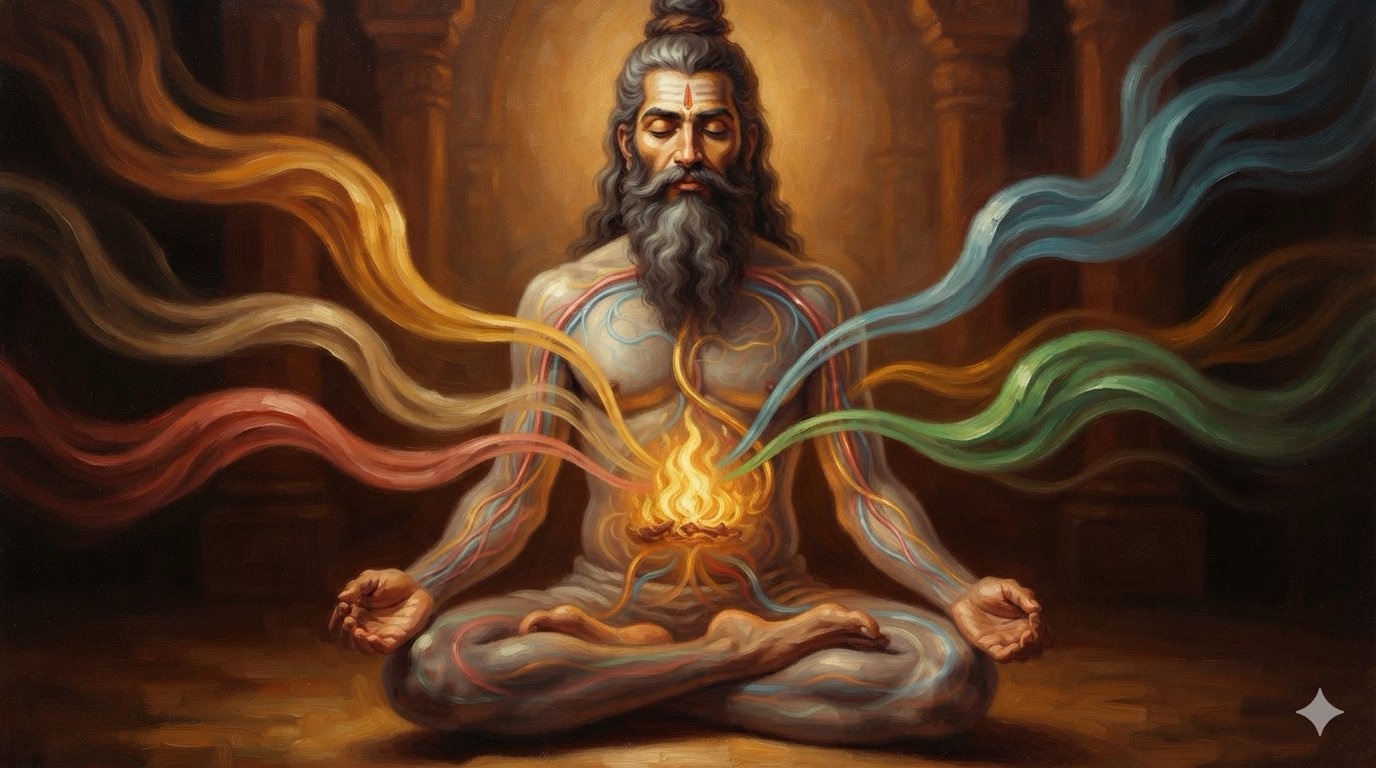
For centuries, a profound epistemological divide has separated the reductionist precision of modern medicine from the systemic, experiential insights of ancient India. To the contemporary clinical researcher, metabolism is an intricate web of chemical kinetics: a sequence of enzymatic cascades, peptide signaling, and Adenosine Triphosphate (ATP) synthesis—the primary chemical energy currency of the cell—occurring at the cellular level. To the Vedic practitioner, this same life-sustaining process is viewed as a holy fire—a continuous biological sacrifice known as Prāṇāgnihotra.
When we look past the differences in vocabulary, an astonishing realization emerges. Modern metabolic science, unlocked through advanced microbiology, and ancient Vedic physiology, mapped through the deep meditative insights of the Rishis, are reading the exact same blueprint of human nature from opposite ends.
Nowhere is this convergence clearer than in the daily ritual of Pariseshana—a mealtime practice that serves as a highly precise, time-tested neuro-biological protocol to optimize human digestion.
1. The Multi-Stage Engine: Mapping the 13 Fires of Transformation
In modern gastroenterology and hepatology, metabolism is recognized as a highly coordinated, multi-tiered pipeline:
Remarkably, traditional Vedic anatomy maps this exact same structural pipeline using the universal principle of Agni (the biological fire of transformation). Rather than viewing digestion as a singular event, classical Sanskrit texts divide human metabolism into 13 distinct biological fires, categorized into three precise evolutionary phases:
Phase 1: The Core Ignition (Jatharagni)
Situated in the stomach and upper intestinal tract, Jatharagni is the master gastrointestinal engine. It corresponds directly to the mechanical churning of the stomach and the chemical breakdown of food via hydrochloric acid, pepsin, bile, and pancreatic enzymes. If this core ignition fails or burns unevenly, the downstream stages are starved of viable fuel.
Phase 2: The Sorting Facility (Bhutagni)
Once food passes the gastric barrier, it encounters the five Bhutagnis (elemental fires), localized primarily within the liver. Ancient philosophy states that all matter is composed of five elements: Earth, Water, Fire, Air, and Space. The Bhutagnis act as a cellular customs house, breaking down the external elements in food and reassembling them into human-compatible elemental building blocks. This is a perfect systemic metaphor for hepatic metabolism—the liver’s unique role in sorting, filtering, and converting complex macronutrients into standardized biomolecules before releasing them into the systemic circulation.
Phase 3: Tissue Synthesis (Dhatvagni)
Finally, these refined nutrients enter the bloodstream to feed the seven *Dhatvagnis* (tissue fires). Operating sequentially at the cellular level, each tissue fire consumes its share of nutrition to synthesize specific bodily structures: moving from plasma (Rasa) and blood (Rakta), down to muscle, fat, bone, marrow, and ultimately, the reproductive fluids and master hormones (Shukra). This beautiful sequential chain reaction mirrors the modern understanding of anabolism, cellular respiration, and tissue-specific protein synthesis.
2. The Ventilation System: How the Five Airs Drive the Fire
A chemical fire cannot burn without oxygen, ventilation, and mechanical kinetic force. In the human body, while the Agnis represent the chemical energy of transformation, the Panchapranas (the Five Airs) represent the mechanical and neurological forces that manipulate and direct that energy.
When a Vedic adherent performs the Pariseshana rite, they offer five initial unchewed morsels of grain mixed with clarified butter (ghee) to these five vital currents. Far from a mechanical litany, the Prāṇāhuti mantras are a systemic activation sequence for the nervous system:
Om Prāṇāya Svāhā: Activates Prāṇa Vāyu, the inward-moving force that governs the swallowing reflex and pulmonary oxygenation, bringing in the literal oxygen required for aerobic cellular metabolism.
Om Apānāya Svāhā: Triggers Apāna Vāyu, the downward force governing renal and colonic excretion. By signaling the lower gut to clear out metabolic waste and ash from previous cycles, it prevents systemic toxicity (Ama) from suffocating the metabolic furnace.
Om Vyānāya Svāhā: Awakens Vyāna Vāyu, the outward-radiating force regulating cardiovascular circulation. This prepares the vascular network to efficiently transport and distribute newly absorbed nutrients to peripheral tissues.
Om Udānāya Svāhā: Energizes Udāna Vāyu, the upward force governing diaphragmatic breathing and cellular vitality, driving the structural output of metabolic energy expenditure.
Om Samānāya Svāhā: Targets Samāna Vāyu, the localized abdominal force that directly fans the flames of Jatharagni. This corresponds to the enteric nervous system triggering peristalsis—the mechanical churning movements of the gut—and the synchronized secretion of digestive enzymes.
3. The Neurobiology of Pariseshana and the 6 Physical Mudras
For dietitians, food psychologists, and medical clinicians, the most compelling aspect of Pariseshana is its profound capacity to alter gastrointestinal physiology through the mind-gut axis.
Modern clinical research proves that optimal digestion requires the body to be in a calm, parasympathetic state (“rest and digest”). If a person sits down to eat while stressed, distracted by digital screens, or rushing, the sympathetic nervous system (“fight or flight”) takes over. The brain redirects blood flow away from the gut, stalls stomach contractions, and inhibits the production of hydrochloric acid and salivary enzymes.
The physical mechanics of Pariseshana act as a profound biological circuit breaker:
A core element of this circuit breaker is the deployment of 6 distinct Mudras (hand gestures) used throughout the pre- and post-meal sequence. Fingertips possess a massive concentration of sensory nerve endings. In Vedic physiology, the thumb represents Agni (Fire), and touching it to other fingers completes specific neurological and reflexology loops that alert the autonomic nervous system:
The Water Circle / Mandala (Containment Cue): While not a hand lock, the clockwise movement of water around the plate frames the psychological boundary, severing external stress loops and prompting sensory focus.
Prāṇa Mudra (Thumb + Ring + Little Finger): Deployed for the inward-moving air offering. It maps to the reflex arcs that regulate pulmonary and esophageal motility.
Apāna Mudra (Thumb + Middle + Ring Finger): Deployed for the downward-eliminating air. This is a classic grounding gesture that helps modulate pelvic nerves and intestinal motility to ready waste clearance.
Vyāna Mudra (Thumb + Index + Middle Finger): Deployed for the circulatory air. It stimulates peripheral cardiovascular reflexes, preparing the capillary beds to expand and receive blood-bound nutrients.
Udāna Mudra (Thumb + Index + Middle + Ring Finger): Deployed for the upward-vitalizing air. It focuses somatic awareness on the thoracic cavity and diaphragm, ensuring steady, oxygenated breathing.
Samāna Mudra / Mukul Mudra (All Five Fingertips Touching): Deployed for the central equalizing air. Bringing all five elemental finger paths into a single focused point acts as an instantaneous neural trigger to ignite Jatharagni, signaling the stomach to execute intense peristaltic churning and release targeted gastric secretions.
4. The Macro-Scale Engineering Wall: Why Science Uses “Chips” Instead of Flesh
While microbiology has meticulously unraveled the chemistry, endocrinal secretions, and nutrient transfers of metabolism, medical science faces absolute, insurmountable barriers to building a full-sized, macro-scale, “flesh-and-blood” mechanical humanoid apparatus outside the body to replicate digestion.
The primary engineering barrier is vascularization. A full-scale living organ tract requires a staggering network of trillions of microscopic capillaries to feed its cells. Without a closed loop, synchronized pumping heart, and complex angiogenic blood vessel systems, large masses of engineered or cloned human tissue cannot receive uniform oxygen or clear away metabolic waste products (Malas). Instead of functioning, the outer tissue layer quickly undergoes ischemic necrosis (tissue death).
Because macro-scale simulation is physically impossible today, science must downsize. Through Microfluidics (“Gut-on-a-Chip”), scientists isolate microscopic layers of real human intestinal cells on memory-stick-sized platforms. Tiny computer-driven vacuum chambers physically stretch the sides of the chip to mechanically mirror peristalsis, and micro-channels simulate the liver (Bhutagni) and cardiovascular system (Vyāna Vāyu). It is an elegant, functional compromise, but it underscores a profound reality: modern science can only study the macroscopic, integrated harmony of human alimentation by scaling it down to a microchip.
5. The Epistemological Wall: The Barriers to Realising the Yogic Path Today
If modern science is bottlenecked by physical scaling and vascularization, modern seekers face an equally steep hurdle in trying to replicate or scientifically verify the Yogic path of inquiry used by the ancient Rishis.
Ayurveda was not compiled through random empirical guesswork, but recorded as a byproduct of Samadhi—states of complete meditative stillness where the analytical mind and physical senses are utterly quieted. Yoga psychology explains that when the mind achieves perfect inner absorption (Samāpatti), it functions like a flawless, noise-free bio-receiver. By turning this noise-free awareness inward, the Rishis could subjectively map visceral currents (Pranas) and metabolic fires (Agnis) with absolute experiential accuracy.
Today, realizing this path to the point of recording objective medical science faces profound barriers:
The Proliferation of Neuro-Cognitive “Noise”: Modern human life is saturated with continuous digital, sensory, and chemical stimuli. This creates a state of perpetual hyper-arousal in the Default Mode Network (DMN)—the brain network responsible for ego-chatter and anxiety—making the required levels of deep, sustained Samadhi exceptionally rare.
The Inherent Subjective-Objective Paradox: A Rishi’s yogic revelation is a first-person, purely subjective experience. Modern science, by definition, demands third-person, reproducible, objective measurements. We can stick an fMRI machine on an advanced yogi’s head and watch their neuro-chemical signatures shift or their vagus nerve stabilize, but the machine can only record the somatic echo of their experience—it cannot record or download the intuitive architectural insights themselves.
Conclusion: Reading the Same Master Script
Ultimately, we are looking at a magnificent convergence. Modern medical science operates from the outside in, utilizing microfluidic platforms, cellular assays, and network pharmacology to mathematically prove how our tissues and endocrine channels coordinate. The ancient Vedic seers operated from the inside out, clearing away mental noise to read the very same systemic laws of thermodynamics and biology directly within their own bodies.
Whether we measure this journey through the exact expansion of Adenosine Triphosphate (ATP) cycles and hormonal loops, or navigate it through the sequential ignition of the 13 Agnis powered by the 5 Pranas, the master script is identical. By reviving a rational, mindful appreciation for time-tested rituals like Pariseshana, we bridge the reductionist vocabulary of the laboratory with the holistic poetry of the Vedas—transforming each meal into a scientifically optimized, deeply sacred fuel sequence for human vitality.
(Disclaimer: This article is for informational purposes only. For related medical advice or diagnosis, please consult a professional).
As the “Trump Doctrine” dismantles 66 global pacts, humanity faces the death of international diplomacy.
Discover how a zero-sum world is hurtling toward anarchy.
At the 81st United Nations General Assembly, a venue built on the foundational premise of collective security and shared global governance, President Donald Trump delivered what may well be remembered as the obituary for modern international diplomacy.
Eschewing the traditional, sanitized euphemisms of statecraft, he looked out at an assembly of world leaders and proclaimed a primal law of nature: “To the victor belong the spoils”.
This was not mere rhetorical bluster; it was the unvarnished crystallization of a radical foreign policy doctrine — one that actively swaps the ink of binding international covenants for the volatile water of raw transaction.
We are currently witnessing an unprecedented institutional demolition. While prior American presidents have occasionally walked away from treaties to protect vital national interests, the current administration has executed a systematic, blanket repudiation of the international order. The turning point arrived with Executive Order 14199, which instituted an aggressive freeze on global funding and culminated in a historic, mass withdrawal of the USA from 66 global organizations, conventions, and treaties.
The 66-Part Purge: Thumbnail Briefings of the Critical Breaches
This sweeping retraction is not characterized by a few isolated disputes; rather, it is defined by a massive catalog of 66 individual institutional delinquencies executed simultaneously. To understand the velocity of this shift, one must look at how the most critical, highly consequential pillars of this 66-part breach of trust shattered decades of global cooperation, and how its unilateral, transactional fallout directly disrupts partners like India:
Draconian H-1B and Green Card Visa Curbs: In a stark demonstration of ignoring bilateral trust, the administration enacted sudden, sweeping restrictions on high-skilled immigration pathways. By implementing a Presidential Proclamation that re-enacted massive “visa integrity fees”, proposing to scrap the long-standing “deference policy” for H-1B extensions, and launching aggressive fraud investigations that freeze processing, Washington unilaterally reshaped the tech pipeline. These measures were executed without prior consultation with major democratic partners like New Delhi, fundamentally threatening the security and livelihoods of millions of global professionals.
The Volatile Weaponization of Oil Import Tariffs: Energy security has similarly been turned into a tool for geopolitical leverage. The administration previously shook bilateral trade by slapping a 25% tariff on Indian imports explicitly to punish New Delhi’s purchases of Russian crude. While Washington eventually walked that back in early 2026 following tough trade talks, the constant threat of a 100% tariff under the Lindsey O. Graham Sanctioning Russia and Iran Act loomed heavily over major energy importers until an eleventh-hour executive waiver was signed. This pattern reveals a doctrine where stable trade rules are discarded in favor of perpetual economic pressure.
The Fragile U.S.A-Iran MoU (2026): Proving that diplomatic commitments are now entirely fleeting, the administration signed a 14-point memorandum of understanding to end hostilities, reopen the Strait of Hormuz, and establish a 60-day negotiating window. Yet, within less than a week, a swift return to military friction shattered the truce, illustrating that modern diplomatic frameworks are treated as temporary tactical pauses rather than durable peace architectures.
The Tearing Up of Global Trade Covenants: Multilateral trade agreements have been systematically targeted for renegotiation or outright cancellation. The formal repudiation and dismantling of NAFTA (replaced by the transactional USMCA), the structural narrowing of the U.S.A-South Korea Free Trade Agreement (KORUS), and the swift withdrawal from the Trans-Pacific Partnership (TPP) demonstrate a clear rejection of integrated global economic structures in favor of zero-sum bilateral leverage.
The Collapse of Arms Control Architectures: Security frameworks designed to prevent global catastrophe have been explicitly cast aside. By unilaterally walking away from the Intermediate-Range Nuclear Forces (INF) Treaty and the Open Skies Treaty, the administration dismantled decades of bilateral security verification and aerial surveillance transparency, removing the critical guardrails that historically kept superpower friction from boiling over into open conflict.
UNFCCC & The Paris Climate Framework: By completely severing ties with the United Nations Framework Convention on Climate Change (UNFCCC), the parent treaty underlying all global climate diplomacy, the U.S. became the first nation to exit the foundational framework entirely. This, coupled with pulling out of the Intergovernmental Panel on Climate Change (IPCC), halts multilateral environmental verification and leaves the U.S. structurally isolated from the global commons.
UNRWA & Humanitarian Relief Lifelines: The complete termination of funding and withdrawal from the UN Relief and Works Agency (UNRWA), alongside exits from UN Women and the UN Population Fund (UNFPA), abruptly dismantled decades of human rights and aid delivery networks. It shifted the baseline of global aid from a collective moral duty to an instrument of political compliance.
Beyond these prominent rollbacks, the remaining bulk of the 66 total breaches quietly hollowed out regional governance and specialized bodies, systematically pulling the United States out of the UN Economic and Social Council (ECOSOC) Regional Commissions (including ECLAC, ECA, and ESCAP), technical forums like the International Law Commission, and global policy groups like the International Energy Forum.
Reciprocity vs. Hyper-Sovereignty: A Clash of Geopolitical Philosophies
This institutional scorched-earth policy exposes a profound, irreconcilable clash between two competing philosophies of international relations: the Doctrine of Reciprocity and the Doctrine of Hyper-Sovereignty.
For nearly a century, the civilized world operated on the principle of pactasuntservanda: the foundational concept that international agreements must be kept. This Doctrine of Reciprocity recognizes that in an interconnected world, state sovereignty is not diminished, but rather secured, when nations collectively bind themselves to shared rules. Reciprocity acknowledges that existential threats, whether global pandemics, environmental degradation, or nuclear proliferation, cannot be solved by unilateral decree. It treats treaties as durable covenants written in the ink of mutual trust.
The “Trump Doctrine,” conversely, views the international system through a lens of pure Hobbesian realism. In this view, multilateral pacts are not sacred moral obligations, but inherently flawed shackles that dilute a superpower’s leverage. It elevates an anarchic interpretation of state sovereignty to an absolute virtue, operating on the premise that a nation’s signature on a treaty lasts only as long as the immediate transactional benefit. It signals a deeper truth: to hyper-sovereignty, international law is merely an optional constraint for others, and an irrelevant nuisance for the powerful.
The End of Diplomacy: Hurtling Toward a Hobbesian Morass
The terrifying implication of this shift is the structural normalization of this behavior. If the world’s most powerful nation operates on the anarchic principle of “America First,” it invites a catastrophic chain reaction. If every global superpower, from Beijing to New Delhi, is forced to fully embrace the exact same survivalist doctrine, we face what Francis Fukuyama’s contemporary antithesis would call the “end of the history of international diplomacy.”
We are hurtling toward a diplomacy-extinct morass. If sovereignty consistently overrides reciprocity, and if binding agreements are signed in water rather than ink, the sprawling architecture of global governance will collapse entirely. The death of the United Nations and its affiliated international institutions will not be a sudden explosion, but a rapid, hollow draining of authority, leaving behind a world stripped of an arbiter.
In this approaching twilight, humanity reverts to a primitive state of nature where anarchy rules, international law is replaced by raw kinetic leverage, and the strong do what they will while the weak suffer what they must.
By raising the banner of “to the victor belong the spoils” at the UN podium, the United States has not just walked away from its global commitments; it has lit the match that threatens to burn the global village down.
And that’s why we in the rest of the world must face up to a question from asking which we all today seem to flinch if not cringe: Is America a rogue state?
Just to let you know, the global listing process typically takes about 60 days to be fully established across all platforms.
Thanks & Regards Priiyanshu Post-Publication Team
Please find the editor’s note attached herewith that was sent by:
Ms Shruthi, Editorial Coordinator, Blue Rose Publishers:
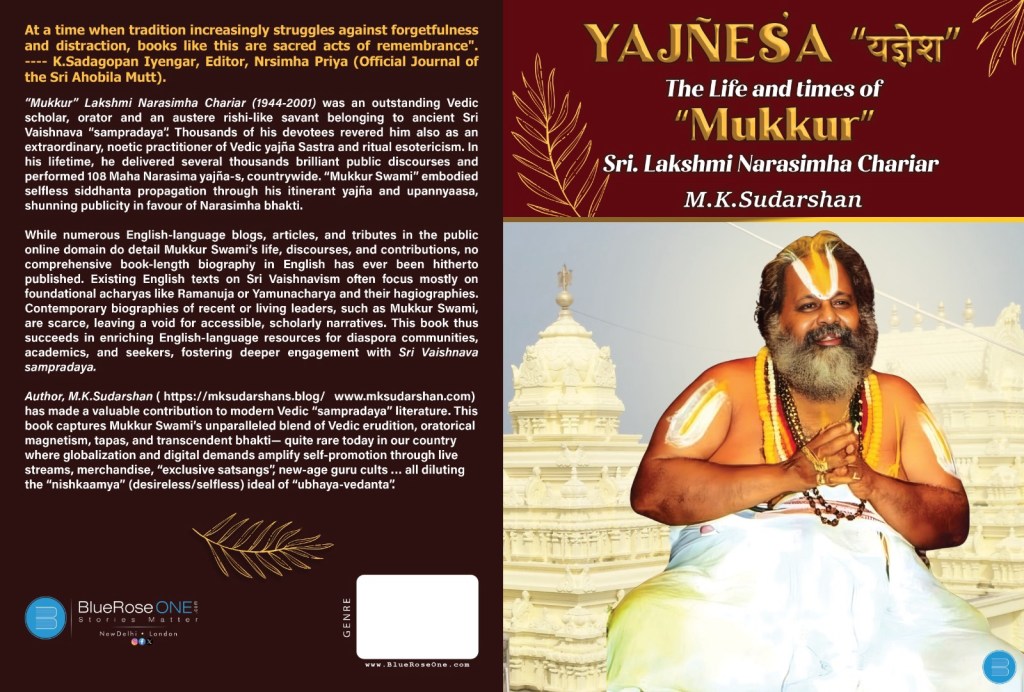
“Mr. Sudarshan, I had the privilege of going through your latest work on Mukkür Svãmĩ, and I could not help but convey my heartfelt appreciation for what you have accomplished with this excellent book.
What sets your book apart from other biographies is that your writing goes way beyond that – you have masterfully managed to capture the essence of a rare Acārya in all his complexity, using research, reminiscence, historical insight, and spirituality to do so.
Your account is fascinating and instructive as it enables the reader to gain insight into the personality, scholarship, and teachings of a prominent figure. All that comes together to produce a truly compelling reading experience.
What I appreciated most about your book was that you managed to preserve invaluable memories and information that would otherwise remain unknown to us today. It is a worthy homage to a great scholar and philosopher and a significant contribution to the Srivaişnava heritage.
I thank you sincerely for your labor of love and dedication. It has been a pleasure to go through it and learn so much from it.
Shruti Editorial Coordinator
Find us on social media 1484836361_square-twitter.png 1484836356_square-facebook.png 1487771825_Instagram-1.png 1484836633_internet_explorer.png
[October 18, Sunday, 2026:In the auspicious fortnight of Navarathri and on the sacred day of observance of the Mahasamadhi Day of Her Holiness Sathguru Gnananda Saraswathi, the VishnuMohan Foundation held a special religious event at the Ashram of Sri Srihariprasad Swami-ji by conducting Vedic Homam and Devi Puja. The event was attended by a large gathering of Swami-Ji’s devotees who participated in the Guru puja, Devi puja and Homam.
At the kind invitation of Sri Sriharidas Swami-ji and with His Blessings, it was my “baagyam” to deliver a talk on the occasion on “MEDHA SUKTAM”. The full transcript of the talk is reproduced below]
Recitation of Acharya “Tanian” and Dhyaana shlokas-s
Vedic Invocation: Medhā Sūktam
ॐ यश्छन्द॑सामृष॒भो वि॒श्वरू॑पः ।
छन्दो॒भ्योऽध्य॒मृता᳚थ्सम्ब॒भूव॑ ।
स मेन्द्रो॑ मे॒धया᳚ स्पृणोतु ।
अ॒मृत॑स्य देव॒धार॑णो भूयासम् ।
शरी॑रं मे॒ विच॑र्षणम् ।
जि॒ह्वा मे॒ मधु॑मत्तमा ।
कर्णा᳚भ्यां॒ भूरि॒विश्रु॑वम् ।
ब्रह्म॑णः को॒शोऽसि मे॒धया पि॑हितः ।
श्रु॒तं मे॑ गोपाय ॥
ॐ मे॒धादे॒वी जु॒षमा॑णा न॒ आगा᳚द्
वि॒श्वाची॑ भ॒द्रा सु॑मन॒स्य मा॑ना ।
त्वया॒ जुष्टा॑ नु॒दमा॑ना दु॒रुक्ता᳚न्
बृ॒हद्व॑देम वि॒दथे॑ सु॒वीराः᳚ ॥
त्वया॒ जुष्ट॑ ऋ॒षिर्भ॑वति देवि॒ ।
त्वया॒ ब्रह्मा॑ऽऽग॒तश्री॑रु॒त त्वया᳚ ।
त्वया॒ जुष्ट॑श्चि॒त्रं वि॑न्दते वसु॒ ।
सा नो॑ जुषस्व॒ द्रवि॑णो न मेधे ॥
मे॒धां म॒ इन्द्रो॑ ददातु ।
मे॒धां दे॒वी सर॑स्वती ।
मे॒धां मे॑ अ॒श्विना॑वु॒भा-वा
ध॑त्तां॒ पुष्क॑रस्रजा ॥
अ॒प्स॒रासु॑ च॒ या मे॒धा ।
ग॑न्ध॒र्वेषु॑ च॒ यन्मनः॑ ।
दैवीं᳚ मे॒धा सर॑स्वती॒ ।
सा मां᳚ मे॒धा सु॒रभि॑र्जुषता॒ग्॒ स्वाहा᳚ ॥
आमां᳚ मे॒धा सु॒रभि॑र्वि॒श्वरू॑पा॒ ।
हिर॑ण्यवर्णा॒ जग॑ती जग॒म्या ।
ऊर्ज॑स्वती॒ पय॑सा॒ पिन्व॑माना॒ ।
सा मां᳚ मे॒धा सु॒प्रती॑का जुषन्ताम् ॥
मयि॑ मे॒धां मयि॑ प्र॒जां
मय्य॒ग्निस्तेजो॑ दधातु॒ ।
मयि॑ मे॒धां मयि॑ प्र॒जां
मयीन्द्र॑ इन्द्रि॒यं द॑धातु॒ ।
मयि॑ मे॒धां मयि॑ प्र॒जां
मयि॒ सूर्यो॒ भ्राजो॑ दधातु ॥
ॐ हं॒स॒ हं॒साय॑ वि॒द्महे॑ ।
परमहं॒साय॑ धीमहि ।
तन्नो॑ हंसः प्रचो॒दया᳚त् ॥
ॐ शान्तिः॒ शान्तिः॒ शान्तिः॑ ॥
Imagine a child sitting before an examination paper.
The questions are before him. The books have been read. The teacher has explained everything. Yet the mind is restless; the words will not come; what was learnt yesterday now seems distant and unreachable.
Then imagine another child—perhaps no more gifted, perhaps with fewer books, fewer teachers, fewer advantages—but with a mind that is calm, attentive, and receptive. That child listens once, understands deeply, remembers faithfully, and speaks with quiet confidence.
What makes the difference?
We often call it intelligence. We may call it talent. We may call it memory. But the Vedic seers had a more beautiful word for it: medhā.
Medhā is not merely the ability to score marks, solve problems, or remember facts. It is the inner light by which knowledge becomes living. It is the power to receive what is taught, to retain what is received, to understand what is retained, and finally to express it in speech that is clear, sweet, and beneficial.
Today we shall reflect on the Medhā Sūktam, a Vedic prayer addressed to Goddess Sarasvatī as Medhā Devī—the divine bestower of wisdom, memory, and sacred speech.
But let me say at once: this is not merely a hymn for students preparing for examinations.
It is a hymn for every human being who has ever felt that life is too complicated to understand; for every person who has struggled to find the right word; for every parent who wishes a child to grow in wisdom and not merely in information; and for every seeker who suspects that behind all our learning there must be something greater than learning itself.
The Medhā Sūktam begins not by saying, “Make me clever.”
मेधां म इन्द्रो ददातु ।
मेधां देवी सरस्वती ॥
Medhāṃ ma indro dadātu;
medhāṃ devī Sarasvatī.
“May Indra grant me wisdom; may Goddess Sarasvatī grant me wisdom.”
Notice the humility of that prayer.
The Vedic seer does not say, “I will become intelligent by my own effort.” He says, “May intelligence be given to me.”
That is the first lesson of the Medhā Sūktam: wisdom is not merely something we possess. It is something we receive.
And the Goddess who gives it is Sarasvatī—Medhamayī, the one filled with wisdom; Sarasvatī, who began in the Vedic imagination as a sacred river and as Vāc, sacred speech; Sarasvatī, who later becomes the consort of Brahmā and the goddess through whom creation becomes meaningful.
Today, we shall follow this Goddess through five meditative landscapes:
• First, in the Medhā Sūktam itself, with its literal richness.
• Then in the Vedic vision of creation, where Brahmā, Vāc, and the sacred river meet.
• Then in the Purāṇas, through the astonishing story of Prahlāda and Narasiṃha.
• Then in Śrī Vaiṣṇava theism, through Sri Andal’s Goda Stuthi and Tiruppavai and Vedānta Deśika’s Hayagrīva Stotram
• And finally, in the lives of Kālidāsa, Prahlāda, and every seeker who discovers that true speech is not merely eloquence, but grace.
We shall discover that medhā is not the final destination.
It is the pathway.
And if we follow it far enough, it leads us beyond information, beyond cleverness, beyond even eloquence—to bhakti, and finally to śaraṇāgati: the complete offering of oneself at the feet of the Divine… “atma Samarpanam” which was indeed the central “upadesam” of Sathguru Gnanananda Saraswathi all her lifetime.
1. What are we asking for?
When we pray to Goddess Sarasvatī, what exactly are we asking for? We may say: “Give my child success in examinations.” We may say, “Give me clarity in my work.” We may ask for memory, concentration, or success in an interview. All these are legitimate prayers. But the Vedic hymn we are considering today asks for something much deeper.
It asks for medhā.
Medhā is often translated as intelligence, intellect, memory, or brilliance. But in the Vedic imagination it is more than any of these. It is the awakened power by which a human being receives knowledge, holds it faithfully, understands its meaning, discerns what is right, and expresses it in words that heal rather than wound.
The Medhā Sūktam is therefore not merely a prayer for examination success. It is a prayer to become a worthy vessel of knowledge.
The hymn occurs in the TaittirīyaĀraṇyaka, sections 10.41–44, and is also preserved in the MahānārāyaṇaUpaniṣad. It invokes Indra, Agni, the Aśvins, Sūrya, and above all Sarasvatī, asking each to bless the worshipper with medhā.
2. The literal richness of the Sūktam
The hymn begins by invoking the radiant lord of the Vedic hymns:
ॐ यश्छन्दसामृषभो विश्वरूपः
छन्दोभ्योऽध्यमृताथ्सम्बभूव ।
स मेन्द्रो मेधया स्पृणोतु ॥
May that Indra, the bull among Vedic hymns, of universal form, anoint me with wisdom.
Why Indra? In the Vedic world, Indra is the sovereign power—the lord of vigour, action, and victory. The prayer does not want a weak, dreamy intelligence. It asks for a mind that can understand and also act.
Then comes one of the most humanly beautiful passages:
अमृतस्य देवधारणो भूयासम् । शरीरं मे विचर्षणम् । जिह्वा मे मधुमत्तमा । कर्णाभ्यां भूरिविश्रुवम् ॥
May I become a worthy vessel of immortality; may my body be vigorous; may my tongue be sweetest; may my ears hear much.
Notice how complete this vision is. The Vedic seer does not separate the mind from the body, listening from speech, or learning from health. A strong body, attentive ears, a disciplined tongue, and a retentive mind together make a learner.
And then:
ब्रह्मणः कोशोऽसि मेधया पिहितः । श्रुतं मे गोपाय ॥
You are the treasure-house of Brahman, covered by medhā; protect what I have heard.
This is a profound image. The inner being is a treasury of Brahman. But that treasury is guarded, concealed, and protected by medhā. Wisdom both reveals and preserves. It opens the mind to understanding, but it also protects understanding from distraction, arrogance, forgetfulness, and misuse. Finally, Sarasvatī is invoked directly:
मेधां देवी सरस्वती ॥ May Goddess Sarasvatī grant me wisdom.
Sarasvatī is therefore not merely associated with the hymn. She is its central bestower. She is Medhā Devī: the divine power of understanding, memory, discernment, and sacred speech.
3. Sarasvatī as Medhamayi
We may call Sarasvatī Medhamayī—“the one full of medhā,” the embodiment of wisdom.
The word is not among her most universally standard classical names, but it is entirely appropriate as an epithet. Sarasvatī is the goddess of knowledge, learning, speech, music, and the arts; medhā is the living intelligence through which knowledge becomes fruitful. But we should be careful. Medhā is not simply another name for Sarasvatī. Rather: Sarasvatī is the divine source of wisdom; Medhā is the wisdom she bestows.
In the Medhā Sūktam, Sarasvatī is the giver; medhā is the gift.
This distinction matters. We do not worship Sarasvatī merely to become clever. We ask her to make us capable of wisdom: to understand deeply, remember faithfully, discern rightly, and speak with clarity and grace.
The Vedic imagination begins with Sarasvatī as a river. In the Ṛgveda, she is praised as a great, life-giving river and is closely identified with Vāc, sacred speech. A river flows, nourishes, purifies, and gives life. Sacred speech does the same. It moves from heart to heart; it carries knowledge; it cleanses confusion; it sustains culture.
So Sarasvatī is not only the goddess who sits with a vīṇā. She is the sacred current of meaning. She is the word through which the world becomes intelligible, the mantra through which the mind becomes reverent, and the insight through which creation becomes meaningful.
4. Creation, Brahmā, and Vāc
In the Purāṇic imagination, Sarasvatī becomes closely connected with Brahmā, the creator. Many accounts say that Brahmā brought her forth from his mind or mouth as creative speech when he began the work of creation. She then becomes his consort and creative partner.
This is a beautiful theological idea.
Creation is not merely the making of objects. It is the emergence of an intelligible world. There must be light, but there must also be meaning. There must be forms, but there must also be names. There must be existence, but there must also be the word that can say, “This is.”
In Vedic thought, Vāc is not ordinary chatter. It is sacred utterance: the power by which reality is invoked, ordered, taught, and shared. Sarasvatī, as Vāc, is therefore present at the very beginning of creation.
There are also other traditions in which Gayatrī, Sāvitrī, and Sarasvatī are closely associated as names or aspects of one primordial feminine power. In some Purāṇas, especially in connection with Brahmā and the Gāyatrī mantra, they are treated as one goddess under different names; in others, they appear as distinct goddesses associated with Brahmā.
We should thus not force these traditions into one rigid system. Hindu mythology develops in layers. But the underlying intuition is clear: the divine feminine is present as speech, solar illumination, wisdom, and sacred knowledge.
Sarasvatī, then, is not merely the patron deity of students. She is the power by which reality becomes articulate—by which the silent mystery of being becomes capable of being known, remembered, taught, and loved.
5. Gāyatrī Āvāhanam: Wisdom is welcomed
Before the Gāyatrī japa begins, the worshipper does not simply begin reciting. He first performs Gāyatrī Āvāhanam—the invocation of Gāyatrī, Sāvitrī, and Sarasvatī.
The closing lines are striking:
गायत्रीमावाहयामि । सावित्रीमावाहयामि । सरस्वतीमावाहयामि ॥ I invoke Gāyatrī; I invoke Sāvitrī; I invoke Sarasvatī.
Sarasvatī is invoked here not merely as the goddess of learning, but as one of the three aspects of the same divine feminine power—wisdom, light, and vitality.
This is the same movement we find in the Medhā Sūktam: before the mind can receive higher knowledge, it must first welcome the power of wisdom into itself.
In the Medhā Sūktam, Sarasvatī is asked to grant medhā. In the Gāyatrī Āvāhanam, Sarasvatī is invoked as the power that prepares the mind for the light of Brahman.
In both, the lesson is the same: wisdom is not seized; it is welcomed.
6. Prahlāda: Speech that pacifies fury
Now we move from creation to devotion—from Sarasvatī as the word of creation to Sarasvatī as the word that cools even divine wrath.
Consider the story of Prahlāda.
Hiranyakashipu has been destroyed by Narasiṃha, the man-lion avatāra of Viṣṇu. Yet the Lord’s fury does not subside. The gods are afraid. Even Lakṣmī, his own consort, cannot approach him. Then Brahmā sends Prahlāda, the child devotee. Prahlāda approaches without fear and offers prayers. His words pacify the Lord.
Even Lakṣmī, the Goddess of Fortune, who was requested by all the demigods to go forward, saw that unprecedented and wonderful form of the Lord and, though she was requested so earnestly, did not go near Him out of fear.
The point is not merely that Narasiṃha was frightening. It is that the very consort of the Lord, Mahālakṣmī, could not approach Him, while the child Prahlāda could.
Immediately afterwards, the Bhāgavata says that when Narasiṃha saw Prahlāda prostrate at His feet, He became filled with affection, lifted the child, and placed His lotus hand on his head, granting fearlessness.
Now, the Purāṇa does not explicitly say, “Sarasvatī pacified Narasiṃha.” We must be faithful to the text. But we may make a profound interpretive reading:
Prahlāda’s stuti represents Sarasvatī’s grace: sacred speech born of devotion, humility, and truth.
Prahlāda’s words are not clever rhetoric. They are not words used to impress, manipulate, or escape. They are words offered by a child who has suffered, yet who speaks without hatred. They are the speech of a heart purified by surrender. And that is Vāc at its highest.
The Medhā Sūktam asks, “May my tongue become sweet.” Prahlāda shows what such sweetness becomes when it is joined to bhakti: speech becomes so pure that it can transform even divine wrath into mercy.
7. The cosmic awe of Brahman
The Taittirīya Upaniṣad gives this episode a cosmic backdrop:
Out of fear of Him, the wind blows; out of fear of Him, the sun rises; out of fear of Him, fire and Indra function; and Death, the fifth, runs his course.
Even Death, the fifth among the cosmic powers, runs his course in sheer awe of Brahman.
Now recall the Narasiṃha episode.
The devas could not approach Him. Even Mahālakṣmī hesitated. Yet Prahlāda, a child, approached without fear. Why? Because Prahlāda had realised what the cosmos itself obeys: that the fierce and the terrible are not separate from the Divine. The same Brahman before whom Death trembles is the Lord before whom Prahlāda stands in love.
The cosmos obeys Brahman in awe; the devotee approaches Brahman in love.
8. Vedānta Deśika: Hayagrīva and Sarasvatī
In Śrī Vaiṣṇava theology, this vision becomes even more refined through Vedānta Deśika’s Śrī Hayagrīva Stotram. Hayagrīva is the horse-headed form of Viṣṇu, revered as the embodiment and protector of Vedic knowledge. A central myth tells how he recovered the Vedas when they were stolen by the demons Madhu and Kaitabha.
In Deśika’s hymn, Sarasvatī is honoured, but she is also placed within a larger Vaiṣṇava vision. In verse 7, he names her as Brahmā’s consort, yet says that even Sarasvatī, the teaching form of Śiva, and sages such as Vyāsa shine only through particles of Hayagrīva’s power.
दाक्षिण्यरम्या गिरिशस्य मूर्तिर् देवी सरोजासनधर्मपत्नी । व्यासादयोऽपि व्यपदेश्यवाचः स्फुरन्ति सर्वे तव शक्तिलेशैः ॥ ७ ॥
The gracious teaching form of Śiva, Sarasvatī—the divine consort of lotus-seated Brahmā—and authoritative sages such as Vyāsa all shine only through the merest particles of Hayagrīva’s power.
Then comes the great Sarasvatī verse, verse 27:
दिशन्तु मे देव सदा त्वदीयाः दयातरङ्गानुचराः कटाक्षाः । श्रोत्रेषु पुंसाम् अमृतं क्षरन्तीं सरस्वतीं संश्रितकामधेनुम् ॥ २७ ॥
O Lord, may Your gracious glances—companions of the waves of Your compassion—forever bestow upon me that Sarasvatī which pours nectar into the ears of all who hear, and becomes a wish-fulfilling cow to those who take refuge in it.
Notice what Deśika asks for. Not merely eloquence. Not merely success in debate. He asks for Sarasvatī as nectar entering the ear—speech that nourishes the listener, not merely displays the speaker.
Then, in verse 28, Deśika makes an even more intimate prayer:
विशेषवित्पारिषदेषु नाथ विदग्धगोष्ठीसमराङ्गणेषु । जिगीषतो मे कवितार्किकेन्द्रान् जिह्वाग्रसिंहासनम् अभ्युपेयाः ॥ २८ ॥
O Lord, in the assemblies of learned specialists and in the arenas of debate among the skilled, as I seek to prevail over the foremost poets and logicians, may You ascend the lion-throne at the tip of my tongue.
He asks Hayagrīva to be enthroned upon his speech. When the Lord of Speech rules the tongue, eloquence is no longer vanity. It becomes an instrument of truth.
9. Narasiṃha: The fierce protector and the loving mother
Vedānta Deśika’s Kāmāsikāṣṭakam gives us another portrait of Narasiṃha. In verse 7, he says:
सटापटलभीषणे सरभसाट्टहासोद्भटे स्फुरत्क्रुधिपरिस्फुटभ्रुकुटिकेऽपि वक्त्रे कृते । कृपाकपटकेसरिन्दनुजडिम्भदत्तस्तना सरोजसदृशा दृशा व्यतिविषज्य ते व्यज्यते ॥ ७ ॥
Even when Your face is made terrible by the bristling mane, the sudden roar of laughter, and the quivering knit of wrathful brows, O Lion whose fierceness is but a mask of grace, Your love shines through—tender as a mother offering her breast to the demon’s child—revealed in Your lotus-soft eyes.
The image is astonishing: Narasiṃha’s outer form is terrifying, but through His lotus-like eyes shines the tenderness of a mother feeding her child.
Prahlāda is the demon’s child; Narasiṃha is the fierce protector; yet the Lord’s gaze toward him is maternal love.
So the same Lord who is terrible to Hiranyakashipu is maternal toward Prahlāda. That is why Prahlāda can approach without fear: the fury that destroys adharma is the same power that nurtures the devotee.
10. Kālidāsa, Āṇḍāḷ, and the torrent of speech
Now let us bring in Kālidāsa.
There is a famous later legend—apocryphal, not historical—that Kālidāsa was once an ignorant or simple-minded young man, married through trickery to a learned princess. Humiliated, he goes to a temple and prays with utter sincerity. The Goddess grants him learning, eloquence, and poetic genius. In the most widespread version, the Goddess is Kālī; in many popular retellings, she is Sarasvatī or the two are blended.
The story is not history. But it is a profound parable. It says that poetic genius is not merely accumulated information. It can descend as grace upon humility. Sarasvatī does not reward mere cleverness; she responds to the longing to become worthy of speech.
By whose grace the mute becomes eloquent and the lame crosses mountains—that Mādhava of supreme bliss I salute.
Here again, speech is a divine gift. The mute becomes vācāla—fluent, expressive, capable of praise. The lame crosses the mountain. Grace makes the impossible possible.
And in Vedānta Deśika’s Godā Stuti, verse 6, he says of Āṇḍāḷ:
शोणाधरेऽपि कुचयोरपि तुङ्गभद्रा वाचां प्रवाहनिवहेऽपि सरस्वती त्वम् । अप्राकृतैरपि रसैर्विरजा स्वभावात् गोदाऽपि देवि कमितुर्ननु नर्मदाऽसि ॥ ६ ॥ O Goddess, though Your lips are red as the Śoṇā and Your breasts high as the Tuṅgabhadrā, You are Sarasvatī in the torrent of Your speech. By Your very nature, You are the pure, unworldly Virajā; and though You are Godā, You are surely the Narmadā.
Āṇḍāḷ’s speech is not mere eloquence. It is a sacred stream—carrying devotion, purity, and grace. This is Sarasvatī in her fullest flowering: not only the goddess who grants wisdom, but the divine Word itself, flowing through a devotee’s song.
So we have several images of Vac or Speech:
• Kālidāsa’s torrent: speech as irresistible poetic genius, awakened by grace. • Prahlāda’s nectar: speech as sweetness that cools divine fury. • Hayagrīva’s enthronement: speech as wisdom, governed by the Lord himself. • Āṇḍāḷ’s river: speech as devotion flowing as sacred grace.
And behind all of them stands Sarasvatī, Medhamayī—the Goddess who makes speech sacred.
From Medhā to Śaraṇāgati
Let us now return to the Medhā Sūktam itself.
The Sūktam asks for a strong body, attentive ears, sweet speech, retentive memory, and the preservation of sacred learning. It asks Sarasvatī to grant medhā. It asks that wisdom protect the inner treasury of Brahman.[mantra +1] But why do we need all this? Not merely to pass examinations. Not merely to win arguments. Not merely to become impressive.
We seek medhā so that we may become capable of truth.
The Medhā Sūktam is the student’s prayer: “May wisdom enter me.”
Prahlāda’s prayer is the devotee’s fulfilment: “Wisdom has entered me, and now I can stand before the Terrible and call Him Beloved.”
Vedānta Deśika’s prayer is the scholar’s surrender: “Let not my tongue belong to me; let the Lord of Speech be enthroned upon it.”
Āṇḍāḷ’s hymn is the devotee’s song: “Let my speech become a river of grace.”
And the Gītā-dhyāna verse reminds us: “Eloquence itself is grace.”
Āṇḍāḷ herself gives us the perfect Tamil culmination of this idea. In the thirtieth pāśuram of the Tiruppāvai, she says:
சங்கத் தமிழ்மாலை முப்பதும் தப்பாமே இங்கு இப் பரிசுரைப்பார் ஈரிரண்டு மால்வரைத் தோள் செங்கண் திருமுகத்துச் செல்வத் திருமாலால் எங்கும் திருவருள் பெற்று இன்புறுவர் எம்பாவாய்.
Those who recite, here in this world, these thirty verses—the flawless garland of classical Tamil—shall receive the grace of the Lord everywhere and rejoice.
Notice the two decisive phrases.
முப்பத்தும் தப்பாமே—“all thirty, without omission or failure.” Sacred speech is not casual speech; it is faithful, complete, and offered with care.
எங்கும் திருவருள்—“divine grace everywhere.” The fruit of such speech is not merely literary beauty or intellectual accomplishment; it is tiruvaruḷ, the Lord’s grace pervading one’s life.
This is Sarasvatī in her Tamil flowering: not merely the goddess who grants wisdom, but the divine grace inherent in sacred speech.
When words are offered with devotion, truth, and completeness, they cease to be merely ours. They become channels of tiruvaruḷ.
This is the final movement of the Medhā Sūktam. Intelligence is not the final goal. Memory is not the final goal. Even eloquence is not the final goal. They are preparations for something greater: the awakening of the heart, the purification of speech, and finally śaraṇāgati—the complete offering of oneself to the Divine…. Atma Nivedanam.
Medhā leads us from information to understanding; from understanding to discernment; from discernment to devotion; and from devotion to surrender.
May Sarasvatī, Medhamayī, grant us that wisdom.
May our minds become clear, our memories faithful, our speech sweet, and our hearts humble.
And may the intelligence she gives us finally lead us not to pride, but to surrender; not to mere learning, but to love; not to the possession of knowledge, but to the feet of the Lord.