In November 2019, the Supreme Court of India pronounced a grave warning to the People of India in these words:
“Let every person remember that the “holy book” is the Constitution of India, and it is with this book in hand that the citizens of India march together as a nation, so that they may move forward in all spheres of human endeavor to achieve the great goals set out by this “Magna Carta” or Great Charter of India.
“The Constitution places a non-negotiable obligation on all authorities to enforce the judgments of this Court. The duty to do so arises because it is necessary to preserve the rule of law. If those whose duty it is to comply were to have a discretion on whether or not to abide by a decision of the court, the rule of law would be set at naught.“
That was Chief Justices M/s Nariman and Chandrachud signing off on a judgement they together gave upon a public interest petition made to them to review another landmark verdict that had been earlier given by their own senior Bench colleagues, Chief Justices M/s Ranjan Gogoi, A.M Khanwalikar and Indu Malhotra, the latter one delivered in connection with what we all know is the vexatious social issue of a centuries-old canon of the Sabarimalai Temple in Kerala that prohibits entry of women into its hallowed precincts.
What were Chief Justices Nariman & Chandrachud talking about? In very unambiguous terms they made it clear to the People of India:
“Today, it is no longer open to any person or authority to openly flout a Supreme Court judgment or order, given the constitutional scheme as stated by us hereinabove. It is necessary for us to restate these constitutional fundamentals in the light of the sad spectacle of unarmed women between the ages of 10 and 50 being thwarted in the exercise of their fundamental right of worship at the Sabarimala temple. Let it be said that whoever does not act in aid of our judgment, does so at his peril – so far as Ministers, both Central and State, and MPs and MLAs are concerned, they would violate their constitutional oath to uphold, preserve, and defend the Constitution of India”.
Let’s pause Kerala for a moment and go back to 2006 and see what happened in Tamil Nadu.
A government order issued by then Dravida Munnetra Kazhagam (DMK) regime allowed “any Hindu” with “requisite qualification and training” to become an archaka in Tamil Nadu where hitherto only members belonging to either a certain caste or denomination was qualified. The Order was challenged before the Supreme Court. After hearing extensive arguments over nine years, the court held (again it was Justice Gogoi) that priests can be appointed only in consonance with the Agamas wherever applicable, but also went on say that constitutional parameters and non-discrimination should also be respected. Two important aspects had to adjudicated on.
On the one hand, to ascertain if the government order violated the freedom of religion enshrined in the Constitution by being invasive in essential practices vital for the survival of the particular religion.
Second, it had to ascertain if the Agamas, which the petitioners insisted had to be devotedly followed in the appointment of priests, violated Articles 14 and 15 (right to equality) and 17 (abolition of untouchability). Article 17 came into play as Agamas invoke the concept of defilement and pollution of the idols in case its rules are violated and it clearly states untouchability in India stands abolished and its practice in any form is forbidden.
The Court accepted the fact that Agama rules for archaka appointments are not always necessarily caste-based since even some sections of Brahmins are not allowed to enter the sanctum sanctorum for the performance of pujas. But a certain religious “denomination”, the more important eligibility criteria for priesthood, is more sharply defined, such as membership in a particular gothra. So, Justice Gogoi averred that “denominations” are not necessarily caste- or class-based and hence if the Agama laid down that only a member of such “denomination” was eligible to serve as temple archaka, then that would not be violative of Article 14, 15 or 17.
It is on the strength of the above Supreme Court judgement that, in fact, today in the famous Chidambaram Nataraja Temple in Tamil Nadu, only members of the Chidambaram Deekshita denomination are eligible to serve as its archakas in the sanctum.
Today, the question in Tami Nadu is “What about Women serving as Archakas?”
Unfortunately, the question was largely ignored in the judgement delivered by Justice Gogoi. In the entire 54-page judgment of his, the word “women” finds mention only once, that too in a citation. However, it was even at that time then quite common knowledge in public domain that in several small non-Agama Amman temples in Tamil Nadu and other southern states, women were being appointed and serving as Archakas there!
That fact led one Justice of the Madras Court (Justice K. Chandru) to remark in the case of an Amman temple he was adjudicating: “Fortunately, the present temple is not trapped under any Agama sastras. The sub-cultural deities established in the southern parts of India are freed from the norms of Manu Smriti and hence women being subordinated to home-making alone was not warranted.” In practice, women have been systematically kept out of priestly roles with menstruation often cited as the reason. In none of the major Agama temples in Tamil Nadu would one find a woman archaka. In fact, it is only in the absence of the Agamas that women have achieved entering the “holy of holies”, as the sanctum sanctorum is claimed to be.
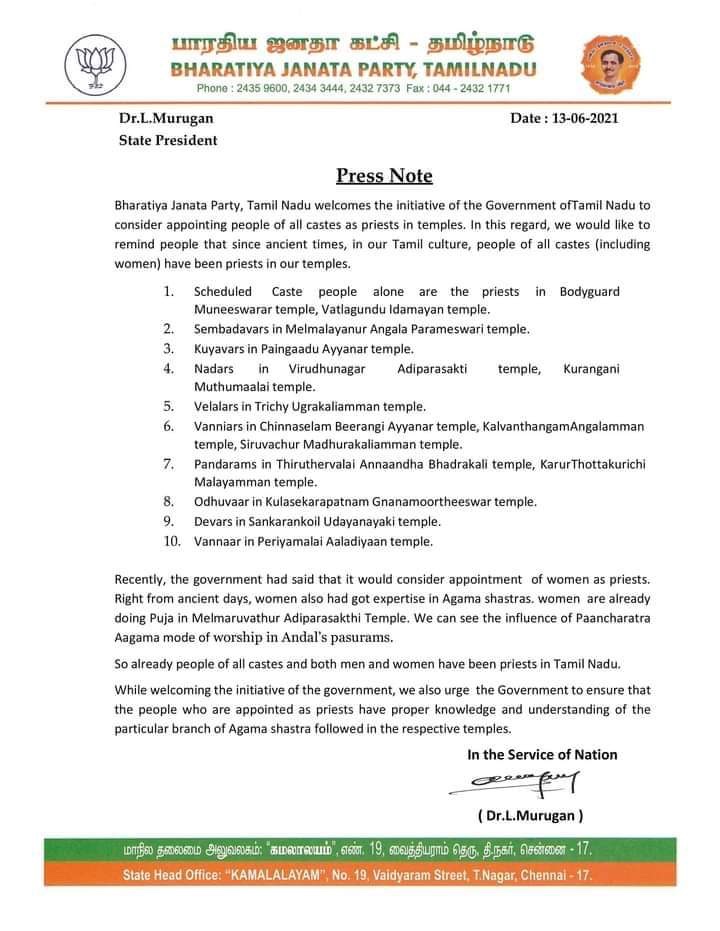
It is in the overall context of Supreme Court pronouncements and utterances above that today in June 2021, with the advent of the brand new DMK Government that has been elected back to power again after a hiatus of 10 years, that the question now of appointing women as archakas even in Agama-compliant temples in Tamil Nadu now raises its head again. The Minister for Hindu Temples and Religious and Charitable Institutions announced last week that around 200 archakas of all castes (not otherwise designated as denominations) having been trained in Agama saastra in government-sponsored institutions will be ready to be appointed as priests in temples. At the same time, he has announced a few days ago that Women in Tamil Nadu — who can as a class be designated neither as caste or a denomination — can also be trained to become temple Archakas if they so aspired to be so occupied in exercise of their right to equality under the Indian Constitution.
In the wake of all that has happened and is happening now, the writing on the wall is becoming clearer by the day for Hindus: the Legislature and the Judiciary are moving in a seemingly planned pincer movement against the ancient Temple Agamas of our land. In Agama temples, so-called denominations (not Brahmin castes) can reserve for themselves the exclusivity of archaka appointments but will have to allow women-priests to function too alongside them. And in non-Agama temples, any Hindu man or woman can serve as archaka. With such a far-reaching reform in temples being ushered in, it is believed that, at least in Tamil Nadu, social equality at last will be realized in the old caste and male dominated bastion of brahmins — the temple of God.
The temples in Tamil Nadu are now openly regarded even by the Judiciary as being “trapped” in Agama “saastras” fundamentally inimical to the provisions of the Indian Constitution. The Judges of the Supreme Court have categorically stated that the Constitution of India is the country’s only “holy book” and is holier than the Hindu Agama derived from the Vedas. Their Lordships have further said to the People of India.. rather to the Hindus of India… that it is the writ of the Supreme Court which will prevail over all other laws, even those of the Hindu temple called Agama. And the same Judiciary has further warned the Executive of the day not to forget its “non-negotiable obligation” “… to enforce the judgments of this Court. The duty to do so arises because it is necessary to preserve the rule of law. If those whose duty it is to comply were to have a discretion on whether or not to abide by a decision of the court, the rule of law would be set at naught.”
So, dear Hindus, please tell me now, isn’t the writing on the wall clear for the Agamas?
The Constitution of India, by which the Legislature of the Land swears it is acting, is against them; the Judiciary and the Executive are against them. With all three great and formidable pillars of the State arrayed against the the ancient codes of the Hindu Temple, are we not beginning to see happening the slow consigning of all but the empty shell of the Agama Saastras to the dustbin of History?
Sudarshan Madabushi