
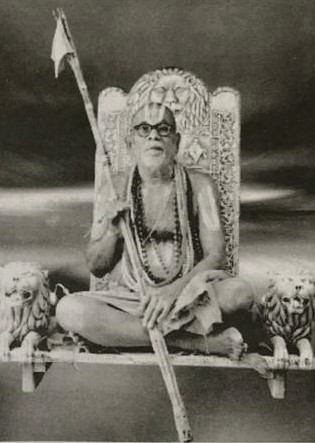

A SESSION of QUESTIONS and ANSWERS
(Translated into English from the Tamizh “arul mozhigal”)
— M.K.Sudarshan
Question (Q1): How intense can the experience of bliss be for a man?
Answer (A): It can be as intense as that which Srimann Naaraayana along with his Consort, goddess Lakshmi, himself experiences Bliss in his divine abode in Sri Vaikuntam.
Q2: To experience such bliss, where forth should a man seek to go?
A: In the realms of what is known as “Nithya Vibhuthi” in Sri Vaikuntam, one can enjoy the same and equal bliss as Srimann Naaraayana does, and it has been attested to by the scriptural revelation … “paramam saamyamupaithi”.
Q3: Is it possible for a man, with mortal body, to reach the realm of Sri Vaikuntam?
A: There is not an iota of a chance, ever.
Q4: From the accounts of the puraanaas, we come to learn of human beings, such as Dasaratha, Dharmaputra and others, for example, who were able to visit “svarga” (heaven) and other such celestial worlds even with their bodily form. Why must Sri Vaikuntam alone then happen to be an exception?
A: Earthly or celestial realms spoken about in the “puraanaas” happen to be within the boundaries of “Brahmmaandam” i.e. the domains that are under the sway, protection or jurisdiction of Brahmma (the primordial Creator). The saastras reveal many kinds of requisite ‘tapas’ (arduous penance) which, if performed successfully, enable one to attain these celestial worlds and to be able to even frequent them with one’s own mortal or bodily form. Sage Narada and a few other rishis like him who were the equals of ‘devas’ (celestial beings), by virtue of the ‘tapas’ they performed, could thus easily visit, to and fro and at will, celestial abodes and other higher heavenly realms. However, mere mortals with bodily form, cannot ever aspire to emulate them in reaching Sri Vaikuntam, since it is situate well beyond the frontiers of “brahmmaandam”, and no being that is tainted by “paapam” (sin) can enter there.
Q5: If a man were to be unsullied by any sin, would he then be able to enter Sri Vaikuntam with his mortal body?
A: Having taken human birth, it is impossible not to become guilty of sin even if they are only as few in number — as few, in fact, as a mere handful of sesame seeds. If you were to ask why, it is because the present birth of a man follows crores and crores of previous births. Even if a man had committed only a very small number of sins in those past births, they would all simply add up and then accumulate into very large, in fact, inestimable amounts in the present lifetime.
Now, those innumerable sins would have to be first redeemed completely before one can aspire to attain Sri Vaikuntam. And even if we assume that did happen, it would still be impossible to get there with one’s mortal body because the very existence of the body is evidence of present and unexpired sin. Therefore, the body which, in fact, is really instrumental to all sin and sinning, will have to be first eliminated before one can even conceive a sinless state of being. This is borne out by the “sruti vaakya” (the word of the Veda):
“tasya thaavadeva chiram…..” , meaning:
As long as the body, which was created through sin in the first place, continues to exist, so long does “moksha”, salvation, remain beyond one’s reach. Once the body dissolves, “moksha” becomes reachable. Therefore, under no circumstances is it ever possible to attain Sri Vaikuntam with one’s mortal body.
Furthermore, as the ‘saastra-s” say, as long as one’s body remains in bondage to “karma”, so long does one remain in thrall of “sukha-dukkha”, the conditions of mundane vicissitudes of “joy and grief”. In the realm of Sri Vaikuntam, as saastra-s have revealed to us, souls assume many other beautiful forms that are of infinitely more wondrous essence and nature than the moribund body that we possess here on earth. It is with such supernatural body forms that they indeed revel in while eternally serving Bhagavaan, the Almighty who resides there in his abode. When such being the case, if a person were to as much as even entertain mere wishful thought that one can ascend to Sri Vaikuntam with one’s own mortal, sin-ridden body, then such a person can only be regarded as someone who is mired already in the grip of grievous sin.
Q6: But that is not exactly what or how I am thinking! I do realize myself how much suffering in life I undergo, and I know the cause for it all is my own body. I am asking these questions not because I harbor even as much as an iota of desire to continue surviving eternally in this body of mine, but only because I wish to know what the “saastra-s” have to say in the matter. My inquiry, therefore, is only for the sake of dispelling genuine doubts. And that is also why I ask now the next question: We see how when grain is harvested and kept stored for unduly long periods of time, it begins to rot, decay and finally gets destroyed. By the same token, would it not be possible to argue that our own stock of sins, accumulated from countless past lives, also might, by sheer efflux of time, completely self-destruct?
A: Such ingenious analogies will not work here since the scripture says “naabukhtham ksheeyathe karma” …. In other words, one’s deeds as “karma” can never be shaken off or get erased in time, even across eons or eras, and hence, there is no escaping at all from having to experience their consequences.
Q7: You stated that one’s previous births are countless in number. Now, in each of those previous incarnations, is it not possible that one might already be done atoning for sins committed therein? Would it not be fair then to say, one has been able to attain the present lifetime only to work off and exhaust the consequences of one’s “paapam” and “punnyam” (evil and good deeds) arising in and from the present birth? That would thus make this birth the very last one too, wouldn’t it? And if one were to live this lifetime unimpeachably, would that not by itself, in the end then, pave the way directly to “moksham”?
A: Your question is certainly very pertinent and hence I must elaborate an answer for it so that it registers well in your mind.
Imagine for a moment a man is in the habit of daily taking some money out of his cash-vault and giving it away in charity to the poor.
Now, if he goes on doing the same every day, surely it would surprise no one if the cash eventually gets all depleted and the money-box emptied. But then let us imagine the same man, one day, takes out five hundred rupees and gives it away in charity to a poor man for, let’s just say, conducting the latter’s daughter’s wedding. And let it be imagined too that on the following day, when the man opens his cash-vault he discovers that the stock of money since the day before has somehow increased by one thousand rupees! And if that were to happen every day, would the money-box ever get emptied at all then?! Would not the stock of money in the vault only keep growing exponentially?
Now, similarly, if one takes birth in this lifetime to atone for, say, four or five sins of past lives, then invariably and simultaneously — and within this same lifetime too — many more sets of four or five of the same sins get committed, and which then simply multiply to outnumber the original set of four or five sins. Furthermore, other varieties of sins also get unavoidably committed in the same lifetime. Under such circumstances, one must deeply ponder over the whole matter: Having taken this birth, and atoned for a few past sins, does not in any way diminish the ever increasing net-stock of sins that is being constantly replenished by newer ones we concurrently commit.
Q8: How then are we to be rid of sins permanently?!
A: By resolving to abjure committing any sin henceforth. And by expiation of sins already committed.
Q9: Do you mean “sethu snaanam”? … I.e. The ritual bathing in the sea (at Rameshwaram) … will it be able to wash off sins? Would it suffice as expiation?
A: Even if you kept yourself indefinitely submerged under the seas at “sethu”, I am afraid that will just not do.
Q10: But then is it not believed that a ritual dip at “sethu” rids one of even such a heinous sin as “brahma-hathyam” (homicide of a Brahmin)? Why won’t it then cleanse us of all sins?
A: Out of the infinitude of sins committed by us, we may expect that perhaps only a few hundred thousands of them will get atoned for through such ritual “snaanam”. But then can we deny that we are, or that we are going to be in all likelihood, guilty of crores and crores more of sins?
Q11: Atoning through ritual bathing in such holy rivers such as River Ganga… won’t that exterminate all our sins?
A: Even if a man were to bathe in the sacred waters of River Ganga that flows in the heavenly world, he will not be able to atone fully for all the sins he is guilty of. If you ask why, this is the reason:
The scripture says “ : “kruthaathyaye anushayavaan …”
I.e. having earned the requisite “punnyam” – i.e. the benefit accruing to him from good deeds – that renders him deserving of the rewards of ‘svarga’ (paradise), he travels there to duly enjoy and delight in them to his heart’s content. But eventually thereafter, to reap the enjoyment of other “punnyam” which he may deserve still, and as well as to atone for sins that yet remain outstanding for him to account for, he is destined perforce to return to earthly realms again. Now, is it not perfectly reasonable to assume that during his sojourn through the delightful realms of “svarga”, he most certainly would have availed the opportunity to take a ritual dip in the sacred waters of the River Ganga flowing there?
And therefrom, from the long and short of the tale, does it not become patently clear to us that, even in spite of his “ganga-snaanam” in the heavenly spheres, upon returning to earth, there still remains a residual stock of sins, both yet to be unaccounted for and un-expiated by him?
Q12: If a man, throughout his lifetime, were to faithfully conduct himself, and perform all his duties (dharma) without a fault, and strictly in accordance with the “varnaashrama” into which he has taken birth… would that by itself not enable him to permanently expiate all his sins?
A: There are sins of omissions as well as sins of commission; in trying to lead a life by abjuring all sins, one might possibly be able to avert some sins but not all of them, especially if those of the former’s nature are the ones that might probably lead, at some time in the future, to grievous lapses.
Q13. Do you mean then to say that sins cannot be extinguished even through acts of service to God and fellow-devotees of God? (i.e. ‘bhagavath–sevai’ and ‘bhaagavatha–sevai’)
A: Definitely No! The power of such good deeds to remove one’s sins is rather limited and can be effective only against certain numbers of them. The power of water to douse fire is undeniable, no doubt, but then can you expect to tame a raging inferno with only a tumbler full of water? It is the same case with our sins, our paapam, which can be likened to an irrepressible, great forest-blaze that cannot be expected to be extinguished even by the occasional downpour of our good deeds, our acts of “punnyam”.
Q14. If there is then really no way in the world in which a man can hope to redeem himself of his sins, does it mean “moksham” is simply unattainable?
A: Nobody has ever said there is no way at all! In the Bhagavath-Gita, haven’t we heard Lord Krishna say, “sarva paappebhyo moksha-ishyaami…”? I shall deliver you from all your sins!
Q15: How is it possible that He can absolve us of all our sins?
A: If one faithfully abides by his commands, there is no doubt one can and then He will cancel all our sins.
Q16: What then has Bhagavaan commanded us to abide by?
A: Bhagavaan has spoken thus:
Residing within the mortal body is none else other than a being known as ‘jeevaatma’. He is imperishable. He uses his body as instruments of both good and evil deeds and thus it is he alone who reaps the consequent “sukha-dukha”, rewards and retributions for deeds committed.
Sin does not relate to the body. If a man wields a dagger and kills another one with it, for both the guilt and the ensuing punishment for such a crime, who is to be held responsible? Surely, it is the man and not the dagger, is it not? Likewise, the responsibility for all the sins of man is to be borne by the ‘jeevaatma’ only and not by its body which, after all, inevitably does perish.
Knowing this truth well, a man should not wittingly commit sin. He should instead engage only in good deeds and that too must be done in a spirit of disinterest without expectation of reward. It should be done in a spirit of renunciation for sole sake of “bhagavath-preethi” – i.e. the pleasure of Bhagavaan. When good deeds are performed in that spirit of renunciation, then it engenders within oneself an attitude in the feeling, “I am the deathless soul” and a recognition of one’s true identity too, in the feeling, “I am but a liege to the Paramaatma, the supreme soul”. With such attitude, even more pious contemplation and pious deeds are naturally enabled in a man (such as for example, frequenting temples and holy shrines and offering worship there by regularly circumambulating their environs and their sacred ponds etc.)
“Do not steal. Do not speak untruth. See no evil. Never betray the trust of others nor that even within oneself. Place your constant trust in Me alone. Train your mind to contemplate on Me always. Evolve and then remain ever as my “bhaktha”. Offer unto Me alone, all your loving worship and salutations, but then again, without expectation of any rewards. I shall then give you absolution and redemption from all your sins. Do not ever worry about it at all!”
Q17: Can you please explain to me in a manner I can easily comprehend what I have been told by some that it is possible in life that even without my engaging by volition in any act, good or bad, I can still get tainted by sin?
A: This is profound question of Vedantic theosophy but, nevertheless, I shall explain it to you.
A very pious man, having expiated all his sons, and aspiring to “moksham” (salvation), approached great and knowledgeable exponents of Vedanta, and after seeking from them proper instructions on how to tread the pathway of “bhakthi yoga” (the way to Godhead through devotion), he began the journey of Bhakthi. He was steadfast in his yogic practice and quest right until the imminent end of his life.
Now, we must know that, when such a man dies eventually, Bhagavaan distributes all of the man’s “punnyam”, the cumulative, accrued rewards of good deeds, amongst his dear friends in the same way that Bhagavaan also distributes the man’s accrued “paapam”, his cumulative sins, amongst all persons who were his sworn enemies while he lived.
Such divine distribution takes place much like how a deceased man’s estate of property is inherited by his heirs and offspring; a truly pious man’s “punnyam”, on his demise, gets inherited by his beloved friends, while his “paapam” devolves upon all those who were inimical to him when alive. This is what the Upanishad reveals to us. It is what our wise ancestors too have explained as precisely how one — even without direct personal engagement in any deed, either good or evil in life – can unwittingly yet inherit “punnyam” or “paapam” … effortlessly or involuntarily, as it were.
It is for this reason, therefore, that we should be extremely careful in life not to become the cause of any kind of hurt, pain, slight or grief, at any time, to a man of piety and righteousness, lest we should inherit his stock of accumulated sins upon his demise. On the other hand, if we are kindly and well-disposed towards such pious souls, we may well become, when they depart from this world, the beneficial heirs to a rich legacy of “punnyam” that Bhagavaan will bequeath to us, and surely, with his very own blessings added too.
In much the same way, we should also be very careful never to offend in any way – through thought, word or deed — the pious ones who we know have performed the rite or sacrament of Saranaagathi (absolute Self-Surrender unto God). Upon their demise, their “paapam” is inherited by their antagonists and their “punnyam” is inherited by their good friends.
The “bhakthi-yogin-s” and the “prapannaa-s” (those who have renounced themselves in Saranaagathi) have both indeed been hailed by the “saastra” as being venerable “brahma-viths” (i.e. those who have realized the Supreme Brahman: “thrasya brahmavidhaakasa:”).
In view of the aforesaid, thus, it can be stated with all certainty, that in line with the words of Bhagavaan when he said “saranam vraja, sarvapaappebhyo mokshayishyaami”, it is only through surrender unto his sacred feet that one can rid oneself of all sins. We will then be able to shed our mortal coils and commence our journey through the celestial route called “archiradi maarga” that leads to Sri Vaikuntam.
Once we ascend there, we will be able to join the assembly of our forebears who, having long before us become liberated souls, began ceaselessly enjoying Bliss in a measure equal to that which Bhagavaan himself enjoys, eternal heavenly bliss. We too then can equally enjoy such extraordinary, unsurpassed bliss without the least diminution. The many distinctions of caste, upbringing, creed or status that are all caused or occasioned by the operation of “karma” in life upon earth, find no place at all in the heavenly realm of Sri Vaikuntam. And whichever form that we may desire our spirits to assume in those realms, we can easily don such forms indeed and proceed to revel in the supreme delight that accompanies eternal servitude to Bhagavaan in the joyous company of divine archangels (nityasuris, such as Anantha, Garuda and others) and other liberated souls (muktha-atma-s) who are also in attendance there. All saastra-s rousingly attest to such a state of eternal bliss being attainable by everyone, and beyond any shadow of doubt. That presents a glorious spiritual opportunity for us, which we must never lose or let slip.
“Shubamasthu”