Following the above blogpost of mine yesterday 12 Dec’21, many readers emailed me their responses and views which were varied, lively and challenging too. The one question that was posed by many was this: Can Waseem Rizvi on being converted from Islam be admitted into the Hindu “Brahmin caste“?
I was truly astonished that in this age and ethos in the history of India, such a question should ever arise at all in the minds of so many of my Hindu friends. So, I chose to give my response to it by keeping it as nuanced as possible and here it is below. It’s rather long but I assure you it’s not long-winded.
“Why not ?! As I explained in my blogpost of Dec 12th, it all depends on considering the combination of Rizwi’s antecedents relating to factors such as guNA (Varna dharma) , Ashrama (chaturvidha or the four-fold dharma) and Jaathi ((ancestral antecedents of hyper- or hypogamous marriage (anuloma and pratiloma) and the dharma arising from past conjugal pedigree)).
But under the Indian Constitution which aims at establishing what is conceived as a “casteless society in this country , why should anyone bother at all where Waseem Rizvi, the high-profile, recent Hindu-convert, be able to find his due place in Hindu society?! After all, we are all homogenized “secular” Hindus now in India, aren’t we? We all do our very best to hide or downplay our caste affiliation in public, don’t we? The Tambrahm who once used to proudly wear his “tiruneer” or “tirumann” (caste-marks on the forehead) on the streets today hardly does so any more lest he be mistaken to be a caste bigot. The names given to our children these days do not carry caste-suffixes. In Chennai, there is a famous road that was named Sri Kasturi Ranga Iyengar Road, in honor of the founder of the Hindu newspaper. The caste suffix “Iyengar” was removed long ago. It is now plain Kasturi Ranga Road… The instances of such complete erasure of all traces of caste from our public life in the last 100 years in the 20th-21st century CE are indeed too innumerable to mention.
Caste therefore is, generally speaking, becoming extinct. But then it does however survive and does matter to people only under 3 circumstances and for 3 related purposes which have nothing to do with religious order or beliefs. They are:
(1) to obtain social benefits of Reservation/Affirmative Action policies in terms of admission to educational institutions and gainful employment/ jobs under quota-based systems
(2) fighting and winning political power and public office through vote-bank electoral politics and
(3) to keep alive the Constitution of India as the holy New Testament of the Republic of India that keeps intact the Unity in Diversity of a vast, populous and tumultuous democracy.
So, to the question “Can Waseen Rizvi become a Brahmin upon conversion?“, the answer is the simple counter-question: “Who confers caste status upon a person when he is not born into one? And upon what criteria? And towards what social ends?”
We must also ask ourselves this: In ancient times, when Varna, Ashrama and Jaathi did matter to the social order, was Rishi Vishwamitra a Brahmin? Was Sage Veda-Vyaasa a Brahmin? Was Rishi Valmiki a Brahmin? Was Sage Tiruvalluvar a Brahmin? Was Kamban in Tamil Nadu a Brahmin? How many of the 12 AzhwAr and the 63 Naayanmaar saints of Tamil Nadu were Brahmins? Who was it that conferred on them any particular caste designation, status or distinction?
That was exactly the sort of issues I took pains to explain in my above blogpost of 12 December ’21.
************************************
The purpose of this blogpost today, however, is not to go on belaboring, ad infinitum, ad nauseam, the socio-political or polemical aspects and issues of Waseem Rizvi’s conversion to Hinduism and his eligibility to be welcomed into Hindu society as a Brahmin. I am beginning to find such polemics to be increasingly banal, tedious and futile because as I explained above, they are irrelevant to the India we all live in today…. or soon will become so, I believe, in the future.
What I am more interested and fascinated in is the historical past of Brahmin-hood.
I am keen to know what did being a Brahmin mean in ancient times? Apart from what we know to be now the much maligned four-fold Varna classification that Sage Manu in his “manu-smriti” described as “brahmana, kshatriya, vaishya and shudra“, what exactly…. and in a deeply philosophical rather than the socio-political or socio-economic sense in which as commonly understood…. did it mean to be a Brahmin in those olden days? Other than the revered caste-status that it ostensibly conferred upon him, what truly defined a Brahmin in the Vedic times?
I ask myself such questions because I am convinced that Manu’s classification of Varna is not that of a “Law Giver” even though his work as we all know it has come to be called the “Laws of Manu” (“manu saastra” or “Manu Neeti”) The more I read Manu the more I am convinced that he was truly a great Social Scientist, and not so much a law-giver. He approached the study of society much like a very thoroughgoing, modern research-minded Social Anthropologist today seeking to achieve a penetrative understanding of society around him as it existed. His grasp of his subject was all-encompassing, so holistic and catholic to such an extent that few social anthropologists that I am aware of anywhere in the world have since been able to match let alone surpass. Manu possessed profound understanding indeed of what constitutes human societies, their motivational drives, structure, dynamics and evolution.
In the four-fold Varna classification of society that Manu observed and blue-printed, he endowed upon each Varna its typical psychological drive … call it Motivation in the parlance of modern psychology. He mapped the 4 varna-s to 4 primal motivations respectively which he called Dharma, Artha, Kaama and Moksha — loosely translatable as “Virtue, Wealth, Pleasure and Salvation”.
The Brahmin psychology and behavioral instincts, according to Manu, gravitated naturally towards the spiritual principle and path of Moksha; the Brahmin’s fundamental search for fulfilment in life was spiritual salvation.
Likewise, the instinctual life of the Kshatriya gravitated towards Dharma, or the life of Virtue.
The Vaishya psychology was motivated principally by the pursuit of Artha, material Wealth in its broadest sense.
And as for the Shudra-psychological archetype, life predominantly meant the pursuit of the Pleasure-Principle and finding fulfilment in it.
The 4 primal Motivations that Manu observed and studied, calling them “purushaarthas“, all were wholly rooted in the domain of temporal and mundane existence except the principle of Moksha, or Spiritual Salvation, which alone was what one might call “other worldly”. It was called “parama purushaartha” — the one supreme goal that transcends all mundane goals. It lay in the spiritual domain and while it was strong aspiration for a very rare few amongst humanity, it was for all the rest, lofty, abstract ideal.
Manu was far too sophisticated a social scientist to believe that his 4-Varna code of social classification would be social strait-jacketing… or rather, any kind of “profiling“, to use a modern expression. He was far too wise to believe that the “purushaartha” mapping to “varna” would lead anyone to believe that society could be neatly compartmentalized into those who single-mindedly, single-purposely pursue Virtue, Wealth, Pleasure or Salvation alone. No. He had no such illusions.
Manu was a brilliant social scientist and human psychologist and while he appreciated the usefulness of a simplistic theoretical model of Motivation, he also was aware that the “purushaartha-s” too, like so many other behavioural urges, operated under the “rule of 80:20” — which tells us that in a large distribution of men, their psychological propensities in life tend to fall into a typical binomial pattern of distribution where 80% is characterized by one predominant motivation and 20% by a complex amalgam of one or more of the other three “purushaartha-s”.
The implication of Manu’s theory above is an important one . It signalled to all men that Moksha, as a goal of life, was open to one and all. Every varna can aspire for spiritual Salvation but then few can, in all earnestness, really pursue it because of natural predisposition resulting from past and prior Karma.
Hence, while all are called, only a few are immediately chosen to pursue the highest “purushaartha” of spiritual salvation, Moksha. The general run of humanity is must be preoccupied only with what it ought to be preoccupied with i.e. pursuing one or more of the three other predominant psychological drives that create and sustain societies …. of Dharma, Artha and Kaama as means of fulfilment in life.
******************************************
From where did Manu derive the idea of these psychological archetypes or Varna-s?
My own bit of research tells me that he must have depended upon a scriptural source to base his social-anthropology upon. The template for social engineering contained in the “manu smriti” has its springs in the Vedas themselves, and more specifically, in the Upanishads.
Amongst both academic and religious scholars, it is well known in fact, that Manu’s four archetypes of human psychology were developed using the seminal conceptions of them as first articulated in the oldest extant religious work in the world, the Rg Veda (c. 10,000 BCE) in which the hymn called “Purusha Sooktha” is found.
Thus, the thoroughgoing social scientist that Manu was, he did really know what he was talking about when he attributed to one particular varna — one amongst the four different psychological classifications of social order he observed in natural human society — the motivation towards the Moksha-principle. The men of such spiritually motivated varna were recognized to be, comparatively, far fewer and rarer, and hence they were as a class regarded more exceptional, if not more exalted than the numbers that plentifully populated the other three more mundanely orientated ones. They were truly men disinterested in the goals of mundane, temporal earthly existence.
And to such men the caste name was given: Brahmana.
***************************************
Where might one hope to find some corroboration, if not direct source and authority, in the Vedic scriptures for what we saw above to be Manu’s regard for the exceptionalism of the Brahmana (Brahmin) archetype?
One might venture to say it can be found in an ancient, not too well-known Upanishad, one among the 108 extant Upanishads in Vedanta literature…. and one among the selection of “THIRTY MINOR UPANISHADS“. (Ref: Book “Thirty Minor Upanishads” (translated by K.Narayanasvami Aiyar (1914).
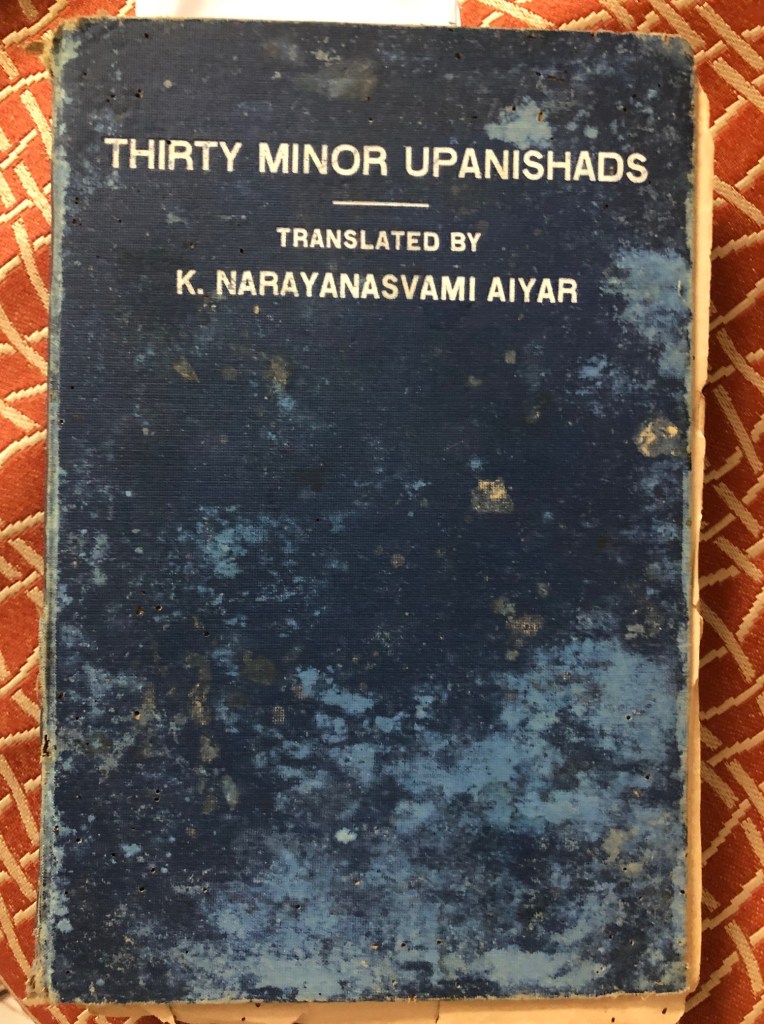
It is the “Vajrasoocchi Upanishad”, a scriptural text of sparkling brevity and belonging to the Saama Veda.
“Vajrasoocchi” is a compound word in Sanskrit. “Vajra” means diamond and “soocchi” means “needle”. So the title “vajrasoochi upanishad” likens this Upanishad to be as sharp as a diamond-tipped needle-point used as a weapon to pierce through, deflate and remove ignorance and serve as a trophy as well for the man of divine vision, the victor. It may also be a metaphor to signify the razor-sharp intellect that is required to fully comprehend the content and intent of the Upanishad.
This Upanishad expresses itself in the form of a gripping and terse dialogue between a student and teacher…. a rishi perhaps.
Ages ago in the mists of time, a student asked his teacher in a dialogue the very same question that we too today never stop asking: “Who is a Brahmana?“.
******************************************
Question: There are 4 castes (varnas) — the brahmana, kshatriya, the vaishya and the shudhra. Even the smritis declare that in accordance with the words of the Vedas that the brahmana alone is the most important of them. If that is so, then the question remains to be examined:
What is meant by Brahmana? Is it jeeva, the soul? Is it body? Is it a class? Or is it pure “gnyaana“, a body of knowledge? Or is it Karma, a set of ordained duties? Or is it Dharma — an order of virtuous choices and deeds in life?
Answer: To begin with: Is jeeva (soul) the brahmana? No it is not. Since the jeeva is the same in all bodies of all persons, and all bodies are only resultants of Karma…. jeeva cannot be said to be brahmana.
Then is the body (deha) the brahmana?
No. Since the body is made up of 5 elements, is the same for all people down to the chandaala (the lowest caste amongst Hindus); since old age and death, dharma and adharma are found to be common to them all; since there is no absolute distinction that brahmanas are white-colored in complexion, the kshatriyas red, the vaishyas yellow and the shudhras dark; and since in burning the corpse of his father, all must follow the same practice; and since the stain of the murder of a brahmana (brahma hathya) accrues to the son in all cases, no matter what… therefore the body is not the brahmana.
Then is a class (Jaathi) the brahmana?
No. Since many great Rishis have sprung from other castes and orders of creations — Rshyasringa was born of a deer; Kaushika was born of Kusa grass; Jambuka of a jackal; Valmiki of a valmika, an ant-hill; Vyaasa of a fisherman’s daughter; Gautama of the posterior of a hare; Vasishta of Urvashi; and Agastya of a water-pot…. Thus, have we heard. Of these, many rishis outside the caste even have stood first among the teachers of divine wisdom; therefore a class is not the brahmana.
So, then, is gnyaana the brahmana?
No. Since there were many kshatriyas and others too who were well versed in the cognition of divine wisdom and truth, therefore gnyaana is not the brahmana.
Then is Karma the brahmana?
No. Since the praarabdha, sanchita, and aagaami karmas are the same for all beings, and since all people perform their actions only as impelled by their respective karma, Karma cannot be said to be the brahmana.
(Praarabdha – the karmic affinities generated by us in our former lives, the fruit of which is being enjoyed in our present life.
Sanchita – the karmic affinities generated by us in our former lives and collected together to be enjoyed in our future lives.
Aaagaami – the affinities generated by us in our present life to be enjoyed in our future lives).
Then is he who is doer of dharma , virtuous deeds, the brahmana?
No. Since there are many kshatriyas etc. who are also givers of alms and charity, therefore a doer of virtuous actions is not the brahmana.
WHO INDEED THEN IS THE BRAHMANA?!
— Whoever he may be, answers the Upanishad, he is the one who has directly realized his Atman (innermost self, the soul).
— He is the one who understands that his atman is but a part of paramaatma, is devoid of class, is devoid of ignorance, is devoid of faults. He knows that the Atman is truth, is knowledge, is bliss and is eternity. (“Satyam, Gnyaanam, Anantham Brahman”).
— He is the one who knows that the same soul in him is the greater Soul in everyone, is in all things, pervading within and without, something that can be felt but not reasoned.
— He is the one who is free from malice, who fulfills his nature, is not driven by cravings for worldly objects or desire or delusions.
— He is the one who lives a life untouched by spite, ostentation, pride or the need to impress others.
*******************************************
The Vajrasoochi Upanishad then closes by stating that this doctrine is the cream of the Sruthis (scriptures), the Smritis, the Itihasas and the Puranas. There is no other way to attain the state of Brahmana.
***********************************************
Now, to the Hindus of India who ask the question can a Muslim like Waseem Rizvi who converts to Hinduism be admitted into the Brahmin caste, the final answer is this:
Please decide on the basis of what you know best… the Indian Constitution or the Vajrasoochi Upanishad.
If you wish to decide based upon the former text, then Brahmin caste or any other will matter little or nothing at all to Rizvi and to Hindu society as we find it today .
If you wish to decide based upon the latter text, then that’s going to be an extremely tall order for the poor man, Waseem Rizvi.
As for me, I think I can very easily guess which one of the two texts the Hindus of India, especially those claiming to be Brahmins, would be choosing.
Why not we first warmly welcome Waseem Rizvi into our fold. There is enough time left in future to find him a suitable place amongst us … He might read the Vajrasoochi Upanishad himself , who knows, and might figure it all out for himself…
Sudarshan Madabushi