A good friend of mine, Mr. V. Ranganathan of Chennai, a top-notch, astute financial and taxation expert, forwarded me the Infograph you see immediately below but without comment, possibly thinking that it was best for him to leave it all to me to figure out myself whatever I wished to make of it.
Like my friend, I too belong to the fraternity of finance professionals (Chartered Accountants) in this city but I, having worked in the field of corporate finance both in India and internationally for 35+ years at senior-management levels, my take on most issues and topics of the day are my very own.
Generally, for people with the sort of background I have, a single chart like the one below usually is much like what, say, a Picasso masterpiece hung on the wall of a museum is to an art-lover who can stand and gaze at it as long as an hour even trying to plumb its artistic depth and its aesthetic sense and spirit.
So too is this single Infograph which I have been gazing at for hours today trying to unravel its sense and spirit as a piece of ethereal financial art.
In it I see a “takeaway” more meaningful and significant than any weighty 1000-word “technical analysis” written by any hotshot market-analyst reporting for the world’s most respected financial magazine or newspaper.
So, here then below is my take on what I thought this chart was trying to tell me as I stared through the day at it trying to divine its message or oracle.
***********
First off, this chart compares the trend of returns to investors in Value and Growth stocks over the calendar years 2020-2021 to date in January 2022.
The trend lines compared are of two giant ETF (exchange traded funds) in the USA . One is ARK Innovations which prides itself as one of the savviest investors in “growth stocks” listed on the American stock markets.
The other is Berkshire Hathaway fund managed by the iconic American investor, Warren Buffet, and prides itself to be the foremost “value investment” champion in that country,

The most obvious fact the above chart highlights is that in and around the middle of the span of the past 2 years, the return to investors who had invested in the “growth stocks” of ARK soared to the skies … 200%! The trend slightly dropped through 2021 but still held steady at around 150%.
Then suddenly during the last 3 months of 2021 and in the beginning of 2022, ARK ETF value plummeted to level of 36% returns.
Now, in stark contrast, the investors who had kept faith in the growth stocks that the Berkshire ETF had put its money in throughout the same span of time delivered only very modest but steady returns to end the year with value of a wee bit the same or just slightly lower than ARK.
***********
Something mysterious happened during 2020 and 2022 to make growth stocks and value stocks behave like the hare in the race with the tortoise in the old fable for little children.
Both began the race, off from the same block, but the hare raced ahead like a zooming rocket with the poor, plodding tortoise lagging badly behind trying to catch up…. But then at the end of the race, surprise of surprises, lo and behold! the fleet-footed hare ended up disappointingly finishing not too far ahead, after all, than the leaden-footed tortoise.
The fabled story of the hare and tortoise holds a timeless moral lesson for any little children who listens attentively to it at bedtime. What moral lessons now can we learn from the fable of how ARK and Berkshire, the hare-and-tortoise growth-and-value stocks respectively, behaved in the race that began in Jan 2020 and ended in Jan 2022?
To answer that question, we need to pause a bit and clear some fundamental concepts. What concepts?:
What is ETF? And what really is the difference between growth and value stocks, between the hare and the tortoise?
*************
Now, for the benefit of only the uninitiated reader who might be reading this blogpost of mine, it needs to be explained what is ETF, and what is the difference between a “growth stock” and a “value stock”?
Well, sometime ago, the difference was succinctly explained in the columns of the Economic Times of India as follows:
QUOTE
“Growth and value investing are two distinct investment styles. The former investing is about finding companies that are expected to grow faster than the market while value investing is about identifying companies whose stock prices are lower than their fundamental worth as reflected by their balance-sheets.
3. Growth stocks typically reinvest earnings to expand and hence do not give out dividends, whereas value stocks are big on dividends. Growth stocks offer higher return potential and hence are a lot riskier and more volatile than value stocks. Growth stocks have higher PE ratio (Price to Earnings) as compared to value stocks.”
UNQUOTE
Next, what is ETF?
ETFs are funds that track market indexes such as CNX, Nifty or BSE Sensex, etc. When you buy shares/units of an ETF, you are buying shares/units of a portfolio that tracks the yield and return of its native index. The main difference between ETFs and other types of index funds is that ETFs don’t try to outperform their corresponding index, but simply replicate the performance of the Index. ETFs don’t try to beat the market, they try to be the market. (Mark these words!)
If you have not broadly grasped the real meaning of all the above definitions, let me lay it out to you then in stark, even simpler commoner parlance.
Those who invest in growth–stocks are “fortune-hunters” and those who invest in value-stocks are “bargain–hunters“.
The fortune-hunters “try to be the market”. The bargain–hunters try “to beat the market“.
************
Alright, now that we have got the basic investing concepts all spelt out, let’s do just a wee bit a bit of comparative analysis of what the bargain–hunters and fortune-hunters in America gained as investors and how they behaved in the last 2 years when the whole world, gripped by a pandemic called the Wuhan virus, suffered untold and as yet unaccounted pain and suffering in terms of widespread death, damage and disruption in life, both personal and social.
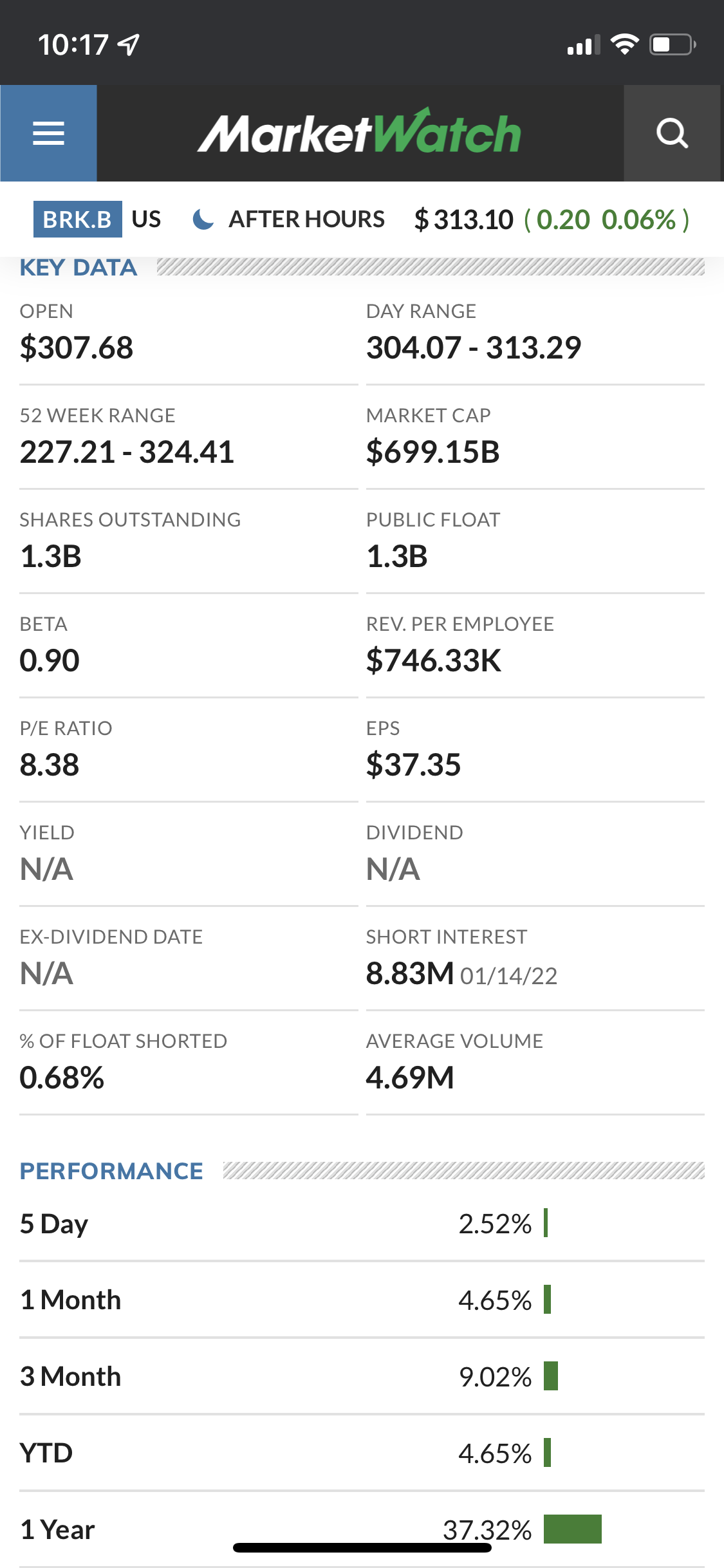
The chart immediately below is a snapshot of how Berkshire investments fared during the Covid pandemic years.
You will see that returns during the year 2020 were virtually Nil but started picking up in 2021 and ended that year generating 50% returns to investors. So, overall in the Covid years while the return was only 4.65%, the 1-year return was 37.32% as at Jan’22.
Also, note that the P/E ratio was 8.38 …,which tells you that on an average Berkshire investments commanded a price on the stock-market that was 8 times its average annual profit bottom-line.
And also that although Berkshire Hathaway prided itself to be “high shareholder-dividend payout” fund, during the pandemic years due to very adverse economic and business conditions, “dividend-yield” was “NA… ” which means exceptionally NIL…i.e. in the last 2 years from a dividend-payout point of view Berkshire has been counter-trending or departing from the normal.
Nonetheless, the chart below does not conceal the fact that investors … or bargain-hunters… who kept their trust in Berkshire have not greatly lost out … they have been rewarded with a decent 37% return on their investment in 12-months — which in the sad, sad times of Covid devastation, any greedy American investor would exclaim is “one helluva bargain”!
Contrast now tortoise Berkshire with the hare ARK numbers below.
As already explained above, ARK was off to a roaring start and quickly reached incredible, dizzying heights of c.150% returns to investors during the period September 2020 to October 2021!
Interestingly, the ARK ETF peaked along with the two deadly peaks of “infection-positivity” caused across the world by the Coronavirus in 2020 first and then by the Delta-variant in 2021!
ARK even paid dividends to shareholders — 1.18% (see info below) — !

But then what is only now surfacing in 2022 as facts is that despite the soaring valuation of ARK in the market during the said period, its PE Ratio was kept under the wraps or the market radar …. can you see it being mentioned in the above table of stats as “N/A”?
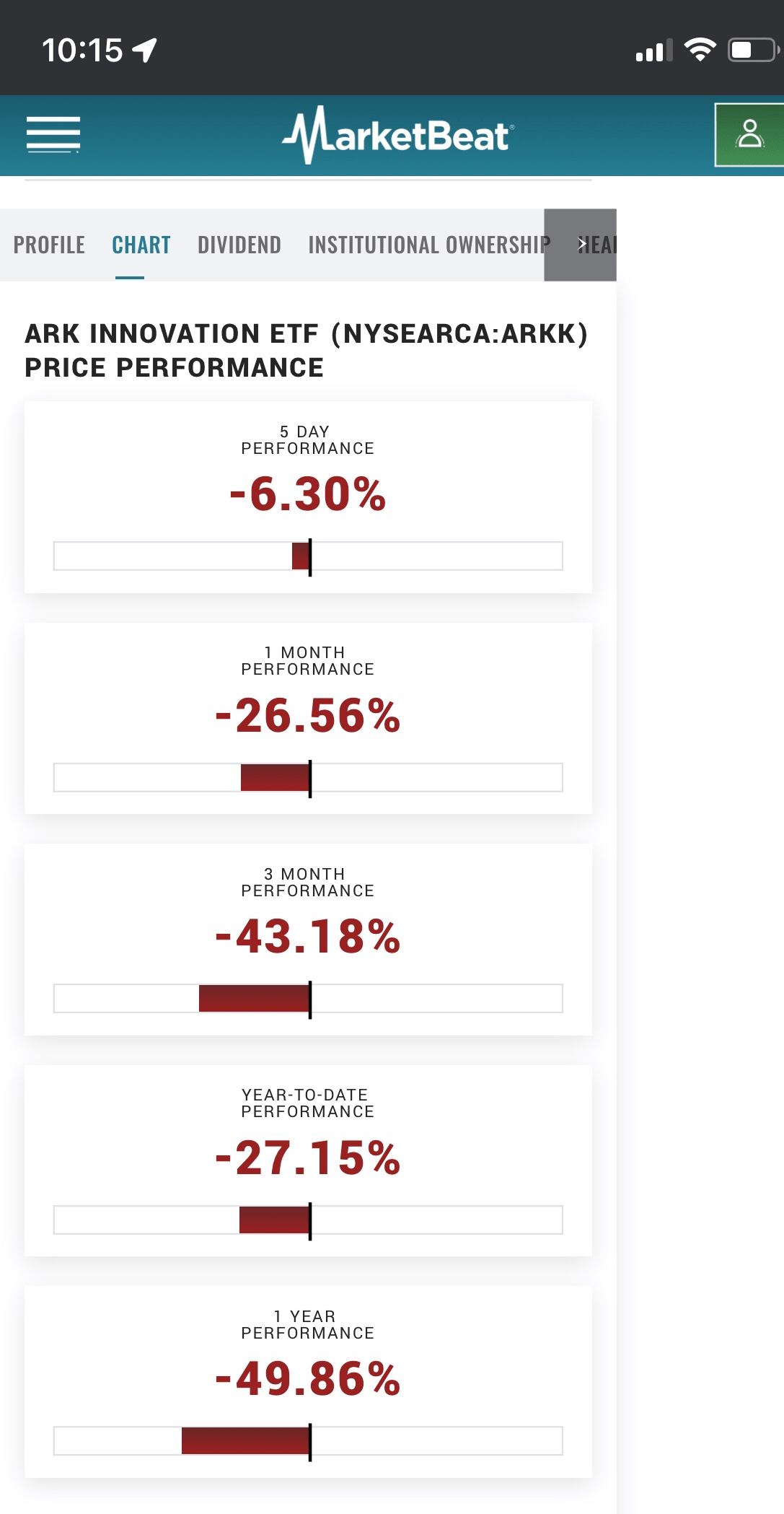
The most likely reason is this: even while ARK’s valuation was soaring in the market, the trend line of its actual price-performance in the markets that was climbing in 2020 then, from the middle of 2021, began barrelling down a steep declining trajectory… see the table below;
Indeed something strange was happening….
The hare in the race with the tortoise, after getting off to such a spectacular start, was up to no good at all ….
How could an ARK ETF portfolio of dazzling growth-stocks that all through a period of c. 15 months had been leaving far behind it its dust a Berkshire ETF portfolio of dullard stocks, showing magnificent 200% return meanwhile in market valuations at the same time, also be steadily suffering steeply eroding but unobtrusive decline in PE ratio?
What was making the hare in the race to stagger, stutter, stumble and eventually fall and to end up suddenly finding itself battling to stay barely ahead of the tortoise by a bare whisker in a neck-to-neck photo-finish by the end of 2021?
The answer to that lies in the remarkably perceptive observation about growth-stock laden ETFs: They don’t try to beat the market, they try to be the market!
***********
That ARK Innovation in the midst of the Covid pandemic worldwide, when the markets were facing dangerously “bearish” pressures and “headwinds”, was trying to follow an innovative and aggressive strategy “to be the market” rather than follow the far less bold and ambitious strategy of “beating the market” as other investors ETF investors like Berkshire were young to so during the turbulent times of the pandemic, is clearly evidenced by the chart below:
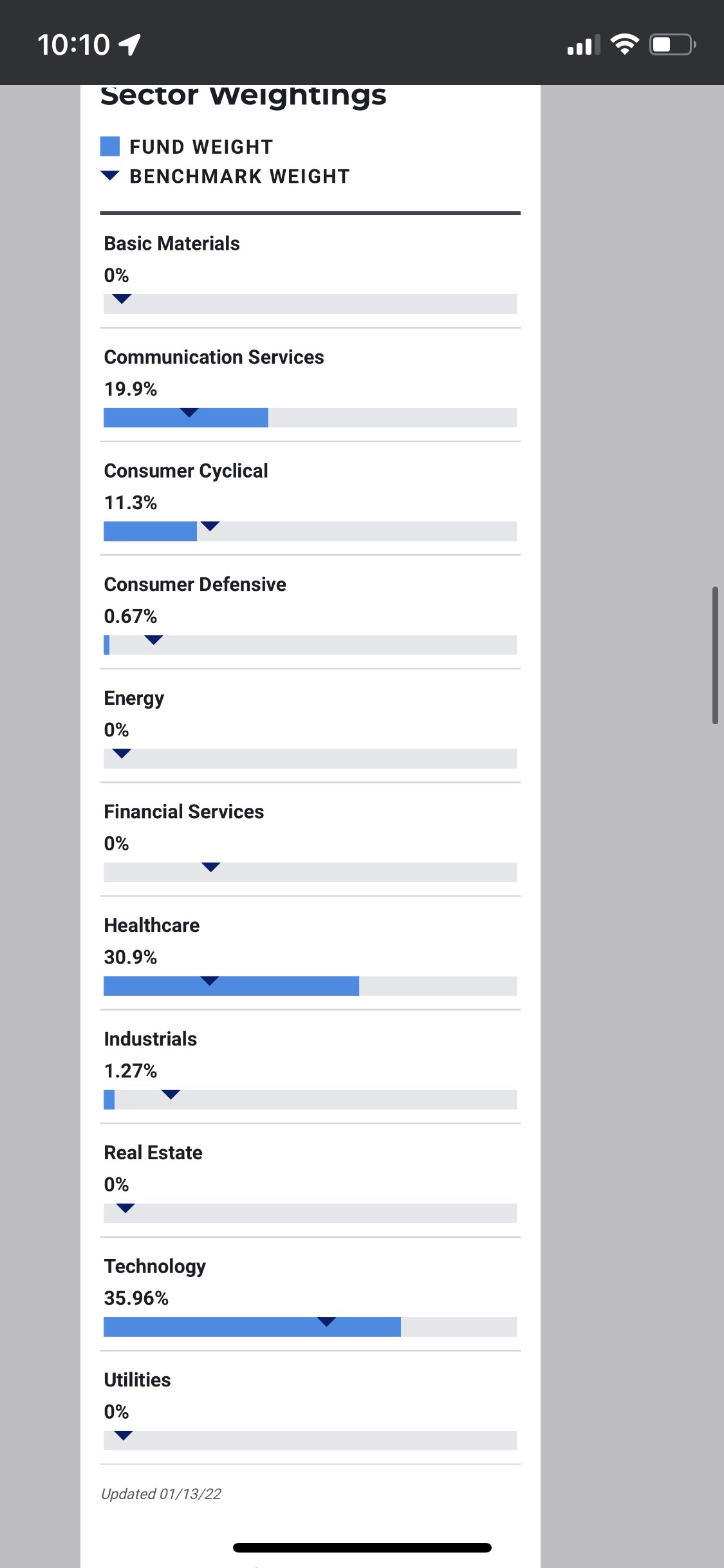
Take a good look at the above chart which tells you how ARK was trying to “be the market” in the time of death, disease and Wuhan virus prevailing all over the world … Do you see that nearly 70% of ARK’s entire fund was invested in only 2 industry sectors? They were Health Care (31%) and Technology (36%)!
ARK was strategically thus over-investing into … unmindful of the risk of over-exposure to downside risks … a single-minded pursuit of the strategy of “being the market” for the Health and Technology “growth stocks” of a world where nations and governments were bracing themselves big time for major global public healthcare challenges of epic, historic proportions, which ARK was anticipating, would soon emerge and descend upon the peoples of all countries.
In a Covid afflicted world there was bound to be a sea-change across the world of capital markets in the way they would be forced to react to tectonic shifts in macroeconomic policy-making of governments that now forced to effect massive infusions and allocations of fiscal and budgetary resources for and towards Public Health and Healthcare infrastructure-building .
In such a pandemic afflicted world, it is possible ARK most likely calculated, the global Public Healthcare sector would have to come to rely heavily upon the Technology sector as its prime enabler and resource.
And when that happened, the global capital markets right across for both the Health and Technology sectors would be deluged ans awash with massive inflows of both governmental and institutional-fund investments on a scale never imagined before at any time in the history of the world.
This, ARK Innovation ETF wanted to position itself to be … yes, you guessed it right! …. it wanted verily to be that market” !
***************
As all investors know, Market valuation of stocks of any industry sector are a determined by two major considerations :
1. Outlook on the future for the sector
2. Risk factors
On both the above counts, during the entire period of 2020-2021, the American stock markets believed that in a post-Covid world the outlook for the Health and Technology sectors could only be robust and get even ever robuster! They saw no major downside investment risks for either.
And so it happened that between Sept 20 and Oct 21, riding the wave of a “bull-run” in investments in the Health and Technology sectors, the ARK ETF succeeded in virtually “being the market” as seen in the chart repeated below: 
There’s a wise old Biblical saying that “Pride presages the Fall” ! Pride certainly did come before ARK’s fall . The chart above proves it.
I have already explained above what caused the pride. I must explain now what caused the fall .
The fleet-footed hare vaulting skyward has been today been brought down to humble earth to amble along at no more than the pace at which the leaden-footed tortoise too plods along. ARK Innovations today has realised that it is no better and can be no greater a market-player than Berkshire.
That realisation is what in the world of financial investors is called inevitable “market correction” . It means that the stocks-market is a wild irrepressible beast that goes out on a berserk rampage at times when none can predict how it will behave and what damage it will do but then, sooner or later, the beast will expend itself, come back to its senses and domesticate itself and turn reasonably docile again.
That “domestication” happens when the markets start to factor in other fresh, new and unnerving information that starts tricking in to it and which make it pause and ponder and then begin regretting if not repenting for its hubris and all its bravado ….
The new facts that have emerged and now subdued the “irrational exuberance” of growth stocks in America are these given in summary below:
— the realisation that government fiscal resources are finite; panic-driven budget and monetary allocations for fighting public healthcare challenges of pandemic proportions can at best be sustained for 3 or 4 quarters … not endlessly without stoking the other great threat and real danger of Inflation… and signs of which have started flashing and flaming already in the US economy:
— the unexpected blowback on the streets amongst large sections of the populations known as “anti-vaxxers ” who are upturning the business assumptions of ETFs like ARK who are not so sanguine now about the future of vaccine and other therapeutics R&D of giant pharmaceutical multinationals
— formidable obstacles to building healthcare and medical infrastructure with ultra-long gestation periods posing very tricky investment risk-return questions and issues for institutional investors
— unpredicted roadblocks in the path of the progress of the technology sector e.g. shortage of chips, rare-earth metals like lithium, tariff-barriers on free trade of techno-IP etc.
— and lastly, geopolitical force majeure that has already started disrupting supply-chains across the world … e.g. tensions in Taiwan, Ukraine and elsewhere .
*************
Finally, the end of the story of ARK and Berkshire ETFs and of the story of so-called Growth Vs so-called Value stocks ends thus pretty much like the fable of the Hare and the Tortoise. Like all morality tales are intended to do, this story too as I have narrated it, must end with the wise homily and warning to all financial investors of the world : Pride presages Fall….
Sudarshan Madabushi