28 April 2022, Bangalore
Author: M.K.Sudarshan
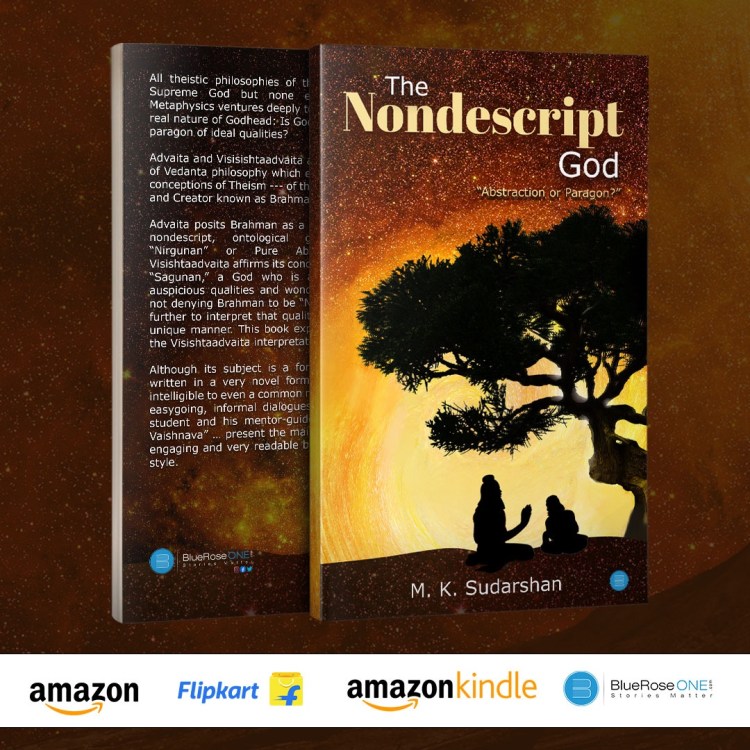
In the benign and gracious presence of HH Srimad Azhagiyasingar Srimathe Srivann Satagopa Sri Ranganaatha Yathidra Mahadesikan, the Jeeyar of the Sri Ahobila Mattam, at a solemn ceremony immersed in religious and pious spirit, the formal book-launch event of the book was celebrated on Thurdsay 28 April, 2022 at Sri Malolan Veda Bhavan Hall, Prakash Nagar, Bangalore.

Full Transcript of Speech by the Author
Delivered as abridged version on the occasion due to paucity of time
__________________________________________
My humble abhivandanam to one and all in this august assembly!
I wish to begin by telling you all that the purpose of this book is very specific: It is meant to benefit three different groups of our brothers and sisters in the Sri Vaishnava community at large:
- The first group is Sri Vaishnavas in the age group of about 25 to 40 years of age.
Who are they? They are highly educated and professionally highly accomplished. They pursue successful careers in different fields in the world of “loukeekam”. Yet, they are deeply devoted to the religious traditions of Sri Vaishnava sampradayam. They faithfully observe all the basics of its customs, practices and way of life. They are devoted to their Acharya and to their temples. They also perform noble “kainkaryam” to the very best of their capacity. Furthermore, they are ardent in learning to recite a few hymns of the 4000 the Azhwaars sang and many of Sri Desika Stotras. But then in spite of all their pious ardor, they often privately confess that they are a little disappointed with themselves because they find themselves unable to go beyond the basics and delve further deeply into the philosophical and religious thought of our Sri Vaishnava sampradaayam. If you ask them why, they often say that the riches of Sri Vaishnava thought are available mostly in literature found either only in formal Tamizh, Manipravalam or Sanskrit or else in very high flown, pedantic English language and both of which they are unable to follow or have to really struggle to understand. Precisely because of that language barrier and because of the lack of availability of books today on Sri Raamaanuja darsana written in English of contemporary 21st century idiom, parlance and style — and which are neither daunting nor overwhelming to read and grasp — this class of young Sri Vaishnavas find themselves greatly handicapped. Many of them thus out of a sense of pious resignation choose to remain largely ignorant about the wealth of profound philosophical literature that “Sri Raamaanuja Siddhaantham” abounds in…. although they do not deny themselves the right to the pride there is, of course, in belonging to its sampradaayam.
- The second group is Sri Vaishnavas in the age group of 40 to 70 years of age.
There are some members today in our Sri Vaishnava community in the above age group who unfortunately regard any individual effort undertaken to study the deep subject-matters of Raamaanuja Siddhaantham to be very arduous, tedious and dispensable. They are being persuaded by the popular but misguided notion that at the very core of Sri Raamaanuja darsana, it is Bhakthi alone — and exclusively — and the devotional Bhakthi-literature of Sri Vaishnavism that should really matter to the community. One can venture to characterize such a stance as a form of “anti-intellectualism”. It provides a formidable pretext for the belief that matters of lofty Philosophy or Metaphysics in “Raamaanuja darsana” is meant only for — and best left to — Vedic “vidwaans” and “pundits” of the community. It is therefore felt that other ordinary Sri Vaishnavas need not feel guilty at all if they choose to distance themselves from or remain agnostic towards the vast number of works of deep Philosophy in Sri Vaishnavism. Such is indeed the unfortunate misconception that this class of Sri Vaishnavas often suffers from. They fail hence to appreciate that Raamaanuja’s “Srimad Vedamaarga” and his “bhakthi maarga” (the “via contemplativa” and “via activa”) cannot be separated. They are two sides of the same coin. One is intellectual capital that Sri Ramaanuja left behind for posterity. The other is intellectual return-on-capital to be enjoyed by posterity by way of emotional fervor (i.e. bhakthi) to be derived from it. Nor do they fully realize that it is the proper understanding of Ramanuja’s Philosophy alone that paves the way for us all to walk the Bhakthi-maarga in the way he himself had laid it in his own time. Sri Ramaanuja was indeed both a philosopher and a bhaktha non pareil.
- Then there is also a third class of Sri Vaishnavas for whom this book was written.
There are some very learned Sri Vaishnavas today within our community who pride themselves on embracing what they call an “eclectic approach” to “Sri Raamaanuja Siddhaantham”. What the “eclectic approach” is this: Many of them have studied Visishtaadvaita in comparison with Advaita philosophy as well as other schools of Vedanta and non-orthodox schools. Some of them even follow the teachings of modern-day gurus and self-styled spiritual-masters today who are firmly-established within their own well-funded institutions of heterodoxy and are propagating many kinds of new-age, new-fangled philosophies and so-called arts of living. Today, their teachings are marketed within India and internationally very successfully. Their spiritual influence on millions of followers worldwide is so powerfully bewitching that even within our own Sri Vaishnava community today, there are so many young — and not-so-young — members who tacitly accept if not endorse such heterodoxy and crypto-atheistic teachings of Vedanta. They are willing to recognize and accept them as authentic and true “alternate darsana-s” even if they are found, in truth, to be a travesty of the ancient orthodox schools of Advaita, Dvaita and Visishtaadvaita Vedanta. Now, the “eclectic approach” is not wholly useless per se as an aid to understanding the original “darsana-s” but only so long as it does not pretend to be superior to, and eventually threatens to replace the original. In such a permissive environment of “eclectic” ideas and fashions prevailing today, it is extremely urgent and important that our young English-speaking generations of Sri Vaishnavites are dissuaded from getting far too enamored by or from starting to embrace false philosophies and specious new-faiths. To that very end, books in easy-to-understand English dealing with the themes of original Visishtaadvaita “siddhaantha” are required to be offered to youngsters today so that they can read them and begin to learn how to separate what is true grain from what is mere chaff in the vast body of literature and commentary we are seeing today proliferating almost everywhere.
With the above three specific purposes in mind I undertook to write this book.
After I had finished writing the book, I confess I was beset by a sense of great fear. I began to have serious misgivings whether the many fine themes and doctrines explained in the book were faithfully adhering to the fundamental principles and interpretations of the concept of Nirgunatvam about which I had been able learn and absorb from my study of Swami Desikan’s “Satadushani” and Sri Parashara Bhattar’s “bhagavath guna darpana”.
My inherent personal limitations in authoring a book of this vast scope and content were many indeed and crippling. For instance, I had very little knowledge of Sanskrit or Manipravalam; I had no formal training in Vedantic “tarka”, “nyaaya” or “meemaamsa” ‘saastra’. And except for the sparse but nonetheless invaluable lessons I had many years ago been able to grasp and imbibe from attending the enlightening public upannyaasams (public discourses) of the late U.Ve. Sriman Mukkur Lakshminarasimhachariar — which had later left a deep and indelible impact on me in my onward spiritual pursuits — I had not undergone any formal “grantha-kaalapshepams” or training at the feet of any stalwart Acharyan. So, I feared that my book would deserve to find no acceptance or approval amongst the Sri Vaishnava cognoscenti and the laity.
It was in such a deep state of fear and self-doubt that I managed to still gather up some courage to seek audience with our Acharya HH Srimad Azhagiyasingar to find out if a work like mine would deserve his consent. Beforehand however, I took the cautionary step of sharing the book’s manuscript with Sriman Dr. S. Padmanabhacharyar, Sri Karyam Swamin of Ahobila Mutt who is an highly acknowledged scholar in Visishtaadvaita philosophy both in academic and religious circles. It was he, after perusing the draft, who then also kindly offered excellent suggestions to correct errors and omissions in the book to improve it overall in both substance and style. Finally, when I met Srimad Azhagiyasingar and shared with him the final draft and requested him for a Sri Mukham, His Holiness, and my Acharya after due deliberations granted my wish without hesitation and blessed my effort.
For me, the Acharya’s act of kindness is not only a message of encouragement to me personally but also his clear affirmation that the study of classic works of Sri Vaishnavism like the Satadushani and Bhagavath Guna Darpana need not necessarily always be the exclusive preserve of only vaideeka vidwaan-s and saastra-nipunaa-s. Any sincere student of Visishtaadvaita, given the proper directions of a competent guide steeped in the “sampradaaya”, can indeed take up the challenge and strive to popularize them in today’s world where, unfortunately, it is the dross that threatens to crowd out the divine in the public domain.
That HH Srimadh Azhagiyasingar readily deigned to accept my humble “likhitha kainkaryam” and also blessed it with his Sri Mukham only attests to our Acharya’s qualities of “vaatsalyam” and “saulabhyam” and to his deep connect with even ordinary “paamara sishya-s” like me, a nobody who call himself the Unknown Sri Vaishnava.
I wish now to also place on record my gratitude to the following persons and institutions who all gave so much of their time, effort and resources to me with such extraordinary generosity to enable me to get this book published:
- Sriman K Sadagopan Iyengar, editor of Nrsimha Priya (English) who penned an excellent Preface to the book.
- The Trustees and members of the Managing Committee of Sri Ahobila Mutt, Bangalore.
- The Trustees of the Smt Mani Krishnaswami Foundation.
- The publishers of the book BLUEROSE Publishers, Noida and New Delhi.
- U.Ve. Sri. Sohathur Sri Ramanujacharyar for gracing this event as Guest of Honor.
- Sriman Rangarajan Ramabhadhran for his erudite address to us.
- Sri K Prathapan, for organizing this event so efficiently at such short notice.
- Sri K.Vaidyanath who correctly advised me to structure this book in the form of dialogues rather than as long and dense essays.
- I express my deep gratitude to the memory of my beloved parents, my mother Sangitha Kalanidhi Dr Smt Mani Krishnaswami, who was Asthaana Vidwan of Sri Ahobila Mutt and my dear father, Sriman Maadabhushi Krishnaswami who hailed from Tirupati and from a family tracing its lineage back to the Sri Tirumala Nambi vamsham of the Tirumala Kumara Thozhappachariars.
- I also acknowledge the affection and great support given to me by my close family, my wife Smt. Divyalakshmi, son Srinvasa Shreyas, his wife Smt Jayanthi Dhanushree and my daughter Smt Harini.
- My grateful thanks also finally to all of you who have taken the time off from your busy weekday daily schedule to come here and grace this event. I sincerely appeal to all of you to please buy this book, read it, give uninhibited feedback and also recommend it widely to everyone you know within and outside the community. My appeal is being made not for the sake of merely promoting the sale of my book but for the sake of popularizing the Satadushani of our paramaachaaryan Swami Vedanta Desikan and the Bhagavath-Guna-Darpana of Sri Ranga purohita Sri Paraashara Bhattar.
Above all and everything else, in conclusion, I invoke the presence here today of my “kula deivams”, Sri Padmaavathi Sametha Sri Tiruvenkatamudaiyaan of Tirumala and Sri Chenchulakshmi Sametha Sri Maalola Nrisimha of Ahobilam.
— Subhamasthu—
I am very pleased to note that anverfitr book has been authored by my good friend MK’s son. Gif bless you.