Discerning the commonalities in Tenkalai and Vadakalai narratives — and after understanding how they actually diminish, not enhance their stature as “ubaya vedaantins” in the eyes of Indian Civil Law and today’s modern society as well — it is important next to examine a few of the major dissonances between them.
“Dissonance“, according to the English dictionary, means “a harsh, discordant combination of sounds or conflicting notes that are not overtones of the major musical note or chord”. In a non-musical context, the word means “a state of disagreement or conflict… a misalignment”.
Generally speaking, to a non-partisan and disinterested reader who is only “outside looking in“ into the history of the Sri Vaishnavism, and trying to understand the genesis of its 500-year-old sectarian conflict, the Tenkalai narrative does come across, more often than not, as being more out of tune and more dissonant than the Vadakalai narrative is with the major and predominant melodic theme of the “ubaya vedaanta” tradition whose very soul is in the absolute equivalence of the Dravida Veda to the Veda, the Tamizh language to Sanskrit and the Azhwaars to the even more ancient Rishis.
Such a non-partisan observer would do well to refer to two very informative and interesting theses written on the matter.
In recent times, a comprehensive compilation of the Tenkalai narratives was published as a book titled “THE TEMPLE OF LORD VARADARAJA: KANCHI – A Study of Its History, Art & Architecture” (1989 edition) https://www.goodreads.com/work/editions/45189304-sri-varadarajaswami-temple–kanchi-a-study-of-its-history-art-archit authored by one Dr. K.V. Raman. In this 250-page book, the author packed a lot of information and analyses which, of course, the author claimed was “researched material” about the Kanchi Temple from historic times to the present day.
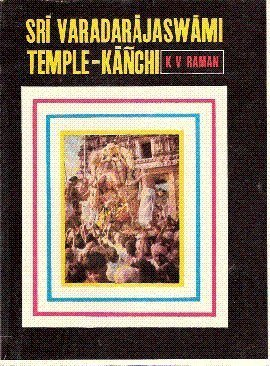
The first edition of the book most probably had been released even as early as the mid-1970’s as, evidently, it was submitted as a dissertation for the award of a university PhD degree. And that is why perhaps another author Sri R. Varada Tatacharya in 1978 also wrote and published a book under the title “A Critical Survey of Dr. K. V. Raman’s book “Sri Varadarajaswami Temple, Kanchi”. This book is more or less a polemic than a strictly academic critique.
Anyone who takes the time and pain to read the above two books would easily be able to appreciate why I have chosen to characterize the age-old sectarian rift between the Tenkalai and Vadakalai as being, in fact, a “battle of narratives” with each side — generation after generation now in the last 200 years — straining every sinew in its sectarian body to project it as though it were a “battle for truth or justice”.
Reproduced below are a few lengthy and un-expurgated extracts from the “Critical Survey” by Sri Varada Tathaacharya of Dr K.V.Raman’s book. The reproduction is deliberate since it is my view that ordinary Sri Vaishnavas (especially the younger generations) reading them today would easily understand the rather toxic nature of the dissonances I have alluded to above.
Firstly, let me quote verbatim the relevant prefatory passages from the book of Sri Varada Thataacharya through which he broadly contextualizes the rebuttals contained in his critique of the many narratives K.V.Raman builds in his own book.
QUOTE:
The author Dr. K. V. Raman in his Treatise “ Sri
Varadarajaswami Temple - Kanchi ” - A study of its History,
Art & Architecture - has taken enormous pains in collecting
data both inscriptional and historical as well as traditional for impressing upon his readers, his theory about the religious and
historical aspects of this great Vaishnavite Temple. Being a
Vaishnavite of the Tenkalai sect, it is no wonder, he gives prominence only to certain Tenkalai features and stories in connection with the Temple, leaving aside the more and most important Vadakalai characteristics of the same. His account of the Temple can be very well described as what they call in
legal parlance “ Suppressio Veri and Suggestio Falsi ”. The glaring omissions of certain Vadakalai Shrines' festivals and features, while describing all others and the emphasis on certain Tenkalai features and festivals will go to show his bias and sectarian approach. His stories regarding the Tenkalai predominance and theories of their influence are exaggerated
and far-fetched. He gives a clever twist to certain inscriptions,
and builds a story of Tenkalai domination in the Temple over
them. The object of the author in this Treatise seems to be
therefore to establish a theory that the Temple of Sri Varadaraja¬
swami is Tenkalai in character.

The object of this book is to counter in detail all the
fallacious theories and accounts set forth by Dr. K. V. Raman
in his Treatise, chapter by chapter.

Though we are not presumptuous to claim perfect knowledge in our religious literature we shall try to counter the disputable points the author has raised in his book, to the best of our ability, in our own way, even though both these do not
have any relevance to the subject-matter of the “ Treatise ” in the ultimate analysis."

"It is surprising to see the author’s references to certain
controversial and sectarian documents and books which he
has evidently taken as the basis for his version. These documents filed in the Courts as exhibits by his sect (Tenkalais) during the litigation that raged over our Temple for the last two centuries or more and books written with a bias, should not be brought in, in as much as they present the picture of only one side. Much reliance shall not be placed on them attributing undisputed authenticity to them. At any rate they should not form part of a thesis submitted for the award of the Ph.D. Degree. To a reader who has no correct knowledge of the
origin and basis of these documents, the author’s references to them would evidently create an impression that these documents and exhibits are genuine. It becomes therefore incumbent on our part to meet the points raised in these documents and exhibits by citing documents which are not only unassailable on the
strength of evidences they contain but also because most of them
are judicial pronouncements."
The message that comes through unambiguously from reading the above passages is that both the Tenkalai and Vadakalai authors were aware of each other’s role as purveyors of “historical narratives” rather than as strictly academic historians.
What is furthermore so very ironic is that while there is a clear, mutual albeit tacit acknowledgment that each other’s narratives are “written with a bias” — and therefore “should not be brought in, in as much as they present the picture of only one side; and (also that) much reliance shall not be placed on them attributing undisputed authenticity to them” — there is, by stark and remarkable contrast, an expression of implicit, beatific and almost child-like trust, faith and supreme confidence in “judicial pronouncements” of the land! The Tenkalais and Vadakalais are willing to accept them as “unassailable“ given “the strength of evidences they contain“! And it is the same Courts that have openly said that in their view the Sri Vaishnava Iyengaars are not even “human beings“….
Anyway, such an irony will not be lost on a truly discerning, non-partisan observer who can easily see that it represents, in fact, a shame-faced confession made by the two sects unwittingly. In effect, they are both saying only this: “Our representations to the Courts we will try make sure meets the definition of Evidence under secular laws; but the historical socio-religious narratives we shall continue to purvey, and from which such evidence is culled, are an entirely different matter“. It is therefore not inaccurate to say that it is indeed a mute confession of both sects that they really speak from both sides of their mouths. To the Courts, on one hand, they offer “suppressio veri” — being economical with truth — but in the sectarian battles with each other, they will purvey “suggestio falsi” — i.e. elaborations of less-than-truthful narratives.
The elaborations of such less-than-truthful historical narratives are what constitute the major dissonances amongst the Tenkalai and Vadakalai versions of the history of the Kanchi Varadaraja temple. The most significant of those dissonances are three in number:
A. Timeline:
The historical narrative of the Tenkalais suggests that the split, or the growing division within the Sri Vaishnava communities into “southern” (“thenn” in Tamizh) and “northern” (“vada“) regions of the Tamil countryside (between Sri Rangam and Kanchipuram) happened soon after the departure of Sri Ramanujacharya i.e. from around or immediately after the lifetime of Sri Pillai Lokachariar (1205–1311 CE) (one amongst many other stalwart Acharyas of the South whose contributions to the propagation of “Sri Ramanuja darsana” and to the preservation of the Sri Rangam temple were enormous and legendary.
The Vadakalais however refute this theory and they believe that the community of Sri Vaishnava “ubaya vedaantins” began identifying itself as Tenkalai and Vadakalai camps only around the time that British Rule came to rule over South India at the beginning of the 18th century.
B. Power and Legitimacy:
The Vadakalai sect in its narratives claims that several generations of the Thaathaachaarya clans enjoyed the exclusive and unequivocal right to exercise stewardship of the Kanchipuram Devarajaswamy Temple by virtue of the royal mandate granted to them by at least three or four successive kingly reigns of the Vijayanagar dynasty …. In fact, such royal mandate is claimed for other important Sri Vaishnava temples too such as Tirupati-Tirumala, Sri Rangam, Sri Villiputtur, Kumbakonam, Sri Perumbudur besides other smaller shrines.
The Tenkalais however challenge the exclusivity of such stewardship rights enjoyed by the Thaathacharya heirs. They claim that their Acharyas too (notably Sri Vadikesari Azhagiya Manvaala Jiyar) enjoyed the confidence of the Vijayanagar Dynastic kings and were in fact appointed to manage and control the Kanchi Varadaraja Swamy temple for extended periods of time.
C. Language as a cultural badge:
The Tenkalai, quite in stark contrast to the Vadakalai sect, identifies itself as a Dravidian ethno-cultural group with marked preference for the Tamizh (or Manipravalam) vernacular over the discourse in Sanskrit, which was the language of Pan-Indian intelligentsia, and hence came to be seen as “vada mozhi” — the language of the north.
The Vadakalai had no such identity issues at all since he viewed “ubaya vedaantham” as a cultivated home-grown tradition that was wholly agnostic towards specious notions of cultural ethno-centricity and linguistic fidelity.
Each of the above 3 dissonances above will be examined in a little more detail in the writings to follow.
(to be continued)
Sudarshan Madabushi