The well-known Sri Vaishnava scholar-historian (late) Sri. T.S.Parthasarathy (1913-2006, also Carnatic musicologist, and Expert Committee Member of the Madras Music Academy https://srutimag.blogspot.com/2018/09/ts-parthasarathy.html ) was a family friend of my parents.
One day, when we visited him at his house, having learnt I was avidly interested in Sri Vaishnavite history as a serious student, he was so kind to gift me a personal compilation of his — a slim slew of very old English articles on Sri Vaishnavism that he had collected and added to his scrap book. The articles had been penned by several Sri Vaishnava scholars of perhaps the 1950s-1960s. After rummaging through bookshelf, he pulled out an old dog-eared, thumb-worn folio-collection and presented the fragile old typescript to me saying, “Read these half a dozen articles that I have hand-picked myself for the wealth of information and thought-provoking views they contain… I am sure they will be useful to you in your ongoing studies on the subject”.
One of those articles in the slim folio was titled “Sri Manavala Mahamuni” by one Prof. M.R.Sampathkumaran M.A.

The article was indeed very well-written and it did contain a wealth of information on the life and work of Sri Manavaala Maamuni. The author’s “Achaarya bhakthi” or devotion towards his guru truly shone through every line and every passage of Prof.Sampathkumaran’s essay.
Nonetheless, after reading right through to the very end of the article, I could not but help asking myself if it was not just another egregious example of how, for the last 200 years or longer, several thousands of similarly articulated articles — not only in English but countless more in Tamizh, in fact, — had been penned, published and broadcast amongst the Sri Vaishnava community at large. To me, the article seemed to only typify the wonted, standard and well-worn ways in which generations of well-meaning, pious and scholarly Sri Vaishnava writers and scholars, much like Prof. M.R. Sampathkumaran, had been tirelessly churning out and filling their own respective narratives of hoary Sri Vaishnava history with what already earlier has been noted to be “legendary accounts, hagiographical apocrypha, “puraana-like” tales and confusing historical narratives that would seem they have been woven around and out of hearsay“.
Any modern, thoughtful young Sri Vaishnava today reading Prof. Sampathkumaran’s article will be quite awe struck by how the Sri Vaishnava historical narratives of the last 200-300 years constitute a unique genre of writing. It is a unique specialized genre of writing in itself because it is an amazingly modern example of what is known as the “Goebellesian Effect”.
Simply by constantly repeating and rehashing it, modern psychology proves to us that a narrative can be made to register itself inside the minds of readers as de facto history. A mass of ordinary people can thus be beguiled into believing unquestioningly that an historical event did happen exactly as it is being repeatedly narrated and endlessly suggested…. Such is said to be the terrific power of “subliminal suggestion”, according to modern psychology while it explains to us the Goebellesian Effect.
It would be simply impossible for me to adequately demonstrate how the Goebellesian Effect works in Sri Vaishnava narratives too unless I put myself to the trouble of effort in reproducing at quite some length, certain select, elaborate passages from Prof. Sampathakumaran’s essay. So the reader must now prepare to bear with me if he or she has to perforce read quite a few extracts below from Prof. Sampathkumaran’s own article with more than a bit of patience and indulgence.
*****************************************
In the first part of his article, Prof. Sampathakumaran presents an account that is partly information, — and indeed, the historical information provided here is very valuable — partly legend and partly apocrypha.
The informative part of the article begins with several good references to historical records which are unquestionably authentic.
The first of such references is titled “Madhuravijaya” which was written by a princess, and poetess too, of the Vijayanagar Royal Family who with her lord and husband, Prince Kampanna, was touring (circa. 1360 CE) the southern regions of the Empire that had been conquered and brought under the reign of the Hindu dynasty.
Next, the “Sri Rangam Koil Ozhukku” is also referred to again by Prof. Sampathkumaran while describing the state of utter ruin to which the Sri Rangam Temple had been reduced by the Muslim invasion of 1327 CE and had remained in such ruinous condition for well over 44-45 years until it was restored to some semblance of its old grandeur around 1377 CE well after the reign of Devaraaya-II and before Krishnadeva Raya ascended the throne in 1509 CE.
Finally, Prof. Sampathakumaran draws from the “guruparampara” chronicles to describe how Sri Manavaala Maamuni following the instructions of his immediate guru, in the Sri Rangam temple, Sri Sailesa (1329-1434 CE) (a follower of Sri Pillai Lokaacharya) set about the great task entrusted to him of restoring and re-establishing the old liturgical order and regimen of Sri Ramanuja that had prevailed before….. but then had suffered disruption and fallen into desuetude in the temple for over half-a-century after the Muslim invasion.
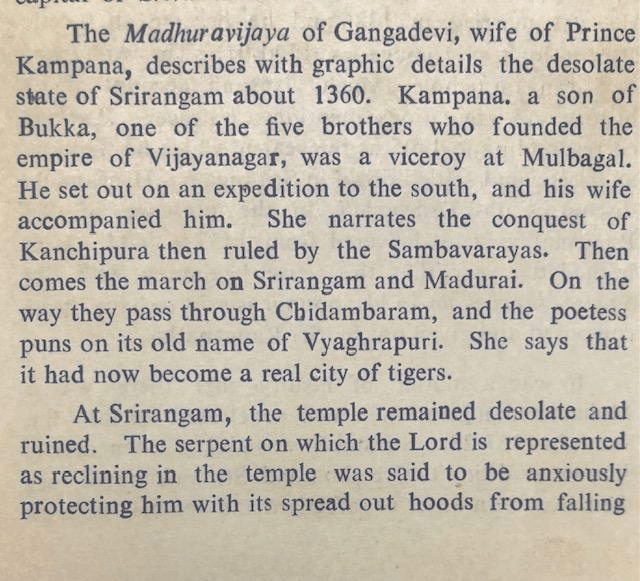
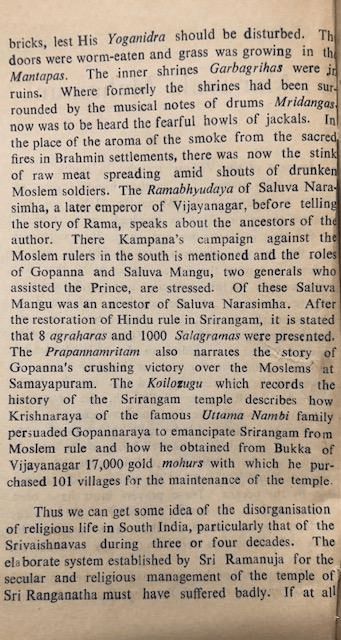
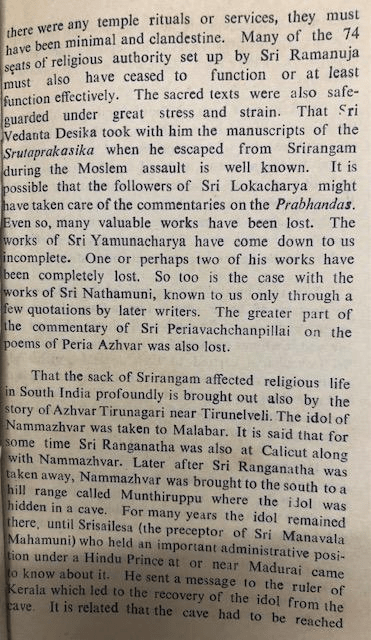

Up the point essayed above, Prof. Sampathkumaran presents a very graphic and more or less accurate picture of the events of Sri Rangam that happened in and between the period of post-Vedanta Desika,/post-Pillailokachariar times …. i.e. much of 14th century CE …. and the era when Sri Manavala Maamuni and his guru Sri Sailesa are said to have begun working on zealous mission-mode style for the restoration, renovation and resurrection of Sri Rangam Temple…. i.e. much of 15th century CE.
Beyond this point in his essay, however, follow suddenly several passages in Prof. Sampathkumaran’s dissertation wherein sober, sympathetic and dispassionate account of History suddenly turns hagiographic excess, exaggeration and non-sequitur.
(to be continued)
Sudarshan Madabushi