From a broad survey of the history of South India between the 15th and 17th century CE, it is easy to learn and conclude that the glory of scores and scores of Hindu temples (both Saivite and Vaishnavite) reached its pinnacle during the same period and it was thanks largely to the power of the great Vijayanagar Dynasts but for whose sustained generosity and sponsorship, generations of hereditary family-lineages such as the Utthama Nambis in Sri Rangam and Thaathaachaarya=s of Kanchipuram would not have been able to build — in the post-Sri Ramanujacharya era — the edifice of the great spiritual empire of “ubaya-vedaantham“, the cornerstone of Sri Vaishnavite culture and tradition in all of Tamil country.
When the decline of the Vijayanagar Empire began, the decline of the “ubaya-vedaantin” tradition in Tamil country too began…. and the fall of both became imminent too with the rise of the new Mughal power across India that emerged.
One of the most amazing facts of history of the Hindu kings of the Vijayanagar Empire was that throughout their reign of almost 250 years — through the Sangama, Tuluva and Aravidu dynastic rule beginning 1336 CE up to 1565 CE — they were constant and munificent benefactors to Hindu temples dotted all across their land. Their philanthropy to temples was rich, even-handed and multifaceted. It led in fact to 300 years of a marvelous Hindu renaissance….. in the arts, crafts, sciences, literature and vigorous intellectual accomplishments in far-flung parts of Tamil Nadu, Andhra and Karnataka. Although the reign of the Vijayanagar Dynasts was constantly plagued by frequent wars and battles with the Bahmani Sultanates, they ensured that Hindu temples were never deprived of financial support and resources. Amongst the Vaishnava temples in Tamil country, Sri Rangam, Tirumala, Melkote, Kanchipuram, Madurai, Sri Villiputtur, Kumbakonam, Sri Perumbudur etc. and many more were the recipients of large grants and enormously lavish donations from the dynasts. The temple wealth was never used in any way to finance the wars of the Vijayanagar Empire.
When the Vijayanagar Empire declined, after the mid-16th century CE , the steady and copious capital-flows from the royal treasuries to the temple-treasuries was dramatically reversed. Instead of the rulers of the kingdom providing revenue and wealth to the temples, the tide turned and it was the rulers who now began to look upon temple-treasuries as rich sources of revenue which could finance ongoing wars and help bankroll even new wars of conquest throughout the country. This trend became most evident in the eras of both the great Mughal and British Empires.
*****************************
After the Vijayanagar Empire fell in the late 16th century came the great Mughal Empire. From the time of Babur right up to the time of Aurangzeb, came a long line of dynasts who were ceaselessly at war for around 250 years, first with the Marathas and then with the European colonialists — Portuguese, Dutch, French and the British. When the last of the Mughal Emperors, Shah Alam Khan was defeated in war by the British East India Company in 1756 CE, and he ceded control over the vast Indian subcontinent to the imperial powers of Great Britain, almost all of India, including many parts of South India, was a terribly war-ravaged subcontinent.
How were such wars financed?
The two most fecund and copious sources of finance for these rulers to fund their terrible wars was Taxation and Temple. The Mughals looked upon Hindu temple treasuries and granaries as an inexhaustible reservoir of wealth to be plundered and looted and thereby provide a steady stream of funding with which to conduct their wars with the Marathas and later the colonialists of Europe.
The historian William Dalrymple in his best-selling book of the history of the British East India Company EIC, viz. “The ANARCHY” – The East India Company, Corporate Violence and the Pillage of an Empire”, (2019: Bloomsbury Publishing) while writing about the last days of the last Mughal Emperor, Aurangzeb, mentions this fact specifically of how Hindu temple wealth aided and funded Mughal wars and military campaigns and infrastructure:
QUOTE:
“Around a dozen Hindu temples across the country were destroyed, and in 1672 (Aurangzeb) issued an order recalling all endowed land given to Hindus and reserved all future land grants for Muslims, In 1679 the Emperor re-imposed the jizya tax on all non-Muslims that had been abolished by Akbar;….” (page 26)
“It was Aurangzeb’s reckless expansion of the Empire into the Deccan, largely fought against the Shia Muslim states of Bijapur and Golconda that did most to exhaust and overstretch the resources of the Empire. (page 27)
“The days of huge imperial armies financed by an overflowing treasury, had ended forever… Instead as authority disintegrated everyone took measure for their own protection and India became a decentralized and disjointed but profoundly militarized society. Almost every one carried a weapons. Almost everyone was potentially a soldier. A military labour market sprang up across Hindustan…. one of the most thriving free markets of fighting men anywhere in the world — all up for sale to the highest bidder.” (page 46). By the end of the 18th century , substantial sections of the peasantry were armed and spent part of their year as mercenaries serving in distant locations.
UNQUOTE
The extent to which the wars and military campaigns of conquest of the great Mughal Empire succeeded in India is graphically captured in these 3 vivid maps of those historical times and they give us an idea of how temple-wealth across India got depleted as it got diverted for advancing military purposes rather than spiritual — from the times of Babur in 1530 CE to the times of Aurangzeb in 1707 CE and right up to 1730 CE when it was the turn of the Mughal Empire to disintegrate to give way to the European colonial powers.
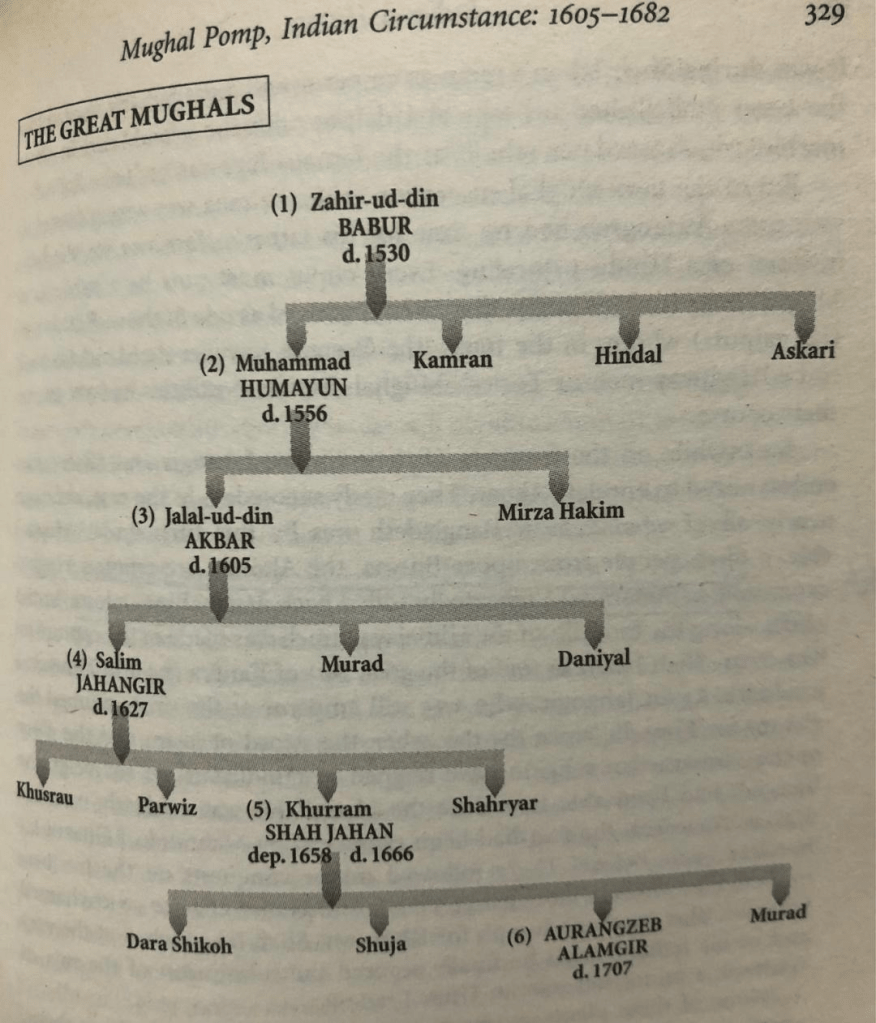
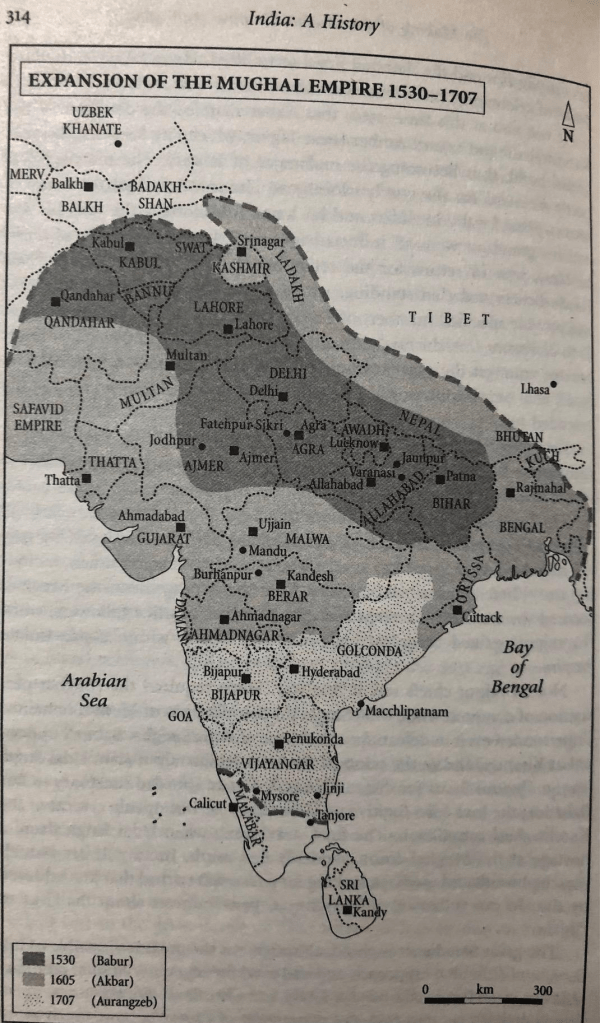
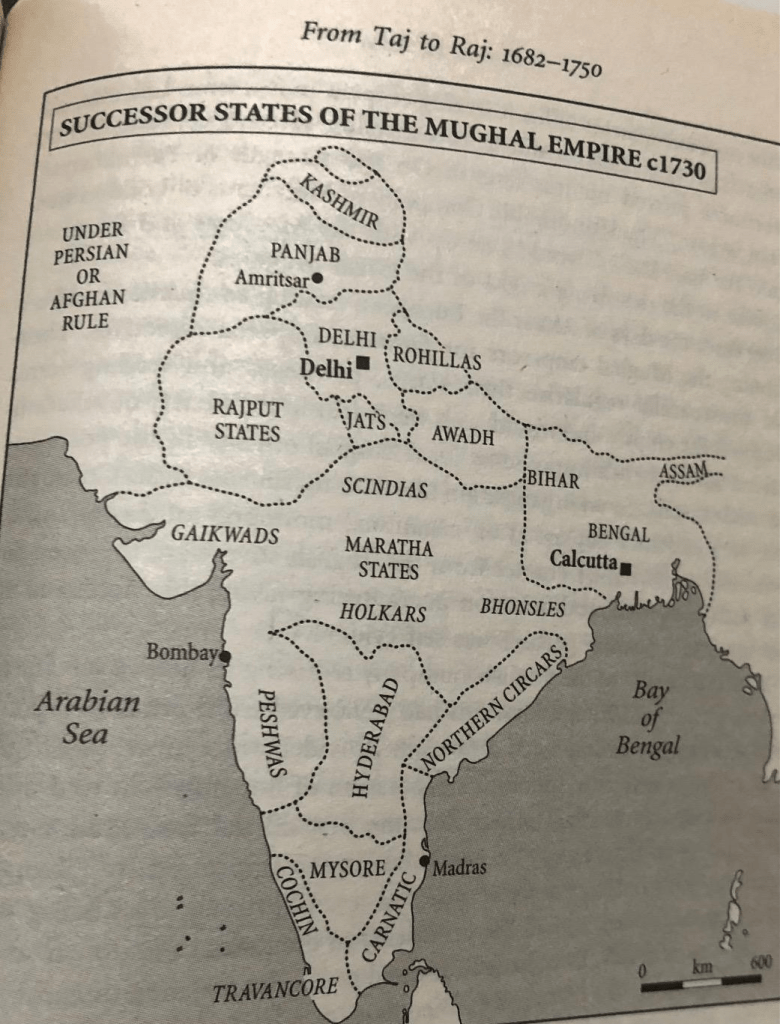
The condition and state of India under Mughal Rule reflected in the maps above provide a vast canvass of historical backdrop with aid of which any young modern-minded “ubaya vedaantin” of today should be able to easily visualize and contextualize the much smaller and localized canvass on which the historic conflict between Tenkalai and Vadakalai sects was playing out in the Tamil country of those times.
It was a time when the wealth, revenues and treasuries of all Sri Vaishnava temples — whether in the north or south of Tamil Nadu — were all getting steadily drained by the rulers of the day. The method of draining such temple-wealth was both covert and overt — as seen in Aurangzeb’s order to directly plunder temples or through the levy of the dreaded punitive Islamic tax of “jiziya“.
In the post-Mughal Rule era, when the British East India Company – EIC – (followed later by the British Crown) came to takeover and rule throughout India, the business of waging endless imperialistic wars became even more pandemic!
Wars were the staple occupation of the British who carried out bloody and costly campaigns against the Nawabs of Bengal, Orissa and Bihar (Awadh). Thereafter, the British fought dozens of wars against the Marathas.... then against the Nizam of Hyderabad‘s mercenary French Army and then against the Muslim despots of South India, Hyder Ali and Tipu Sultan (The great Carnatic Wars!)…..
Wars were perennial under British Rule and much like the Mughals before them, the imperialists too needed to raise enormous revenues and wealth from within India itself to fund their military regimes and troops. Unlike the Mughals, however, the British were circumspect about how they went about extracting revenues from the land they ruled. They did not resort to direct plunder but instead chose to tax India to death….
Again, the accounts of how the British East India Company financed its wars through punitive and cruel taxation is graphically described in William Dalrymple’s book “The Anarchy”. A few passages are reproduced below only to illustrate how the whole country suffered under British colonial rule…. and institutions such as Hindu temples were not spared either from extreme hardship and adversity:
QUOTE:
“In August 1765, the young Mughal Emperor Shah Alam, exiled from Delhi and defeated by the East India Company troops, was forced into what we would now call an act of involuntary privatisation…… (He) dismissed his own Mughal revenue officials …. and replaced them with a set of English traders appointed by Robert Clive ….. The collection of Mughal Taxes was henceforth subcontracted to a powerful multinational corporation — whose revenue collecting operations were protected by its own private army.” (page xx1v)
“(Robert Clive made) promises to the Mughal Emperor to return him to power in Delhi while making the offer of financially managing the three rich eastern provinces of the Emperor dominions — Bengal, Bihar and Orissa. This was the granting of … diwaani …. the office of economic management of Mughal provinces….. This not only gave a veneer of Mughal legitimacy for the EIC’s conquests, it also potentially gave it the right to tax 20 million people and generate an estimated revenue of between 2 to 3 million sterling pounds a year — equivalent to 210- to 315 million pound sterling today. Seizing the many riches …….(of the country) ….. with its fertile paddy fields and rice surpluses, its industrious weavers and rich mineral resources, opened up huge opportunities for EIC and would generate the finance to continue building up the most powerful army in Asia…. (page 207).
The Battle of Plassey in 1757 — victory that owed much to treachery, forged contracts, bankers and bribes as it did to military prowess — transferred to EIC treasury no less than 2.5 million pounds seized from defeated rulers —- 262.5 million pound sterling today….. (page xxiv)
“A trading corporation had become both colonial proprietor and corporate state, legally free, for the the first time, to do all the things that governments do: control the law, administer justice, assess taxes, mint coins, provide protection, impose punishments, make peace and wage war……
“Indian tax revenues were now being used to provide finances….. India being treated as if it were a vast plantation to be milked and exploited with all its profits shipped overseas to London. (page 209)…. in other words, simply to secure as large a revenue as possible through land taxes and then to transfer that surplus to London bank accounts…
In June 1770 …. famine (struck Bengal) … East India Company (EIC) administration as a whole did not engage in any famine relief works… Instead anxious to maintain their revenues at a time of low production and high military expenditure, EIC in one of the greatest failures of corporate responsibility in history, rigorously enforced tax collection and in some cases even increased revenue assessments by 10 %…
“Platoons of sepoys were marched out into the countryside to enforce payment. where they erected gibbets in prominent places to hang those who resisted tax collection. Even starving families were expected to pay up: there were no remissions authorized on humanitarian grounds. …. in 1770-71 alone, at the height of the Bengal famine, an astounding sum of 1,086,255 pound sterling was transferred to London by EIC executives — perhaps a 100 million pound sterling in modern currency. (page 221).
UNQUOTE
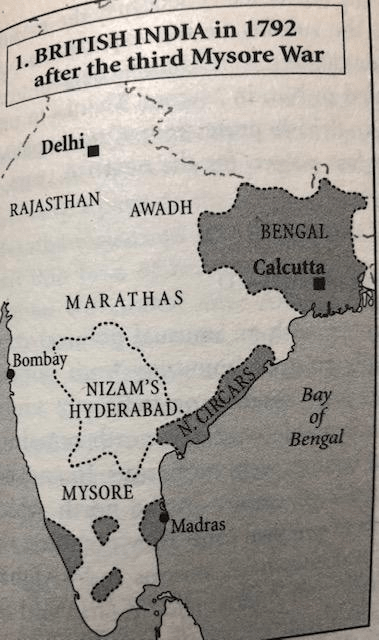
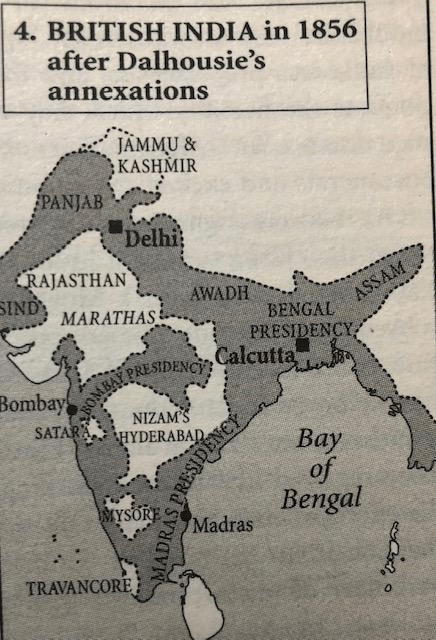
It was through such rampant and unconscionably venal taxation systems that the British colonialists ruined India for over 250 years and expanded their empire. The extent to which tax on land, wealth and the produce of the peoples of India was used to vastly extend and expand British Rule through wars is graphically pictured in the below two maps:
************************************
For well over 400 years after the fall of the Vijayanagar Hindu Kingdoms, the entire length and breadth of the Indian subcontinent suffered from alien rule imposed by the Mughal Empire and later by British Imperialism. It was an era of darkness that had enveloped the peoples and the land….. Peasantry and Nobility went to seed. The Wealth of the Nation was bled dry. Disease, despair and ignorance spread. Fear gripped the hearts of people and a collective miasma of melancholy their minds. Even institutions such as temples and religions fell victim to the general malaise of corruption and deceit that seemed to have blighted the whole country….
One of the most perceptive historians of those times, Ghulam Hussain Khan wrote a very moving account of the darkness and despondency that descended on the country and destroyed it, slowly but relentlessly, in 200 years of abject slavery (as quoted in Dalrymple’s book – ibid) :
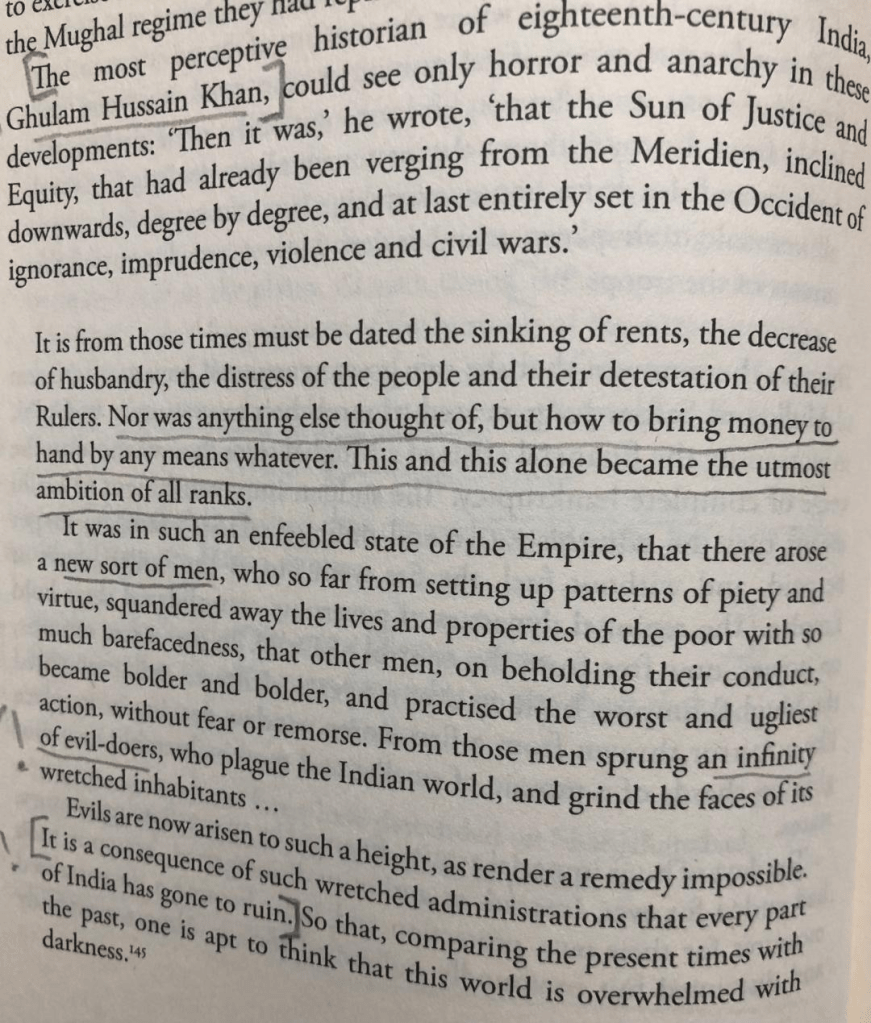
Reflecting more or less accurately the somber mood of all-round despair that prevailed in the rest of the country, Kanchipuram of the “ubaya-vedaantin-s” too suffered much during the same time in history from what — to use Ghulam Hussain’s Khan’s pained words — was the “consequence of such wretched administrations that every part of India had gone to ruin…..” and which made the Sri Vaishnavas “apt to think that this world is overwhelmed with darkness”. There were no Vijayanagar Kings to either protect or save them and their temples. There was no royal guarantor for their communal wellbeing. Bereft of all support from the State, the Sri Vaishnavas clung to and fought over whatever still remained of their temples and their wealth. Psychologically, it was a trauma that befell them which the entire community could not cope with adequately and the scars remained forever. Powerless to resist their new oppressive rulers in any meaningful way, or prevent them from usurping their commonwealth and common dignity, the hapless “ubaya-vedaantins” simply turned upon themselves and descended into petty squabbling and internecine sectarian feuding.
(to be continued)
Sudarshan Madabushi