Between 1833 CE and 1874 CE the East India Company was itself going through the severe throes of winding up its governance over all its vast provinces in India.
Meanwhile, it also tried its best to complete as soon and as smoothly as possible the process of transferring back to the Sri Vaishnavas of South India the ownership, control and management of their temples, 100-odd in number then. They were the same temples which a hundred years ago, the Company had been able to commandeer and exploit to the hilt, extracting from them vast amounts of revenues, tax, inestimable wealth and powerful social influence…. all in the name of “reforming” the temples.
By an Act of the British Parliament in 1833 CE, India became a dominion of the Queen of Great Britain. In 1947 CE when the Queen’s Rule too came to an end with India gaining Independence after more than half-a-century of rule by foreign imperialists. By then, many great events of social upheaval had already disrupted if not utterly uprooted the life of the community of “ubaya-vedaantins” at large in South India. They transformed its identity…. deeply and permanently.
In Parts-28 through Part-31, an overview of the main causes of such upheavals the Sri Vaishnavas experienced was described broadly under the separate headings of Language, Education and Employment, Migration, Social Alienation and Wealth Dispossession. To be able to understand the transformations — i.e. to grasp how far-reaching their consequences were for the future of Sri Vaishnava temples — which began trending imperceptibly at first but then started to unravel rapidly during the hundred years straddling late-19th and mid-20th centuries CE, and which culminated finally in Indian Independence in 1947 CE, it is necessary to study them all against the backdrop of those very same social upheavals the “ubaya-vedaantins” experienced.
Sanskrit became a dead-language and “ubaya-vedaantins” — who were identified in society as being Brahmins — all but abandoned the learning of what was once their principal language of intellectual, artistic and cultural discourse. As already explained in Part-29, western academia and Christian missionaries in South India, through their relentless work of spreading propaganda against “varnaashrama” or caste-system of social order in India, had greatly succeeded in polarizing Tamilian society into Brahmin and Non-Brahmin linguistic, ethno-racial groups.
The polarizing socio-economic forces that conditioned the crucial decades of the 19th-20th centuries CE has been well explained in a well-researched article published in “Social Sciences.in” (http://socialsciences.in/article/caste-politics-and-social-conflict) authored by G. Sudarshan Reddy. His thesis is being reproduced below at quite some length to underscore the identity crisis into which the Sri Vaishnavas were plunged during the decades leading up to India’s political independence from the British:
QUOTE
“…. (An) element that reinforced the polarity between Brahmans and non-Brahmans was the belief, widely held at the turn of the century that Brahmans were racially different from non-Brahmans. In the nineteenth century a number of European and Indian scholars who had begun to study the origins of Tamil, the language spoken in the far southeastern portion of Madras province, posited the idea that non-Brahmans were Dravidians and the original civilizers of the region, and that the Brahmans were the “Aryan invaders” from the north. These scholars believed that the Dravidians had been conquered and their institutions supplanted by an imposed Sanskritic ‘Aryan religion’ and a caste system, by which non-Brahmans had for centuries been kept in an inferior position. Linguistically, also, there was a strong tradition for a division between Brahmans and non-Brahmans, especially in the Tamil area. The Brahmans were the guardians of ‘northern Sanskrit’; the non-Brahmans, or so they themselves believed, were the creators of ‘southern Tamil’ and Tamil culture. Thus there were linguistic and cultural as well as social differences (growing rapidly) between the two groups.
“……the majority of the inhabitants of Madras presidency (under British Rule) spoke one of five Dravidian languages, the most important of which were Tamil and Telugu. Telugu was spoken in all the northern districts of the province as well as in the area known as Rayalseema, to the north and west of Madras city; the Tamil—Telugu dividing line lay just north of the city of Madras. In 1911 Tamil was the mother tongue of seventeen million people in the southeastern part of the province, but in the Tamil areas there were also considerable numbers of Telugu-speakers, mainly as a result of southerly migrations in the fifteenth century and later during the hegemony of the Vijayanagar kingdom”.
“After the 1850’s the Telugu and particularly the Tamil Brahmans, who together comprised only 3.2 percent of the total population, enhanced their position in the social system by gradually filling the great majority of administrative and educational positions then open to Indians. These Tamil and Telugu Brahmans had for centuries been respected as the guardians of Sanskritic learning and religion. Since only a few non-Brahman groups in the Telugu districts, such as the Velamas, were permitted to study Sanskrit, the Brahmans exercised almost complete control over the body of Hindu religious works written in Sanskrit. One of the great centers of Brahmanical learning was Tanjore, in the heart of the Tamil country. The author of the Tanjore Gazetteer (1906) described the position of the Brahmans there in these. terms: ‘Brahmans versed in the sacred law are numerous in Tanjore; Vedic sacrifices are performed on the banks of its streams; Vedic chanting is performed in a manner rarely rivalled; philosophical treatises are published in Sanskrit verse; and religious associations exist, the privilege of initiation into which is eagerly sought for and the rules of which are earnestly followed even to the extent of relinquishing the world’. A knowledge of Sanskrit and access to Hindu scriptures also made Tamil and Telugu Brahmans indispensable as priests at family and domestic occasions such as weddings.“
UNQUOTE
Everything changed however in the Brahmin communities at large — and in the Sri Vaishnava community too in particular — when they in large masses abandoned their Vedic and traditional educational systems and instead moved out to urbanized India to embrace and take to modern education in the English language. As G. Sudarshan Reddy writes:
QUOTE:
“Knowledge of English was essential for employment in government service, as well as in teaching and politics. In these areas, the Tamil Brahmans led all the other caste groups. In 1921, 28.2 percent of all Tamil Brahman males were literate in English; for Telugu Brahman males the figure was 17.3 percent. By 1921, six of the non-Brahman groups—Nairs, Chettis, Vellalas, Balija Naidus, Indian Christians, and Nadars—had achieved fairly high literacy rates. But they could not compete with the Tamil and Telugu Brahmans so far as English was concerned. Two Telugu non-Brahman caste groups, the Kammas and the Reddis, who also had relatively high male literacy rates by 1921 (13.6 and 10.2 percent, respectively), had an English literacy among males of less than one percent”.
“Brahman traditions for literacy and education can be seen most fully from an analysis of the students attending the constituent colleges of the University of Madras. Between 1870 and 1918, some 67 to 71 percent of the students enrolled and of those granted Bachelor of Arts degrees by the university were Brahmans. During the same period the number of non-Brahman Hindus awarded B.A.s averaged between 18 and 22 percent of the totals; Indian Christians (in the decade 1901-1911) accounted for 5.3 percent of the B.A.s granted. The Brahmans also led in graduate work. For example, of the 3,651 candidates for the Bachelor of Laws degree, the basic qualification for entry into the legal profession, if not the political world, 2,686 were Brahmans and 752 were non-Brahman Hindus. The proportion was similar for the Licentiate of Teaching degree: 1,094 Brahmans, 163 non-Brahman Hindus, and 207 Indian Christians out of a total of 1,498 degrees granted. Only in the Licentiate of Medical Science were the Brahman candidates exceeded in number by non-Brahman Hindus”.
UNQUOTE
In the great social upheaval of mass-migration of Sri Vaishnava families from the rural interiors of Tamil country to the urban areas — when they gave up their language, their temples and traditional ways of life in village-based communities — most of them went in search of modern, western education modelled on the British Macaulayan syllabus and system. Education in such schools and colleges run on the British-system was sine qua non for being eligible to secure lucrative and stable jobs in government, civil-services, armed and police-forces, in schools and universities, medical corps and hospitals and in the legal profession.
Those families of “ubaya-vedaantins” that however remained in their traditional village-temple milieu came to be soon regarded as the “left behind generation“… the so-called laggards in the great, historic stride that India as a nation was taking towards progress and modernity in the 20th century — economically, socially and culturally.
The old temple-ecosystem of the Sri Vaishnavas, that once had been sponsored and sustained by the Vijayanagara Empire for over three centuries; which had thereafter been already ravaged for another three centuries by Islamic and Mughal dynasties and then reduced to a limping rump utterly impoverished in terms of material wealth and resources by British colonial rule for more than two centuries; and that had become severely dilapidated in stature as a hoary religious institution, was left finally to be tended and nurtured only by a motley “left-behind generation” of “ubaya-vedaantins“.
The Sri Vaishnavas who stayed behind were the “last-men-standing”, so to say, who stubbornly stayed put in their temples and their orthodoxies, and managed somehow to eke out subsistence-grade living — scrounged from the meagre income still accruing to them from the vastly denuded wealth still belonging to the temples. Their near-penurious conditions of living was supported mainly by ungainful part-time leased-land, absentee-landlord agricultural farming that was supplemented by dwindling earnings from the temples they tended to.
Within the Sri Vaishnava community thus grew, slowly but surely, a new, hitherto unknown deep and clear socio-economic class-divide. Those amongst their families who migrated away to the bustling urban centers of India, quickly acquired modern British-institution education, secured safe and profitable jobs or entered lucrative professions, began regarding themselves as the “progressives” of Sri Vaishnava society. With increasing income and wealth levels, successive generations of this group of Sri Vaishnava “progressives” began adopting, to steadily growing extents, lifestyles and outlook in life that were held to be modern, urban and even slightly Western. Such sea-change in mindset and cultural adaptation was effected and instilled in them thanks to the secular education and employment opportunities that were offered to them aplenty under British institutions and which they seized wholeheartedly and quickly.
Over the decades in later-19th and early 20th century CE, the Sri Vaishnavas thus distinctly splintered into two socio-economic classes:
One class — call them Class A — continued to remain in the village still clinging to its traditional ethos rooted as it had been for centuries in priesthood, temples, scriptural learning and sacerdotalism.
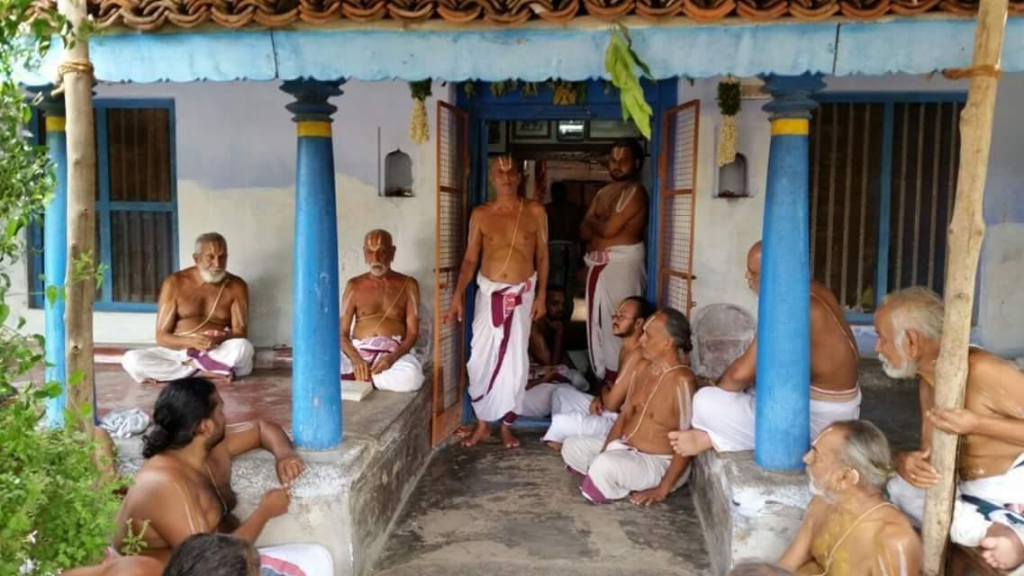
(un-dated image of a group of “ubaya-vedantins” assembled for religious discourse in a village home somewhere in rural Tamil Nadu)
The other class — call it Class B — was a migrant one of parvenus flooding into the city in ever larger and larger numbers, and which was embracing modernity through education, employment in government and in the professions.
The income and wealth distinctions and disparities between Class A and Class B of Sri Vaishnavas got starker and starker as the decades rolled by. The modern “progressives” were soon accumulating positions of eminence and influence in the political landscape of a country that would soon become independent. The Class B Sri Vaishnavas became part of the emerging ruling classes in India. By contrast, the traditional “left-behind-generations” of Class A “ubaya-vedaantins” felt trapped within the cultural backwaters of the temple-villages and towns of Tamil Nadu, and in what rest of society was increasingly beginning to view as the anachronisms of hoary traditions.
Amongst the Class A Sri Vaishnavas, it was no surprise therefore that a deep, acute sense of impoverishment and disenfranchisement drove them even deeper into sectarian squabbling over whatever was still left in their hands that could be called — if at all it could be called that — as ownership and control of the incomes and administration of their great and ancient temples.
In the first half of the 20th century, in the decades before and after Indian Independence in 1947, that sense of impoverishment and deep disenfranchisement amongst the so-called “left-behind generation” of Class A “ubaya-vedantins” only got worsened further. The reasons were many but they arose mainly out of much larger pre- and post-Independence social movements and political developments engendered by a new republican Constitutional regime. It exacerbated the already frail and emasculated conditions of the temples of Tamil Nadu, generally, and more particularly, those of the “ubaya-vedantins”.
A brief overview of those reasons that caused such a regime is both necessary and relevant to take. It will be essayed next in Part-37.
*************************************
(to be continued)
Sudarshan Madabushi