Between 1925 CE and about the turn of the 21st century CE, the Sri Vaishnavas of the community of “ubaya-vedantins” suffered, in various degrees of intensity, the severe trauma, as it were, of a deep identity crisis brought about by profound social churning all around them in the larger outside world that simply overtook and overwhelmed them.
The churn caused deep, seismic shifts in Sri Vaishnava zeitgeist. It created a sort of collective schizophrenia within the community. It was precisely such an identity crisis that then led to the slow decline of the hoary tradition of “ubaya-vedanta” witnessed until 1967 CE or thereabouts. And thereafter, the fall of the tradition began to happen rapidly until about the turn of the new millennium.
First the slow decline and then the rapid fall of the tradition, quite ironically, happened even while the rest of the country — in the decades after Independence in 1947 CE — was in fact transforming itself into a new, modernistic and democratic republic striving for great military, economic, social and cultural advancement. The national mood was indeed one of buoyant hopes and robust spirits!
A new found faith in republicanism and of the tenets of Western-style democracy — and those of the so-called “open, free and pluralistic society” — gave the peoples of India a tremendous surge of new self-confidence in themselves. Social assertion began to surge forth, fueled largely as it became by a seemingly ever-expanding nation-wide awareness of social rights and social justice. The old order of “varnaashrama“, of rigid hierarchy and ossified patriarchy, of oppressive feudalism and economic overlord-ism was challenged everywhere in society, overturned and began waning. The old order was changing and yielding place to new: a new order of India that was envisioned in the newly written Constitution of India — the new “holy book” of the nation — which the peoples gave themselves in 195o CE! It verily guaranteed that Equality, basic human Freedoms and Secularistic outlook on life would soon and increasingly become enshrined as inviolably sacred and overarching holy grail that the country would swear and live by for all times to come.
India’s “tryst with destiny” became thus a lofty national aspiration which was believed could only be sought and achieved in the world of modernization, rapid industrialization, social egalitarianism and cosmopolitanism. And Democracy was seen to be the surest pathway to fulfil that aspiration and realize that destiny.
While at one macro-level — i.e. the national level — the various societies of peoples of India were generally surging forward in the country’s march towards a new order, a new dream and a new self-identity… one of hope, aspiration and an abundance of new ambitions and opportunities… by sharp, stark and somber contrast on the other hand, the community of Sri Vaishnavas, down in a remote part of southern India in the state of Tamil Nadu, was beset, throughout the same period in history, by a crisis of self-confidence, self-belief and self-identity! The “ubaya-vedantins” underwent a severe collective dislocation and disorientation of spirit engendered by social upheavals of the kind that were described in some detail earlier in Parts 29 through Part-38.
Rather than being inspired by the expansive mood of optimism and nationalistic fervor that the new Indian Republic was gripped by during the decades of nation-building following the attainment of political freedom in 1947, the small religious community of Sri Vaishnavas — living in the narrow strip of land about 700 KMs long and 300 Kms wide lain between two famous and historic temple-town capitals of Sri Rangam in the south and Kanchipuram in the north of the state of Tamil Nadu — became, by stark contrast, more and more inward-looking, even more fractured and fractious, more moorings-less and much more parochial-minded than ever before!
It is certainly an interesting academic question to ask why there emerged such a stark contrast between the general upbeat mood of the rest of the country and that of the community of “ubaya-vedaantins” at large which was markedly downcast in that particular historical period?
*********************************
Samuel Huntington, an American historian, in 1995 wrote a classic work titled “The Clash of Civilizations” (1996) (Penguin Random House 2016). The book dealt with how great civilizational changes occurred at various points in human history and what larger-than-life factors played a part in bringing about such epochal shifts and changes in the world.
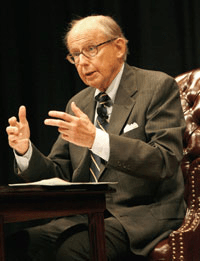
In one very insightful chapter in his book, while discussing the many deep impacts that Democracy leaves on societies and upon small communities in newly-founded nations (like India, for example), Huntington penned a few memorable passages that… with almost eerie precision… sum up the plight and predicament of the “ubaya vedaantins” of Tamil Nadu circa 1925 CE all the way through c. 2000 CE.
QUOTE:
Page 94: “….. democracy is inherently a parochializing not cosmopolitanizing process“.
Page 76: “At the societal level, modernization enhances the economic, military, and political power of the society as a whole and encourages the people of that society to have confidence in their culture and to become culturally assertive. At the individual level, modernization generates feelings of alienation and anomie as traditional bonds and social relations are broken and leads to crisis of identity….”.
Page 97: “People do not live by reason alone. They cannot calculate and act rationally in pursuit of their self-interest until they define their self. (The politics of) Interest … presupposes identity. In times of rapid social change established identities dissolve, the self must be redefined, and new identities created. For people facing the need to determine Who am I? Where do I belong? religion provides compelling answers, and religious groups provide small social communities to replace those lost through urbanization. All religions …. furnish “people with a sense of identity and and a direction in life”.” In this process, people rediscover or create new historical entities. Whatever universalist goals they may have, religions give people identity by positing a basic distinction between believers and nonbelievers, between a superior in-group and a different and inferior out-group”.
UNQUOTE
In the above passages, the lines relevant to and most aptly descriptive of the condition of the Sri Vaishnava community in the decades following Indian Independence have been underscored.
Democracy in new India certainly did not cosmopolitanize the Sri Vaishnavas. It only parochialized them even more than before.
In the post-Independence mood of fundamental change, plentiful opportunities, and great social mobility that was all brought about by populist and democratic revolutions getting institutionalized in the country, one might have expected that age-old, narrow Tenkalai and Vadakalai sectarian differences and mutual animosities would get buried; and that the community would close ranks and stride forth in unity to face a variety of emerging new-age challenges that modernity was beginning to pose to it in its own state of Tamil Nadu. That however is not what and how it turned out to be.
While, as Huntington describes it above, at the societal level, modernization was enhancing the economic and political power of the society as a whole and encouraging other castes and sections of the Tamil population and society to have confidence in their culture and to become culturally assertive, it was becoming disconcertingly clear that at the individual level, amongst the community of “ubaya-vedaantins”, modernization was generating in fact feelings of alienation and anomie, with its age-old traditional bonds and social relations steadily fraying and getting broken and leading slowly but surely to crisis of identity…
At a particular time in the history of India when its vast numbers of diverse societies were all experiencing the energy and growth-pangs of a young nation on the move i.e. at a time of rapid social change (as Huntington calls it) when established identities were dissolving and reforming or reconfiguring themselves in a new socio-political climate, and when “the self must be redefined, and new identities created“, the Sri Vaishnava community was, by quirky fate and circumstances, found badly wanting in both energy and sense of purpose. In other words (or rather, putting it in Huntingtonian phraseology), the “ubaya-vedaantins” of that time and generations were simply unable to garner the communitarian energy required to either create for itself a new identity or re-discover one.
Why and how did that happen? What was the so-called “quirk of fate and circumstance” that led to the anomie and identity-crisis of the “ubaya-Vedaantins” ?
The answers will be explored next in Part-39.
(to be continued)
Sudarshan Madabushi