In at least six or seven decades that immediately followed Indian Independence in 1947 CE, the deep crisis into which the “ubaya-vedaantic” identity fell was caused fundamentally by the sudden social chafing that suddenly irrupted between its centuries-old traditional Vedic value-system and those that soon came to be enshrined and championed by the new holy book, the Republican Constitution of India, as secular, progressive and modernistic.
The chafing grew into conflict and that increasingly rendered the community of Sri Vaishnavas at odds with the generally prevailing socio-political clime in the country but more especially with the zeitgeist of the state of Tamil Nadu. The values of “ubaya-vedaanta“, it became clear as the decades went by, were simply out-of-synch with the basic philosophy and legal provisions of the Constitution of India in four principal ways:
- The continuing use of Sanskrit by Sri Vaishnvas as their most revered language which was seen to have a detrimental impact upon Tamizh language and culture.
- The Sri Vaishnava’s reluctance or baulk in disavowing or publicly denouncing one of the most fundamental tenets of Hindu Sanaatana Dharma viz. the social order of “varna-ashrama-dharma”.
- Continuing Brahminical dominance on Education, Employment, Governance and Arts and Culture at large in Tamil Nadu.
- The exercising of hereditary and tradition-bound rights to control the wealth and administration of some of the wealthiest and institutionally the most influential of Sri Vaishnava temples right across Tamil Nadu.
The constant chafing between the Constitutional value-system and that which Sri Vaishnavas regarded as their traditional and communitarian, if not wholly civilizational, value-system was very often caused by fractious legal disputes between the community’s establishmentarians and government bodies or statutory authority empowered by Legislative enactments.
Several bitter and protracted legal cases came to be fought in the courts of the land — especially in the state of Tamil Nadu. They dragged on in time for several decades. In most of these cases, it was the socio-political powers-of-the-day, that were seeking to intervene and impose Constitutional imprimatur upon the traditional order through continual litigation fought via grievance-redressal processes and appellate procedures laid down under the laws of the land. One of the most potent and much invoked such law was the statue in the state of Tamil Nadu known as the Tamil Nadu Hindu Religious and Charitable Endowments Commission Act of 1959. In the course of several such contentious legal interventions and repeated appellate processes, the various court-judgements that were delivered over the years came to be based upon extremely complex and at times inconsistent interpretations of the doctrines and principles of the Constitution of India. Such complexity and inconsistency in interpreting constitutional law only resulted in deepening the crisis of the Sri Vaishnava identity. It severely denting the community’s collective self-esteem and social cohesion. It also resulted in the steady deterioration in the conditions of its temple ecosystems and the dilution of its control over them.
In an Op-Ed piece written in the context of another only slightly different, wider and not dissimilar context of another Constitutional debate, Suhrith Parthasarathy, a noted Constitutional lawyer in Chennai, India wrote the passage quoted below with penetrative insight. It is so relevant in fact to every one of the aforementioned four principal causes why the “ubaya-vedaantins” found themselves at odds with the Constitutional philosophy. https://www.thehindu.com/opinion/lead/in-ews-verdict-a-discrimination-antithetical-to-equality/article66125697.ece:
QUOTE: “In its more than 70-year old history, the Supreme Court of India has delivered a plethora of judgements touching on the fundamental tenets governing the Constitution of India’s guarantee of equal treatment (of citizens). On occasion, its verdicts have contradicted each other, with different Benches (of judges) championing different meanings to the Constitution’s texts and values.
Some of this conflict is understandable. After all, the Constitution’s most important promises — among them, the rights to equal treatment, personal liberty, and freedom of expression and religion — are couched in abstract language. The job of interpreting the Constitution’s words, of fleshing out their real meaning, lies with the courts. Judges perform this task by looking not only at the text of the provisions but also by appealing to the Constitution’s finest moral vision, by studying its history, and by applying rules and codes that have formed over time through an accretion of precedent. Naturally, in construing the guarantees of the Constitution, judges can arrive at varying conclusions on how the document must be read…..” UNQUOTE
********************************
Sanskrit :
In post-Independent India, two strands of thought and opinion emerged each championing diametrically opposite views on what ought to be the fate of Sanskrit. It had for many centuries in history served as the lingua franca or “link-language” that united the linguistically diverse peoples of India through common cultural ties. But what now? What now after the Constitution (Seventh Amendment) Act, 1956, enabled the complete re-organization of the Indian Union into different States under States Reorganisation Act of 1956? The States Reorganization Act of 1956 was a major step towards dividing India into states and Union Territories and, consequently, all its peoples too. The question then became of paramount political importance: Which language should serve as the “link language” linking different peoples and states? Should it be English, Hindi, Hindustani… or Sanskrit?
One strand of public opinion pitched for the relegation of Sanskrit to the “dust-bin of history” since it no longer was a “spoken language of the masses” but had managed to survive the ages only because of its local prevalence and use in lowly priesthood occupations or in the elitist religious discourse and conclaves of academic study within the Hindu temple-ecosystem. This school zealously even today advocates the adoption of the English language as the best means of modernizing India and providing for its millions of “aspirational youth generations” a gateway to a truly global and cosmopolitan future.
The other strand of public opinion however defended retaining Sanskrit since they regarded it as the language of the very civilisation of India. It thus actively sought to revive Sanskrit’s significance as a great unifying factor, one that could be the most capable amongst all other vernaculars in the country to realize the ideal of “unity in diversity“.
Two very notable and high-profile public-figures and political celebrities today in India can be said to typify the two respective strands of thought and public opinion — Kapil Sibal, an eminent expert in Constitutional Law and Dr. Subramanian Swamy, one-time Harvard University professor of Economics and International Relations and now an active national politician known to be Hindutva ideologue of the RSS (Rashtriya Svayamsevak Sangh). Here below is what each has gone on record recently to say about the Sanskrit language after the harsh fate that the Constitution of India eventually dealt to it and the state of sheer neglect and pathetic desuetude into which the ancient but rich language has fallen into in this country:
QUOTE: “What language a child should be taught in, is ultimately the choice parents must exercise, subject to the policy of the State. What other languages a child must learn should again be left to parents till the child can decide on her own. The State cannot be allowed to interfere, as a matter of law, since it relates to the future of the child. This is indeed a matter of privacy and personal liberty……. To learn a language is a matter of choice. It is personal to every individual and any imposition by the State is an assault on privacy. India’s diversity is under assault, and uniformity is not an answer, for it makes for divisive politics which tears asunder rather than unites.
English is an aspirational language. That is why, across the country, even the poor and the marginalised wish to learn and speak it, for even a little proficiency in it opens up avenues for seeking employment. That is why, along with the mother tongue, English is taught as one of the languages in both public and private schools across the country.
“….. our aspirational youth may get isolated from the wealth of knowledge that is available to those familiar with English. Be it China, Japan, France or other countries across the world, the young desire to learn English because it helps enrich their knowledge especially in areas of research and scientific developments.” UNQUOTE
At the opposite end of the public discourse on the fate of Sanskrit, Subramanian Swami wrote the following in his book: “Hindutva and National Renaissance” (Har-Anand Publications, 2016) – (Page 142 through 151):
QUOTE: “The very name “Sanskrit” means “language brought to formal perfection”…. Until 1100 AD Sanskrit was without interruption the official language of the whole of India. The dominance of Sanskrit is indicated by a wealth of literature of widely diverse genres including religious and philosophical: fiction (short story, fable, novels, and plays); scientific literature including linguistics, mathematics, astronomy, and medicine; as well as law and politics.
“…. as we look back, it seems that the founding fathers (of the new independent India) committed a blunder in not according Sanskrit its rightful place”.
“It is generally not known that in the Constituent Assembly (a body formed in 1948-50 to draft the Constitution of India), there was a body of opinion that strongly advocated the adoption of Sanskrit language as the official language….. The highly articulate member of the Constituent Assembly, Prof. Naziruddin Ahmad, regretted that we (Indians) did not know with what great veneration Sanskrit was regarded in the civilized world outside….. It should therefore be accepted as India’s national language in preference to Hindi which gave undue advantage to Hindi speaking areas…”
Lakshmikant Maitra moved an amendment to the language clause in the Constituent Assembly. He proposed that Sanskrit should be accorded the status of the national and official language of India. (He said)….Sanskrit was a “world language in the sense that its importance, its wealth, its position, its grandeur have made it transcend the frontiers of India and travel far beyond India, and it is because of the Sanskrit language and all the rich heritage of Indian culture that is enshrined in it that outside India we are held in deep esteem by all countries”.
“However, what came out of the all that discussion in the Constituent Assembly was that Sanskrit was included in the 8th Schedule of the Constitution as one of the Indian languages (the number of these languages has now gone up to 18)….” UNQUOTE
Dr Swamy however went on in his book to make an impassioned but rather ineffectual appeal to restore Sanskrit to its old and glorious position in India:
QUOTE: “…. for National Renaissance, we must unite the nation by propagating for adoption of Sanskrit as the ultimate nation language of India. For the time being Hindi vocabulary should be continually Sanskritized till Hindi merges with Sanskrit. Modernization can never be achieved without the re-throning of Sanskrit as Hindustan’s national language.” UNQUOTE
It was thus that the Sanskrit language — after having been for long centuries in the past the very bedrock of the “ubaya-vedanta sampradaaya” and which had been the foremost language of intellectual and cultural discourse of the Sri Vaishnavas — came to be dislodged by the Constitution of India from its position of pre-eminence, and relegated to relative social insignificance. It was thus left to languish in slow but sure linguistic atrophy in the expectation that it would in due course of time, within India itself, die a natural death.
*********************************
With the death of Sanskrit… or with the language slipping into moribundity… the hoary tradition of “ubaya-vedaantins”, sown and nurtured in the 11th century CE by none other than Sri Ramanujacharya himself, was dealt a death-blow. The death of Sanskrit struck at the very root of its identity and sundered it. Imperceptibly but surely, there began to appear amongst the Tenkalai sect of “ubaya-vedaantins” a growing distaste for learning Sanskrit while the Vadakalai sect struggled to conserve it at least in its temples through ecumenical rituals and practices.
The unspoken reasoning for such distaste amongst the Tenkalais for Sanskrit language was that since anyway it had become a “dead language” in the whole country — and since it longer held any sort of pride of place amongst Indian languages — and since it had been placed merely as just yet another language amongst several others in a designated Schedule of the Indian Constitution, Sanskrit was no longer of any central importance to the practice of Sri Vaishnavism. It had become simply an “also-ran” language that was no longer able to run! It did not really define Sri Vaishnava identity. There existed already a legacy of rich and prodigious scriptural literature in Tamizh language that had been handed down to posterity by a long lineage… virtually, a galaxy… of “tennaachaarya” Sri Vaishnavite preceptors all hailing from the southern districts of Tamil Nadu. Both in essence and identity, therefore, it was their Tamil legacy that now truly represented the best traditions of Sri Vaishnavism. Hence, what then was really any need for Sanskrit? What useful social purpose did the Sanskrit language really serve in Tamil Nadu?
With such a parochial slant in reasoning pervading the mind-set of the “ubaya-vedaantin” community, the rift that, historically, had already developed in the course of the 18th and 19th century CE between the Tenkalai and Vadakalai sects began to widen and deepen rapidly. The former all but rejected Sanskrit learning while the latter continued to struggle to cling on to it more out of a defiant sense of hopelessness than out of true pride. But since a large chunk of the miniscule minority-population of the Vadakalai-sect of the northern districts of Tamil Nadu had already migrated to the cities to become more and more urbanized, modernized and secularized, the learning of Sanskrit amongst them virtually vanished.
Soon a time arrived when Vedic learning — which was conducted largely in Sanskrit — became rare amongst the Sri Vaishnavas. Today proficiency in Sanskrit is rare indeed if not non-existent amongst Sri Vaishnavas… and genuine Sanskrit scholarship is rarer still. This is, in fact, quite in stark contrast to the other Brahmin sectarian groups such as the Advaitin and Smaarthaa communities living in Tamil Nadu who, even while laboring under the same adverse social circumstances of the times as the Sri Vaishnavas faced, have nonetheless managed somehow to preserve Vedic learning in Sanskrit within their own.
It was thus that Sanskrit came to be regarded in Tamil Nadu as an Aryan language while Tamizh was Dravidian. And since Sri Vaishnavism in the post-Ramanujacharya millennium germinated, flowered and flourished in the lands known today as Tamil Nadu, the Tenkalais believed it had to be therefore, intrinsically, a faith of Tamil-speaking peoples only. If it were not for the strong Dravidian influence on the faith and “sampradaaya” that Sri Ramanujacharya propagated, and which he himself in his own time duly recognized and helped to widely promote through the “divya-prabhandham” literature of the Azhwaars, Sri Vaishnavism would surely not have appealed all that much to the popular religious sentiment of Tamilians and proliferated so rapidly. Thus, in the view of the Tenkalai sect, Sanskrit could claim really no more than only a marginal status — if ever at all — as a language of the Sri Vaishnavas. Having come from the Aryan North (“vada mozhi“) to the Dravidian South — and being more alien than kindred in spirit to “ubaya-vedaanta” — it really could not be accorded any prime position .
In such an imperceptibly but clearly felt preference for Tamil over Sanskrit that the Tenkalais began declaring and affirming, there was a veiled but unmistakable vote of acceptance, even allegiance to the idea of the Dravidian Vs Aryan cultural binary that very soon became the overarching, defining motif and hallmark of every socio-political discourse and movement in the State of Tamil Nadu in the post-Independence era. Just one example will serve to illustrate the fact:
In August 2021 in the city of Chennai, at the famous Saivite temple of Sri Kapaaleeshwarar of Mylapore, the government of Tamil Nadu inaugurated the introduction of “Tamizh “potri” archanai” (sacred litanies recited) in the sanctum in praise of the deity. It was a landmark milestone indeed in the efforts to gradually displace Sanskrit inside the temples of the Hindus wherein, for centuries past, the mode of offering worship by Brahmin priests had always been in Sanskrit. https://www.thehindu.com/news/national/tamil-nadu/tamil-archanai-begins-at-47-temples/article61430211.ece
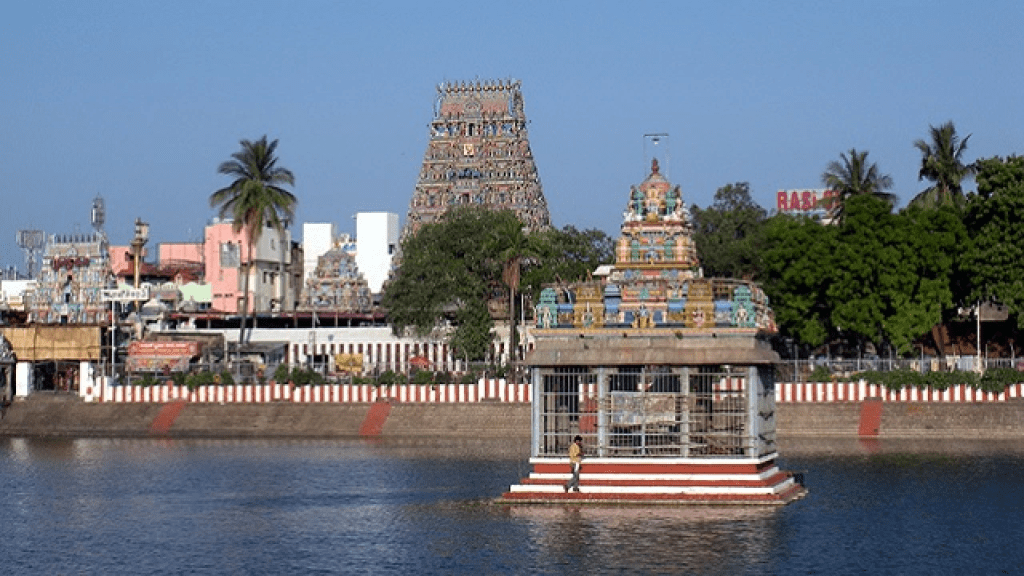
It has now become a matter of serious conjecture whether it could be only a matter of time before the practice of “Tamizh archana” would also get introduced into the temples of the Sri Vaishnavas too in Tamil Nadu. And the moot question asked by many within the “ubaya-vedaantin” community is how will the Tenkalai sect — given their marked and well-publicized preference for Tamil over Sanskrit — react? Would the sect perhaps be encouraged and emboldened — given the direction in which the political winds presently blow in the State — to connive with rather than oppose the Government’s move to achieve in Sri Vaishnava temples what was successfully accomplished in the Kapaaleeshwarar Temple at Mylapore? Or would they simply maintain a low-key agnostic position on the issue and quietly let the measures of the government by themselves achieve the ultimate goal of ejecting Sanskrit from temple-traditions of the “ubaya-Vedaantins”?
“varna-ashrama-dharma”
This will be dealt in the next Part-41.
(to be continued)
Sudarshan Madabushi