“varna-ashrama-dharma”
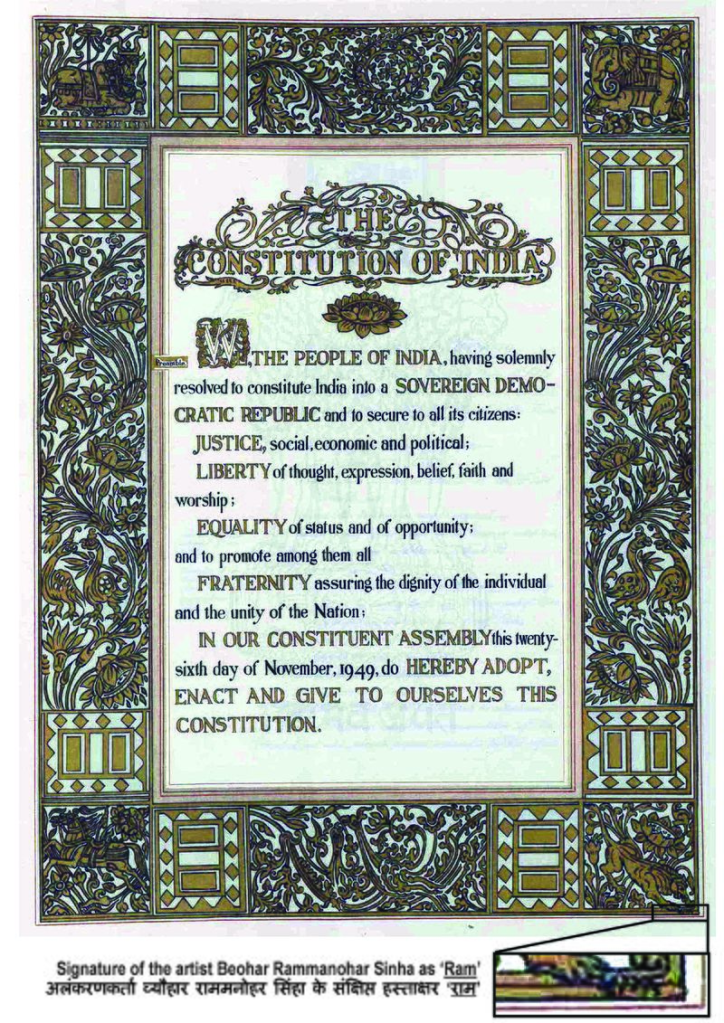
“Varna-ashrama-dharma” was outlawed in 1950 in the country by the Constitution of India. It created a deep and fundamental fissure inside the philosophical world-view of the “ubaya-vedaantins” of Tamil Nadu. The trauma became yet another cause for the crisis of identity into which they plunged and it beset them throughout the post-Independence decades…. and to some extent it perhaps lingers even today. It drove the three centuries-old unreconciled sectarian wedge between Tenkalai and Vadakalai “sampradaayam” only deeper.
****************************
“Varna-ashrama-dharma” was the name given to a societal order that had prevailed and held Indian peoples together for numberless centuries in history since Vedic times. The European historiographers from Germany and Great Britain who came during the time of colonial rule from the 17th century CE onwards to study Indian society gave it another name: Caste.
Caste, the new name, is in fact of European origin, not Sanskrit or any Indian vernacular. Caste is drawn from the Latin word “castus” (chaste) which then in Portuguese became “casto” (unmixed, pure) and then in Spanish also became “casta” (lineage, race and breed).
Unlike the word Caste used in the European sense, “varna-ashrama-dharma” did not refer to or really connote any narrow notions of biological heredity. “Varna-ashrama-dharma” was not even just a social institution. It was actually a cosmogonic view of human society. In the Vedic era it had been accepted by peoples across the land called Aryavartha or Bhaaratha-varsha as being an enduring ethos — a way in which the human community could protect itself from anarchy and dissolution and remain preserved.
The Rg Veda, the oldest religious text in the world (at least 8000 years old, according to even modern scholars) clearly affirmed “varna-ashrama-dharma” in a “rk” or aphorism in the “Purusha Suktam”, a famous and often controversial Vedic hymn (10.90) in praise of the Supreme God who it personified as “Purusha“, the primordial reality from which the universe was created:
brā̠hma̠ṇō̎-‘sya̠ mukha̍māsīt । bā̠hū rā̍ja̠nya̍ḥ kṛ̠taḥ ।
ū̠rū tada̍sya̠ yadvaiśya̍ḥ । pa̠dbhyāgṃ śū̠drō a̍jāyataḥ ॥
“The Brahmanas were his mouth, the Kshatriyas became his arms, the Vaishyas were his thighs, and the Shudras were assigned to his feet”. (#12)
What the Rg Veda pronounced in mantra form was echoed in the Bhagavath-Gita too in a famous “shloka” or verse. And it was spoken by none other than Lord Krishna himself, an avatar of Vishnu, who re-affirmed the institution of “varna-ashrama-dharma”:
cātur-varṇyaṁ mayā sṛṣṭaṁ
guṇa-karma-vibhāgaśaḥ
tasya kartāram api māṁ
viddhy akartāram avyayam
The fourfold-caste has been created by Me according to the differentiation of GUNA and KARMA; though I am the author thereof, know Me as the undifferentiated and immutable.
Many millennia later after the Rg Veda and the Bhagavath-Gita, came the “Manu-Smriti” of Sage Manu, which too even more firmly institutionalized “varna-ashrama-dharma” as a system of social architecting. Although Manu dealt with “varna” (and “jaathi“, its offshoot) elaborately, it was in fact only one facet of a much larger world-view posited in what came to be later known as “Manu-Smiriti“. his so-called book of codified laws accepted by all historians to be seminal work on Dharma even today. But that Manu’s work was as much a work of Vedic sociology as it was a law-book was well-known since even as early as the 4th century BCE.
The Manu-Smriti — the Book of Manu — was basically structured around ethical principles intended to provide guidance towards realizing an idealistic way of going about ordering human life and society. That ideal was founded on an even more profound universal, eternal and holistic philosophy called “sanaatana dharma”. The Manu-smriti was accorded primacy among all “smritis” and its study was imposed as a duty on the leaders (kshatriyas) and teachers (brahmins) of society. The book of Manu was thus in the Vedic era entitled to veneration by all who claimed to be intelligent… “maananiyo maneeshinaam”, said the great poet Kalidasa about it.
*************************
The idea of “varna-ashrama-dharma” came to be outlawed, out rightly, in India in 1950 in the Democratic, Secular and Socialistic Republic of India by the Constitution of India because of a very widely-held misconception, misconstruing and misunderstanding of it amongst the political ruling-classes and influential intelligentsia. They understood it to be a standalone concept of social-engineering in the bygone Vedic era of Manu. Such misconception was in reality a hangover of two long centuries of false narratives about Indian society woven by colonial-era academia and European orientalism. The founding fathers of the new republic of India — for reasons still being debated about today by modern historians — allowed themselves to be totally blinded to the fact that “varna-ashrama-dharma” was only one amongst seven other interlinked and interlocked dimensions of a social order representing the greater cultural heritage of “sanaatana dharma” and that it would be utter folly to view it in total isolation from the rest.
The other seven dimensions to which “varna-ashrama-dharma” was related — inextricably and integrally — and of which, in fact, it was only an adjunct, are even more uniquely Vedantic concepts. They are (i) the Law of Karma (ii) Transmigration of souls (metempsychosis) (iii) The theory of “guna-s” (iv) The ultimate Aims of Life (“purushaartha“) (v) Sacraments (“samskaara“) (vi) Sin and Atonement (“paapam” and “praayaschitta“) (vii) Excommunication (“patana“).
None of the above eight ideas if studied as discrete and separate categories would make sense or appeal to modern sensibilities. Examined in isolation some of them, especially the idea of “varna-ashrama-dharma“, for instance, might seem even utterly repugnant to contemporary moral norms and the conscience of society. Nonetheless, none of them could be truly and fully understood without reference or in relation to the others since one is so dependent upon and conditional to the other. They are all linked to each other and together in a logically constructed, organic system of thought and wisdom.
The Constitution of India however simply went ahead and isolated the idea and institution of “varna-ashrama-dharma” from all the other defining dimensions of “sanaatana dharma” and banned it.
What was thus an integral part of the cultural ecology or warp-and-woof of India, the Constitution of India in one fell swoop — through a stroke of the pen and an Act of of Parliament in 1950 — outlawed, lock, stock and barrel. It was done on the same grounds on which the European and colonial orientalists and academicians had for long been condemning it viz.: Caste was intrinsically and fundamentally the cause of all social ill, evil, discrimination and injustice; hence, it is imperative for ushering a new social order in the new nation; the State must totally destroy “varna-ashrama-dharma” in all its forms manifested in society… by and under the Law.
Latter day legal experts explained such a Constitutional position more starkly in the wonted language and idiom of Marxist-Liberal philosophy: https://www.lawinsider.in/columns/what-is-the-history-of-reservation-in-india#:~:text=The%20Constitution%20of%20India%20has%20secured%20the%20first,it%20speaks%20about%20the%20real%20and%20substantive%20equality.
*******************************
Thus with the above clear objective in view, the Constitution of India secured the first fundamental right to the people of India i.e. ‘Article 14 – Right to Equality’. This right prohibits the discrimination on the basis of caste, religion, gender or color. It is an essential ingredient of social and economic justice as it speaks about the real and substantive equality. Breach of this rule of law would amount to breach of equality under Article 14.
The Indian Constitution’s fight against “varna-ashrama-dharma” was posited fundamentally thus on the philosophical conviction that it was the very root of all social discrimination and oppression. With the passage of time and with the making of non-discriminatory laws in many States — such as in Tamil Nadu, the Hindu Religious and Charitable Endowments Act, 1959 — Equality of people did come to be challenged on the basis of caste, religion and gender and that discrimination persisted in society on the basis of birth.
To cope up with the above situation of inequality, the Indian Government considered ‘Reservation’. In other words, the Constitution provided for and enabled a slew of laws promoting “affirmative action“. It was an attempt to uphold equality among citizens by ensuring equal and fair opportunities to all and to ensure that minority groups were not pushed backward, neither socially nor economically. In the larger Constitutional scheme of things, such Reservation policies did not violate Article 14. Instead they rightfully recognized and helped to treat the special and backward groups of society to be treated equally.
Now, who were the “special and backward” groups of society? And what had made them victims of social injustice, discrimination and becoming disempowered? The wise men of India who wrote the Constitution were all convinced that the villain of the piece was none other than the institution of “varna-ashrama-dharma“. And therefore, the Constitutional founding-fathers wrote Article 14 and sanctified it as the very edifice upon which all the other commandments of the new holy book for the new Indian Republic were cast into stone.
QUOTE: Discrimination is in our holy books like the Mahabharata that also quotes of many instances wherein a warrior like Karna was not allowed to showcase his talent merely on the ground of him being a Shudra. He was often referred to as ‘Shudra Putra’ and humiliated because of his caste. From time of ancient Kings of our land, our society was divided into different groups and classes on the basis of caste and religion. The Hindu society was an extension of the varna system, where the 4 varnas were: The Brahmins who were the most superior caste and then came Kshatriyas, Vaisyas and finally the Shudras.
Except these castes another caste existed which were the ‘untouchables’ and the lowest in the social strata. They were exempted from all benefits of society. These untouchables were recognized as ‘Dalits’ they were not allowed to take education, their entry was prohibited in temples, they were treated like animals. They were believed to be so impure that caste Hindus considered their presence to be polluting. They were mentally and physically harassed by the people of upper castes. The touch of an untouchable was considered tarnish to an upper-caste Hindu. They were mostly given ‘impure’ tasks such as work involving human waste and dead animals. Moreover, they were excluded from drawing water from upper-caste wells. Even if their shadows were casted on the upper-class people then it was considered that the person has got impure and many strict restrictions were imposed on them for social gatherings and social life and if these restrictions were get violated, they were severely punished and in some cases were even killed.
The divisions of society on these counterfeit norms of castes were what led to adverse effects on the development and growth of these lower class people. UNQUOTE
******************************
Between the Indian Constitution’s core and paramount value and that of “varna-ashrama-dharma” — when viewed simply as a naked, standalone concept — there is an irreconcilably fundamental difference.
The philosophical fulcrum of the Indian Constitution is the idea of Right to Equality whereas the philosophical pivot of “varna-ashrama-dharma” is the idea of Enjoined Duty.
In the Constitution, the Right to Equality is conferred on all human-beings verily by the fact of birth. In “Sanaatana Dharma”, it is that very same fact of birth which, ipso facto, predestines Enjoined Duty in life for a human being.
In the scheme of “varna-ashrama-dharma”, Rights were seen to be only by-products or results from the enforcement of Duties, whereas in Article 14, Rights were paramount and sacrosanct.
******************************
It was the above deep and fundamental conflict in philosophical premising between the two social orders — one ancient and the other modern — that caused great collective trauma, confusion and disorientation within the Brahmin community at large in Tamil Nadu and especially within the “ubaya-vedaanta sampradaaya”.
For centuries their religious faith had been founded on the eight dimensions of the basic structure of “sanaatana-dharma” and of which “varna-ashrama-dharma” had always been a key one. It was always part of their belief-system It was an existential paradigm too in which they as Brahmins had come to view themselves as moral referees whose enjoined duty it was i.e. whose “varna-ashrama dharma” it was to uphold values of rectitude in conduct and learning represented by mastery of the scriptures, the Vedas and sciences or saastra-s. Now, all of a sudden, in the new social order that the Constitution of India had ushered in, the old Vedic social order was getting uprooted and upturned!
The new-fangled notion of Equality as political and social ideal was displacing and overriding Enjoined Duty, which had been a time-honored religious ideal. The ideological disconnect that ensued thus created utter disorientation in the mind and soul of the Sri Vaishnava community whose tradition-bound worldview on human equality could not be squared with that of the Indian Constitution. The resulting trauma that came to be felt and experienced by the community was very accurately described by a scholar-historian of the Banaras Hindu University in 1949. In a lecture delivered to students in the university under the title “Aspects of the Social and Political System of Manusmriti”, Professor K.V.Ranswamy Aiyangar made this bold, rather contrarian and yet scholarly assertion:
QUOTE: “In a universe in which uniformity and law dominate, there can be no assertion of natural equality. The concept of equality is a deduction not from facts but from aspiration or supposed needs…. Rights are by-products or results from the enforcement of duties…. Enforcement of Equality will be putting every one in a Procrustean bed. Inequality, not equality, is what is found in nature. No two persons are exactly equal to each other, physically, mentally and spiritually. The sexes have different functions, often different psychological traits, and differences of physical strength and constitution. …. Men and women do not start with the same initial equipment in strength or intelligence (“guna”). Men are not placed, all in the same conditions, to make a universal rule applicable to them all. … No two persons are constituted in exactly the same way. Their requirements are not always identical. Their psychological make-up is often different; their physiological needs vary. We have to allow for inequalities springing from age, education, health and disease.
Glib references to “equality before law” fail to take note of of inequalities for which the judge, who enforces the law, has to allow. A minor, an idiot, ad a person sunk in senility are not to be treated as equal to healthy persons in maturity. …. In spite of the slogan of equality of every one before the law, differentiation has to be made on one ground or the other. Even as an ideal in the administration of justice, equality can work wrong. …. The classification into varnas is explained on the basis not only of functions to be discharged but of initial psychic differentiation (through metempsychosis). It is founded on the differences of temperament of psychic drift known as “guna”. The scale of “gunas” may be likened to that of scales of personal development. The fourth varna is placed as in the scale, as it represents the “kaarmic” consequences of “taamasa-guna” in previous births….. In the scheme of society envisaged in Manusmriti, equality, in a civil sense, is treated as a myth. There is no equality in status and emoluments. Human needs, no less than human powers, emphasize inequality. The recognition of the fact is essential to advancement of the individual self and the group.
“Equality exists only in one sense: cosmic equality. The self is basically the same in all: its ultimate need of liberation is the same for all . The route it has to follow, through endless time, is the same, and the basic features of Dharma enjoined for every one are the same. …. To the Highest Reality and His inexorable law all selfs are equal. Redemption is the ultimate destiny of every one (as “purushaartha“), and it springs in every case from the same instrument, the discharge of (enjoined) duty (sva-dharma). It is only before the Infinite that the fundamental equality of every self emerges. There is no exception, and there will be no omission. Even if one soul is unredeemed eventually, there will be a failure of cosmic justice. In the long march to self-realization the marks of inequality drop off, one by one, till the released “aatman” (soul) attains the perfection which is the mark of the Divine”. UNQUOTE
*****************************
The Sri Vaishnavas of Tamil Nadu, even since the time of Ramanujacharya, had always been beset with ambivalent and at times downright contradictory and inconsistent attitudes towards both the precept and practice of “varna-ashrama-dharma”. One of the main sources of dissonance in the theological beliefs of Tenkalai and Vadakalai sects had always been what each thought about and interpreted Ramanujacharya’s own express or tacit position on “varna-ashrama-dharma“. Adherence to varṇāśrama dharma in the life of the community also had always been a point of contentious disputation between the theologists of the Vadakalai and Tenkalai sects.
The Vadakalai sect was all for treating all Bhāgavatas or devotees of Vishnu, irrespective of “varna” or “caste” with equal respect. But it also however held steadfast to the theological position that sacraments and rituals of Vedic significance such as yagnya, homa, japa, pūjā, and other sacral “vidhis” were to be practiced only in accordance with one’s “varṇa” or caste credentials. For e.g. sacred mantras like “Praṇava” and “Mūlamantra” were not to be imparted outside the group of the three castes called collectively as “traivarṇikaas“. The Vadakalai sect further also gave due regard to connubial and commensal rules laid down in the Vedic “dharma-saastras” and “smritis”.
The Tenkalai sect however had always taken a far less conservative or orthodox position on such matters, always placing no more than perfunctory if not negligible emphasis on the strict rules of varṇa dharma. Their position on the matter, they claimed, rested on Ramanujacharya’s own personal example that came to be known through an oft-narrated incident at the temple of Tirukoshityoor. His own acharya, Goshtipurna had imparted under oath of strict secrecy to Ramanujacharya the sacred mantra known as “ashtaakshara mantra” which was believed to secure for the initiated-seeker the reward of ultimate spiritual liberation (“moksha“). The disciple however boldly came out in public thereafter, and much to the consternation of even the Acharya, broke the holy taboo that forbade publicly broadcasting the same mantra to one and all. Ramanujacharya loudly pronounced the mantra from the temple ramparts to an entire motley group of people assembled there!
The above apocryphal legend of the Tenkalais, although found recorded in the hoary hagiographic literature of Sri Vaishnavism, however, has never been accepted by the Vadakalais who treat it as nothing but a concocted story peddled only to project the image of the Tenkalai sect as being very liberal or catholic and the Vadakalai being rigid and caste-bigoted.
Although the Vadakalais of even today do not refute at all the fact that Ramanujacharya in his lifetime did strive strenuously for the elimination of all ills and all forms of caste-discriminations within society which in his times were undeniably associated with the abuse of the institution of the “varna-ashrama-dharma”, they never however accept the Tenkalai narrative that he also called for its complete rejection, or that he ever denounced it. The Vadakalai’s assert that if Ramanujacharya indeed had had good reason to denounce and repudiate “varna-ashrama-dharma”, then he would by the same logic have had been compelled to reject too the authority of both the Purusha Suktam and the Bhagavath-Gita in which the validity of “varna-ashrama-system” is upheld. There is absolutely no evidence in history to suggest that Ramanujacharya ever questioned the authority of the Vedas or the Bhagavath-Gita.
The Tenkalai sect opposing view is based not so much on the authority of the Rg Veda or the Bhagavath-Gita (i.e. “sruti” and “smriti“) as on what it holds to be of equal if not greater authority of the revelations in Tamizh found in the hymnal Bhakthi-inspired (devotional) outpourings of the holy Azhwars — the saintly authors of the “Dravida Veda” or the “naalaayira divya prabhandham“. They quote the verse of an Azhwar who was, in fact, from the Brahmin caste: Tondaradipodi Azhwar, an ardent devotee who sang in praise of the Deity of Sri Rangam temple:
You are the god of Srirangam surrounded with walls.
You give your grace to those who worship you and tell them,
“Even if you belong to a low caste,
you should recite the Vedas,
follow a faultless way of life
and become my devotee,
mingling with other devotees, worshipping them,
giving them whatever they need
and sharing your things with them.”
Isn’t that the way you give grace to poor people
and make them worship you as your good devotees?
O god, you stay in beautiful Srirangam.
If even Brahmins of the highest caste
who recite the six divine Upanishads and the four Vedas
disgrace your devotees,
they will become Pulaiyars (aboriginal outcastes) in a moment.
(English translation of the 42nd and 43rd verse of the Tamil original “Tirumaalai“)
Now, given the two opposing sectarian positions above on “varna-ashrama-dharma”, it soon came about that under the new dispensation of the Constitution of India, the Tenkalai sect’s theological position clearly seemed far more closely aligned with political correctness and social virtues of the day than the Vadakalai’s. The marked difference between the two sects thus only deepened further the already other pre-existing rifts and differences with each other.
***************************
The psychological trauma caused by a real crisis of identity suffered by the “ubaya-vedaantins” in the post-Independence decades — along with the larger community of Brahmins of Tamil Nadu — manifested itself in many ways. The community’s struggles to cope with social upheavals, and the experience of pain that came in their wake, have already been described (earlier in Parts 29 through 32). They were all brought on by Migration, Urbanization, Education, the scramble for Employment and the desertion from traditional ways of living to the modern and secular. But nowhere was such trauma felt more intensely and more painfully than in the experience of a sustained social campaign of casteist anathema directed against all Brahmins in the State. The Sri Vaishnavas bore the brunt of it too along with the Saivite, Smaartha and Saaktha communities. The campaign was stoked and fanned, throughout the decades since 1949, by hard-core Dravidian ideologues of Tamil Nadu who chose to call it their righteous fight against “Brahminical dominance“. It will be described briefly next in Part-42.