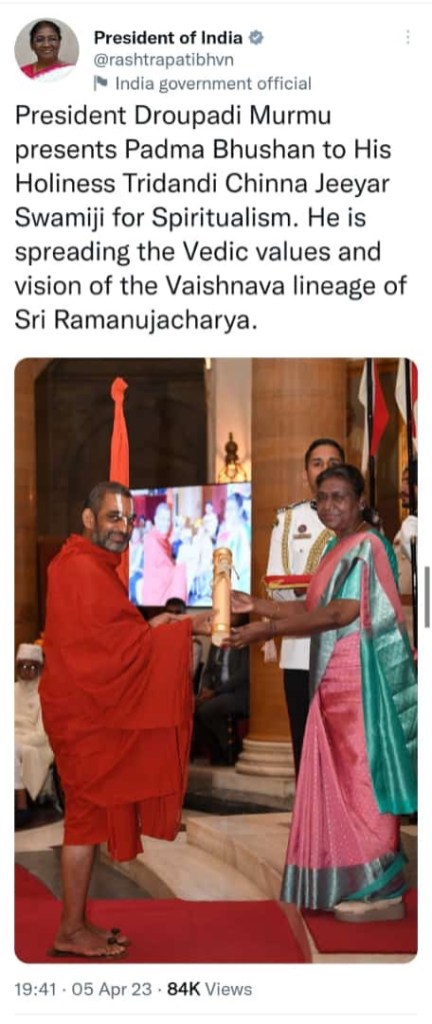
It is beyond doubt that HH Sri Chinna Jeeyar Swamiji has done so much work far and wide in the world to propagate Sanatana Dharma . None can ever grudge any accolade and gratitude he receives from millions of ordinary people and from his disciples in India for his work.
To some minds like mine, however, to see a Yathi , a Hindu Vedic monk and Sannyaasi donning ochre robes and carrying the holy “tridanda” staff certainly does set him far apart from and high above the world of secular establishments such as the Government of India whose allegiance is to the Indian Constitution which we all know solemnly affirms Secularism as an ideal and upholds the peculiar often perverse Indian brand and version of it.
To see Chinna Jeeyar Swamiji swami, a Yathi receiving the Padma Bhushan , to whom awards and recognitions of the secular world should mean nothing at all really, yet proudly going forward to receive the Award from the President of India, the Head of a Secular State, seems rather incongruous, to say the least, and so much like a regrettable reversal of societal or conventional roles. What do I mean?
In Hindu religion and history, it was secular heads of state — maharajas, Chakravarthis, monarchs, noblemen and chieftains — who used to seek blessings, recognition and accolades from Rajagurus …. Not the other way around .
The Royal sceptre could not be seen to be carried by kings into the presence of the Sannyaasi’s tridanda or ekadanda. The Church could never be seen to bow to the Crown. It was always the other way around —- the king would approach the Rajaguru or Acharya without any royal paraphernalia, seat himself at least a few notches below the Peetam of the RajaGuru in an open exhibition of humility, subordination and homage due to the power that spirituality held over secularity.
Now, in the photo-image above, everything that I see is the very reverse of age-old Vedic civilisational convention or tradition. It doesn’t quite seem to me at least as being Yathi Dharma.
I am reminded here of a great Vedic scholar of yesteryears who lived in TamilNadu many years ago and passed away in the year 1988. His name was Sri Devanatha Thaathacharya Swami who lived in a tiny hamlet called Navalpakkam. He was an outstanding Vedic Sri Vaishnava pundit who throughout his lifetime showed exceptional adherence to the strict Vedic way of life.
The most venerable,
the late Sriman Navalpakkam Devanatha Tatachari lived in this village. He was a veritable giant amongst Vedic
scholars of recent times. He was a "nitya-agnihotri". All his life he was
known to have hardly stepped out of Navalpakkam. His farthest trip was to
Kanchipuram to attend "brahmOtsavam" of Varadar temple. He spent the rest of
his life in Navalpakkam in strict observance of all Vedic precepts and
ideals. When it was announced that he was the recipient of the President of
India Sansrit Award, he politely asked that if he must receive it at all
then it better be handed to him at Navalpakkam itself. For he had no plans
to go to the Rashtrapati Bhavan to collect a mere award!
Eventually, the President’s Award was dispatched to the Collector of the Kanchipuram District who then hastened with it to the village of Navalpakkam and dutifully — with minimum fuss , pomp and ceremony — conferred the national Award on the Thathaacharya.
Sri Devanathacharya was a “gruhastha” … i.e. one who belonged to the “householder” “ashrama” in the 4-fold “ashrama dharmic” order laid down in the Vedic sastra … (brahmacharya, gruhastha, vaanaprastha and sannyaasa). From a “Dhaarmic sookshma” standpoint , there was no bar at all whatsoever on him to be able to travel anywhere in the country and to receive awards, recognitions or accolades from any institution , government or private, religious or secular. Yet he chose not to swerve from his strict, inflexible resolve to remain faithful to the Vedic ideal of going about quietly in life not only propagating but also exemplifying the Vedic Way (“veda maarga”) without bending or succumbing to the pulls, pressures or blandishments of the secular world.
One therefore cannot for a moment help wondering to oneself why it should be so very difficult today for our Sannyaasis or Yathis, gurus and Acharyas, to demonstrate the same steely, uncompromising resolve which an ordinary Vedic grushastha, not very long ago in our own times, had shown in such exemplary and remarkable fashion.
Given all the above facts and circumstances, I would earnestly urge the Government of India not to embarrass henceforth our Vedic Acharyas and Gurus by offering them national awards and accolades under its auspices. Please let the Government maintain its Secular credentials and let our Vedic Acharyas maintain their credentials as true proponents of Sanatana Dharma.
Sudarshan Madabushi
PS: I wish to report erratum : I’m told that Sri Devanatha Thatacharya was not performing “nithya agnihotram” but “Nithya aupaasanam” rite at home. Please pardon my error .
Sri NavalpAkkam Ayyaa Swamy doing nithy aoupasanam this is smarthakarma agnihotram is srouthakarma
Sir … I have inserted the correction to this as a Post Script in my blogpost . Pls see . Thank you