— M.K.Sudarshan
Part 1 of 4
You can infer much about a Religion from the many ways it communicates with itself and the manner in which it addresses its audience.
In terms of sheer population, the world’s leading religions today are Islam (2.8 bn), Christianity (2.9 bn), Hinduism (1. 38 bn) and Buddhism (0.5 bn).
All these religions have communicated themselves throughout history through the medium of powerful Ideas conveyed to the masses and it was thus that they became the powerful worldwide creeds they have come to be today.
The question that one might hence ask is: In what modes and styles of persuasive communication did all these religions engage with their audiences to be able to win their hearts, minds… and heads?
********************
In Christianity, the main medium of communication is the Word of God spoken by the spirit of the Holy Ghost through His Son, Jesus of Nazareth. God’s Prophet Jesus spoke through Sermons. The sermons became Gospels. And the Gospels became the Scripture called the Book of the Bible which people across the Western world then embraced. Thus, one might say that it is the Sermon which is the principal means of communication of Christianity.
Jesus gathered together around him a band of faithful apostles and disciples and through the medium of Sermons communicated all the essential ideas and ideals of the Christian religion. It was through that famous Sermon on the Mount that Jesus taught his followers the Lord’s Prayer and also told them several parables. That Sermon also contained the Beatitudes and Jesus’ teachings about God’s laws, which he expected his followers to uphold.
The Sermon thus even today in Churches, Chapels and Minsters is the principal medium through which Christianity communicates both with itself and its laity.
***********
In Islam, the word of Allah was spoken through the medium of Ayat or verse of the Quran. These verses, that filled 114 large chapters in the Holy Book of Allah, were transmitted to his Prophet Mohammed of Mecca. The Prophet revealed the Quran to the masses through his own sermons or sayings (in Arabic known as “khutbah”) which were collectively known as Hadith. Thus, while the Quran itself is considered the Word of Allah given to Prophet Muhammad, it is the latter’s Hadith which is believed to be the actual words of Muhammad which today the Muslims of the world embrace as the Religion of Islam.
The Last Sermon Of Prophet Muhammad was delivered on the Ninth day of Dhul-Hijjah, 10 A.H. (623 CE) in the Uranah valley of Mount Arafat in Mecca. It was the occasion of annual rites of Haj. It is also known as the Farewell Pilgrimage. The Sermon reads like a charter for humanity at large to follow in all walks of life to maintain peace and order in any society. It is a sermon full of peace, blessings and mercy for all mankind of all times. It is a sermon which today reads in fact like a legal instrument … more of a manifesto of an international order than a discourse on universal spiritualism.
Thus, it may be said that it is the sayings or Sermons of Prophet Mohammed — the Hadith — through which Islam communicates both with itself and to its Believers (especially as seen in the Friday “juma” assembly) inside every mosque even today anywhere in the world.
***********
Communication of the Buddhist religion is a slightly more complex matter than that of Christianity or Islam for one main reason that this religion is fundamentally atheistic — i.e., there is really no idea of God Almighty or His Spoken Word which is to be disseminated to the masses for them to embrace and adhere to.
The only Word to be paid attention to in this religion is what came to be known as the Teachings of the Buddha . No texts were written by the Buddha. He taught but did not write down his teachings. His assistant and a disciple named Ananda, acted as a sort of scribe for the Buddha. He wrote down the Buddha’s sermonised teachings which were known as “sutta” (Pali) or “sutras” (Sanskrit) …. which collectively became the aphoristic teachings of the Buddha popularly called the Dhammapaada. And such Sermons of the Buddha were later handed down to generations of disciples and wise, liberated souls who were revered as Tathagathas (a name Buddha, in fact, first gave to himself).
For example: The first teachings of the Buddha were the Four Noble Truths: 1. Suffering (Dukka) exists. 2. There is a cause of suffering. 3. There is a way to freedom from suffering. 4. The Noble Eightfold Path is the way to freedom from suffering.
What was the 8-fold path?
The Fourth Noble truth charts the method for attaining the end of suffering, known as the Noble Eightfold Path. The steps of the Noble Eightfold Path are Right Understanding, Right Thought, Right Speech, Right Action, Right Livelihood, Right Effort, Right Mindfulness and Right Concentration. The idea of the Eightfold Path appears in what is regarded by all Buddhists as the “first sermon” of the Tathagata, Siddhartha Gautama, the Buddha, which he delivered after he attained spiritual enlightenment in the ancient city of Bodh Gaya, Bihar, India.
Hence, it may be said that, as in Christianity and Islam, the Buddhist religion too communicates with itself and with its vast following across many countries in Asia mostly if not only through the medium of the Sermon.
*************
Thus, out of the 4 major religions of the world today, three are seen to rely mainly on the form of communication known as The Sermon.
What is a Sermon? It is said that:
“Sermons address a scriptural, theological, or moral topic, usually expounding on a type of belief, law, or behaviour within both past and present contexts. Elements of the sermon often include exposition, exhortation, and practical application. The act of delivering a sermon is called preaching. A sermon is usually preached to a congregation in a place of worship, either from an elevated architectural feature, known as a pulpit or an ambo, or from behind a lectern.”
Thus, it is quite clear from all the aforesaid facts that all Communication in Christianity, Islam and Buddhism — in strictly technical terms of mass-media outreach — is a one-way system of traffic that delivers or conveys ideas, principles, tenets and morals from the one (i.e., the preacher) to the many (i.e., the congregation). Didactic teaching is a method that focuses on the teacher and the knowledge he imparts. It is essentially a prescriptive or didactic method of communicating wherein the enlightened one enlightens the unenlightened many.
Teachers or Prophets who use such didactics as their principal mode of communication plan their lessons carefully and structure the message of the information they seek to impart logically — very passionately too — to promote learning amongst their following. And on the other side, from a pupil’s perspective, it involves intense listening, intense reading and intensely taking down instructions handed down.
As against its Christian, Islamic and Buddhist counterparts in the rest of the world, now how does the religion of the Hindus communicate with itself and its faithful?
*****************
Part 2 of 4
The Sermon is not however the principal mode of Communication of the Hindu religion.
The one-to-many didactic style of communication that is so very characteristic of the other 3 major world religions is a remarkable rarity within the faith practiced and known as Sanatana Dharma in the Indian sub-continent.
In Hinduism the predominant style of imparting and disseminating spiritual knowledge is that of one-to-one personal interaction and mentoring. However, this is not to say that the tradition of Sermonizing is totally absent in Hinduism… it is just that it happens to be only one, and certainly not a too very significant one, amongst several other modes of communication.
The varied ways in which the Hindu religion communicates are the following viz.:
(1) “upadesam”: This is the classic “one-to-one” format of communication between a guru or acharya and his sishya or disciple. The Sanskrit phrase “yatha upadesam” means:

In other words, it is through the medium of “upadesam” that spiritual instruction as per the sastra or scriptural authority was traditionally imparted to the disciple. It was mentoring within the structured ambit of an interpersonal relationship between Master and Disciple which was strictly one-on-one.
In all the scriptural annals and literature of the Hindu religion one cannot find an example of “upadesam” as perfect as the “Gitopadesam” — the Bhagavath-Gita. The loftiest lessons of Vedanta Philosophy were imparted by Sri Krishna to his protege and dear friend, Arjuna, in an intimate one-on-one conversation in which the two of them engaged on the eve of the great battle of Kurukshetra. Krishna is often therefore referred to as “parama guru” and Arjuna as “parama-sishya”. Together they symbolize the iconic archetype of Nara-Naraayana that represents the intimate and eternal personal bonding between a guru and disciple.
Likewise, every practicing Hindu in India who as a boy has undergone the rite of passage called “upanayana“, will surely remember that it was in the intimate presence of his father that the sacred “Gaayatri mantra” was conveyed to him through the medium of spiritual communication known as “brahmopadesam“.
The greatest spiritual leaders in the Hindu religion were known by the “upadesam” which they gave, one-on-one, to many of their disciples. The founder of Advaita school of Vedanta Philosophy, Adi Sankara, his “upadesams” are compiled in a famous work (grantha) called “उपदेशसाहस्री, upadesa-saahasri”; the “upadesams” Sri Manavaala Mahamuni, a Sri Vaishnava preceptor and follower of Sri Ramanuja’s Visishstadvaita school of Vedanta, his upadesams are found versified in a Tamil work called “upadesa-rathnamaala”; and in modern times the intimate “upadesams” that the mystic saint of Tiruvannaamalai, Ramana Maharishi, gave to many of his disciples who flocked around him are compiled in a work called “upadeśa sāra”.
The “upadesam” thus is so fundamental to the spiritual traditions of the Hindu religion that no person pursuing a spiritual journey in life can claim any real progress unless he has, to begin with, received “mantropadesam” from a guru or acharya through an intimate rite of passage. In all cases a “sishya’s” acquires identity or credentials as a genuine spiritual aspirant only from a particular “acharya parampara” or traditional lineage … and such identity or credential is gained only through “upadesam” received from a guru of the same “parampara”.
***************
(2) “kaalapshepam”: This form of communication is in the format of “one-to-many” where the “many” does not signify any mass-audience but denotes only a very small, private group of disciples or seminarians (perhaps a dozen or little more) enrolling themselves as students of a spiritual guru or acharya. The Sanskrit word “kaalakshepa” has many fine shades of meaning:

The word “kaala” means in Sanskrit, Time. Out of the several meanings of the word “kaalapshepa” seen above, the one that best describes the particular mode of communication employed by a guru or acharya to engage with a small group of his disciples while training them in a course of spiritual education is: “allowing time to pass away“.
Kalakshepam literally means ‘passing time with stories’ from the itihaasa and puraana‘ such as the Ramayana, Mahabharatha, Srimadh Bhagavatha, Vishnu Purana, Siva Purana and a host of other mythological lore and legends that abound in the traditions of Hinduism. The guru will gather around him a handful of his chosen disciples in his ashram. The acolytes will undergo a full curriculum of spiritual instruction imparted by their guru over several years; and that would invariably include many days or evenings involving the leisurely “passing of time” while listening in rapt attention to the solo narration of mythological stories, and at times even acting out of the characters’ roles (‘katha kaalapshepam“) by their Master.
The medium of spiritual instruction called “kalapshepam” does indeed seem rather intriguing when it is understood in terms of the common parlance of “passing away time”. It seems rather odd to think of communication of spiritual knowledge as being laid-back, idle pastime of sorts engaged by Master and Disciple to fritter away time. But then “kalapshepam” as a medium of communication is actually a very ingenious method of spiritual instruction designed to subliminally seep non-verbalized lessons into the consciousness of the disciple without straining the intellectual faculties of his that may be already overstretched by the intense effort required of him to study other more cerebral branches of Vedic learning — such as metaphysics, dialectics, logic and grammar How the medium of “kalapshepam” goes to work subliminally upon the minds of a small group of sishyas of a guru has been very well explained by a scholar (Kambandasan, https://www.kinchit.org/dharma-sandeha/thread/why-kalakshepam-is-called-time-pass-when-actually-it-is-best/) in the following words:
“Nobody needs to put any effort to ‘pass Time’. Time is one thing that is steadily flowing; no one can accelerate or slow down Time. But how we perceive the passage of Time is relative. If we are engaged in something pleasurable, Time appears to pass very quickly; if we are engaged in something non-pleasurable, then Time appears to pass very slow and we need to somehow manage to ‘pass’ the time; here is ‘passing time’ means changing our mind’s absorption during that period”.
For the disciples of a guru in an ashram, engaged as they are in seeking spiritual knowledge and truth, there is awareness that passage of the allotted time during this life is a long, arduous and painful journey. Therefore, “kalapshepam” comes to their aid by enabling them to enjoy ‘Time pass’ – bymerely listening to their guru recount the long and expansive tales of the itihasas and puranaas. It thereby helps them to subliminally “soak in” many a spiritual insight or moral truth embedded in such “kaalashepam“.
The same scholar goes on to explain further:
“Kaalakshepam doesn’t get things done immediately and directly. The words, the puranic characters, the dramatic situations, the music etc. have to slowly sink into the consciousness, and in time purify it, enlighten it, activate dormant areas of the disciples’ persona and then become an intrinsic part of their nature, all of which takes time for most spiritual aspirants. But since one doesn’t engage in bad thoughts, words and actions while undergoing kaalakshepam, at least time passes by without sin while the guru gets to accomplish what he sets out to do viz. to awaken the spiritual being within the sishya.
“When one form of enjoyment reaches saturation and frustration (or spiritual ennui) sets in, the disciples need next something different; so, to overcome such boredom the guru engages his group of sishya-s in a variety of ‘Time pass’ activities’ — i.e., more puranic fables and different narratives — until the new activity reaches saturation-frustration stage, and then the disciples themselves look for a newer ‘time-pass’ activity”.
*****************
(3) “upannyaasam”: Much like the “kalapshepam” mode explained above, this form of communication in the Hindu religion too is in the format of “one-to-many” … But where it differs fundamentally from “kaalapshepam” is that the “many” (in the “one-to-many”) does denotes a large impersonal mass-audience.
The guru or acharya addresses here not a small group of acolytes chosen and known to him intimately but speaks instead to a large assembly of people gathered at a forum to listen to him deliver a lecture or an exposition of a religious subject or theme.
In the “kalapshepam” mode the goal of the guru in communicating is to share Meaning and bring about personal transformation in the sishya. In “upannyaasam” mode, the communication goal of the guru in addressing the large audience is mainly to provide elucidation, expatiation and edification for the benefit of members in the audience who may be able to appreciate the subject or theme of the lecture. The guru or Acharya in other words takes no responsibility for the personal transformation of any member of the assembly. If transformation does happen at all, it is either happenstance or caused by divine grace.
The word “upannyaasam” in Sanskrit has several connotations depending upon semantic context. For us to be able to understand what has been stated above, it would be useful to refer to the several meanings of the term in translation:

In discerning the difference between “kaalapshepam” and “upannyaasam“, the relevant translations in English of the term which are most helpful in understanding what exactly this mode of spiritual communication in Hinduism aims at are: “speaking of…”, “lecturer”, “reference”, “proof”, “reason”, “pretext”, “bringing forward” and “placing near to”.
***************
(4) “samvaadam”: This is another mode of “one-to-one” communication widely used by the Hindu religion. In the annals of Vedic and Vedantic scripture, it is found in fact to be used as often as “upadesam“.
“Vaadam” in Sanskrit means “debate” or “dialogue” and the prefix “sam” denotes “civil and civilized debate” leading finally to clear conclusions of mutual acceptability, concurrence or assent. The debate itself is vigorous and intellectually ebullient but the dynamics of the one-to-one communication between two proponents never descends to the level of acrimony or any sort of ill-will.

It is through the medium of “samvaadam” that the greatest truths of philosophy, metaphysics, human ethics, eternal values of Sanatana Dharma have been communicated through the ages to its faithful adherents.
The one-to-one dialogues found in the literature of the Vedantic Upanishads are so many indeed… and the three most illustrative of them all are the famous ones held between (a) Nachiketas and Yama, the god of Death, in the Kathopanishad, (b) the debate in the Chandogya Upanishad between Svetaketu and his father, Uddalaka and (c) the brilliant dialogue between Brighu and his father, Varuna, in the Taitireeya Upanishad.
The bulk of all the philosophical treatises, exegeses and discourse found in the Hindu religion are indeed in the form of “one-on-one “samvaada”” only. All the three major schools of Vedantic philosophy in the Hindu tradition viz. Advaita of Adi Sankara, Dvaita of Madhwacharya and Visishtadvaita of Ramanujacharya all got propagated, throughout the march of history, only through the medium of communication called “samvaadam“.
***************
(5) “sambhaashanam”: This mode of communication is in the one-to-many format wherein the guru delivers homilies which do not quite fit the definition of a typical sermon but are more in the nature of a benedictory address to a gathering of disciples, larger in size than a group attending a kaalapshepam but much smaller than the assembly attending an upannyaasam.
A “sambhaashanam” usually takes the form of a short and crisp religious discourse that is intended primarily for spiritual edification rather than doctrinal instruction.
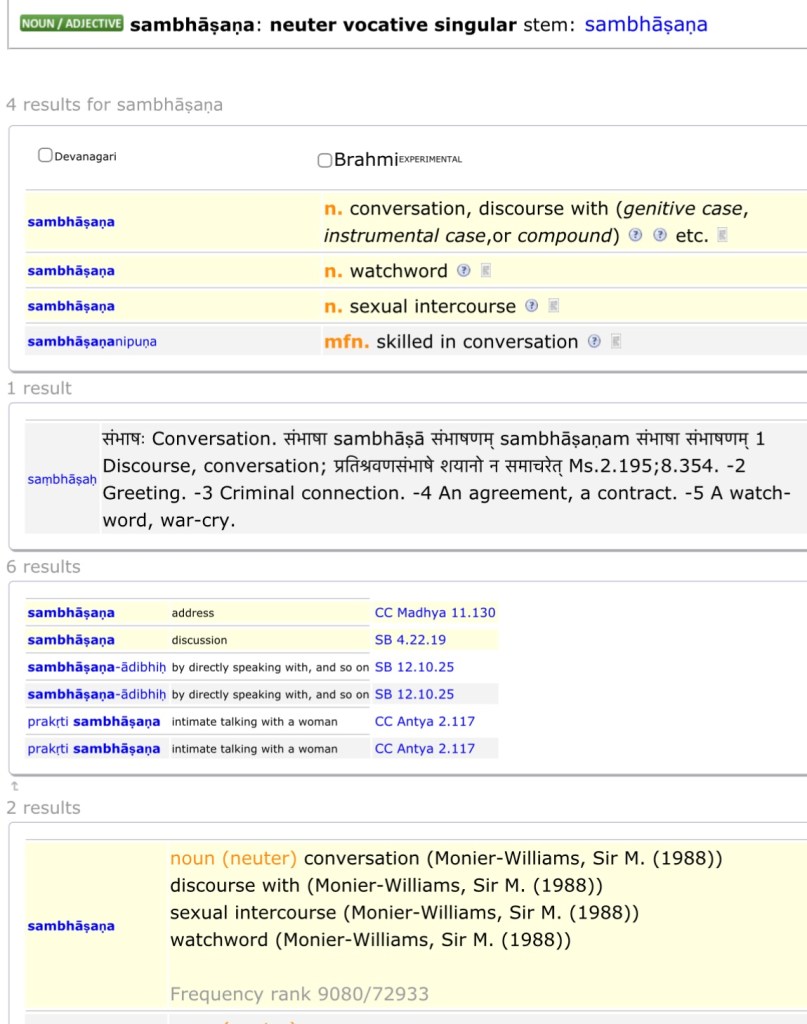
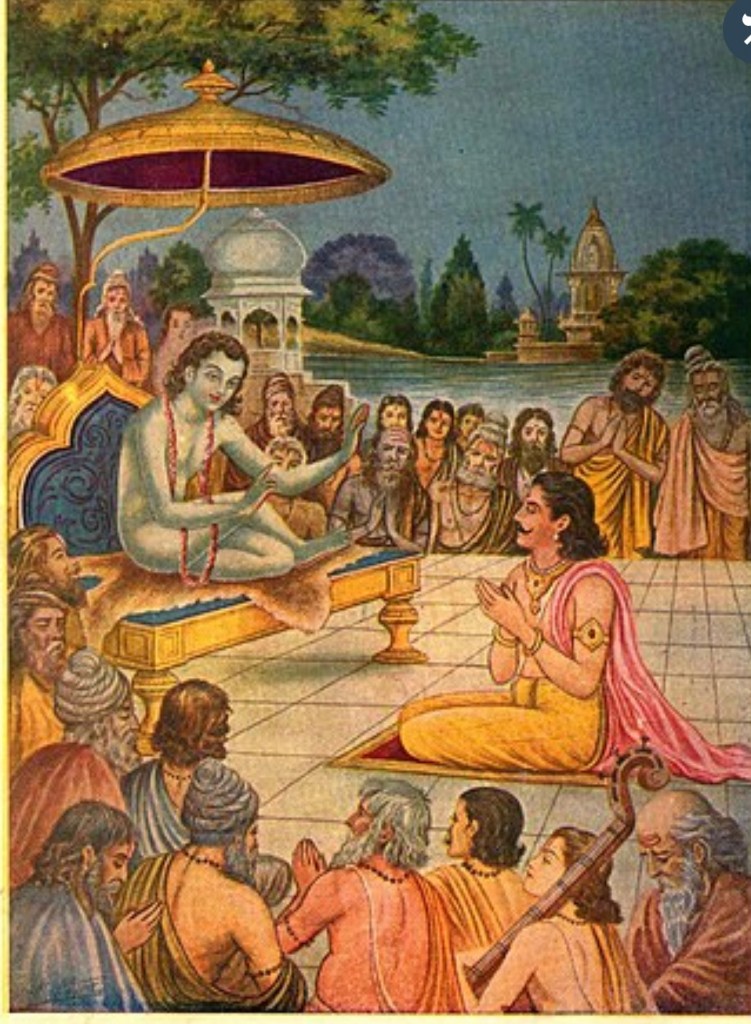
A sambhaashanam can also however be in the format of “two-to-many” communication and many a puraana in the Hindu scriptures, in fact, is a vivid example of it.
In this variant of “sambhaashanam“, two persons are engaged deeply in conversation with each other; they speak on subjects or themes of spiritual education or else simply recount a morality-tale or a mythological story underscoring such a theme. While the long and prolix conversations take place between the two persons engaged in conversation, there are several other persons who are gathered around them listening in, absorbing and assimilating the profound lessons and spiritual wisdom contained in them.
The most popular and typical example of “two-to-many” form of communication in “sambhaashanam” is the Srimadh Bhaagavatham authored by Sage Veda Vyaasa. The text consists twelve books (skandhas) totalling 332 chapters (adhyayas) and 18,000 verses. The tenth book (dasamaskandha), with about 4,000 verses, is the most popular and widely discoursed upon throughout the ages in India. The whole of the Bhaagavatham is but a faithful transcript of the extraordinarily long but then extraordinarily illuminating conversations between two individuals King Parikshith and Rishi Sukha-Brahma on a mind-boggling array of topics covering cosmology, astronomy, genealogy, geography, legends about the avatar of Krishna and his exploits as a youth, music, dance, yoga, ethics, bhakthi and culture!
The unique character of the Srimadh Bhaagavatha puraana being a massive compendium of spiritual “sambhaashanam” has been well explained in a scholarly quotation below:
Parikshith the King and Suka the Sage carry on their “sambhaashanam” while seated in the sylvan, silent and picturesque forests of Naimishaaranya (now in Uttar Pradesh in India) but many other small communities of rishis, sages, seekers of spiritual enlightenment inhabiting the same forestlands, as well as bhakthi-practitioners, assemble too around the two of them to listen intently to the conversations and to imbibe from them lofty lessons of spiritual wisdom and truth. It is thus only two persons who are engaged in deep conversation but then it is the many gathered around the two who can and do receive spiritual instruction.
“We have alluded to the Bhagavata’s identity as a Purana, an important feature of which is its multilevel dialogical structure… the layered arrangement of dialogues, in which a speaker (typically Suka, the main reciter, addressing his interlocutor, King Pariksit) quotes an “earlier” speaker (for example, Narada, addressing King Yudhisthira, Pariksit’s granduncle, in a dialogue understood to have taken place earlier and elsewhere), who may in turn quote yet another speaker. Two or three such layers are typically operative simultaneously… the compounding of voices serves to strengthen the message delivered; and second, one is left with the sense that one cannot, and indeed need not, trace out the origin of the message.
— Ravi M. Gupta and Kenneth R. Valpey, The Bhāgavata Purāna: Selected Readings
*****************
(5) “aakhyaanam”: This is one more mode of “one-to-many” communication through which Hinduism speaks to itself and to its followers.
It is different from the other one-to-many forms of communications — viz. kalapshepam or upannyaasam — in that this happens to be no more than story-telling — plain and simple — that seeks however to accomplish the most complex goals of real and effective communication.

Hinduism’s oldest mass-communication medium is that which involves narration of stories in the village-square or town-hall or under the open sky beneath a banyan or peepul tree in the vast rural landscapes of the country.
A village-elder or wiseman, an expert in the art of story-telling, will sit and regale his audience with narrations from the itihaasa and puraana as well as many other local folklore and legends. But unlike as in “kaalapshepam” or “upannyaasam“, there is no element of sermonizing or didactics in this form of one-to-many “Akhyaana” communication. It is plain story-telling and one can compare its methods, contents, its purpose and styles to the modern tool of education via “class-room case-study” where a teacher deftly guides students toward discovery and learning on multiple levels “through their own self-observation and reflection.”
The case-studies are either real or invented stories that include “an educational message” or they recount events, problems, dilemmas, theoretical or conceptual issue that requires analysis and/or decision-making.
This medium of communication used as “Akhyaana” in the Hindu religion, much like “case-based teaching does, simulates real world situations and asks students or the audience to actively grapple with complex problems. Dependent on the goal they are meant to fulfil, the cases under study can be fact-driven and deductive where there is a correct answer, or they can be context driven where multiple solutions are possible”.
The reason why “Akhyaana” is used in the Hindu religions as a means of communication is the same as the one why the “case-study” method is used to impart instruction in various educational fields such as in Law, Business Administration, Medicine etc. It is well known that in any discipline of study, there are some lessons which are far more effectively taught only through case-study method rather than through other formal or standard courses of study such as class-room lectures, seminars, group-discussions, symposium etc.
In modern conceptual Communications Theory, communication is defined to be as follows: https://open.lib.umn.edu/businesscommunication/chapter/1-2-what-is-communication/:
“The root of the word “communication” in Latin is “communicare”, which means “to share”, or “to make common”. Communication is defined as the process of understanding and sharing meaning.
“At the centre of (any) study of communication is the relationship that involves interaction between participants…. the emphasis (of this definition) is therefore on the process…. of coming to understand and share another’s point of view effectively.
“The first key word in this definition is process.
“The second key word is understanding: “To understand is to perceive, to interpret, and to relate our perception and interpretation to what we already know.”
“Next comes the word sharing. …. In communication, sharing occurs when you convey thoughts, feelings, ideas, or insights to others. You can also share with yourself (a process called intrapersonal communication) when you bring ideas to consciousness, ponder how you feel about something, or figure out the solution to a problem and have a classic “Aha!” moment when something becomes clear.
“Finally, meaning is what we share through communication. … By looking at the context the words used in (a story, narrative or a case-study) and by asking questions, we can discover the shared meaning of the word and understand the message.
The Hindu religion is replete with several sterling examples of such “Akhyaana” mode of communication. They are commonly referred to as “upaakhyaana“, a popular and notable few of which are:
(a) Kuchelopakhyanam, the story of Kuchela and Krishna (Bhaagavatha puraana),
(b) Lalitopakhyaanam (of the Bhramaanda puraana),
(c) Jadabharatha upaakhyaanam,
(d) Ajamila upakhyaanam, of the Mahabharatha and many more.
****************
IN and through the many different and complex ways in which Hinduism communicates with itself and its followers, it set itself uniquely apart from all other major religions of the world i.e., Christianity, Islam and Buddhism, all of which as explained above, rely almost solely upon one medium, the Sermon. However, what the one-to-many mode of communication of Sermon is to the other three principal religions of the world, one can without hesitation say that “upadesam“, the one-to-one mode, is to the Hindu religion.
Now, what could be the probable reasons for such a unique difference?
The answer lies in both historical circumstance as well as, perhaps, an element of psychology too.
**************
Part 3 of 4
It would be facile — and a tad facetious too, in fact — to start attributing commonplace reasons for why ancient thinkers and wise preceptors of the Hindu religion chose the “one-to-one” mode of “upadesam” and not the “one-to-many” mode of the Sermon as principal means of communication.
One could, for example, flippantly remark that most Sermons do get tiresome over time due to repetition. They often result in audience boredom or fatigue and result in diminishing effectiveness of communication. In fact, that is the reason why the word “sermonizing” in the modern context is sometimes used a tad derogatively.
Whereas, on the other hand, and as experience bears it out, upadesam, kaalapshepam, sambhaasahanam, samvadam and the many story-telling techniques of ‘upaakhyaanam” taken altogether, form a rich and variegated bouquet of communication tools. If employed imaginatively, they can ensure religious messaging does not become stale catechism or rigid indoctrination. The bouquet of messaging modes remains fresh … to continue resonating with religious-minded Hindu audiences, strongly and intimately.
However, such facile reasoning does not tell the full story about the relative merits of the Sermon versus Upadesam modes and to appreciate which one must look to History and to Psychology.
****************
The history of Christianity, Islam and Buddhism respectively reveals clearly that the religion Jesus Christ, Prophet Mohamed and Gautama Siddhartha, each founded in their lifetime respectively, was born and steeped in the Politics and political conflicts of their times. In contrast, the roots of the Hindu religion were almost totally apolitical and principally inspired by human spiritual aspirations.
Prof. Marcus J. Borg (1942-2015) , Hundere Professor of Religion and Culture Emeritus at Oregon State University, past president of the Anglican Association of Biblical Scholars, and author of twenty books has written this below in his essay https://www.bibleodyssey.org/people/related-articles/jesus-and-politics/
QUOTE: “Politics are at the centre of the story of Jesus. His historical life ended with a political execution. Crucifixion was used by Rome for those who systematically rejected imperial authority, including chronically defiant slaves and subversives who were attracting a following.
“…. So also, the heart of his message was political: it was about the coming of “the kingdom of God.” These are the first words of Jesus in Mark, the earliest Gospel, an advance summary of what the Gospel and the story of Jesus are about (Mark 1:14-15).
“In his world, “kingdom” language was political. Jesus’ hearers knew about other kingdoms—the kingdom of Herod and the kingdom of Rome (as Rome referred to itself in eastern parts of the empire). The kingdom of God had to be something different from those kingdoms…
“If Jesus had wanted to avoid the political meaning of kingdom language, he could have spoken of the “family” of God, or the “community” of God, or the “people” of God. But he didn’t: he spoke of the kingdom of God. …. It would be a world of economic justice in which everybody had the material basics of existence. And it would be a world of peace and nonviolence. Together, economic justice and peace are “the dream of God”— God’s passion for a transformed world. UNQUOTE
The historical circumstances under which Islam emerged first in Arabia too were wholly riven by political conflict and fraught with social turmoil. The Prophet Mohamed’s religion was essentially a socio-political mass-movement in Medina and Mecca. Many scholars, both religious and political scientists, have clearly explained the origins of Islamic religion to have been rooted in political conflict https://en.wikipedia.org/wiki/Political_aspects_of_Islam:
QUOTE: “Political aspects of Islam are derived from the Quran, ḥadīth literature, and sunnah (accounts of the sayings and living habits attributed to the Islamic Prophet Muhammad during his lifetime), the history of Islam, and elements of political movements outside Islam. Traditional political concepts in Islam include leadership by elected or selected successors to Muhammad, known as Caliphs in Sunnī Islam and Imams in Shīʿa Islam; the importance of following the Islamic law (sharīʿa); the duty of rulers to seek consultation (shūrā) from their subjects; and the importance of rebuking unjust rulers.
The origins of Islam as a religious and political movement are to be found in the life and times of the Islamic Prophet Muhammad and his successors. In 622 CE, in recognition of his claims to prophethood, Muhammad was invited to rule the city of Medina. At the time the local Arab tribes of Aus and Khazraj dominated the town, and were in constant conflict. Medinanians considered Muhammad as an impartial outsider who could resolve the conflict. Muhammad and his followers thus moved to Medina, where Muhammad drafted the Constitution of Medina. The laws Muhammad established during his rule, based on the Quran and his own doing, are considered by Muslims to be sharīʿa or Islamic law, which Islamic movements seek to re-establish in the present day. Muhammad gained a widespread following and an army, and his rule expanded first to the city of Mecca and then spread across the Arabian Peninsula through a combination of diplomacy and military conquests. UNQUOTE
Although it might appear to a student of comparative world religions that the origins of the Buddhist religion were apolitical and quite unlike Christianity and Islam, modern historians, religious scholars and researchers have widely dissonant views on the matter.
An historian, Mathew J. Moore in his 2018 work “Buddhism and Politics” https://www.oxfordbibliographies.com/display/document/obo-9780195393521/obo-9780195393521-0251.xml has referred to the political origins of Buddhism at its inception as follows:
QUOTE: Politics has always been part of Buddhism. The earliest Buddhists texts, the Tipiṭaka, contain numerous references to and discussions of kings, princes, wars, and policies. Later Buddhist texts, up to the present day, likewise contain advice to rulers about how to govern well, warnings about the dire consequences of ruling poorly, and admonitions to avoid arrogance and ignoring the needs of the common people. In the realm of political practice, since the time of the historical Buddha, Siddhattha Gotama (Sanskrit, Siddhārtha Gautama), Buddhism has both influenced governments and been identified by governments as a source of their authority and legitimacy. Buddhist monarchs have ruled Buddhist-majority realms across Southeast and East Asia at various times over the past two thousand years, and even today many nations in Asia understand their governments to have a duty to rule in a way that is consistent with Buddhist values. In many other Asian nations, Buddhism is an important ethical and religious tradition, even if it is not explicitly incorporated into the political system. UNQUOTE
Another Buddhist source https://studybuddhism.com/en/advanced-studies/history-culture/buddhism-in-india/buddha-and-the-political-events-of-his-times has this to say about the life of Gautama Buddha:
QUOTE: “…. the Pali literature of the Theravadins reveals a picture of the Buddha as a charismatic, almost tragic spiritual leader who struggled to establish and support his ever-growing community of disciples and followers under extremely difficult circumstances. He had to face political intrigues, several wars, the massacre of the people of his homeland, a personal denunciation before a government, a challenge of his leadership from among his disciples, the murder of one of his closest disciples, and, in the end, a death by poisoning. Yet, throughout all these ordeals, Buddha maintained peace of mind and did not get discouraged. Throughout the forty-six years during which he taught after achieving enlightenment, he remained steadfast in his commitment to show the world the way to liberation and enlightenment”. UNQUOTE
***************
From the facts of History stated in the foregoing passages, it becomes clear that Christianity, Islam and Buddhism were major religions of the world that were revolutionary in nature. They were mass-movements and hence the Religions themselves had to be ready and able to arouse rabble and address mass-audiences if they were to attract the fealty of the faithful. Fundamentally, these religions served as vehicles of great social movements. It should surprise therefore none that the mode of communication the founders of these three religions were convinced was the most effective to employ in their religious mission was the one-to-many medium of the Sermon.
**************
The ancient Hindu religion called Sanatana Dharma however was a singular exception.
It dated back to pre-historic times and it was founded by mystics and rishis, monks and spiritual-seekers who lived sequestered lives away from the communities of societies and the common weal. They in fact shunned constant contact with city, town or village dwellers. They lived deep in the forests, in small riverside retreats known as “ashramas” or high in the Himalayan or other mountain ranges. They wandered about the land in search of Truth and existential verities. They had very little to do with the din, bustle, conflicts, strife, frictions, pressures, fissures and factions of state politics. Their primary goal was to serve not the political aspirations of the masses but to cater to the spiritual yearnings of the individual. They had no need at all to address or message vast multitudes of people within societies that were mired in myriad problems of life all arising from communal, state, economic or political strife.
These rishis and mystics of ancient Hindu ancestry thus had no need or compulsion at all to communicate on, what one may call, mass-media “one-to-many” sermonic terms or formats. The simple and plain “one-to-one” mode of communication i.e., the format of person-to-person mentoring, the “upadesam“, worked just perfectly for them. Where “upadesam” did not however exactly suit their purpose, conditions or mission, the rishis and preceptors resorted to the more variegated modes of communicating with disciples and the laity viz.: “kaalapshepam”, “upannyaasam”, “sambhaashanam”, “samvaadam” and “Akhyaanam“.
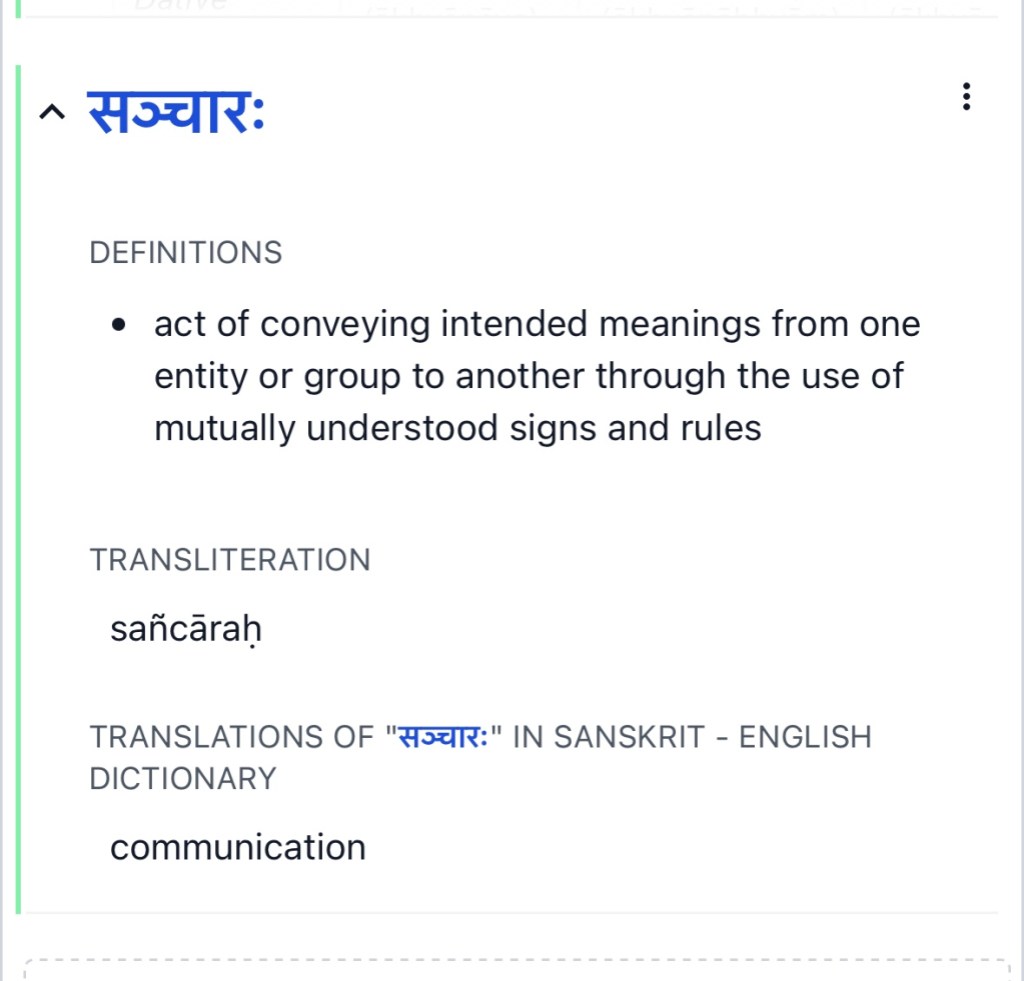
It is an interesting fact to note that these ancient Hindu preceptors — gurus, acharyas, siddhas, pontiffs — who wandered about in the land and delivered “upadesam“, “kaalapshepams” etc. were known as “sanchaaris” … i.e., wandering or travelling spiritual teachers. The Sanskrit word “sanchaari” is derived from the word “sanchaaram” which has many meanings but the main and most remarkable one happens to be, in fact, Communication!
****************
While History’s influenceupon the ways in which the 4 major religions of the world communicatedthemselveshas been very briefly explained above, there is yet another fascinating dimension to the Sermon Vs. Upadesamstory.A fewconcepts and elements of modern Psychology help in understanding it.
**************
Part 4 of 4
The Psychology underpinning the Sermon and the Upadesam modes of communication is very different and is to be understood in terms of the concept in modern Communications Theory known as Proxemics.
What is Proxemics? It is the study of physical distance and its influence on human interactions. The amount of space existing between people when communicating can reveal the nature of the relationship.
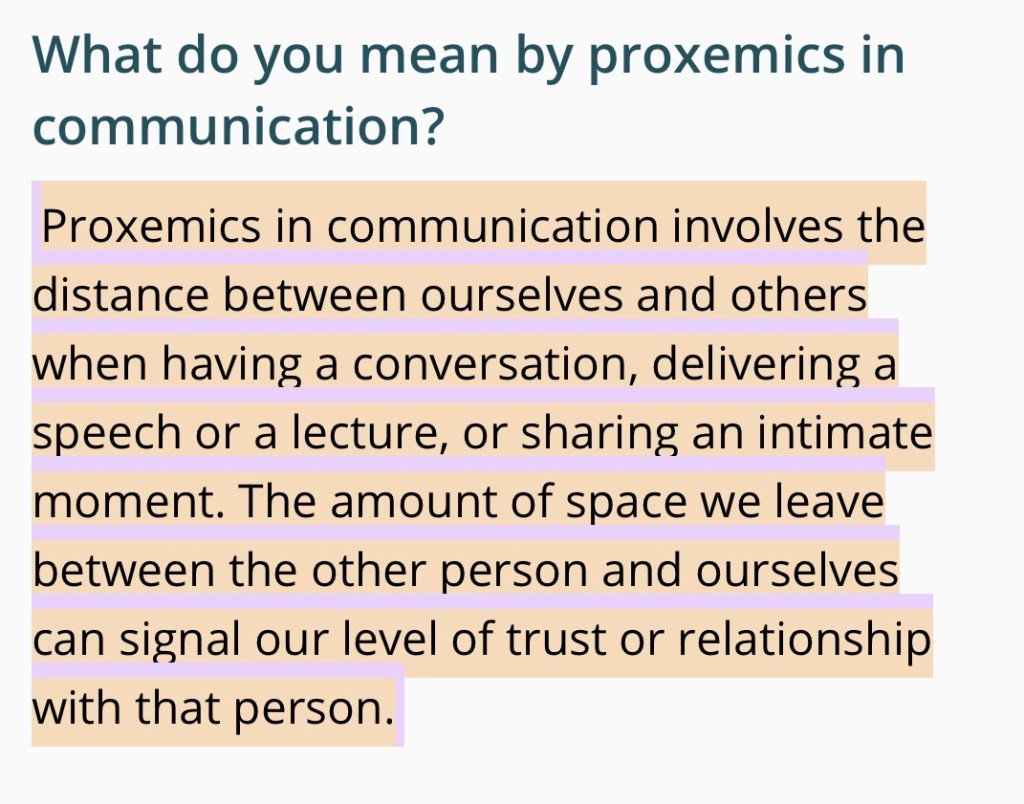
This term was coined by Edward Hall, who was an anthropologist at the University of Denver https://en.wikipedia.org/wiki/Edward_T._Hall. He was interested in understanding how humans place themselves in terms of space. He defined proxemics as “the spatial dimension of non-verbal behaviour.” Does physical space influence communication? Could it have an effect on meaning behind it? Is it capable of altering the nature of communication?
As subtle as it may seem, proxemics can influence communication to a great extent. It has great advantages and sometimes can also turn detrimental to the quality of communication.
“Humans tend to establish a clear boundary regarding the physical distance between them and other people. They base this tendency on the level of comfort and preferences. People may be close or distant from other individuals for various reasons.
Understanding proxemics can be beneficial during conversations as it gives us knowledge about the intent of the one talking to us. Different levels of distance can imply different messages. However, the amount of space given shouldn’t be the only aspect to be considered when trying to understand the intent of an individual. It should always be coupled with other non-verbal and verbal cues that seem to indicate a specific intention.
Humans tend to draw clear-cut boundaries about their space and who is let in. They classify people into different categories such as friends, family, intimate partners, acquaintances, strangers etc. and also determine the amount of space they would opt for each group.
For example, the kind of physical closeness they desire with their intimate partners might change when it comes to friends or acquaintances”.
******************
Conceptually, Prof. Hall established that the Space that separates “one-to-one”, “one-to-many” and “many-to-many” communication is different in length, content, quality and purpose and each is deliberately structured so for very different and specific purposes that may be desired. The concept was explained through the following simple diagram:

The concept then went on to explain the above as follows:
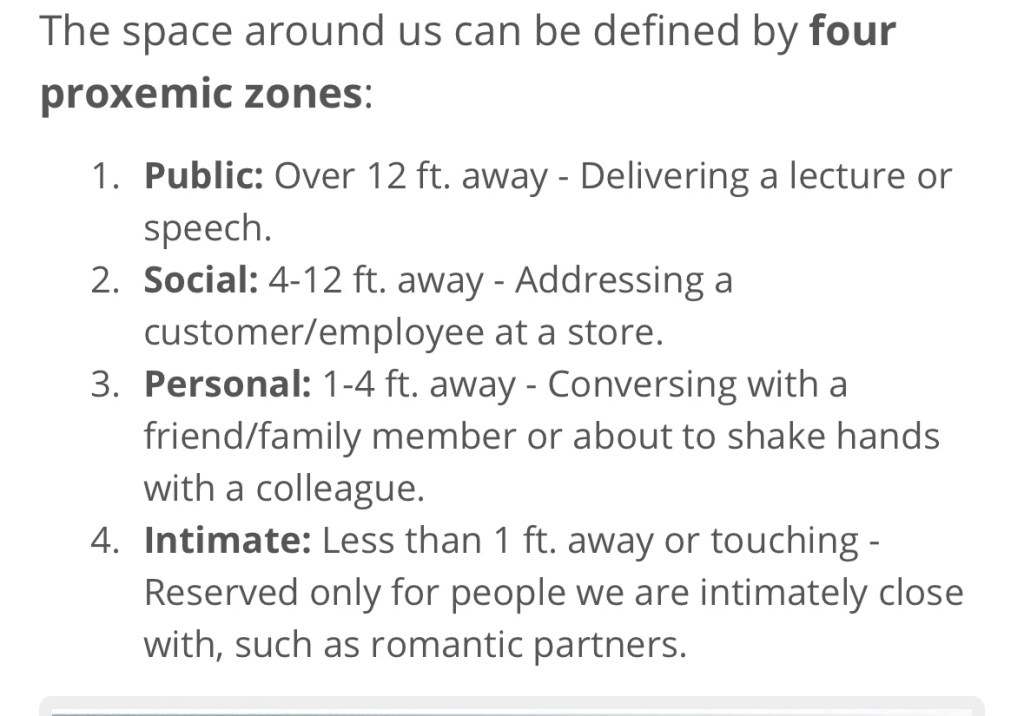
Public space
Public space is the least personal zones of all the other zones. It extends 12 feet from a person’s body. Such a zone is held mostly during a professional setting where a person has to address a group of people. They hold a distance of 12 feet between them and others. Celebrities and other high-profile also make sure to keep themselves from others at 12 feet for safety reasons and as a sign of power.
For example, when people give public speeches, they place themselves far from the audience especially to be visible and to address the entire crowd.
Social space
Social space extends from 4 to 12 feet away from a person’s body. This is not as impersonal as the public space and not as close as the personal space. This is the zone where normal social interactions between distant acquaintances and colleagues take place.
When someone is in a social space, one is not obligated to interact with them. However, as they approach closer it would be hard to ignore their presence and hence interactions would become necessary.
Intimate space
It is considered an intimate space when the extended space is 1.5 feet or lesser. This zone is usually reserved only for romantic/intimate partners, closest friends and family. Based on context, other people closing on our intimate space can be comforting, frightening or even annoying. People usually look for physical closeness with significant others as that can be more soothing than words on many occasions.
****************
Communication in all religions is not only about a prophet, a guru, preceptor or spiritual leader exercising influence over the minds and intellects of believers, followers and disciples. It is also about forging interpersonal relationships between Master and Acolyte based on delicate, mutually expected and reinforcing behavioural equations of trust and … yes… power too.
The greater the distance between the Teacher and the Disciple/s, the lesser the chance of bringing about spiritual transformation of individuals through intimate mentoring. But then there is under the same circumstances, a far greater probability of arousing mass-consciousness and of influencing and directing mass-behaviour towards fulfilling a larger, overarching political or social cause.
The above simple conceptual framework of Proxemics enables us to understand where exactly the medium of Sermon positions itselfas the principal mode of communication in Christianity and Islam, and thereby how the religion connects and communicates with its target-audience and what religious purpose is thereby served.
Both the religions, at their very core indeed, had (and do still have even today) deeply political ideas and message which had to be broadcast to the largest assemblies of masses in as short and momentous a time as possible to arouse them to action. It was through the power of words couched in soul-stirring Sermon that such powerful communication could achieve its primary purpose and goals. In the skilful hands of the prophets, powerful politics thus got transformed into powerful religion!
The Sermon clearly falls therefore under the category of Public and Social space in terms of the conceptual framework of Proxemics.
***************
Buddhism’s main modes of communication can likewise also be categorized in terms of Proxemics as falling broadly under the categories of Personal and Intimate space.
History tells us that Gautama Buddha too was not entirely apolitical and that his communication to his followers was also not entirely free from political or revolutionary fervour and purpose. However, the modes of communication he was seen to employ was not in the typically Christian or Islamic mould of one-to-many mass-communication whose width and range was broad-band and high-decibel. Many of the Buddha’s early teachings were more in the nature of closely-held “sambhaashanams” delivered privately to small groups of disciples rather than as Sermons from the top of pulpits on historic mounts.
**************
Within the conceptual framework of Proxemics, and going by what is available as evidence in ancient historical records about its earliest roots, Hinduism (sanatana dharma) for many millennials continued to remain almost totally apolitical. The religion’s primary focus was always on spiritual transformation of the individual rather than on catalysing any large-scale social revamp, revolution or political change.
One finds testimony for this exceptional fact by referring to many a famous one-on-one “upadesam” or private one-to-many “sambhaashanams” found in the Vedic scriptures known as the Upanishads — e.g., the SeekshaavaLi of the Taittireeya Upanishad or the passage in the Brihadaranyaka Upanishad “Da, Da, Da...”.
The mode of communication of the Hindu religion in ancient times was most certainly not the Sermon; it was the “upadesam“. Hence, if one were to know where exactly to position Hindu religion inside the three concentric circles of Proxemics shown in the concept-diagram above, it would have to be firmly occupying the centre most one… the space known as Intimate Space from where all true spiritual gurus mentor individual sishyas one-on-one.
*******************
Christianity and Islam when they were incepted by their great prophets in history, communicated the way they did because, fundamentally, they were political ideologies that were seeking to transmute themselves into religion. The Sermonic pulpit served them admirably to project themselves in the perception of the masses as new religion born for the times.
Today in India, there are unmistakable signs that Hinduism (including its dissident offshoot, Buddhism) — known under the recently coined pseudonym, “Hindutva” — is now a religion that is rapidly transmuting itself into political ideology.
The reasons for the new trend in the Hindu religion are many but the fact of the matter itself is beyond doubt. Anyone can see that a sea-change has come about in the ways in which Hinduism — creepingly but increasingly associated nowadays with Hindutva within the consciousness of many a young Hindu’s mind today — communicates with itself and seeks to communicate with its vast following of nearly a billion believers. What is that perceptible change?
There is today a raging proliferation of new-age Hindu gurus, acharyas and “prachaaraks“, and a host of Hindu religious institutions, ashrams, maths, gurkulam-s, paathashaala-s etc. spread and established wide all across the country. They are slowly discarding the old tradition of one-one-one traditional mode of communication, Upadesam. Instead, they are devoting most of their energies and resources to adopting and mastering the art of the Sermon, as the main mode of “sanchaaram“, and the main mode of communication of its major competitor- religions.
The “upadesam” is giving way to the Sermon. The Master-Disciple relationship – that staple of Hindu spiritual life for centuries past – has turned dysfunctional. Gurus no longer know the art of “upadesam”; sishyas no longer care to receive “upadesams”. The proxemic distance between Spiritual leaders and the Hindu following today is no longer “Intimate“; it now lies positioned squarely in the “Public” or “Social Space” within the conceptual grid of Proxemics. As Proxemic distance widens between mentor and disciple, the intimacy of upadesam wanes quickly. Where there is no intimacy, Trust is difficult. Today, in the Hindu religion, it is widely observed that there is steady and growing general breakdown in trust between gurus and sishyas.
The individual “one-to-one” traditional guru-sishya mentoring practices have simply fallen by the wayside and are fast vanishing to be replaced instead by mass-media religious communication. The sermons that Hindu religious leaders deliver these days in public forums are staged mass-events, conducted in giant-sized auditoriums and stadiums. These events are often given grand names such as “gnyaana yagnya“, “maha sadas“, festival of “katha-kalapshepams” and so on and so forth. The guru often gets elevated to “rock-star” status since, on stage, he is expected to deliver electrifying performances via long speeches, brilliant religious sermons or magnificent orations for the benefit of the thousands assembled and clamouring for such performances at religious mass-gatherings in cities and large towns all across the country. The modern Hindu guru’s eminence is no longer judged by the number of faithful few disciples that deserve to receive “mantropadesam” from him but by the length of the lists in the membership-registry of the ashram, math, gurukulam, paatashaala he presides over.
Once upon a time, the Upadesam served as principal means of communication between the guru or acharya diligently working upon a disciple’s spiritual transformation. On the other hand, the Sermon served as principal communication channel between prophets and their mass-following that awaited political and social transformation. The focus of upadesam and the Sermon was different: for the former the unit of humanity was the Individual while for the latter, it was Society.
From a study of the matter using concepts of Proxemics, one may conclude that the ways in which they communicated both with themselves and with their following, Christianity, Islam and Buddhism were essentially political tenets that strove to become Religions. And the unique historical exception that Hinduism had been once upon a time, today (in its latest avatar as Hindutva) seems to have set itself, however, upon an exactly reverse course: a religion seeking to become a political creed.
— END —