What I am going to write about in the ensuing 10- Part series of blogs on the subject is not a travelogue of a religious tourist or pilgrim. There are plenty and more of such write-ups on Kashi, Gaya, Prayag and Ayodhya that one can easily browse through on the internet. I have no intention of penning one more of such myriad commonplace diaries of personal pilgrimage. My main purpose in recording this long account of my travels north from Chennai to do a “teertha-yaathra” to the ancient holy “kshetra-s” of Kashi , Prayag, Gaya and Ayodhya is to provide some useful information and practical tips, hints, do’s-&-don’ts to any reader of my blogposts who is yet to visit any of those sacred spots and nurtures a deep desire to do so sometime in the future.
*****************
First things first: Budget for the pilgrimage to all 4 kshetras.
A pilgrimage covering all the 4 holy places will certainly demand a sizeable budget depending upon (a) Desired Time-schedule (b) Mode of travel and (c) Choice of living accommodation.
The entourage of my family comprised 6 members. None of us could afford to spend more than 10 days on the pilgrimage. And since we were nearly all senior citizens in our mid-60s we did not think it would be comfortable for us to travel on any other but the most comfortable modes. So, we flew by airplane to Varanasi from Chennai/Banglore; and then made Kashi our base-camp from where we travelled elsewhere to-and-fro by hired or rental car-service providers.
As far as living accommodation is concerned, my family and I chose not to stay in fancy 3, 4 or 5-star hotels or lodgings. We chose instead to put ourselves up in Kanchi Sankara Muttam-affiliated (1-room, common-shared bathroom, bed-breakfast-and-meal) residential quarters that had no more than the barest of conveniences.
There were other important reasons for the choice of our living accommodation away from the usual choices of comfortable star-hotels or sophisticated guest-inns.
Kasi was the base-camp for the pilgrimage from where we went also to Gaya, Prayag and Ayodhya. At Kasi my wife and I had to do the ritual snaanam before we could undergo the Maha-sankalpam and pitru Tarpanam rites at the 5 ghats — bathing stepways along the Ganges river flowing past Kashi city. There are 64 such ghats built on the banks of the river, each separated by a distance ranging anywhere between a few hundred yards to a couple of kilometres. The first of such ghat is named “Assi ghat” and the last one is called “Varuna ghat“. It was by concatenating the names of both the ghats that the city of Kashi got its other famous name, Vaaranaasi.
My wife and I had to perform the rites after snaanam in the Ganga on two different days at several ghats. (More will be explained about these rites in the ensuing Parts in this series of blogposts). These ghats like the Hanuman ghat and Manikarnika ghat along the Ganges are situated very far apart and can be reached only by boat sailing from one end to another along the river banks. Also, they are very far away from the city-centre where all the fancy hotels (like GRT and other fancy lodgings) are located.
When one goes to do the ritual of pitru-tarpanam at Kashi one has to necessarily wear the same wet-clothes which one has had the Ganga snaanam . So , my wife and I figured it was always better for the family to stay at an accommodation very close to the river ghats …
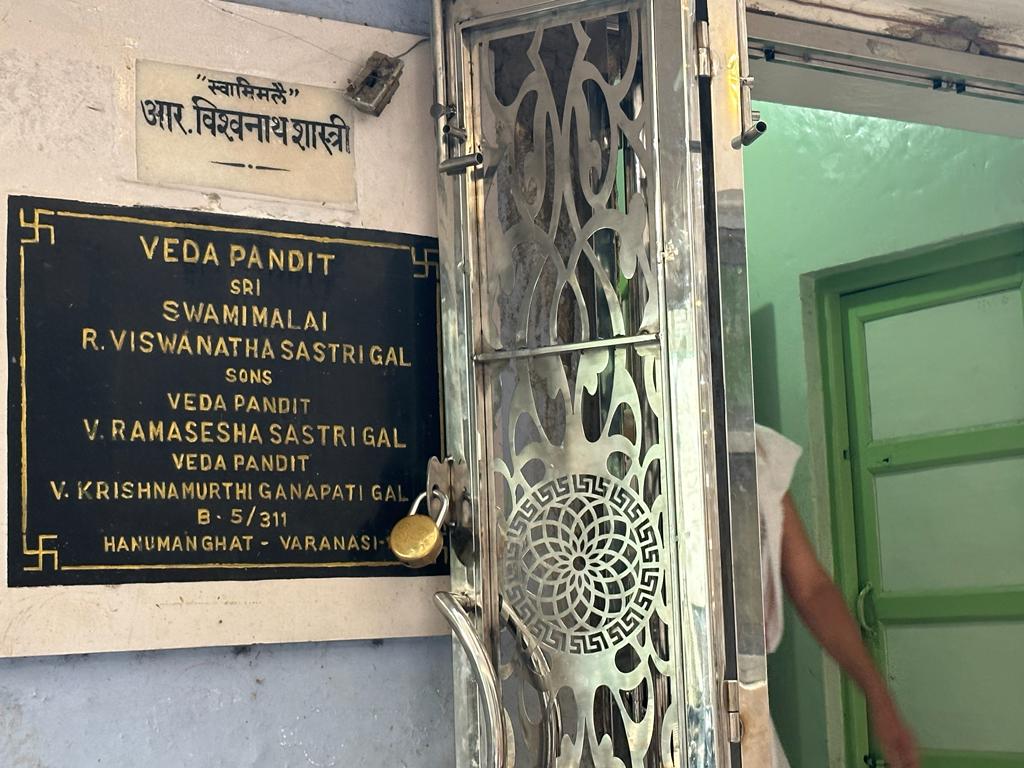
We chose a place to stay at a modest board-and-lodge rented quarters which was at a distance no more than a stone’s throw from the Sankara Muttam in Kasi near the Hanuman Ghat. The quarters were old and old-fashioned but they had been been well-refurbished too as they were home of a native family of 3rd-generation Tamil Smaartha Vedic brahmin priests and purohits who had immigrated to Varanasi from deep South India.
At this Tamil Smaartha home — an antiquated version of the modern “B&B” perhaps — we were all also assured that the food served us was prepared according to sastra imposed hygiene … something which I knew would most certrainly not have been made available at other modern hotels in Kashi where no one could really know who the chefs/waiters were or where they came from.
Since I was not bothered too much about creature comforts and knew that Kasi Tarpanam is meant to be a ceremony where one must observe a bit of both physical and mental austerity to please one’s pitrus , we all decided to take lodging in the house of the orthodox Tamil Ghanapaatin family who have lived there for 3 generations. I am glad I did . During the four days and nights we lived there, I truly felt I was living in a proper Vedic Agraharam throughout my pilgrimage . Six of us shared onkly one large room . All but two of us slept on the floor on a makeshift mattress. The Food we were served was inexpensive, simple but absolutely saattvic. And the Smaartha vaadhyaars there who officiated as the main priests who helped perform our “pithru tarpanam” and “Kashi shraadham” were experts and excellent indeed in the way they sincerely conducted the elaborate rituals, homam and ‘pinda pradaanam‘ routines.
The entire pilgrimage if undertaken under circumstances as explained above might cost anywhere in the range of Rs. 100,000/-. This includes cost of everything —- travel, boarding, lodging, conducting rituals, daanam or charity, temple Darshan , etc.

************************
In the olden days, spread across hundreds of centuries in the history of this nation called Bharath, or India, pilgrims from all over the country used to vow to visit Kashi, Prayag and Gaya at least once in a lifetime to offer libations and obsequies to the memory of the spirits of their respective “pitrus“, ancestors belonging to 64 past geneations in the family lineage, both paternal and maternal. Performing “shraadham” at these holy “teertha-sthalam” has always been ordained to be the prime and bounden duty of the eldest or only son in the family, who by performing the pilgrimage expressed gratitude to his long lineage of ancestors. Thereby the son spiritually washed off the taint and burden of “paapam” or Sin weighing heavily upon his soul.
In the olden days, this great and solemn individual pilgrimage used to be denoted by three picturesque phrases in Sanskrit: (a) “mundanam” (b) “dandanam” and (c) “pindanam“.
The son’s first stop on the pilgrimage used to be at the holy city of Prayag (ersthwile Allahabad) where at the confluence of 3 magnificent rivers, the Ganga, Yamuna and (subterranean) Saraswathi, he and his wife took a holy dip cermonially. Thereafter, the son must have his head ceremonially tonsured. (The ceremony will be described in a later blogpost in this series). This tonsuring of hair was called “Mundanam“.
After visiting Prayag, the son had to travel to Kashi (about 250 kms away by motor-car today but which in the olden days might have taken several days on foot or bullock cart!). At Kashi, son would have to visit the ancient temple on the banks of the Ganga and offer worship to the Deity in the Temple of Dandapaani (more about this in later instalments). At this temple in the sanctum, the son would receive a ceremonial whack delivered by the priest yeilding a small baton or ‘laathi” upon his back! The stick with which the priest of the Dandapaani Temple gives a stroke in mild beating on the son’s back is called “Dandam” … and the little rite itself is called “dandanam“! This rite symbolises the due punishment for “paapam” or sins of commission and omission that the son might have committed prior to his visit to Kashi and the absolution thereof.
From Kashi, the son then has to finally proceed to Gaya — a small town situated across the border of Uttar Pradesh and in the State of Bihar. At Gaya after a ritual bath in the cool waters in the River Phalguni ( a tributary of the Ganga), the son performs the formal funerary rituals for the “pitrus” and it is called “pinda pradaanam“. This elaborate and even poignant ritual involves conducting fire-homam, symbolic offering of steamed, puffed rice-balls and sacred water as oblation and libation to the spirits of 64 generations of one’s past ancestry as a mark of deep gratitude to them. The rice-balls are called in Sanskrit “pindam” and hence the whole sacerdotal procedure gets its name “pindanam“.
*********************
Our 10-day pilgrimage lasted from the eve of Deepavali on 10th November until 19th. The rest of my travelogue will in the following instalments will be written not in chronological, day-wise or daily-diary, journalized form and sequence. That, in my opinion, would be a quotidian, even rather hackneyed kind of presentation. Instead, I will proceed to describe the whole pilgrimage under the broad headings captioned as follows. However, I have taken the liberty of offering a slightly altered version of the traditional way in which the whole sacerdotal pilgrimage used to be described always in terms of “Mundanam“, “dandanam” and “pindanam“:
(1) “Snaanam“
(2) “Shraadham“
(3) “Darsanam“
(4) “Alinganam“
More in the next instalment of the blogposts, Part-2 of 5.
Sudarshan Madabushi
Very timely, since we have been planning to do something like this for our pitrus. Thank you for the post. Can’t wait for the other posts in this series.
Thank you 🙏 please watch this space for 4 more blogs to get posted over this and next week .