“Shraadham” at Kashi
The “pitru shraadham” rituals which I performed (along with my wife) at Kashi were over a period of 2 days. On the first day the ritual called “Maha Sankalpam” was conducted. It was followed by sailing the Ganga in a boat to the Manikarnika Ghat for “snaanam“.
On the second day, the ritual called “Panchaghatta Sraadham” was conducted followed by “brahmana bhojanam“ and “dampathi puja”.
Both the rituals were conducted at the home of our very hospitable “ghanapaatin” hosts. They themselves conducted the rites as “Brihaspati ” or officiating priests — Sri. Venkatramanan Ghanapadigal and his cousin-brothers Sri. Shankar Raman and Sri. Sivaraman.. .
The order in which the various rites on the first day were conducted, which as a matter of interest I learnt later, was as follows:
“Anugnai; Ganapathy and Visvekshena pooja; Poorvanga Sankalp; Navagraha preethi dhaanam; Nandhi Srardham; Punyaha vachanam; Godhaanam; Vaishnava srardham; Dhasa Dhanam; Pala Dhanam; kruchchara charanam; Maha Ashirvadham; Maha Sankalpam; Chakkra-kunda Theertha snanam; Manikarnika Theertha snanam; Manikarnika hiranya roopa theertha srardham (or) Annaroopa theertha srardham (with homam); Pinda dhanam; Thila tharpanam; kshetra pinda dhanam; Brahma yagnyam“
For me and my wife, the highlights of the above rites was the Mahasankalpam rite at the ghanpaatin’s home and the Manikarnika Theertha snaanam at the ghat.
The Mahasankalpam (that was followed by the othe rites listed above) also featured a very thrilling chanting of traditional Vedic “ghana paarayanam” by Sri. Venkatramanan Sastrigal. In his stentorian voice, he rendered the “ghanam” with flawless diction and aplomb. I later learnt that that he for several years since his boyhood in Kashi had been trained under his father, a Vedic practitioner of great repute in the holy city. As we listened to Sri Ramanan chant, I felt overwhelmed by the occasion.
Here below are a few videos of the Mahasankalpam ritual…. In the 4th below you can listen to the sonorous ghanam chanting:
Pancha Ghata theertha sraadham at kashi
After Mahasankalpam, we then set sail on a boat for a ride of about 30 minutes to the Mani Karnika Ghat.
In the tranquil, mid-morning hazy light of the day, the River Ganga was in full spate and flowed past us majestically… It was a breath-taking sight! It filled my spirit with a strange, almost eerie sense of calm, clarity and chastened humbleness…
Manikarna in Sanskrit means Ear Rings. The mythological story of this Ghat is this: Manikarnika Ghat is one of the oldest ghats in Varanasi. It is mentioned in a Gupta inscription of 5th century. It is revered in Hinduism. When Mata Sati (Adi Shakti) sacrificed her life and set her body ablaze after Raja Daksh Prajapati (one of the sons of Brahma) tried to humiliate Shiva in a Yagya practiced by Daksh, Shiva took her burning body to the Himalayas. On seeing the unending sorrow of Shiva, Vishnu sent the Divine chakra to cut the body into 51 parts, which then fell to earth. These are called “Ekyavan Shaktipeeth“. Shiva established Shakti Peeth wherever Sati’s body had fallen. Mata Sati’s ear ornament fell at Manikarnika Ghat.
Manikarnika Ghat is regarded thus as one of the holiest cremation grounds among the sacred riverfronts, located on the Ganges, in the city of Varanasi. In Hinduism, death is considered a gateway to another life marked by the result of one’s karma. It is believed that a human’s soul attains moksha, and hence breaks the cycle of rebirth when cremated here. A son who performs “pitru shraadham” for his manes at this Ghat eases the way for his ancestors’s souls to ascend into the state of moksha.
At the Manikarnika Ghat I performed the ritual “snaanam” and then performed the “maadhyanikam sandhyavandanam” too:

After the “snaanam” at Manikarnika Ghat, we returned to the home of the “ghanapaatins” wearing the same wet clothes to perform the other rituals that remained to be completed. In about an hour, the “Kshetra tarpanam and pindapradaanam” were all performed to “sampoorthi” under the expert guidance of our “bruhaspati“, Sri Shankar Raman sastrigal…
During and as part of the ceremony proceedings, when I did “abhivandanam” and uttered the litany of “abhivaadaye…. etc.”, Sri Shankar listened intently to my submission with a keen ear. When I had finished he smiled at me and politely told me that while my utterance of the “abhivandanam” was correct but it still needed a little fine refinement. He explained:
“You ended with the phrase — “Yajus shaakaa adhyaayee Sri Sudarshana sarma naama aham asmibho…” did you not? I am sure you know that Yajur Veda is a full-fledged in itself… It is not a “shaakai” which in Sanskrit means “branch” or offshoot. So, instead of saying “Yajus shaaka adhyaayee…” it is better to be correctly saying “Yajur Veda antargatha taitireeya shaaka adhyaayee Sri Sudarshana Sarma naama aham asmibho”. This will mean that I am a student or adhyaayee of the Taitireeya Branch found in the Yajur Veda.… All of us who belong to the Yajur Veda today are indeed of the Taitireeya Shaaka.”
I thanked Sri Shankar Raman sastrigal profusely for enlightening me in the correct usage of the Abhivandana litany.
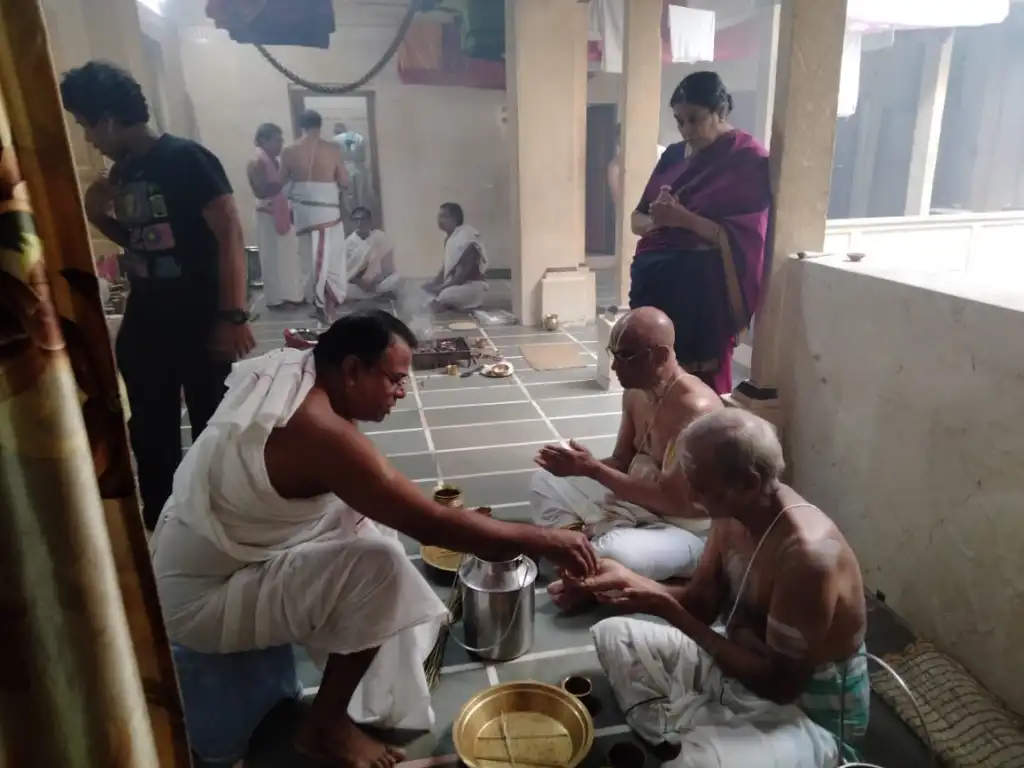

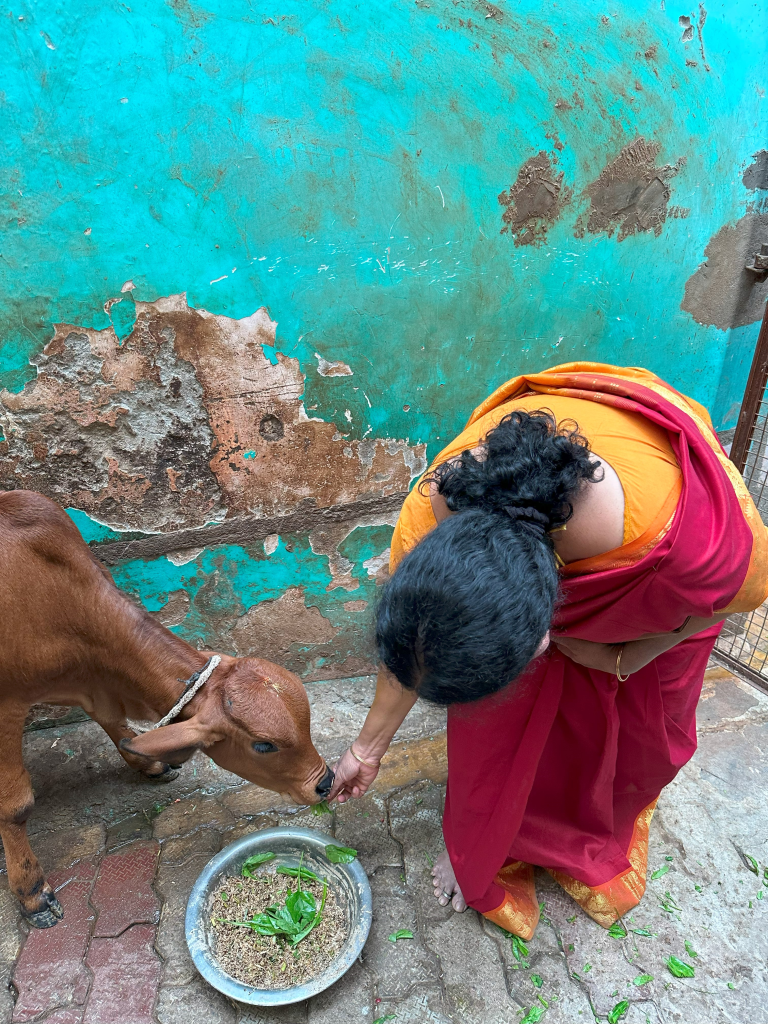
After the “sraadham” followed the “Godaanam” and “brahmana bhojanam”. We were so happy to see more than ten Kashi Brahmins grace the occasion and partake of the “bhojanam” and deign to receive our “dakshina” (gifts”).
********************
“Panchaghatta Shraadham” at Kashi
The following day, the “shraddham” and “pinda pradaanam” was performed by me along with my wife at the “pancha (5) ghats” of (1) Assi ghat, (2) Dhasasvamedha Ghat, (3) Varana Ghat, (4) Pancha Ganga Ghat, (5) Manikarnika Ghat.
We sailed forth once again early in the morning from Hanuman Ghat from where the boatman ferried across the River Ganga. It was a little over an hour and half ride.
We stopped at 5 most important Ghats alongside the Ganga where the rites were performed in order but with the last five of them at the home of the ghanapatins: Theertha srardham; Hiranya srardham; Pinda Dhanam; kshetra pinda dhanam; Thila Tharpanam; Brahma Yagnam; Ganga Mata pooja; Dampathi pooja; Dhasa Dhanam; Pancha dhanam.
All the above rites were officiated by a Vedic “purohit” who accompanied us on the boat. The deck of the boat itself served us a platform on which we performed the “tarpanam” and “pinda pradaanam”. The “theertham” we used in the proceedings were from the Ganga itself!
We performed 5 “tarpanam” and 5 “pinda pradaanam” rites at each of the 5 ghats after “snaamam” at three each of the 5 ghats. Surprisingly, although the weather was chilly in the November forenoon, I did not feel in the least discomfited. I felt invigorated in fact by the experience.

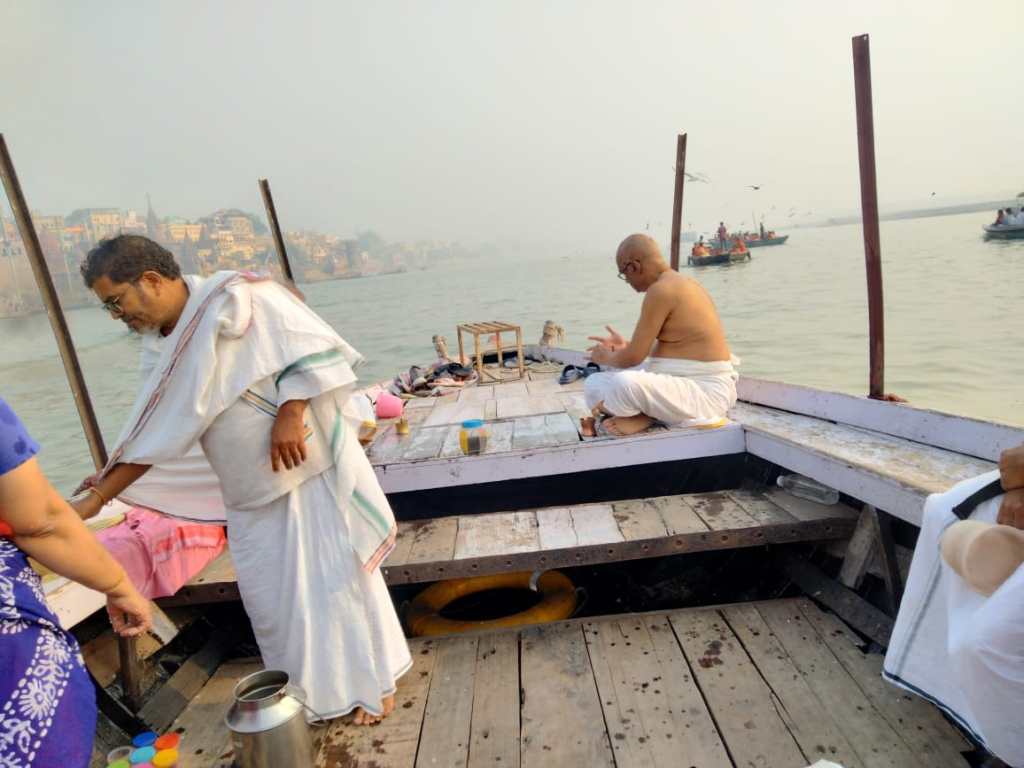
On the return journey back to Hanuman Ghat, and after the “panchaghatta shraadham” was completed, my wife and I performed the “Ganga Puja” on board. The ritual is truly a very moving experience in which through mantras is invoked the Mother who blesses this vast country of ours with her compassion, abundance of goodness, life-giving water, fecundity and felicity… and washes away, as well, all our impurities and all afflictions of body, mind and soul! In that moment I could instantly recall the verse of Maharishi Vyaasa who spoke thus:
“Sharire jarjari bhute vyadhi graste kalevare oushadham jaanhavi toyam vaidhyo naraayano Harihi“
” For the human body that is prone to afflictions, infirmities, sickness and old age it is the waters of Jaanhavai (maatha Ganga) that are the true medicine prescribed by the Supreme Doctor Srimann Narayana who is Hari!”
The brief ritual is only a little token of our gratitude to Mother Ganga, but its enormous significance was not lost on my wife and me. We both felt immensely humbled and utterly awestruck in the presence of this majestic mahaanadi of our land….
The finale for the day was the performance of the “Dampathi Puja“. This ritual marks the successful culmination of the shraadha at Kashi and is the precursor for the climactic Gaya Shraadham which would ensue the following day. We ended this rite in the most auspicious manner by reciting a few “paasurams” from “goda naachiyaar” Sri. Andal’s “Tiruppaavai“.
*******************
We were now ready and all set for the journey to Gaya — a 4 hour drive by road from Kashi. There we would perform the Shraadham the following day at the famous temple of Vishnu Paadam situated on the banks of the River Phalguni. About it and more in the next instalment of this blogpost series.
Sudarshan Madabushi
Great experience.God Bless.What a wonderful narration.
Thank you for the detailed information on all the rituals. Makes wonderful reading and the videos are excellent. Thank you for posting this series. Cannot wait for the final chapter of this saga. Once again, this is information that is very timely for us. We are planning something like this in the very near future, Lord Krishna willing.