Shut out from your mind all the din and noise of heated debates on the subject issue that is raging today in the media , press, TV and social media.
Turn away or turn blind to the unending stream of statements and commentaries emanating out now ad nauseam from politicians and social celebrities, many of whom have little acquaintance with Carnatic Music or its long traditions.
Let us all rasikas for a moment insulate ourselves far from the madding crowd, and try to sift the chaff from the grain in the matter of the case why TMK does not deserve the Sangitha Kalanidhi.
Let’s all forget Krishna’s enfant terrible public image; forget his well-publicised trespasses of the past; forget his anti-Brahmin tirades; forget his adulation of EV Ramaswamy Naicker; forget his tastes in lungi sartorial styles….
Let us focus solely on only two statements put out in the public by the President of the Madras Music Academy, N. Murali. They read as follows:
QUOTE:
“The choice of the Sangitha Kalanidhi made year after year is the prerogative of the Madras Music Academy and has always been made after careful deliberation, with the sole criterion being musical excellence demonstrated over a significant and sustained career”.
“He has been a top-ranking and extremely talented musician for a long time and truly deserves the award for his music. The Music Academy has thought it fit to confer on him the award on the basis of sheer excellence in music,”
UNQUOTE
If a true rasika of Carnatic Music — especially if he or she has a deep and fine appreciation of the music of Saint Thyagaraja — were to put to the test of scrutiny the above two statements of the Madras Music Academy, the conclusion would have to be that
(1) T M Krishna (TMK) fails the test and
(2) The Madras Music Academy (MMA) appears prima facie guilty of grievous misapplication of mind and gross failure to exercise proper judgement.
****************
Let us examine (2) above first.
The conclusion drawn is that MMA appears to be prima facie guilty as charged.
Why prima facie? Because “missapplication of mind” and “exercising flawed judgment” cannot be conclusively proven. Why? Because there is really no verifiable evidence immediately available to support such a conclusion.
There is no ” verifiable evidence” available for the simple reason that the MMA’s process of selecting the successful candidate for the Award every year is and has always been absolutely non-transparent.
No ordinary member of MMA has ever had the faintest clue about answers for the basic question: “What is the process by which the Awards or Executive Committee decide? Is there a comprehensive process at all? And does it cover all grounds listed below?”:
1. Nominations
2. Listing of selection criteria
3. Screening of nominations and detailed appraisal
4. Consultations amongst committee members and expert committee panels
5. Consensus on short list
6. Final selection
Since the process of the selection of Sangitha Kalanidhi is shrouded in as much mystery and secrecy as election of the Holy Pope by a conclave of archbishops in the Vatican, the near total non-transparency of the way the MMA conducts it gives us all no way at all to conclude whether the selection of TMK as this year’s Sangitha Kalanidhi was caused by the “misapplication of mind” of a single individual or whether it was the collective “error of judgment” of an Expert or Executive Committee.
The grave charge will however still stand … and the jury will still be out on whether the MMA is guilty as charged or should be acquitted.
************
Let us as mere plain unsophisticated rasikas now turn to (1) above and subject to sharp scrutiny the two statements of the President of the MMA quoted above.
Even by the “sole criterion of musical excellence“, we have to conclude that TMK does not really pass the test and therefore is undeserving of the Sangitha Kalanidhi award. The reason for such a forthright conclusion is plain and simple but needs elaboration at length as below.
*************
“Musical Excellence” is an English phrase that is very imprecise although it is overused in common parlance to suggest “highest quality of performance” by a Carnatic musician. How to judge “highest quality”? Are there any objective standards? What are they?
For most of the past hundred odd years that Carnatic Music as a classical art form has been cultivated and nurtured in South India, the cognoscenti, pedagogues and practictioners of the art-form in the world of Carnatic Music at large have relied only on Conventional Wisdom — and most certainly not upon any verifiably set of objective standards — to determine what constitutes “highest quality“. The determinants of “musical excellence” are subjective in nature.
“Highest quality” is broadly determined by two principal factors: (a) technical virtuosity and (b) “manodharma”.
Technical virtuosity comprises adherence to the purity of the grammar, idiom, structure, conventions and melody and rhythms of the music…. in other words, it comprehensively includes what are well known meta-conceptions in Carnatic Music such as sruthi, raagam, taalam, sahityam and bhaavam. It takes many decades for any artiste or exponent of Carnatic music to achieve exceptional or outstanding levels of quality in this area of technical virtuosity.
Although exceptional accomplishment of “technical virtuosity” is a difficult thing to define in any concrete or formal terms, it is not however regarded as impossible to determine. Just as an experienced University Don in Oxford or Professor at Harvard can gauge the merit of a post-graduate student to finally win a PhD degree, so too can great vidwans and great connoisseurs of the art, and musicologists and faculty of sangitha kalaacharyas, through dint of long years of study and practice devoted to this musical genre, easily determine if an artiste makes the cut — and that truly he or she has been able to attain in a performing career spanning say, 25 to 40 years what can said to be the “highest quality” of “excellence”.
Then there is the second dimension of “excellence” in Carnatic music called “manodharma“.
What exactly is this manodharma sangeeta? While the eminent musicolgist, Prof. Sambamoorthy describes it as ‘on the spot creation’, M.B. Vedavalli says that it is “singing without any previous thought,” (i.e. without premeditation) and T.M. Krishna himself defines it as extempore rendition. It is what one may call “spark of brilliant creativity” that flashes across the inward eye. However, everyone agrees that it is not possible to exhibit manodharma or creative exposition without long years of arduous prior practice or preparation. Manodharma music is 99% perspiration and 1% inspiration but, yes, it is still indeed “streak of genius“. https://www.sruti.com/articles/reviews/pedagogical-aspects-of-manodharma
Thus, when the MMA asserts that in selecting T M Krishna for the Award, it applied the “sole criterion” of “musical excellence demonstrated over a significant and sustained career”, it is referring only to this “technical virtuosity” and “manodharma sangeetham” of T M Krishna’s singing and performing career. Out of precisely that consideration, therefore, President N. Murali boldly has asserted, “The Music Academy has thought it fit to confer on him the award on the basis of sheer excellence in music”.
**************
The matter for many discerning rasikas does not however end there.
There is the moot question: technial virtuosity and manodharma sangeetham are two essential requisites to judge “musical excellence” but are they also sufficient conditions ?
The answer is No. Because, they know that there is yet another crucial, incalculably more important “lakshanam” or quality of “musical excellence” in Carnatic music called “Bhakthi“. If the first two qualities of excellence are the form and body of Carnatic Music, Bhakthi is the Soul. A brand and syle of Carnatic music even if measuring up fully to the highest standards of “technical virtuosity” and “manodharma” will still fall short of “excellence” if it is bereft of Bhakthi. It would be excellent music to the ears maybe, but to the human heart it would be only soulless music.
TMK’s music is a soulless one.
**************
Bhakthi is a yoga… a way of life characterised by loving devotion and adoration of Bhagavan.
Every human has a natural tendency to serve others. An intrinsic part of being human is to want to help people, whether it is our family, friends, or even a stranger on the street. This longing to be of service is an indirect expression of the soul’s longing for God in a relationship of bhakti, or devotional service. As the Srimad Bhagavatam explains, bhakti is the innate nature of the soul:
sa vai pumsam paro dharmo yato bhaktir adhoksaje
ahaituky apratihata yayatma suprasidati
“The supreme duty [dharma] for all humanity is that by which men can attain to loving devotional service unto the transcendent Lord. Such devotional service must be unmotivated and uninterrupted to completely satisfy the self.”
(Srimad Bhagavatam, 1.2.6).
Sri Andal said in her famous Tamil hymn, the Tiruppaavai: “…. vaayinaal paadi, manathinaal sindikka….” meaning, that Bhakthi cannot be grasped without “a song springing from the mouth and a deep thought lodged inside the the mind”. Bhakthi is not easy to cultivate in life for everyone. It is very arduous Yoga. But there are many ways to practice the yoga and attain mastery of it (upaasana).
Carnatic music is one of the easier pathways to Bhakti and that is why Saint Thyagaraja described it in one of his kritis as “bhakthi maarga”. The music itself is a very unique way of rendering service to Bhagavan and realising thereby the transcendent state finally of self-realization or “moksha“.
It is this integral quality of Bhakthi which is sadly and egregiously missing in T.M.Krishna’s music. Hence, his music is soulless… and falls short of true excellence. Therefore, he must be judged to have failed the objective test of Excellence in Carnatic Music.
***************
In one of his public utterances, TMK openly admitted that for him Bhakthi is neither an essential nor integral part of the art of Carnatic Music. Hear him out:
QUOTE: “…. I talk about language and about the sonic as a syllabic aesthetic unit, the idea that you can get bhava from the way a ra or a ma sounds and not necessarily from the words that invoke God.
The tenor of my discourse has moved because I realised nobody was getting it. I thought, what if I sang on various subjects? How would people respond? Would they remain trapped in linguistic meaning? Would these new themes then become crutches?
But I then realised that if the canvas of meaning is enlarged, people may start experiencing divinity in thoughts that are not divine, or even in ideas that disturb them. That’s when I started changing lyrical content on the concert stage.” UNQUOTE
In one of the interviews he gave in 2017 TMK said: https://openthemagazine.com/columns/open-conversation/we-musicians-sit-on-the-high-horse-of-religiosity-says-tm-krishna/
“The intention of classical music is not to literally create social or political change, but we can use the aesthetics of the form to raise our voice. The music must be grounded in the reality that exists around. I will go a step further and argue that abstraction in art occurs only when our feet are grounded on the streets, not when we float like disconnected puritans.”
For TMK, even the language of Bhakthi — the lyrical content and quality of all Carnatic music compositions — was unimportant and secondary. It was needless or incidental to the pupose of conveying his brand of music which — and he said so very clearly in the interview in 2017 — was not really too keen about matters of Divinity. It hardly mattered to him at all if his music was thoroughly de-divinized:
QUOTE: “…. if the canvas of meaning is enlarged, people may start experiencing divinity in thoughts that are not divine, or even in ideas that disturb them. That’s when I started changing lyrical content on the concert stage. I have worked with Perumal (Murugan, the Tamil novelist) for nearly a year now and we Shriram Kumar (violinist), Sangeetha (musician wife) and Arun Prakash (mridangist) have tuned 11 of his compositions. His kirtanas cover a wide range of themes— from non-irrigated agricultural land, love, the five elements and the mind to the palm tree. My hope is to keep moving the discourse to a point where it really doesn’t matter what you are singing about. You may get to a point where Rama is equalised with a palm tree or a dog”.
In yet another interview to a news magazine in the past, T M Krishna’s de-divinization of Carnatic music was spelt out even more clearly in the even larger context of what can only be characterzied as the outright expurgation of Saint Thyagaraja from the tradition of Carnatic music. Here is what he is reported to have said while explaining his own understanding of what “bhakthi bhava” was as Carnatic music norms conceive it:
https://thewire.in/culture/t-m-krishna-and-the-quest-for-a-truly-contemporary-art-music
QUOTE: ” ….. the most important element of a vocalist’s performance is their bhava. Bhava, which can be loosely translated as ‘mood’, is a concept from the Natya Shastra, the 5th century Sanskrit treatise attributed to the sage Bharata, to which the more mainstream of our ‘classical’ arts, from Bharatanatyam to Hindustani music, all seem desperate to trace their origins. In the context of Carnatic music, the concept of bhava makes singers akin to actors. When they sing a Tyagaraja keertan (devotional song), they are supposed to convey the saint’s piety and devotion (bhakthi) – convey, in other words, the meaning of the lyrics.
This, to Krishna, is a denial of the essentially abstract nature of music. One listens, he says, not to the words but to the sound of the words. Even more importantly, one listens to the sounds that aren’t words at all: the percussion, the violin, the vocalist’s hums and wails, the meaningless syllables that are used to improvise (‘ta’, ‘da’, ‘ri’ and so on). One listens not for a reenactment of Tyagaraj himself but for the individual singer’s musical talent. This, Krishna argues, is most manifest in manodharma, or improvisation within the raga and rhythmic structure. The most novel, sophisticated sounds in Carnatic music are improvised“. UNQUOTE
In the same interview Krishna was also asked this: For audiences that know Telugu and Sanskrit, are not the bhakthi-laden lyrics of Thyagaraja and other vaageyakaras very important? He is reported to have said: No! and further added:
QUOTE: “But you see, all they need to hear is ‘Rama’ and ‘Saraswati’, and they think they understand (the music).” An audience member once told him (TMK) after a concert that his singing had given him a divine vision of the goddess Saraswati. A Carnatic concert is, still, a religious experience for many, rather than a purely musical one. It’s also an experience heavily inflected by caste. Tyagaraja – the mythological Tyagaraja, the hero in the current story of Carnatic music — is the Brahmin par excellence, devoted and ascetic. What we we are told about him resembles hagiography more than it does music criticism: stories of the depth of his love for Rama, and his refusal to accept money from the wealthy and move to the city. He expresses not only a kind of Brahmin ideal, but also an anxiety about modernity: the fear of a former class of priests that their enthusiastic participation in capitalism and urbanisation is impoverishing them spiritually. Tyagaraja is the pivot around which current musical practice turns, and the result is a ‘Brahminised’ music.“
****************
On the question of the essentiality of Bhakthi serving as an objective yardstick of Excellence in Carnatic Music, T M Krishna and Saint Thyagaraja differ very diametrically and they are opposed so fundamentally. That difference is verily a chasm and is so glaringly evident if one were to savour even just a sampling of Sri Thyagaraja’s most famous compositions, their lyrics and themes.
In the famous kriti in Raagam Saaramathi, “mokshamu galada?“, Thyagaraja asks plaintively: “Is beatitude attainable by anyone who has not experienced the profound ecstasy of Bhakthi music?” …. “saakshaatkaara nee sadbhakthi sangita gnyaana vihinulaku…”
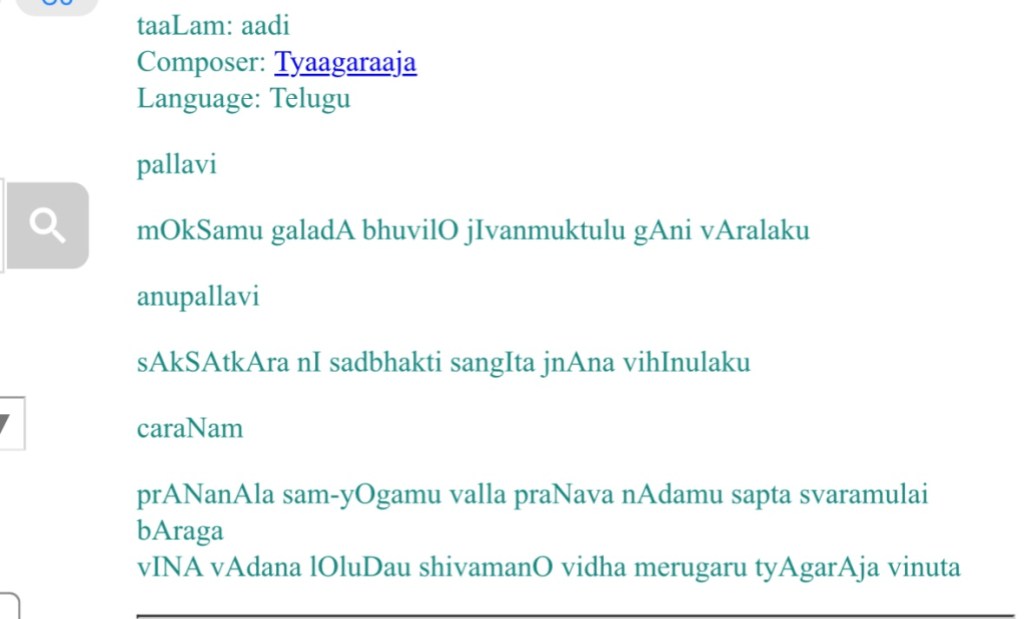

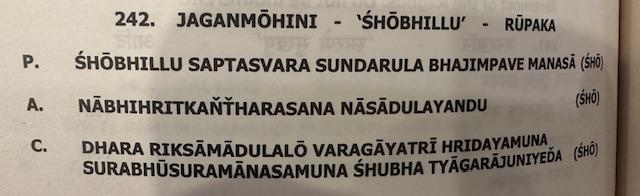
In the kriti “sogasuga mridanga taalamu” in Raagam Sri Ranjani, and in the other kriti in Jaganmohini raagam, “shobillu sapta swara…“, the Saint composer emphasises that Carnatic Music is essentially Dharmic in nature and form. It is “nigama shirortamu….“. The import is thus very clear … the music is Veda-Vedantic based. It belongs to the culture of Sanatana Dharma and is suffused with its traditions. However, it is most certainly not Brahminical or priest-centric music. Every human heart — irrespective of caste or creed or condition — that listens to Carnatic Music will beat to the sound of its lilting melodies and rhythm and be swayed by the experience of Bhakthi.


If TMK hurls ill-tempered and ill-advised invectives at Carnatic Music being “brahminized”, let him know that Thyagaraja himself was not entirely unsympathetic to such indignant sentiments. But Thyagaraja never went about deameaning either the music or a community for it. His social criticism did not seek to destroy but only to mildly chide.
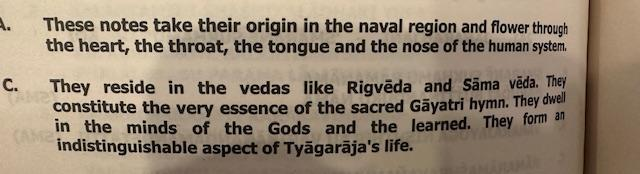
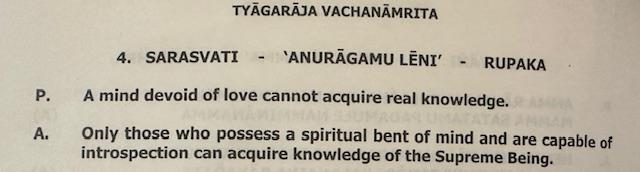
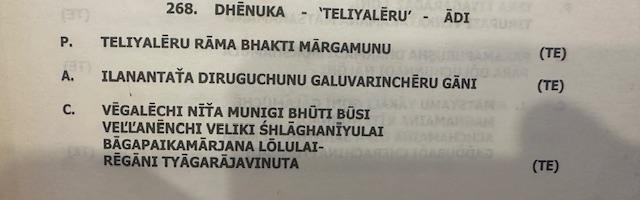
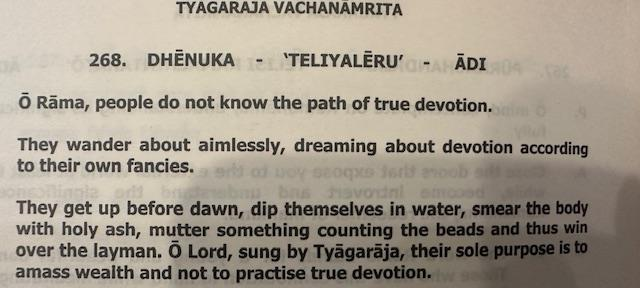
Thyagaraja in fact was quite critical of those few amongst haughty Brahmin communities who themselves did not care to seek Divinity or Bhakti in music but merely exploited it to earn measly livelihoods or fame… Pay attention to the lyrics below in the two famous “kritis” — one in Raagam Saraswathi, “anuraagamu leni…” and the other in Dhenuka raagam, “teliyaleru raama bhakthi maargamu…”

****************
Neither N.Murali nor the stalwarts in the Committees of the Madras Music Academy seem to have given sufficient attention to the most essential and integral quality of excellence in Carnatic Music viz. the sublime quality of Bhakthi that Saint Thyagaraja, the mystic-vaageyakaara of the Musical Trinity of Carnatic Music, spoke of as being the soul and sine qua non of “saastreeya sangeetham“.
The MMA is guilty of not exercising proper professional judgment in carrying out its remit. Every member of the Committees too must hence bear constructive and vicarious responsibility for the grave lapse.
As for T.M.Krishna himself, I believe that come December 2024, he will certainly be coronated with Sangitha Kalanadhi, the title he does not deserve. He will of course bear the honour with pride and a dash of gloating triumph too. But will it all change his music? Will it make him humble and thoughtful? I doubt it…
TM Krishna will continue to purvey his very own special brand of Carnatic Music in much the same manner as Saint Thyagaraja described it in immortal lines:
“ilanantata dhiruguchunu galuvarincheru gaani….”
“They will wander about aimlessly in the world, dreaming up their own fanciful, conceited notions of bhakthi and devotion…..”
***************
Sudarshan Madabushi
Compare for instance with the artist profiled by TheHindu.https://www.thehindu.com/entertainment/music/the-many-facets-of-charumathi-ramachandrans-music/article25881343.ece
Anami
Why b3at round the bush ? Of all said and done, T M Krishna is an outstanding carntic vocal artist as well as an utmost rational human being.
A hard hit on Murali’s defence of TMK.
TMK’s music lacks divinity and his politicisation of music has alienated him from the true rasikas of carnatic music.