Hello folks ! Good news, Category 4 hurricane storm that hit Chennai earlier this month has passed!
I mean the storm in social and mainstream media that tore through the world of Carnatic Music in India and abroad for a couple of weeks earlier this month has weakened quickly and significantly and is just about to fizzle out completely as no more than storm in a mini teacup ….
Right throughout the duration of the maelstrom, TM Krishna who was awarded Sangitha Kalanidhi title by the Madras Music Academy, very wisely decided to hunker down quietly and simply waited to ride it out until it had made land crossing, whipped up emotions for about a week and then very soon began dissipating itself. He just did not care to respond to the torrents of public outcry that poured down on social-media platforms, on TV talk-shows and in high-faluting newspaper Op-Eds. He probably knew only too well that in the end it would all amount to only so much sound and fury, fire and brimstone and righteous fulmination turning finally damp squib ….

A quietus now has descended upon the Carnatic music world. No more grandstanding by ex-Sangitha Kalanidhis returning … or threatening to return … their titles in protest against MMA … No more peeved Sangitha Kalanidhi-wannabes shooting off letters to the MMA deploring MMA’s growing drift towards Periyarism and “social change” …. No more hand-wringing and breast-beating by rambunctious masses of rasikas or the “discerning” aficionados of Carnatic music ruing the ruin the MMA and TMK are about to bring upon “rich and hoary traditions” of this “unique art form” of South India…! The haranguing and moralizing has stopped abruptly… almost magically in fact!
TMK is now safe and sound in his bunker. And the imperious Music Academy Executive Committee too is safely ensconced with the walls of its formidable fortress in Alwarpet …. unmoved, unperturbed and unassailable to any form of siege attack by any Carnatic music vidwan, rasika, fellow-Sabhas, newspaper columnist or social-media warrior. If you imagine the MMA Vs Carnatic Music-World fight as a world boxing-bout championship, you would be tempted to say that jury has ruled it’s a clean Technical Knockout (TKO) that the Academy has won over the latter. The defeated challenger now lies on the floor of the ring with a bloodied nose and is not likely to survive or revive anytime before the count to 10 … er… I mean, before the countdown to Dec 15, 2024 and the Sadas!
*********
Now that the TKO has been ruled and the booing crowds have all tucked tail and gone home to watch IPL matches and election poll results, one can take a pause, sit back quietly and begin pondering over some of the most important questions in the aftermath of Hurricane TMK ….
What have TMK and MMA achieved? What were their objectives and long-term goal?
What does the triumph of TMK and MMA mean to the Carnatic Music World ?
What will be the long-term impact ? What will the Sangitha Kalanidhi title and award henceforth come to signify or symbolise ?
In my view, the stated and explicit objective of MMA-TMK tango is obvious from the citation that the Executive Committee of the Academy read out while announcing the 2024 Award conferred on T M Krishna. What did it say?
“Renowned carnatic singer T M Krishna has been conferred the Sangita Kalanidhi for 2024 by the Music Academy. He has used his music as a tool for social reform. A writer with analytical books to his credit on music, Krishna has received several awards for his music, his writing and his championing of social causes”.
It stands established now therefore beyond an iota of doubt that MMA will henceforth bestow its recognition on those Carnatic Music artistes of excellence who will follow in the footsteps of TMK “using music as a tool for social reform” and “championing social causes“.
The above goal as enunciated by MMA marks a transformation of its raison d’etre as it was first articulated at its inception.
The MMA’s own website tells us that its founding fathers back in 1928 had no such thing as “social change” or “social causes” in their minds and they conceived the MMA to be a purely a cultural institution dedicated to the preservation primarily of classical South India performing arts, and secondarily to arts from other parts of the country. At least this is what one can gather from a reading of what’s in there on the MMA Webpage quoted below:
“The Music Academy, Madras is a landmark institution in the history of the fine arts. It emerged as an offshoot of the All India Congress Session held in Madras in December 1927. A music conference was held along with it and during the deliberations, the idea of a Music Academy emerged. Inaugurated on August 18, 1928 at the YMCA Auditorium, Esplanade by Sir CP Ramaswami Aiyar, it was conceived to be the institution that would set the standard for Carnatic music. In the process, it began in 1929 the practice of hosting annual conferences on music, which in turn spawned the December music festival of Madras, one of the largest cultural events of the world.
Founded by a group of opinion-leaders of Madras Presidency, all of whom had their individual ideas on how the institution ought to function, the Academy soon won over the entire community of artistes. Its evolution became a collaborative exercise between the two groups”.
*************
The second paragraph above is extremely significant to parse and it must be carefully read between the lines.
From the way the paragraph has been phrased, it clearly implies that even back in 1928, the Academy had to “win over” “two groups” to get off the ground! One group evidently comprised “artistes” on the one hand who had their own ideas about how the “institution ought to function”. Their ideas had to be reconciled with those other “individual ideas of a group of opinion–leaders of Madras Presidency“!
Thus, going by the above, it is so very clear that ever since 1928 there has always been simmering within the Madras Music Academy establishment an invisible, subterranean tension prevailing between “artistes” and “opinion-leaders“… We can infer quite reasonably that some sort of a clash of cultural will between the two… a tug-of-war, so to say, had always existed between the musical fraternity i.e. vidwans, rasikas, musicologists, exponents, cultural aficianados and other cognoscenti, on one hand, and the administrative, managerial or bureaucratic mandarins of the institution who weighed in as “opinion-leaders” exercising their heft and power stemming not out of the art itself but out of the political and social clime of the times from outside.
This constant tension between the “two groups” since 1928 has always been there but rarely did it ever surface as openly and brazenly as in 2024 when the “opinion-makers” brought in the idea of “social change” and “social causes” and have now successfully enshrined it for the very first time as the new, trail-blazing and abiding “standards to be set for Carnatic Music“.
In bringing such a sweeping sea-change in the MMA, the “opinion-makers” group has effectively staged a coup d’etat. It has relegated the “artistes” group to irrelevance and, who knows, sooner or later, perhaps to utter oblivion too. From 2024 onwards, the Sangitha Kalanidhi awardee will be judged on the basis of not only artistic excellence but more importantly upon considerations of how impactful his or her music has been in ushering “social change” or has otherwise been serving “social causes”.
************
If one were to ask to whyfore and towards what ultimate ends or purpose has the Madras Music Academy decided to change course suddenly after its 96 years journey since 1928, well…. one can come up with only conjecture or vague speculation.
“Social change” and “social cause” are two terms with rather fluid and fuzzy meaning. Carnatic music like any other pure classical form of Music in any other part of the world did not make great waves in history. In India, for a brief while Carnatic music in its purest classical form inspired pre-Independence patriotism and especially so when it combined with vernacular literature — such as the Tamil poetry of Bharahtiyar for example — to stir up nationalistic pride amongst ordinary peoples in society. But pure classicial classical music — such as even opera music or theatre philharmony compositions — had little to do with great social revolutions. Classical music — and certainly Carnatic Music — was an art-form that was always narrowly focused only on the eternal quest for the acme of spiritual, religious and aesthetic experience.
So, when MMA makes an announcement about setting its new standards and new norms for recognizing excellence in Carnatic Music to bring in new-fangled notions of “social change” or “social causes”, one cannot but be very sceptical about it …. if not downright distrustful.
As a Carnatic Music rasika myself (and as the son of a Sangitha Kalanidhi of yore), I dare to go even beyond scepticism or distrust vis-a-vis the intentions and purposes of the MMA in seeking to bring about a whole cultural paradigm-shift for the institution through its announcements in 2024. Pardon me, but I just cannot help viewing the MMA intentions with a great deal of cynicism.
************
Post-2024 Madras Music Academy, I make bold to predict, will slowly but inevitably emerge sometime in the decades ahead this 21st-century — when India itself becomes one of the top-3 largest economies of the world — as the cultural confluence where the commercial market-place will mingle with the artistic-realm only to completely subsume it.
Music Festivals across the world are today coming to be rated not half as much on their artistic worth as the commercial revenue-genrating potential they command.
Just take a look at the infograph below which tells you about the world’s most successful Music Festivals in 2023 with their gross revenues earned and the number of tickets sold.
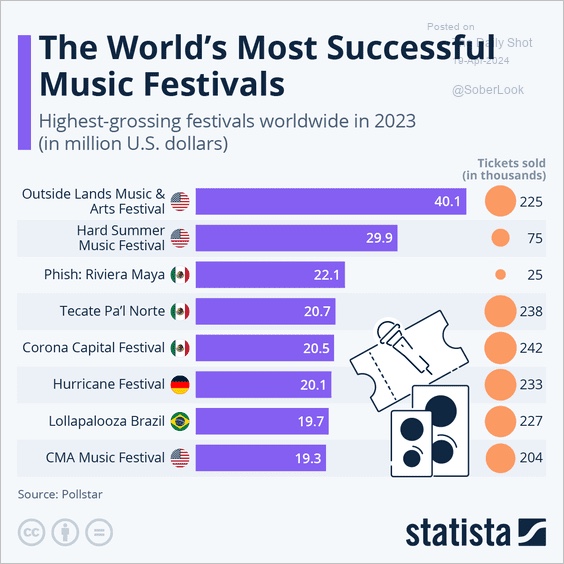
Now, there are festivals and then there are mega-festivals, some of the largest gatherings of people on the planet. These Music Festivals are now being regarded as mega commercial opportunties .... I mean, one could think of them each as venues for the IPL cricket matches today in India!
Most of the “biggest music festival in the world” are fast being developed as mass fan-base events with enormous tourist appeal too. This list below is updated for such mega-music festivals in the world for year 2024 and it gives us a vivid idea of their commercial potential in terms of what is called “total attendance”.
You can click on each commercial venue below to understand the massive scale on which these mega Music Festivals are conducted across the world and then try to imagine their revenue-generating capacity.
Lollapalooza Chicago
Attendance: 400,000
Source
EDC Las Vegas
Attendance: 400,000
Source
Pol’and’Rock
Attendance: 400,000
Source
Sziget Festival
Attendance: 420,000
Source
Austin City Limits
Attendance: 450,000
Source
Amsterdam Dance Event
Attendance: 450,000
Source
New Orleans Jazz Fest
Attendance: 475,000
Source
Essence Festival
Attendance: 530,000
Source
Tomorrowland
Attendance: 600,000
Source
Summerfest
Attendance: 624,407
Source
Rock in Rio
Attendance: 640,000
Coachella Music And Arts Festival
Attendance: 645,000
Source
Donauinselfest
Attendance: 1.2 million
Source
Quebec City Summer Festival
Attendance: 1.4 million
Source
Montreal Jazz Festival
Attendance: 2 million
***************
The future of Music Festivals …. even classical music festivals … is also going to be all about scale and about touristic potential only. Why? Because Tourism again means huge revenues! And Tourism by itself is truly a great and powerful social-change agent.…! Why? Because it can easily deliver the greatest amount of artistic-content to the largest numbers of peoples and for the highest of financial returns possible!
The best example to prove this point is the Classical Music Festival at Provence-Alpes-Cote d’Azur... The South of France is well-known for its lifestyle and the region is also renowned for its excellent summer season. In the summer, the evenings will be drenched in classical music during the festival season which has forged history in the South while becoming famous worldwide. https://provence-alpes-cotedazur.com/en/things-to-do/events/classical-music/greatest-international-classical-music-festivals-south/#:~:text=The%20Aix%2Den%2DProvence%20International,by%20the%20world’s%20greatest%20conductors.
*************
The Madras Music Academy’s much feted and fussed-about December Music Festival simply pales into insignificance in comparison to the world’s top music festivals. Because since its inception in 1928, the institution remained unmindful of social changes or causes, it also deliberately remained indifferent to its own “commercial potential“. It remained stuck to its much vaunted image as the premier standard-bearer for Carnatic music all these these years. In spite of the “opinion-makers“, trying to pull and drag it the other way towards a socially more outward-looking instiution, the MMA continued to remain a centre of cultural excellence “of the artistes”, “by the artistes” and “for the artistes“. However, the year 2024 heralds a change from all that…. TMK is the messiah who has shown MMA the new way!
To get a foretaste of how the future of the Madras Music Academy December Festival might turn out to be in say, circa 2047 or 2075 … one only has to take a look at the video-clip in this news report about a recent concert of Sid Sriram below :
TMK’s greatest contribution to “social change” is therefore not really about taking Carnatic Music to the slums of Chennai, the “de-brahminizing” of Carnatic Music, the “broad-banding”, “secularization” and “democratisation”of it. His greatest and lasting contribution is to the Madras Music Academy for he has awakened it to the huge potential commercial benefits of such “democratisation”.
The MMA now discovers at last its true purpose — which is not so much to serve as “standard bearer for Carnatic Music” as to henceforth pursue its own vast, untapped and unrealised commercial potential.
I know my views here might sound very cynical but then I confess I cannot help suspecting that behind the idea of so-called “democratisation” of Carnatic music, there is no such thing as pious motives for “social change”. Instead, it’s really more likely that it’s all simply a farsighted strategy to achieve greater commercial expansion into the realm of art ….
***********
Sudarshan Madabushi