Let me at the outset, make it clear that I don’t know who MLA Ruby Manoharan is and nor do I know why or what his interests are in the affairs of the holy and famous Sri Vaishnava Nambi Perumal Temple at Tirukurungudi . All I know about this Nanganuri Constituency MLA is that he is or was under police investigation for the murder of another political colleague of his over some matter of mutual dispute between them. https://www.dtnext.in/amp/news/tamilnadu/police-summons-congress-mla-ruby-manoharan-over-tirunelveli-leader-jeyakumars-death-783508
This morning as I turned the pages of The Hindu , the following news item at once grabbed my attention. After I finished reading it, I was able to learn that MLA Ruby Manoharan has appealed to Tamil Nadu HR&CE Minster Tiru. Sekhar Babu to address the problem of “inadequate infrastructure” at Tirukurungudi for pilgrims. Please read :
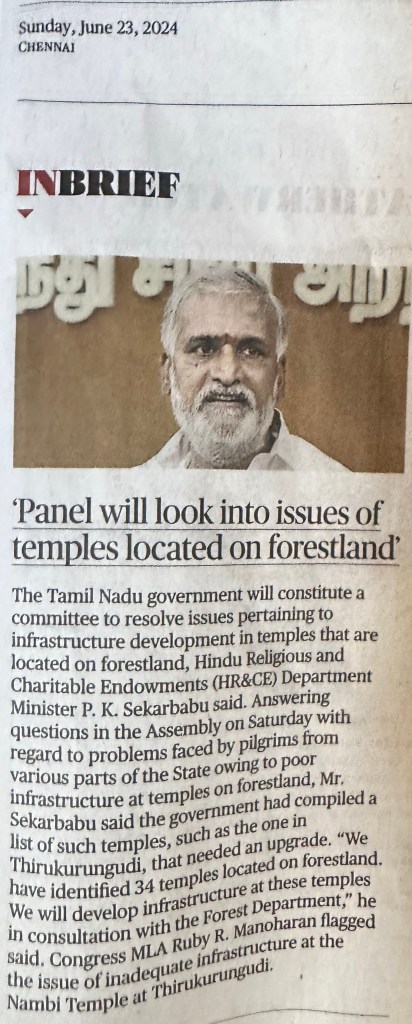
At first glance, the appeal to the TN HR&CE Minister by the Nanguneri MLA would appear as well-meaning and well-intentioned. Who wouldn’t want better camping amenities for the thousands of pilgrims who visit the Sri Vaishnava Nambi Perumal Temple year round ? Who would ever object to it if the local MLA urges the State Govt. to add, expand or upgrade “infrastructure” in the temple ecosystem? t would be fair to surmise that he must only be interested in increasing the pilgrim footfall in this famous temple and consequently, in enhancing also the potential of the Temple to generate more and more revenues for the TN HR&CE Department as well as local employment opportunities in the Nanguneri constituency?
Thus, none can possibly find any fault if Minister Sekhar Babu responds positively and earnestly to the MLA’s appeal and eventually initiates steps to expand and improve Tiurukurungudi “infrastructure”, all for the sake and benefit of pilgrims.
The question I ask myself, however, is what exactly does the MLA mean by “infrastructure” and what is the Minister of HR&CE understanding of the term?
– Does infrastructure mean building more roadways?
– Pressing into service and plying a large fleet of public transportation? Buses, mini-vans, tourist cabs, autorickshaws?
– Building vast colonies of traveller guest-houses and bungalows all around the temple town?
– Granting permits to private parties to go ahead and construct everywhere great many hotels, traveller inns, lodging-homes and restaurants?
– Permitting street-side food-courts alongside the streets and “maada–veedhis” of Tirukurungudi?
Or, shall we say, improving infrastructure means:
* supporting and empowering the local communities in and around Tirukurungudi to set up for all pilgrims visiting there , free or subsidised public accommodation at choultries, dharmashaala or “bed and breakfast” private home-guest accommodation?
* building more common bathing and toilet facilities for pilgrims at street corners?
* providing copious drinking water dispensers on every street?
* Or, “infrastructure” perhaps could mean vast “greening”, reforestation or landscaping of the entire area falling under the temple-zones ?
* Or, building more primary-health or medical centres and child-care clinics for Tirukurungudi residents and temple employees ?
* Or else, maybe even building more Veda paatashaalas or Agama training schools for local youth?
***********
While pondering seriously thus over the above plausible implications or explanations of what the term “infrastructure” could really mean to both MLA and Minister, I could not help dwelling then upon a few deep, personal misgivings that I have for long nurtured in my heart about the whole issue of this recent and modern-day fixation that many of our temple administrations — especially the most well-funded or endowed ones — throughout the country have with “providing all manner of comfort and convenience to pilgrims”.
This whole idea of “undertaking pilgrimage in comfort style” has become a modern oddity if not a moral aberration, at least to the best of my own understanding of what in true spirit of “yaathra” is as per the age-old Vedantic customs of our vast country which in the past has always and rightfully taken great pride in its innumerable places of pilgrimage or “kshetraadam”. There are hundreds of places of worship to which our ancestors as humble pilgrims travelled to on foot and on “yaathra” journeys that lasted for not days but months even! They journeyed to far off and at times inaccessible places —- to temples, remote hills, river-banks, sacred lakes and forestlands —- “giri”, “teertham”, “nadhi”, “Aranyaka” ….
On these great journeys of “yaathra” , the pilgrim was expected actually to subject himself voluntarily to a certain degree of austerity, personal discomfort if not privation. Trekking through forests, trading on stony or thorny pathways, fasting periodically, traversing rocky terrain , wading river currents , sleeping under the skylight on the hard ground … all these hardships were considered as part and parcel of the “yaathra experience”.
Such austerities were regarded, one might say by using a modern expression, as a sort of spiritual boot-camp exercise that only helps to tone-up one’s inner self, fortify one’s mental faculties and elevate soulful awareness. The rigours of Yaathra were looked upon as serving many purposes — some higher than the other.
The most common purpose why people went on a yaathra was to propitiate a deity and seek worldly personal favours or relief from some cause of misery and unhappiness.
Another purpose, slightly higher, was to atone for sins, do penance for other transgressions in life and seek forgivance.
The highest purpose of yaathra however was to strengthen the pilgrim’s sinews of deeper consciousness (“Chitta Shuddhi”). In that strictly Vedantic sense of discipline, a Yaathra was never designed or intended to be “convenient comfortable or pleasant” in the kind of ways now demanded by pilgrims of all temple administrators.
The pilgrims of the present day, no matter from which walk of society they come from, all wish however to be pampered quite a bit by temple-administrations with all kinds of creature amenities. Why? Because they think they have a very reasonable justification. The pilgrims after all have travelled over vast distances to come visiting the temple. They have arrived with their entire family too in tow and that too after a gruelling journey either by road, rail or air. All they want is to spend a day or two at the place of worship performing and consummating their pilgrimage “without any hassles”. They have every right to demand good amenities and basic creature comfort to fulfill the pilgrimage … don’t they?
********
Nowadays many people go around complaining that some of our most famous temples and centres of Yaathra , have become utterly commercialised. What they mean is that while there are facilities and “infrastructure” in place and provided to them as pilgrims, they are however being “fleeced” to pay for it. The costs of completing a pilgrimage for an average middle-class family thus becomes quite exorbitant. “Everthing is charged … from food, accommodation, to darshan and prasad… It’s too much, really!”, is the plaintive cry.
Well, the reason why “commercialisation” has become rampant is for no other reason than that the core purpose of “Yaathra” i.e. the austerity element in it has been foregone and forgotten completely. And it has been replaced by new-fangled, fancy notions about “pilgrim comfort, amenity and wellness”.
In other words , in turn, it has all boiled down to the relentless pursuit of creating temple “infrastructure” and getting the burgeoning pilgrim traffic to ultimately bear cost of it all. That is the precise reason why we see “infrastructure” boom in wanton , indiscriminate frenzy today in such great temples, for example, as Tirumala, Sri Rangam, Rameshwaram, Palani, Kanchipuram , Tiruvannamalai … and many others . Infrastructure building thus leads inevitably and ever increasingly to “commercialisation”.
MLA Ruby Manoharan and HR&CE Minister Sekar Babu are planning very likely to build infrastructure at Tirukurungudi mainly out of such motives of “commercialisation“.
**********
For a moment, let us pause to examine what is the true Vedantic purpose of a pilgrim’s “yaathra”. For the true “yaathri“, the journey is essentially a search for a place of serene tranquility wherein may be found, in the relative desolation of the spirit, and far removed and separated — even if for only a brief while — away from the madding crowds in his own care-worn and worry-filled private world… A yaathra to such a pilgrim is thus a sort of “reset connections” with the divine….
A true “yaathrika” journeys in fact to the remotest temple seeking only those brief cloistered moments of reconnected-ness with divinity. It is not to be… rather, it should really not … be about comfort or too much fussing over creature “amenities” or physical infrastructure. Austerity during a yaathra does wonders indeed to disconnect the human mind from mundanity and briefly focus it upon the non-mundane.
To put it in other words, the yaathra really is all about the mind of a pilgrim, long after the pilgrimage is done, being able to still vividly recollect and relive moments of divine connectivity in much the same manner as what the poet once described:
“When oft upon the couch I lie,
In vacant or in pensive mood,
They flash upon the inward eye
Which is the bliss of solitude”
If I were to visit Tirukurungudi one more time, and return home at the end of the pilgrimage, what I would wish to recollect and cherish are not how “comfortable” I had been throughout the journey nor how good the “infrastructure” there had been. I would want my memories of Tirukurungudi to be seen through the “inward eye”, in a “pensive mood” and while dwelling upon the great temple in the bliss of its stately, magnificent solitude.
************
If you really want to know and understand what I mean by everything I have written above, then you must please continue reading here and also view all the video-clips and photos below.
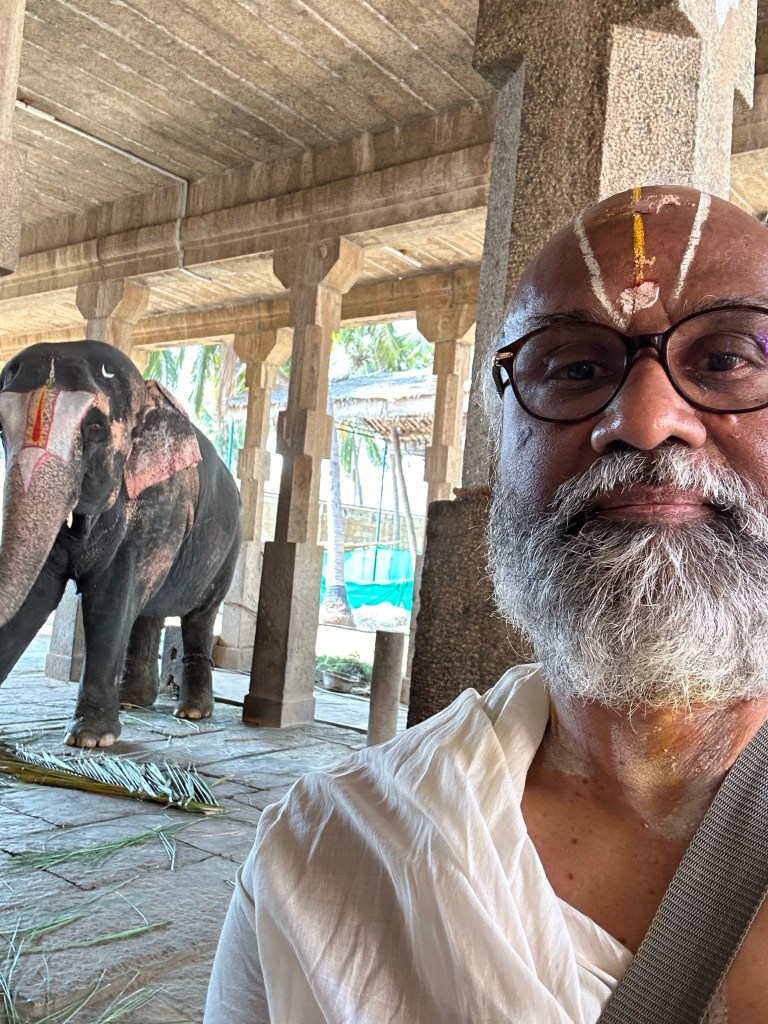
For the very first time in life, on May 5, 2024, I was blessed indeed to be able to go to Sri Vaishnava Nambi Perumal temple as an ordinary pilgrim. It was an unforgettable religious experience for me, one that I know which I will cherish within my memory forever as long as I am alive.
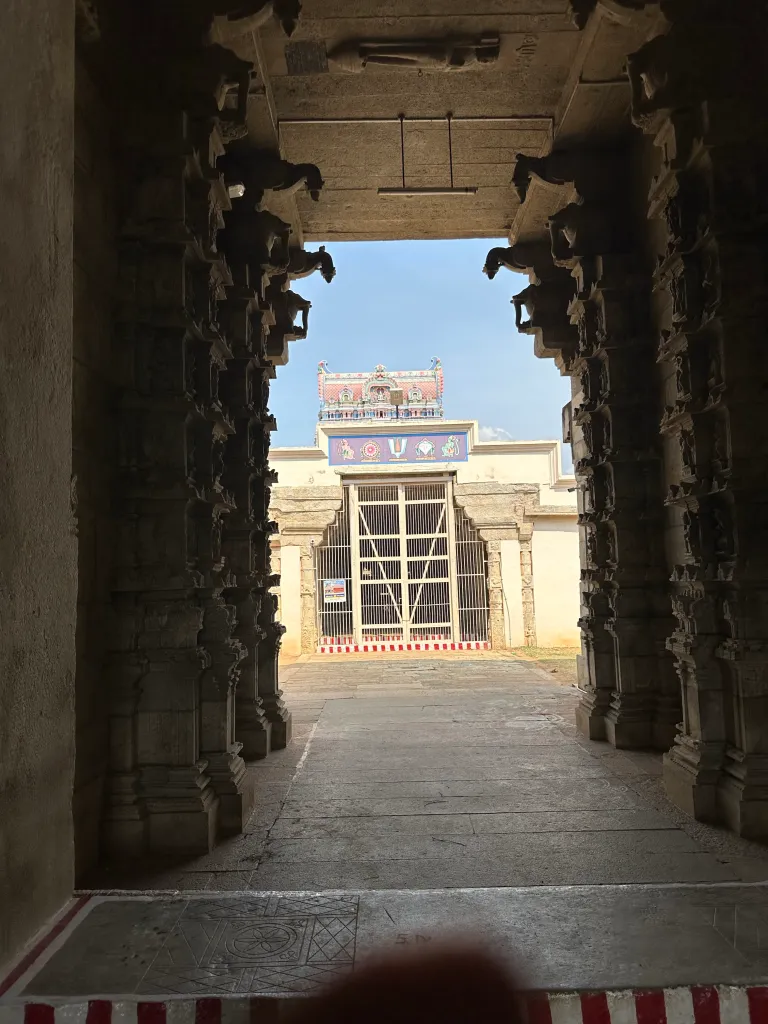
There I saw no fancy “infrastructure”.
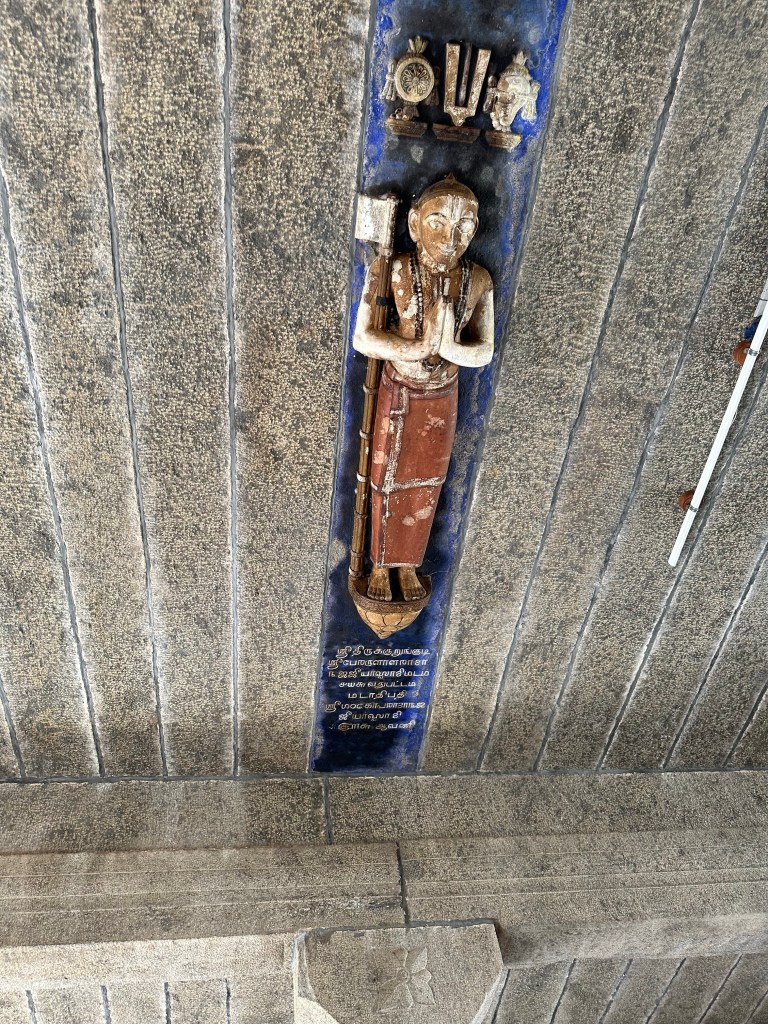
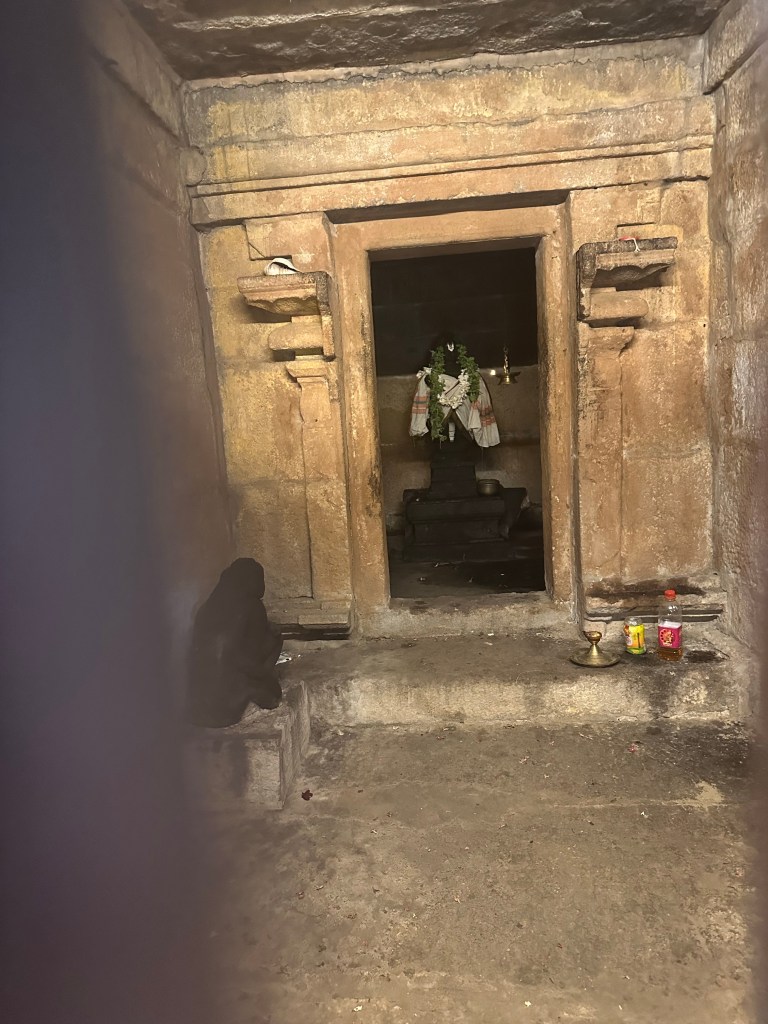
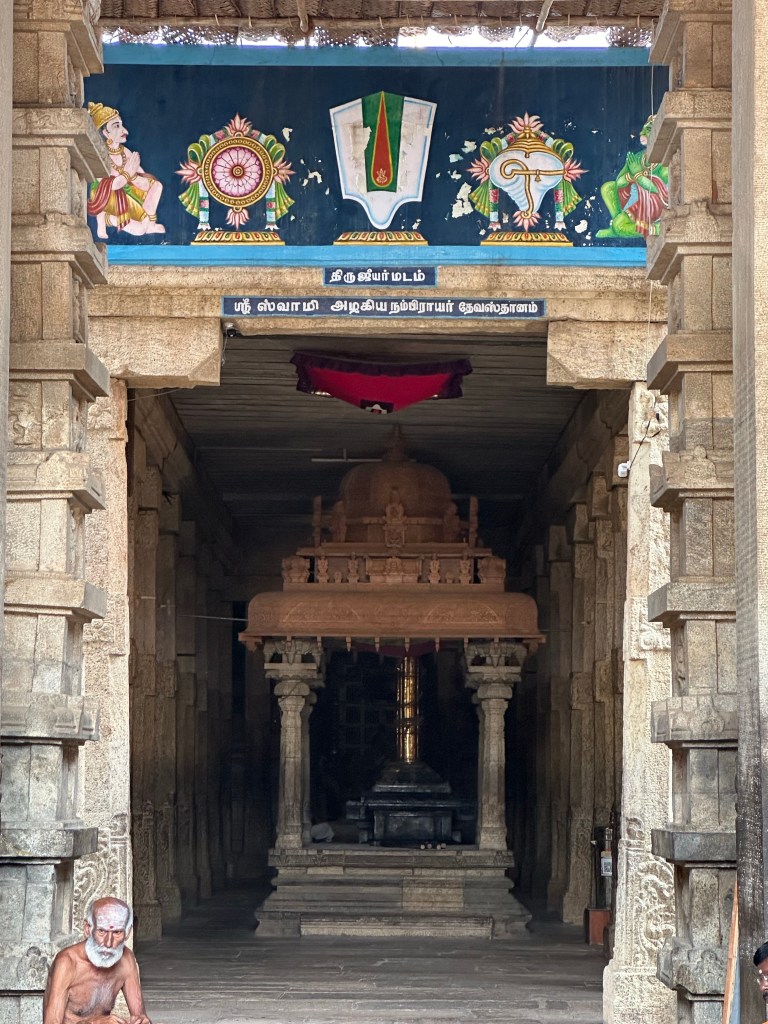
Instead I witnessed the temple’s sculpted splendour, its sacred ambience, the dark and cool, wide and long inner praakaaras, its salubrious, clean precincts, the sylvan coconut-groves and rice-fields. In the distance, I saw the hazy outlines Mahenrdra Hill from whose peaks, it is believed Hanuman, in the Ramayana, took off to Lanka on his famous surveillance mission. In the nearby shrine to Sri Ramanuja I was shown the spot of his famous encounter with his disciple, Sri Vaduga Nambi and the deity of Sri Vaishnava Nambi himself.
It is in the little memories of the visit which I shall always carry within me that, in conclusion, make me want to reach out and tell both MLA Ruby Manoharan and Minister Sekar Babu this:
“Please leave the Tirukurungudi temple alone! For God’s sake, don’t desecrate its cloistered, sacred serenity by turning it into touristic pilgrimage spot! We don’t need your mindless “infrastructure building” in this beautiful temple-town!”




Sudarshan Madabushi