
https://acrobat.adobe.com/id/urn:aaid:sc:AP:860c0e68-c8f1-460d-a8ba-c8e4d85ecd57
Ruchir Sharma’s above Op-Ed piece in the London Financial Times ends with this grim foreboding :

I would like to think perhaps Ruchir Sharma inadvertently forgot to add that America is also over-indebted as never, never seen before…
The omission therefore begs the question : why are we seeing today the strange phenomenon of “American Exceptionalism” completely turning over its head that old truism we all believe in : that it is always economic fundamentals that drive market-sentiment and never the other way around?
Again to my mind, the probable answer to the final question Ruchir poses at the end of his column viz. about when and what will trigger the US Stock market to deflate and decline, is probably this:
The triggering will happen whenever the US sovereign-debt growth trend-graph can’t climb any steeper than it has already and will arch backward to simply topple all over itself, head over heels, and bring the whole world down with it too … (BRICS , are you listening?!) In my view that’s the inflection point when Ruchir Sharma’s anticipated “bubble” will burst.
Take a look at the below graph showing trend of U.S. Sovereign Debt over the last nearly 50 years !
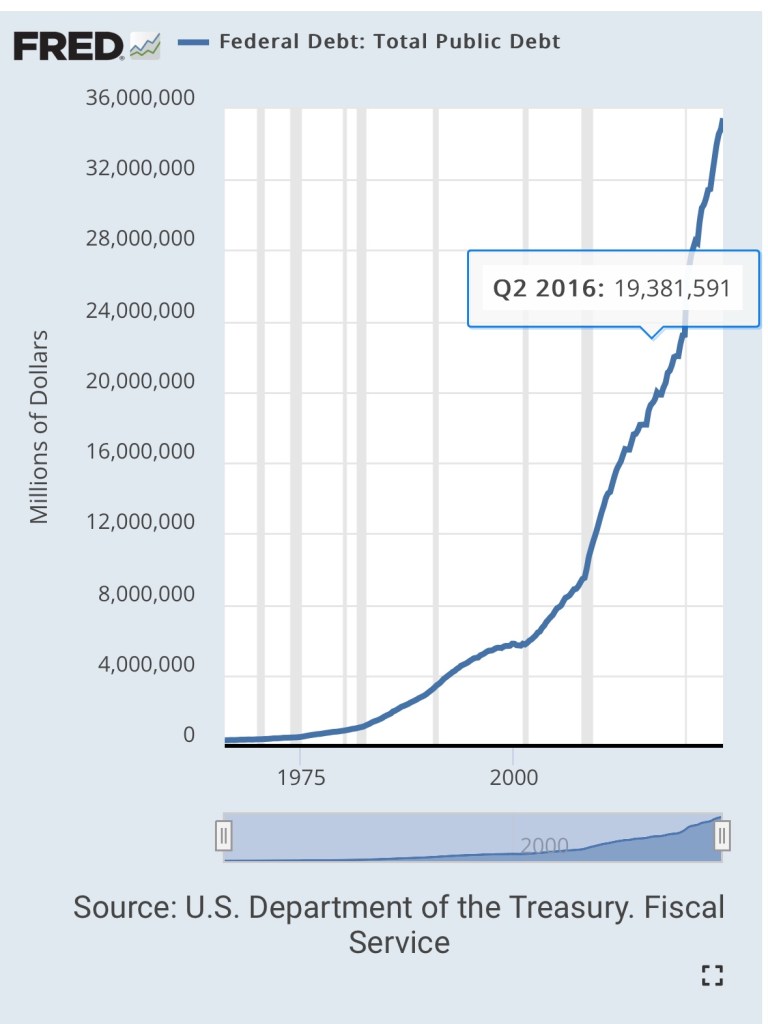
To put the above trend into perspective, and be able to draw some conclusions, let’s consider the below figures and ratios:
1. The total global sovereign debt is approximately $76.8 trillion, and U.S. sovereign debt is $ 34.5 trillion : 45%
2. Global GDP is around $90 trillion and US share in it is $.29.35 trillion : 32%
3. Global stock markets capitalisation today is $ 93.7 trillion and the US stock market–cap accounts for $58 trillion of it : 62%
4. Net Global GDP is Global GDP minus Global Debt : $90 Tn minus $ 76.8 Tn = $ 13.2 Tn.
5. Net U.S. GDP is U.S. GDP minus US Debt : $29.35 Tn minus $ 34.5 Tn = $(5.15) Tn
6. Ratio of Global Stock Market Capitalisation to Global GDP : $93.7 Tn /$90 Tn = 104%
7. Ratio of U.S. stock market Capitalisation to U.S. GDP : $58 Tn / $29.35 Tn= 197%
Conclusions :
— On Gross GDP terms, the global stock-markets seem overvalued by 4% whereas the U.S. stock markets are overvalued by nearly 200%.
— In Net terms, the global stock market-cap is 7 times the GDP or 7X — i.e. 93.7/13.2 — while US stock market cap is 11 times its GDP or 11 X — 58/(5.15).
Now I, for one at least, am able to understand what exactly Ruchir Sharma means when he writes this :

Sudarshan Madabushi
PS: and here below is another perspective on the same subject !
