The Naanmadhiya Perumal Temple (also called Thalachanga Nanmathiyam) is a Hindu temple situated in the village of Thalaichangadu, near Akkur in Mayiladuthurai district in the South Indian state of Tamil Nadu.
Constructed in the Dravidian style of architecture, the temple is glorified in the Nalayira Divya Prabandham, the early medieval Tamil canon of the Alvar saints from the 6th–9th centuries CE. It is one of the 108 Divya Desams dedicated to Vishnu, who is worshipped as Nanmadhiya Perumal and his consort Lakshmi as Talaichanga Nachiar.
Thalaichanga Nanmadhiyam Temple is architecturally modest but historically and mythologically rich, making it one of the most unique and significant temples among the 108 Divya Desams of Tamil Nadu. Its combination of ancient literary references, Chola patronage, and rare iconography that sets it apart from other temples in the region.
The temple stands out for its blend of Saiva and Vaishnava iconography (crescent moon on Vishnu), its role in the ancient conch-shells trade, and its deep roots in both Sangam literature and Vaishnavite tradition.
The temple is believed to have been constructed during the Chola reign. It stands on the southern bank of river Cauvery and was near Poompuhar, the famous port town of the Chola times. This place was so well-known for its conch-shells, that even in the famous Tamil literary work, Silappadikaram, the fact finds a mention.
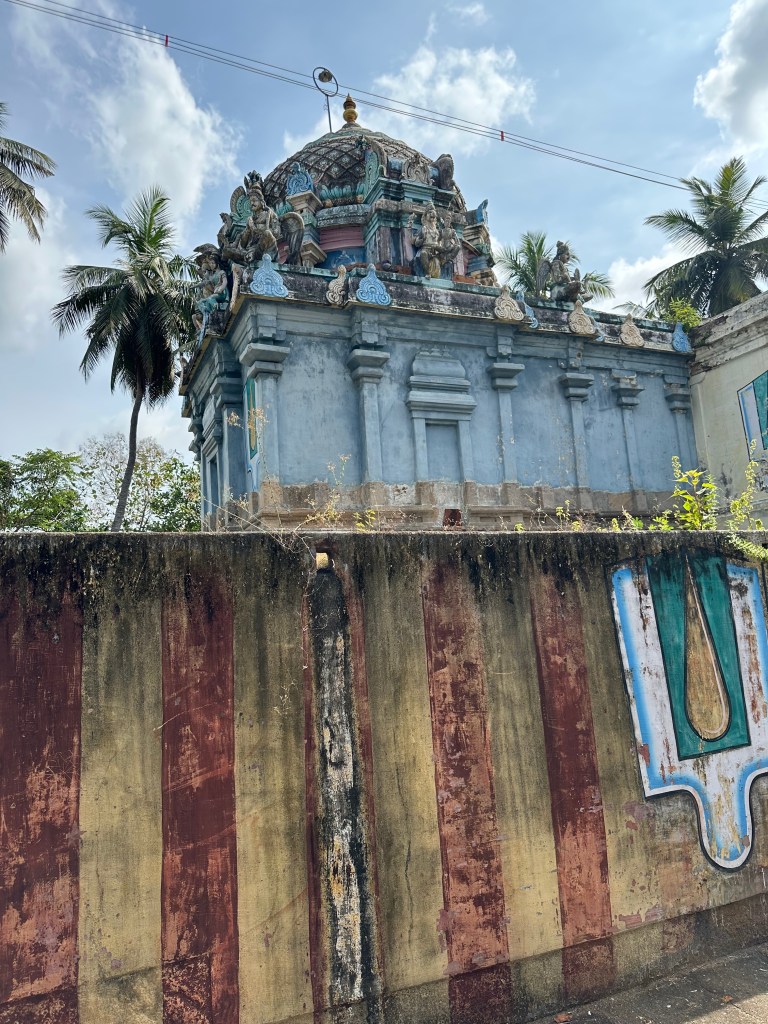
Inside the temple sanctum, the idol of Sri Naanmadiya Perumal is in the standing posture, with the crescent Moon on his head. Chandra Vimanam is the tower above the sanctum. There are shrines for the Goddess and other deities, while the temple tank, Chandra Pushkarini, can be found outside the complex.
The temple’s vimana is of the Ekatha Vesara type, referred to as Chandra Vimanam, which is architecturally unique compared to the more common multi-tiered vimanas in other Divya Desams.
As per the legend of the “sthala purana“, the temple is associated with the Planet Chandra (the moon god) being relieved of a terrible curse afflicting him curse by the grace of Vishnu here. It’s a very unique ‘sthala purana‘ narrative about the sin of adulterous relationships.
Legends Associated with Thalaichanga Nanmadhiyam Temple
1. Chandra’s (Moon God) Curses and Redemption
- The primary legend centers on Chandra, the moon-god, who was afflicted by multiple curses due to his lascivious actions. Chandra, regarded in the pantheon of Hindu gods, as the brother of Goddess Lakshmi, and is second in rank only to Surya (sun-god) among the Navagrahas (the nine planetary demigods) was cursed on two major occasions:
- Tarakamaya War and Guru’s Curse: Chandra developed an illicit relationship with Tara, the wife of his guru Brihaspati (Jupiter), leading to the birth of Budha (Mercury). Brihaspati cursed Chandra to be afflicted by an incurable disease of the skin, specifically leprosy.
- Dhara, also known as Tara, was the wife of Brihaspati (Guru), the preceptor of the Devas (other gods and celestials). In the legend involving Chandra, Tara played a central role that was no less culpable than his. Chandra and Tara developed a mutual attraction, and Tara then deserted her husband Brihaspati to go and live with with Chandra. Despite Brihaspati’s efforts and appeals to the gods to reclaim his wife, Tara remained with Chandra for some time, leading to a major conflict among the gods and asuras who took sides in it.
- This episode culminated in a cosmic war, which got only resolved when Brahma the Creator intervened and restored Tara to Brihaspati. However, Tara by then became pregnant, and after initial reluctance, she had no choice but to reveal the truth that the child, Budha (Mercury), was fathered by Chandra.
- Thus, Tara’s relationship with Chandra not only triggered a divine conflict but also resulted in the birth of Budha, also an important planetary deity in Hindu mythology. Her actions were pivotal in the unfolding of the legend of the purana and its consequences for Chandra, Brihaspati, and the cosmic order.
- Daksha’s Curse: Chandra married the the 27 daughters of Daksha Prajapati, promising to treat them all equally. However, he was especially fond of and favored only Rohini, which caused a lot of heartburn and grief among his other wives. Daksha, angered by this, cursed Chandra so that his lustre and lunar brightness would wane day by day fortnightly … This resulted in the waxing and waning phases of the Moon.
- Redemption through Vishnu: To relieve himself from the above curses, Chandra was advised to perform penance at several sacred sites. As part of a three-phased atonement, he worshipped Vishnu at Srirangam, at Thiru Indhalur, and finally at Thalaichanga Nanmadhiyam. Here, after bathing in the temple tank (Chandra Pushkarani) and performing severe penance, Vishnu appeared as Nanmadiya Perumal and completely liberated Chandra from his afflictions. This is why the deity here is also called “Chandra Saabha Haran” (Remover of Chandra’s Curse).
2. The Sacred Conch and the Name of the Place
- The temple’s name, Thalaichanga Nanmadhiyam, is derived from the word “cankam” (conch). The presiding deity holds a unique and precious conch, denoting the surrounding area which was historically renowned for its conch-shell trade during the Chola period. This association with the conch is both a physical and mythological hallmark of the temple.
- Vishnu adorning himself with the Moon on his head, which is usually seen only in the images of Lord Shiva is symbolic of Vishnu having worshipped Shiva here and obtaining the great conch Panchajanyam. A mention of this conch is found even in the Bhagavath Gita when Sri Krishna used it to announce commencement of the War of Kurukshetra.
3. Connection with Other Temples
- The legend of Chandra’s redemption links Thalaichanga Nanmadhiyam with two other prominent Divya Desams: Srirangam Ranganathaswamy Temple and Parimala Ranganathar Temple at Thiru Indhalur. Chandra’s penance at these three temples forms a spiritual circuit for those seeking relief from “Chandra Dosha” (afflictions caused by lunar influence).
- After I completed my journey here at this kovil, I was able to consider myself blessed by all three Perumals since I had received their grace having complegted the pilgrimage to all three kshetrams.
*****************
The “sthala purana” of this temple is about the planetary god Chandra’s sexual misdeed and his adulterous relationship with the wife of another planetary demigod, Brihaspati.
Hindu Puranic lore is full of othjer similar candid narratives about sexual promiscuity. There are stories where the gods’ and goddesses’ chastity or that of rishi patni-s (wives of sages) are tested or challenged. Such purana legends are symbolic narratives. When viewed through the lens of modern, contemporary secular social mores they might seem extremely offensive … reeking of patriarchy, misogny and sexual licentiousness.
But these purana narratives have to be understood correctly in the perspective and context of the ancient times in which they were authored and not transplant them all in the here and now and subject them to modern-day critiques.
These puranic tales associated with the temple legends only emphasise the immense spiritual power attributed to a woman’s chastity and conjugal devotion.
Such tales as the story of Anasuya and Tara, often depict the gods themselves being humbled or transformed by the virtuous or unvirtuous conduct of their women. Their underlying message is that purity and fidelity in holy matrimony possess a force so great that even lesser deities of the celestial world must acknowledge and respect it, sometimes resulting, in fact, in miraculous or divine events…. such as, for example, the birth of another planet Budha, the offspring of an adulterous relationship between Chandra and Brishaspati’s spouse.
Such stories as this of Nandmadhiyam Thalaichangangudi are not merely about chastity or marital fidelity, but really more about highlighting the significance and the reverence that monogamy (“ekapatni” and “ekapati vrata“) commands in the spiritual hierarchy of Hindu thought.
The core moral of the story is that if the wages of the sin of adultery are sure to befall even the powerful gods such as Chandra, what then is to be said of mere humans who might be all too easily tempted to transgress sexual morality in this world?
*************
The Kovil here in this divya desam is said to have become dilapidated once long ago. It was renovated by a devotee Suntara Ramanuja.
Sundara Ramanujan (also spelled as Suntara Ramanuja) is noted in temple records as the individual who renovated the Thalaichanga Nanmadhiya Perumal kovil. The temple is ancient, dating back to before the 8th century CE, and is said to have been originally constructed by the Chola king Chengkotta Chozhan, with subsequent contributions from later Chola and Maratha rulers.
However, the specific date or period when Sundara Ramanujan undertook the renovation is not mentioned in the available sources. The only clear information is that the temple was in a dilapidated condition at some point and was renovated by him.
Today, the temple is supposedly being maintained by the Tamil Nadu State Hindu Religious and Endowment Board (HR&CE). But as I surveyed its desolate state that morning, I imagined that its state of dilapidation today was perhaps no less grievous as what it might have been during the time of Sundara Ramanujan.
***************
My pilgrimage to the 6 Divya Desams now stood completed.
I prepared next to travel to Vilanagar, Sri Varadaraja Perumal Kovil “mahasamprokshana utsavam”. I hastened forth to that village.
(to be continued)
Sudarshan Madabushi