One very pertinent question about Seemantham that may arise in our minds is this:
If the rite of “Seemantham” is a Vedic “samskara“; and if it must be conducted for sake of ensuring the wellbeing of the pregnant mother, the protection of her natal womb and the fetal life growing inside, how is it that the performance of the “samskara” is enjoined only upon Vedic adherents in India?
No such ritual is practised by pregnant women in other countries and belonging to other religious faiths. Do such women in the rest of the world do not also conceive, become pregnant and nurture healthy fetuses? Are not healthy babies born to them too?
So what is so special about this Vedic “samskara” that it must be performed for the sake of our womenfolk belonging to the Vedic faith?
The most convincing answer to this very valid question I have myself been able to discover nowhere else in our scriptures other than in the Bhagavath-Gita.
***********
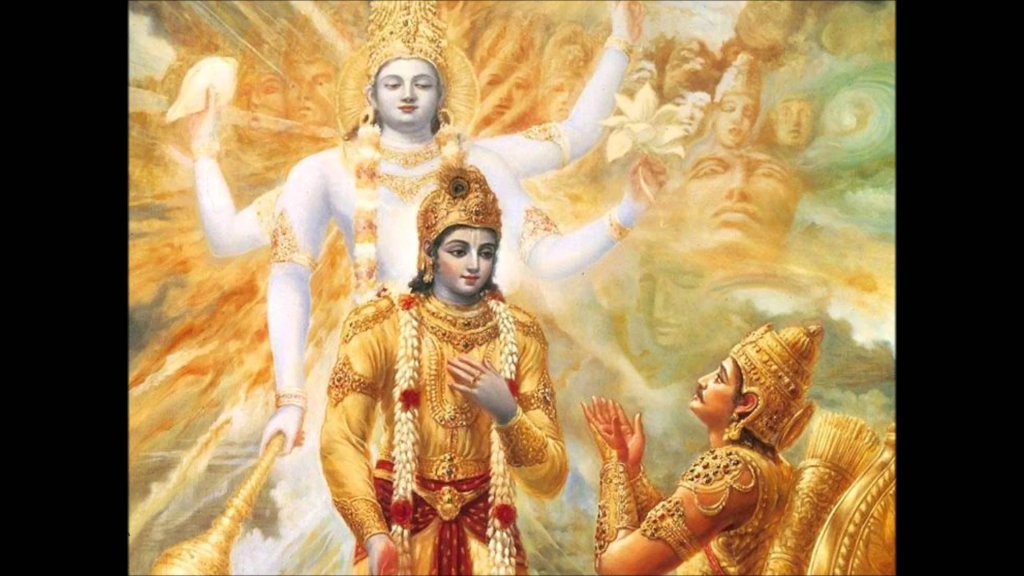
Krishna declares in the Bhagavad Gita that spiritual efforts undertaken in this life viz. svaadhyayana, tapas, saadhana, upaasana, bhakti, yoga etc. — that are yet incomplete and infructuous, will however continue in the next when the soul (atma) takes birth in a virtuous family.
In Chapter 6, Shloka 42 (6.42), Krishna explains that if a yogi or spiritual seeker does not achieve perfection in this life, the soul is reborn in a family of wise and spiritually advanced individuals, which provides a favorable environment to resume the spiritual journey from where it was left off:
अथवा योगिनामेव कुले भवति धीमताम्।
एतद्धि दुर्लभतरं लोके जन्म यदीदृशम्।। 6.42।।
Translation:
“Or else he is born in a family of wise transcendentalists. Such a birth is very rare in this world.”
This shloka assures us that spiritual progress is never lost and continues across lifetimes, especially when reborn into a virtuous or yogic family.
Krishna describes that when a soul is born into a spiritually inclined family, it is really a consequence or culmination of spiritual efforts exerted in previous ‘janma’ or lifetimes. The resultant birth thus provides a salubrious environment where the child is naturally exposed to spiritual values and practices, allowing the atma to restart once again its spiritual journey from wherever it had left off in the previous lifetimes.
Krishna emphasizes that such a birth is a rare blessing for the fetus, as the family into which it is about to be born will nurture divine wisdom and be supportive of its spiritual growth, endeavour and advancement right from the word go even while it is still in the pregnant mother’s womb and long before its childhood years.
In this profound shloka, the Gita assures us all that the spiritual progress made in past lives is never lost, nor wasted. Even if the soul faces external hardships in its journey due to karma, the innermost inclination (vaasana) for spiritual practice somehow finds a way to resurface and remains strong. The impressions (samskaras) of past saadhana (spiritual practice) continue, making it easier for the soul to advance further on the spiritual path in the new life. The soul quickly regains the knowledge and predilections from its previous existence and strives for perfection in spiritual knowledge in the ensuing life.
Krishna’s teaching highlights the continuity of spiritual effort and the importance of providing a nurturing, conducive environment, explaining that the Vedic system itself operates in such a way so as to arrange such a birth to an atma that facilitates the soul’s uninterrupted progress toward liberation (moksha).
What we can thus easily glean and conclude from Krishna’s teachings in the Bhagavad Gita is why and how — in the context of pre-natal rituals of a Vedic nature in the Hindu faith of India — the “seemantha samskara” when it is duly conducted for a pregnant mother in strict accordance with the relevant ‘dharmasastra” (e.g. “Apasthambha sutra” in this case) vouchsafes her the following “phalan” (fruit):
• Birth in a pious family means the individual is naturally exposed to spiritual practices and values, making it easier to continue their spiritual journey. The environment supports and encourages spiritual consciousness almost automatically.
• Birth in a well-to-do family removes economic obstacles, allowing the person to focus on spiritual development without material worries. This privilege is meant to be used for advancing religious endeavour, not merely for sense gratification.
************
To conclude, it must be understood clearly by us that the “seemantham samskara” for a pregnant woman belonging to the Vedic fold, confers upon her — through rites and mantra — many medico-spiritual benefits but also prepares her, physically and mentally, for the rigours of child-birth ahead. But the most important function of all that this “samskara” serves is that it is karmic pre-preparation and prelude for the fetal atma within the womb to resume the spiritual efforts it will engage in during the forthcoming lifetime … efforts which will eventually help complete or finish what in previous “janma-s” was left incomplete or unfinished.
(Concluded)
Sudarshan Madabushi