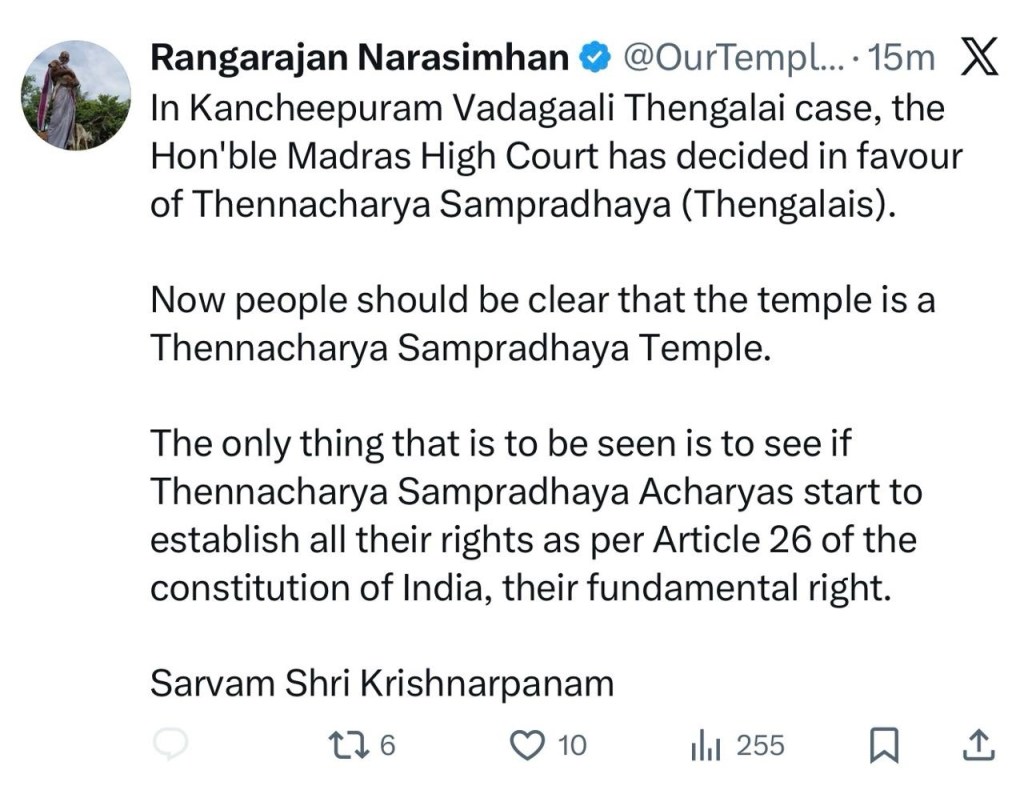
The High Court passed its Verdict today on a long simmering dispute between our two great Sri Vaishnava sects over the Kanchipuram Sri Varadaraja Perumal Temple and, not surprisingly, the first person to celebrate the judgment is from the city of Sri Rangam who has tweeted on X below :
The judgment resolves a long‑standing dispute between Vadakalai and Thenkalai sects over ritual and hymn‑chanting rights at the Sri Varadaraja Perumal / related Kanchipuram shrine, holding that the temple’s denominational character is Thennacharya (Thengalai) rather than Vadakalai or “common” Vaishnavite. This means that in matters such as prabandham recitation, sequencing of goshti, and front‑row positions, the Thennacharya/Thengalai customs enjoy primacy, and any participation by others must accommodate that primacy.
The X post above is worded in such a way as to read as if it is a clarion call to the Tenkalai Sampradaya Acharyas “to start to establish all their rights as per Article 26 of the Constitution of India, their fundamental right” .
By clarifying the temple as a Thennacharya Sampradaya institution, the court effectively recognizes the sect’s collective right under Article 26 to manage its own religious affairs, rituals, and internal arrangements, subject to public‑order and statutory limits. Practically, the “gravamen” of the judgment is not damages or punishment, but this declaratory recognition of denominational status and ritual precedence, which Thennacharya Acharyas can now invoke to assert or regularize their management and worship practices.
HOW DOES THIS AFFECT THE WORSHIP PRACTICES OF THE TEMPLE ?
This Judgment invokes precedents earlier held per the line of Supreme Court and High Court authority on denominational and temple‑ritual rights under Article 26, to the effect that once a temple or endowment is shown to belong to a particular denomination or sub‑denomination, that group has a protected right to manage essential religious practices, subject only to limited regulation by the State.
So, Rangarajan Narasimhan through his X post is only underscoring the above position to secure to the full hilt the advantage that Article 26 Right bestows.
This hard-ball attitude shown by an activist as aggressive a Sri Vaishnava as Sri Rangarajan Narasimhan is known to be is bound to raise immediately fears in the mind of the Vadakalai sect that has got the wrong end of the judicial stick in this litigation.
The fear uppermost now in the Vadakalai mind is : Does this verdict mean that the Varadaraja Temple will have all its Vadakalai character totally erased ? Will the idol of the main deity now bear the Tenkalai naamam or Vadakalai naamam ? Will all Vadakalai symbolism, sacraments and ecumenical marks inside the temples now be revamped wholesale and replaced with the Tenkalai Sampradaya substitutes?
Prima facie , notwithstanding the invocation of Article 26 rights as consequence of the judgment, the verdict does not mean that the entire Vadakalai character or historical associations of the Varadaraja Temple will be totally erased.
The judgment affirms the temple’s denominational character as Thennacharya (Thengalai) for the purposes of establishing the rights and primacy of Thengalai customs related to certain ritual and management practices, particularly in the conduct of prabandham recitation, processions, and worship protocols. However, it does not order the removal of Vadakalai traditions or practices entirely—existing Vadakalai participation, including the priestly thathacharyar family and some ceremonial rights, have historically coexisted due to the temple’s layered history.
Regarding the naamam (sectarian mark) on the main deity: There is no publicly reported directive from the court requiring a change from Vadakalai to Thengalai style of naamam on the idol, nor any order specifically about the physical marks of the deity. The temple’s iconography, ritual marks, and symbols typically reflect long-standing practice, and changes would likely require further administrative or consensual action, not a single verdict.
Thus, unless the temple management now voluntarily shifts to Thengalai symbolism for the deity’s naamam, the existing Vadakalai or composite features might continue, and disputes on such visible markers may persist, requiring further clarification from HR&CE or civil court.
The fundamental ritual primacy and management is affirmed for Thengalai/Thennacharya Sampradaya; total erasure of Vadakalai features or mandates for iconographic changes have not been judicially ordered at this time.
WILL THE VADAKALAI SECT NOW APPEAL THIS VERDICT ?
There is a strong likelihood it will since this great Temple of Kanchipuram is regarded as the last religious bastion of Sri Desika Sampradayam which is at the very heart of the Vadakalai philosophical and theological tradition. If Kanchipuram is lost, within a few decades, Sri Vaishnavism will soon lose all traces of its unique “ubhaya vedanta” nature — the blended beauty and sublimity of TamilIan and Sanskritic culture.
The Vadakalai camp lawyers will now go into a huddle and probably assess the pros and cons of going on appeal to the Supreme Court . When they will decide on a strategy is anyone’s guess .
WHAT COULD BE THE CONTOURS of AN APPEALS STRATEGY?
The temple authorities (and possibly HR&CE or affected Vadakalai parties) can appeal, and several legal grounds are reasonably foreseeable. None guarantees success, but together they sketch the likely appellate strategy.
Key likely grounds:
- Errors in treating temple as “denominational”
- Argue that Varadaraja Perumal Temple functions as a major public temple with mixed-sect history, not as an institution “belonging” to a single denomination, so Article 26 denominational protection was overstretched.
- Contend that historical materials show substantial Vadakalai participation and endowments, so exclusivist Thennacharya character is factually overstated and legally unsustainable.
- Misreading / overextension of earlier decrees
- Say earlier civil-court decrees (Srinivasachariar line etc.) were confined to specified mirasi rights and particular festivals or sub‑shrines, not a blanket declaration of Thennacharya control over the whole temple.
- Argue that the High Court wrongly treated those old findings as conclusively fixing present-day denominational status, instead of allowing for changes in usage and subsequent administrative arrangements.
- Failure to consider change of circumstances and practical manageability
- Plead that over decades, temple practice has evolved with shared or rotational participation, and erasing that in favour of one sect upsets long-settled expectations and public-order concerns.
- Emphasise that courts should prefer workable power‑sharing or regulatory schemes rather than rigidly re‑imposing century‑old patterns that trigger conflict.
- Excessive intrusion into statutory/administrative domain
- Argue that the High Court stepped too far into prescribing ritual/operational details, which should largely lie with trustees and HR&CE under the TN HR&CE Act, subject only to limited judicial review.
- Claim that once core rights are recognised, the mechanics of allocation, scheduling, and crowd-management should be left to statutory authorities, not fixed in writ proceedings.
- Inadequate consideration of equality / non‑discrimination
- Though denominational rights are recognised, authorities could plead that granting near‑exclusive primacy to one sub‑sect in a major public shrine indirectly discriminates against other Vaishnavas and undermines Article 25 rights of the wider body of devotees.
- Frame this not as a direct fundamental‑rights claim between private parties, but as a constitutional limitation on how far Article 26 can be used to constrain general devotees’ access and participation.
- Procedural and jurisdictional objections
- Challenge maintainability of the particular writ (e.g., that issues of title to mirasi/office and detailed facts should only be tried in a civil suit with evidence, not in summary writ jurisdiction).
- Alleged non‑joinder/mis‑joinder of necessary parties (certain families, mathams, or trustees) whose rights are affected but were not heard.
If an appellate court finds any of these persuasive, it could:
- Narrow the effect of the present judgment (e.g., uphold some Thenkalai rights but reject exclusivity or whole‑temple denominational branding).
- Remand issues to a civil court for fresh evidence.
- Or craft a more balanced, rotational scheme for rituals while affirming that BOTH sects retain a recognised place in Varadaraja Temple’s life.
As a Sri Vaishnava (Unknown) myself , I have long been a votary of amity and accommodation to prevail between Tenkalai and Vadakalai . I am also a devotee of Sri Varadaraja Perumal of Kanchi . Only He must show us all a way out of this new chapter of internecine conflict within the broader Sri Vaishnava community.
Sudarshan Madabushi
Thanks a lot. Excellent snd detailed analysis of the past, present and future history of the verdict.Very educative and enlightening.Let us hope peace will prevail in Sri Varadaraja Swamy Temple in the future.Only time can tell whether our hope will become a reality.