Today a reflective morning mood prompted me to think up and ask three pointed questions to the Perplexity AI engine.
The three questions and the Answers obtained are given below in seriatum.
Question No. 1
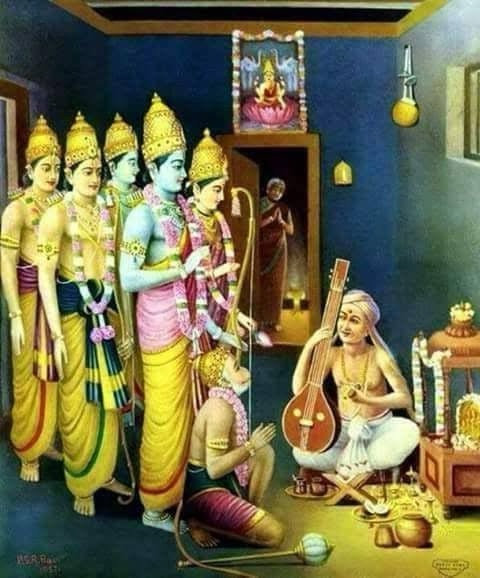
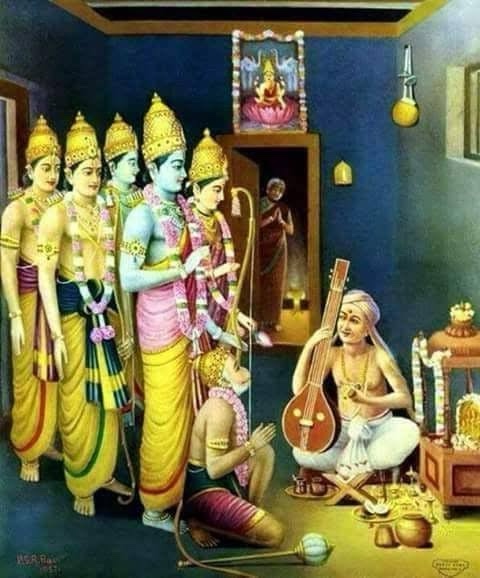
Saint Thyagaraja composed more than a thousand “kritis” out of intense Bhakthi. He was not a musician nor was Carnatic music his career . Music for him was mystic communion with the divine.
Today , musicians and music aficionados thrive on Thyagaraja’s compositions as professional artistes on stage , earning millions of rupees as remuneration for their “kutcheri” all over the world. Many artistes today have made lucrative careers out of Thyagaraja songs.
If Thyagaraja had patent copyright over all his compositions today, how much money would he have potentially earned by way of royalties from the world of Carnatic music? What is the best guesstimate?
ANSWER:
Saint Tyagaraja composed around 700-1,000 kritis, many of which form the core of modern Carnatic kutcheris, often comprising 30-50% or more of a typical concert’s repertoire.
Market Overview
Carnatic music relies heavily on live performances, with Chennai’s Margazhi season alone featuring thousands of kutcheris across major sabhas. Top artists like Sudha Ragunathan and T.M. Krishna command fees around ₹5-10 lakhs per high-profile concert (adjusted for inflation from older data), while mid-tier earn ₹50,000-2 lakhs; global shows add premium pricing. India’s music industry distributed over ₹600 crore in royalties last year, though classical forms like Carnatic represent a small fraction amid Bollywood dominance.
Royalty Estimation
Hypothetical royalties for public performances in India typically run 3% of gross ticket/sponsorship revenue after 15% venue deductions. Assuming 10,000 annual pro kutcheris worldwide (Chennai season ~3,000, plus global/dispersed), average gross ₹2 lakhs each, Thyagaraja share 40% usage, yields ~₹50 crore total live revenue base.
At 3% royalty, that’s ₹1.5 crore annually; scaling for recordings/digital (minor) pushes a guesstimate to ₹2-5 crore per year today.
Key Assumptions
• Concerts: Conservative; actual may exceed with private/corporate events.
• Usage: High dominance in repertoires, per expert consensus.
• No historical claim, pure hypothetical; earnings shared with accompanists in reality.
Question No.2
What usage sources generate most royalties for Carnatic music?
ANSWER
Live performances generate the majority of royalties and income for Carnatic music, as the genre relies almost entirely on kutcheris rather than robust digital or recording streams.
Top Sources
• Live Concerts: Primary revenue via sabha fees, sponsorships, and tickets during seasons like Chennai Margazhi (thousands of events); most artist earnings and hypothetical composition royalties stem here.
• Digital Streaming/Live Streams: Growing post-pandemic (70% of overall Indian music royalties from streaming), but low monetization for Carnatic due to free access culture and niche audience.
• Recordings/CDs: Minimal, with limited sales and poor artist/label payouts; commercial live recordings add little.
Question No. 3
Hypothetically again, from whom or which institution would royalty income flow to Thyagaraja ? And in what conceivable contractual form?
ANSWER
Hypothetically, royalty income for Tyagaraja’s compositions would flow through India’s performing rights organizations (PROs), primarily the Indian Performing Right Society (IPRS), which manages public performance and broadcasting rights for musical works on behalf of composers and publishers.
Primary Institutions
IPRS would act as the key collector, issuing public performance licenses to concert organizers (e.g., sabhas like Music Academy), venues, broadcasters, and streaming platforms for live kutcheris, recordings, or online events. Phonographic Performance Limited (PPL) handles sound recordings separately, but Thyagaraja’s focus would be on underlying compositions via IPRS.
Flow Mechanism
Organizers pay blanket or per-event license fees to IPRS based on tariffs (e.g., percentage of gross revenue), which pools and distributes royalties quarterly using logs, setlists, or usage data from concerts and media. For global use, international reciprocal agreements (e.g., via CISAC) would route foreign royalties back through IPRS.
Contractual Forms
• Membership Agreement: Tyagaraja (or estate) assigns non-exclusive public performance rights to IPRS via a standard membership contract, retaining ownership while authorizing global licensing.
• License Agreements: Event hosts sign IPRS public performance licenses (annual/blanket or event-specific), with terms like upfront fees, audits, and penalties for non-compliance (18% interest + 30% penalty).
• Publishing Assignment: Optional deal with a music publisher for administration, sub-licensing, and mechanical royalties (e.g., recordings), taking 20-50% commission.
************
The Upshot
The upshot of all my above conversations with Perplexity-AI is that finally now I have got a pretty approximate idea of the quantified total estimated Debt that the world of Carnatic Music morally owes to Sri Thyagaraja.
In other words, I now can imagine a broad picture of Sri Thyagaraja — i.e. if were alive today in flesh and blood and perhaps also as commercial-minded as I see our musicians are today in India across the board — rightfully coming forward to claim settlement of the debt owed to him by the Carnatic Music world, based on retrospective cumulation and compounding of the sum of royalties not paid to him all these years for his “kritis”. Perplexity-AI engine helped me also to do the back-of-the-envelop maths on this as below:
Indian courts reject perpetual or moral rights revival for ancient compositions. Copyright doesn’t apply retroactively to public domain works like Tyagaraja’s (pre-1920s Indian law), so no legal claim exists. So, the Carnatic Music world can heave a big collective sigh of relief!
However, hypothetically assuming new moral/publishing rights, Thyagaraja’s cumulative demand would cover ~180 years (1847–2026).
Tyagaraja lived from 1767 to 1847 (about 80 years), with major compositions spanning roughly 1800–1847; modern Carnatic usage greatly surged post-1900 via disciples and sabhas.
Annual royalties today that Thyagaraja could potentially earn is ~₹2-5 crore (as estimated above).
Projecting backward with conservative growth: negligible pre-1950 (<₹1 crore total), ramping via inflation (6-8% avg), kutcheri expansion (post-1970s), and digital (2010s)—yields ₹200-500 crore cumulative in present value (discounted at 5%). Undiscounted nominal sum: ₹1,000-2,000 crore.
Thus, the total outstanding Debt owed today by Carnatic Music artistes and Sabha aficionados — after they have made merry earning a livelihood out of Thyagaraja “kritis” for more than a century now — is an astounding amount of ₹. 1.25 billion … at the very least.
It is my hope that all Vidwans, Sabhas, corporate sponsors, students and Rasikas — everyone who looks upon Thyagaraja Bhakthi as something that can be monetized too in the frenetic marketplace of classical performing arts— will all remain however humble and mindful out of a sense of noblesse oblige; out of realization arising from deep collective moral indebtedness to the spirit of Saint Thyagaraja.
“nidhicAla sukhamA rAmuni sannidhi sEva sukhamA nijamuga balku manasA”
Sudarshan Madabushi