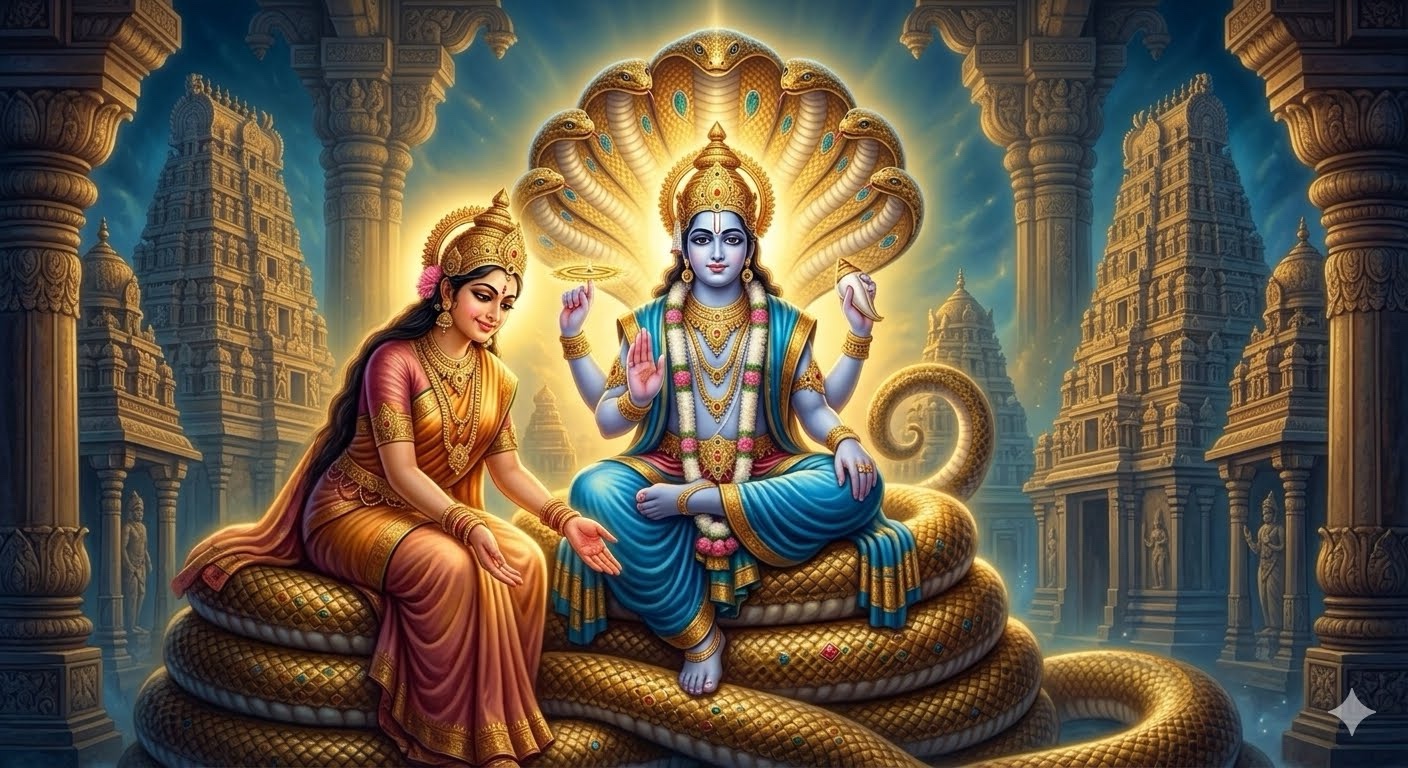
An Essay on the Ontology of Daya, the Lakshmi Tattva, and the Puruṣakāra Doctrine
“Does Bhagavan experience the suffering of the jīvas?
An exploration of Divine Compassion, the Lakshmi tattva, and the Puruṣakāra doctrine in Vadakalai Viśiṣṭādvaita Vedānta.
By M.K. Sudarshan
August 9, 2026: Chennai, India

Prologue: The Theological Puzzle
The question is deceptively simple, yet it cuts to the very heart of Viśiṣṭādvaita metaphysics:
“If the entire universe—cit and acit—is Bhagavan’s śarīra (body), and if Bhagavan is the śarīrī (Inner Controller) of all existence, then does Bhagavan experience the karmic suffering of the jīvātmās who constitute His body?”
On one hand, the śarīra-śarīrī relationship implies an intimate, inseparable connection between Bhagavan and the jīvas. If the jīvas suffer, how can Bhagavan remain untouched?
On the other hand, Bhagavan is Śuddhasattva—pure, transcendental existence, untouched by karma, avidyā, or material guṇas. If Bhagavan suffers, He would cease to be divine.
This essay explores how Viśiṣṭādvaita Vedānta, particularly through the Vadakalai tradition and Vedānta Deśika’s Daya Śatakam, resolves this paradox through the Lakshmi tattva, the Puruṣakāra doctrine, and the ontological reality of Divine Empathy (Daya).
I. The Śarīra-Śarīrī Relationship: Intimacy Without Identification
A. The Basic Doctrine
In Viśiṣṭādvaita, the relationship between Bhagavan (Nārāyaṇa) and the universe (cit and acit) is understood through the śarīra-śarīrī bhāva (body-soul relationship):
- Bhagavan is the śarīrī (Inner Controller, Owner, Supporter).
- The universe (cit and acit) is the śarīra (body, instrument, owned).
- The relationship is inseparable (apṛthak-siddha)—like the soul and body in a human being.
Key implication:
- The jīvas are not separate from Bhagavan—they are His body.
- But the jīvas are not identical to Bhagavan—they are distinct from Him as body is distinct from soul.
B. The Problem of Suffering
If the jīvas are Bhagavan’s body, and if they suffer due to karma, then:
- Does Bhagavan experience their suffering?
- If yes, then Bhagavan is affected by material karma—contradicting His Śuddhasattva nature.
- If no, then the śarīra-śarīrī relationship seems impersonal—how can Bhagavan be compassionate if He does not feel the pain of His body?
This is the theological tension that has troubled Viśiṣṭādvaita thinkers for centuries.
II. The Nature of Bhagavan: Śuddhasattva and Transcendence
A. Bhagavan is Śuddhasattva
In Viśiṣṭādvaita, Bhagavan’s essential nature (svarūpa) is Śuddhasattva:
- Śuddhasattva = pure, transcendental existence, untouched by material guṇas (sattva, rajas, tamas).
- Material suffering arises from rajas (passion) and tamas (ignorance).
- Therefore, Bhagavan cannot experience material suffering—just as darkness cannot touch the sun.
B. Bhagavan’s Compassion is Not Based on Empathy
In human experience, compassion arises from empathy—we feel another’s pain because we have experienced similar pain ourselves.
But Bhagavan’s compassion is different: Human Compassion Bhagavan’s Compassion Based on empathy (feeling another’s pain) Based on svabhāva (essential nature) Requires personal experience of suffering Does NOT require personal experience Arises from material identification Arises from Śuddhasattva nature Limited, conditional Unlimited, unconditional
This creates a problem:
- Human compassion requires empathy—we feel another’s pain.
- Bhagavan cannot experience material suffering—so how can He have compassion?
- If Bhagavan’s compassion is not based on empathy, is it truly compassion—or is it merely a divine attribute without genuine feeling?
III. The Lakshmi Tattva: The Vadakalai Resolution
A. The Tēṅkalai vs. Vadakalai Debate
The Tēṅkalai and Vadakalai schools of Viśiṣṭādvaita differ fundamentally on the nature of Lakshmi: Aspect Tēṅkalai Position Vadakalai Position Lakshmi’s NatureJīvātma (exalted, immaculate soul) Viṣṇu tattva (co-eternal with Īśvara) Lakshmi’s RoleMediatrix (separate entity interceding) Alter ego of Bhagavan (externalized Daya) EmpathyGenuine empathy (as jīvātma, she feels jīvas’ pain) Divine attribute (Dayā personified as Lakshmi) PuruṣakāraExternal mediation (separate from Bhagavan) Internal projection (Bhagavan’s own compassion) Mokṣa-grantingCannot grant mokṣa (only intercedes) Can grant mokṣa independently (like Nārāyaṇa)
B. The Vadakalai Position: Lakshmi as Co-Eternal with Īśvara
In the Vadakalai understanding:
- Lakshmi is NOT a jīvātma—she is Viṣṇu tattva, co-eternal with Īśvara.
- Lakshmi is inseparable from Nārāyaṇa—they are substantially one (though distinct in person).
- Lakshmi is the externalized projection of Bhagavan’s Daya—she is Divine Empathy personified.
Key insight:
“Lakshmi is not a separate entity mediating between Bhagavan and jīvas—she is Bhagavan’s own compassion projected as a divine person.”
IV. The Puruṣakāra Doctrine: Divine Empathy in Action
A. What is Puruṣakāra?
Puruṣakāra literally means “recommendation” or “intercession.” In Sri Vaishnavism, it refers to Lakshmi’s role as mediatrix between Bhagavan and the jīvas:
- The jīvātma surrenders (prapatti) to Bhagavan.
- Lakshmi intercedes on behalf of the jīvātma.
- Bhagavan grants grace (anugraha) through Lakshmi’s mediation.
B. The Vadakalai Understanding: Puruṣakāra as Bhagavan’s Own Daya
In the Vadakalai view, Puruṣakāra is not external mediation—it is Bhagavan’s own compassion acting on behalf of jīvas:
The Process:
- Bhagavan’s Daya (Divine Compassion) is an ontologically real attribute—not a metaphor.
- Daya is personified as Dayādevī/Lakshmi—she is Bhagavan’s own compassion projected as a divine person.
- Lakshmi as Puruṣakāra is not a separate entity—she is Bhagavan’s Daya acting on behalf of jīvas.
- Grace flows to the jīvātma—through Bhagavan’s own compassion, not through external mediation.
C. The Varaha Charama Śloka: A Case Study
The Varaha Charama Śloka exemplifies this dynamic:
The Context:
- Bhūdevi (Earth) approaches Lord Varaha and expresses concern for the suffering of all beings.
- In Sri Vaishnavism, Bhūdevi is Lakshmi in her form as Earth—representing the universal mother who feels the suffering of all beings.
- Lord Varaha responds with the Charama Śloka—promising liberation to those who remember Him at death.
The Theological Point:
- Lakshmi (as Bhūdevi) feels the suffering of all beings—this is empathy.
- She intercedes with Varaha—this is Puruṣakāra.
- Varaha responds with grace—this is Daya.
But in the Vadakalai view:
- Lakshmi’s empathy is not separate from Bhagavan’s Daya—it is Bhagavan’s own compassion projected as a divine person.
- Puruṣakāra is not external mediation—it is Bhagavan’s own compassion acting on behalf of jīvas.
V. Vedānta Deśika’s Daya Śatakam: The Ontological Reality of Divine Empathy
A. The Uniqueness of the Daya Śatakam
The Daya Śatakam is a hundred-verse hymn composed by Vedānta Deśika in praise of Daya (Divine Compassion):
Key features:
- First hymn in religious literature to praise Daya as a deity (Dayādevī).
- Daya is personified as a Consort of the Lord—alongside Lakshmi, Bhūdevi, and Nīlādevi.
- Daya is the supreme attribute of Bhagavan—greater than aiśvarya (sovereignty) and jñāna (wisdom).
B. Daya is Ontologically Real
The Daya Śatakam teaches that Daya is not a metaphor—it is ontologically real:
Key teachings:
- Daya is the Empress of all divine attributes—without Daya, all other attributes (justice, sovereignty, wisdom) would become faults (they would punish us for our sins).
- Daya is personified as Dayādevī—she is Bhagavan’s own compassion projected as a divine person.
- Daya is causeless (anupadhi)—it arises from Bhagavan’s svabhāva, not from experiencing suffering.
- But Daya is also responsive—it responds to the suffering of jīvas through Lakshmi’s Puruṣakāra.
C. The Paradox of Daya: Causeless Yet Responsive
The Daya Śatakam presents a profound paradox:
- Daya is causeless—it arises from Bhagavan’s svabhāva, not from any external cause.
- But Daya is responsive—it responds to the suffering of jīvas and grants them grace.
How is this possible?
The Vadakalai resolution:
- Daya is both transcendent and immanent—it is Bhagavan’s svabhāva (transcendent) and Lakshmi’s Puruṣakāra (immanent).
- Lakshmi is the externalized projection of Daya—she is Bhagavan’s own compassion acting on behalf of jīvas.
- Thus, Daya is both causeless (arising from svabhāva) and responsive (through Puruṣakāra).
VI. The Resolution of the Paradox: Does Bhagavan Suffer?
A. The Direct Answer
No, Bhagavan does NOT experience the material suffering of the jīvātmās.
- Bhagavan is Śuddhasattva—pure, transcendental existence, untouched by material guṇas.
- Material suffering arises from rajas and tamas—which cannot touch Śuddhasattva.
- Therefore, Bhagavan does NOT experience material suffering—just as darkness cannot touch the sun.
B. But Then How Does Bhagavan Have Compassion?
The answer lies in the Lakshmi tattva and the Puruṣakāra doctrine:
- Bhagavan’s Daya (Divine Compassion) is ontologically real—it is not a metaphor, but a real divine attribute.
- Daya is personified as Dayādevī/Lakshmi—she is Bhagavan’s own compassion projected as a divine person.
- Lakshmi as Puruṣakāra is not a separate entity—she is Bhagavan’s Daya acting on behalf of jīvas.
- Thus, Bhagavan’s compassion is effective—not because He experiences suffering, but because His Daya is externalized as Lakshmi, who acts as Puruṣakāra for jīvas.
C. The Theological Synthesis
The Vadakalai position (via Vedānta Deśika): Aspect Resolution
Does Bhagavan suffer?No—He is Śuddhasattva, untouched by material suffering.
Does Bhagavan have compassion?Yes—His Daya is ontologically real, not a metaphor.
How is Daya effective?
Through Lakshmi as Puruṣakāra—she is Bhagavan’s own compassion projected as a divine person.
Is Lakshmi separate from Bhagavan?No—she is Viṣṇu tattva, co-eternal with Īśvara, substantially one with Nārāyaṇa.
Is Daya causeless or responsive?
Both—it is causeless (arising from svabhāva) and responsive (through Puruṣakāra).
VII. Implications for Soteriology: The Path of Prapatti
A. The Role of Lakshmi in Prapatti
In the Vadakalai understanding of prapatti (surrender):
- The jīvātma surrenders to Bhagavan (through an Ācārya).
- Lakshmi, as Puruṣakāra, intercedes on behalf of the jīvātma.
- Bhagavan’s Daya grants grace—through Lakshmi’s mediation.
- The jīvātma is liberated—not by its own effort, but by Bhagavan’s grace, mediated through Lakshmi.
Key point:
“Lakshmi is not a separate entity mediating between Bhagavan and jīvas—she is Bhagavan’s own compassion ensuring that grace flows to the jīvātma.”
B. The Assurance of Salvation
The Vadakalai doctrine provides assurance of salvation:
- Bhagavan’s Daya is causeless—it does not depend on the jīvātma’s merit.
- Lakshmi’s Puruṣakāra is guaranteed—she is Bhagavan’s own compassion, always acting on behalf of jīvas.
- Therefore, the jīvātma can surrender with confidence—knowing that Bhagavan’s Daya, through Lakshmi, will grant grace.
VIII. Conclusion: The Mystery of Divine Compassion
The question we began with was:
“Does Bhagavan suffer the karmic distress experienced by the mortal jīvātma?”
The answer is:
“No, Bhagavan does NOT suffer—but His Daya (Divine Compassion) is ontologically real, externalized as Lakshmi, who acts as Puruṣakāra for the jīvātmās.”
This is the profound theological synthesis of Vadakalai Viśiṣṭādvaita:
- Bhagavan is transcendent (Śuddhasattva, untouched by material suffering).
- But Bhagavan is also immanent (His Daya is externalized as Lakshmi, who feels the pain of jīvas).
- Lakshmi is not a separate entity—she is Bhagavan’s own compassion projected as a divine person.
- Puruṣakāra is not external mediation—it is Bhagavan’s Daya acting on behalf of jīvas.
This is the genius of Vedānta Deśika’s Daya Śatakam:
“Daya is both causeless (arising from svabhāva) and responsive (through Puruṣakāra)—a divine mystery that reflects the simultaneous transcendence and immanence of Bhagavan.”
Epilogue: The Theological Beauty of the Vadakalai Position
The Vadakalai position is theologically superior to the Tēṅkalai position because:
- It preserves Bhagavan’s transcendence (He does NOT suffer).
- But it also preserves Bhagavan’s immanence (His Daya is effective through Lakshmi).
- It avoids the problem of making Lakshmi a jīvātma (which would diminish her divinity).
- It affirms the ontological reality of Divine Empathy (Daya is not a metaphor).
This is the profound insight of Vedānta Deśika:
“Divine Compassion is not a weakness—it is the supreme attribute of Bhagavan, personified as Lakshmi, ensuring that grace flows to the suffering jīvātmās.”
And thus, the paradox is resolved:
“Bhagavan does NOT suffer—but His Daya, through Lakshmi, ensures that no jīvātma suffers without recourse to divine grace.”
References
- Vedānta Deśika’s Daya Śatakam (with commentary by D. Ramaswamy Ayyangar)
- Rāmānuja’s Śrī Bhāṣya (on the Brahma Sūtras)
- Sri Vaishnavism: The Aṣṭa-daśa Bhedas (doctrinal differences between Vadakalai and Tēṅkalai)
- The Philosophy of Viśiṣṭādvaita (S. S. Raghavachar)
- Daya Satakam of Vedanta Desika (various commentaries)
- Lakshmi as Mediatrix in Sri Vaishnavism (various Sri Vaishnava sources)
- Bhagavān’s Compassion and the Problem of Suffering (Jīva Gosvāmi’s Bhakti Sandarbha)
Author’s Note
This essay is dedicated to the memory of Vedānta Deśika, whose Daya Śatakam remains the most profound theological exposition of Divine Compassion in the Viśiṣṭādvaita tradition. May his Daya guide all suffering jīvātmās to the feet of Śrīman Nārāyaṇa.
End of Essay
