By M.K.Sudarshan
September 7, 2026: Chennai, India
“Are algorithms causing a structural collapse of human consciousness?
Explore a profound spatio-temporal dialogue between an Unknown Sri Vaishnava and a Himalayan Maharishi, offering a raw Vedantic diagnosis of our modern attention-span deficit and the ancient acoustic technology of “Smriti Balam” that can cure it.”

The air in the foothills of the Himalayas did not merely cool the skin; it stilled the breath. Moving past the tangled canopy of ancient Devadaru trees, the scent of wild herbs and wet earth grew thick. The world left behind—with its mechanical clocks, fractured noise, and desperate speed—seemed to dissolve into the mist rising from the fast-flowing glacial streams below.
Deep within the dark forest, where the light filtered down in pale, golden shafts, stood the ashram. It was a simple dwelling of mud, thatch, and timber, completely open to the elements. Seated upon a mat of Kusha grass, motionless as the mountains themselves, was the Maharishi. His eyes were closed, his presence radiating a deep, unfathomable Shanti.
As the traveler approached, the dry leaves beneath his feet gave way with a soft crunch. The Sri Vaishnava, wearing the sacred marks of his lineage, felt a profound wave of recognition wash over him. This was the exact spot, the exact face, and the exact presence that had visited him in his dream only hours before waking. A bridge across the vast spatio-temporal expanse had brought him here, to the feet of ancient wisdom. The Maharishi slowly opened his eyes. They were bright, clear, and unburdened by time. He gestured softly to a wooden plank before him.
THE MAHARISHI: “Welcome, child of the future. You carry the marks of devotion, yet your mind bears the heavy burden of a world I have not seen. The Spatio-temporal winds have brought you far to this valley. Tell me, what brings an Unknown Sri Vaishnava so far from his home to these quiet woods? What burns within you?”
THE UNKNOWN SRI VAISHNAVA: “O Gurudeva, I bow at your feet. I have crossed time and space because a vision led me to your light. I come seeking your wisdom on what I believe is the most crippling, enervating mental infirmity afflicting mankind in the world from which I hail.
In my time, ‘attention span deficit’ has become a worldwide mental affliction. The symptoms of this disorder are many and varied: we see deficient listening skills, fretful and stilted conversations, and an utter inability to read, compose, or write cogently long letters, essays, or books. My contemporaries rely prolifically on social media platforms to communicate with an acronymic lingo, showing a complete disdain for grammar, syntax, and diction. There is an inability to let others speak without constantly interrupting them, an inadequate application of the mind, and an over-dependence on gadgets, gizmos, and artificial intelligence tools to accomplish complex tasks. Tasks that otherwise would require serious ideation, the formulation of ideas, and deep conceptions are outsourced. These are mentally debilitating predilections.
This attention deficit syndrome seemed to be a mild and even rather amusing nervous tic of the condition of millennials about twenty years ago. But that nervous tic, twenty years later among the generations we call Gen Z and now Gen Alpha, threatens to become a permanent disability of sorts.
Parents, teachers, employers, and psychologists worldwide worry and wring their hands about it, but hardly anyone is able to come up so far with an accurate, credible diagnosis of it. Nor does anyone seem to have the faintest clue about how to effectively combat this enervating mental condition. Most simply shrug their shoulders in an attitude of giving up on our young generations, leaving them to fashion a brave new world in the way they wish to do as they please.
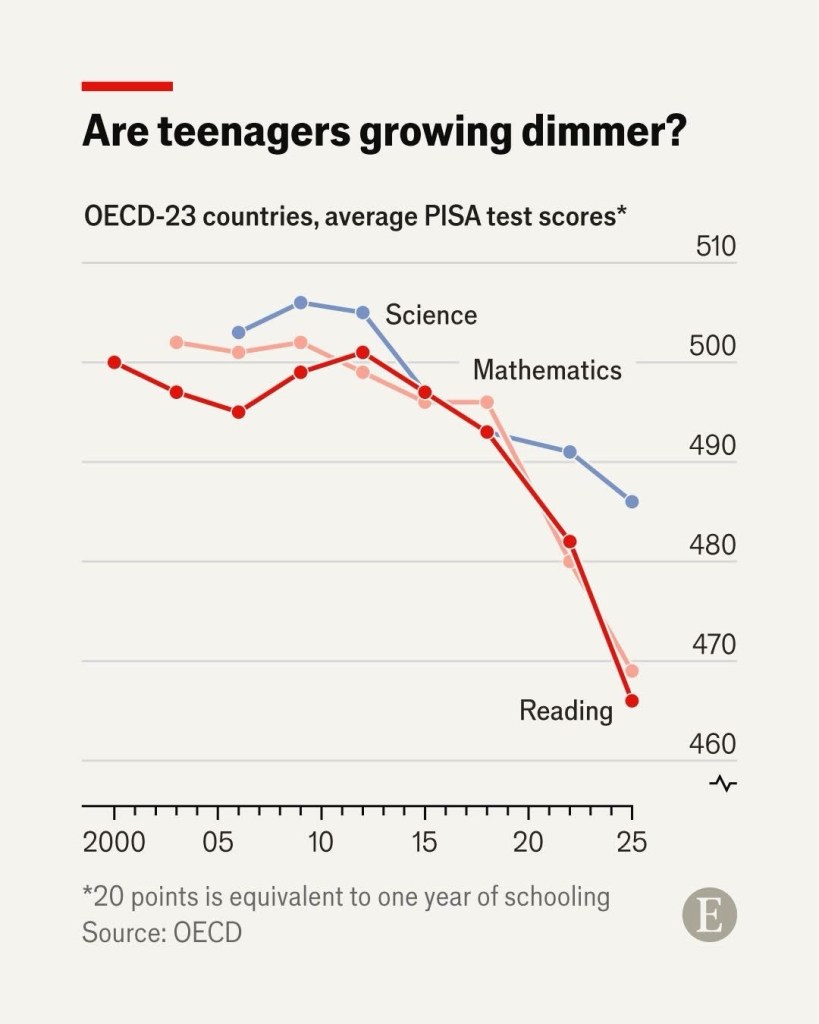
The young generations justify themselves with a quip: ‘If an AI algorithm can in a jiffy solve my needs and challenges of all communication—reading, writing, reflecting, and even abstract thinking—why on earth should I worry about Attention-span deficit? What’s the big deal here?!’
Tell me, Holy One, how do we answer them? What is the true diagnosis of this disease?”
THE MAHARISHI: “Ah. You speak of a famine of the spirit, a structural collapse of the Antahkarana—the inner psychological instrument. Your young ones make a fatal philosophical error. They confuse the mere retrieval of information with the actual assimilation of knowledge.
The human mind is not a vessel to be filled by external mechanical means; it is a sacred fire that must be tended. In the Yoga Sutras and our ancient Vedantic psychology, the mind is a four-fold instrument. There is the Manas, the sensory, oscillating mind that jumps from object to object; the Buddhi, the discriminating intellect; the Ahamkara, the ego; and the Chitta, the deep storehouse of memory and consciousness.
What your world has done with its algorithms and gadgets is over-stimulate the Manas. It feeds the mind constant, fragmented, sensory data packets. This scatters the consciousness, creating Chitta Vikshepa—a state of perpetual distraction.
When your youth ask, ‘What’s the big deal if a machine can think for me?’, they do not realize that deep attention is a cognitive muscle. The human brain operates on the law of the universe: that which you do not use, you lose. Long-form writing, deep reading, and sustained focus are not just ways we express thoughts—they are the very fires in which thoughts are forged. The friction of trying to find the right word or connecting two complex conceptions forces the soul to build dense pathways of understanding.
When you use a machine to bypass this friction, you eliminate the mental workout. It is the spiritual equivalent of using a motorized chariot when your legs function perfectly. Eventually, the muscles will atrophy. You will be left intellectually hollowed out, possessing an empty Antahkarana. You will become entirely dependent on the corporations and machines that hold the summaries of the world. Whoever controls the summary controls your worldview. You will hand over the steering wheel of human consciousness to automated systems, demoting mankind from creators to passive consumers of your own civilization. This is the ‘big deal’ they do not see.”
THE UNKNOWN SRI VAISHNAVA: “Your words strike at the absolute truth, Gurudeva. Hearing you describe this cognitive conditioning reminds me deeply of the foundational pillars of our own heritage.
One of the fundamental building blocks of Vedic education is the grueling training of ‘smriti balam’—the strength of memory. In a Veda Pathashala, a student undergoes eight to twelve years of grueling vedadhyaaya, which consists mainly of the oral transmission of Veda shakha texts by a guru to a sishya. The sessions are repetitive, known as the ‘sandhai’ method of a ceaseless classroom drill. The student must listen to what the master is chanting and repeat it faithfully without error, again and again and again. No reference to printed textual material is allowed.
Memorization takes place over the years of the entire Veda shakha—so voluminous that a printed document of the same would fill more than four thousand pages of A4 sheets printed on both sides. This entire volume gets committed indelibly to memory through the method of sheer ‘paying unrelenting, intense, and cerebrative attention’ to what the curriculum demands: listening to chants, word for word, syllable for syllable, with absolute attention to metrical rhythm, correct intonation, and an absolute fidelity to the word, or ‘pada’.
The whole of Vedic traditional learning is thus oriented to human attention-span enhancement, rather than the opposite, which is the outsourcing of the attention span.
Yet, Vedic learning in India since colonial times has been in severe decline. It was, and continues to be, demeaned by the modern intellect as ‘Brahminical’, ‘anachronistic’, and ‘valueless to modernity’. I see now that the devaluation of this traditional method of Vedic learning has in large part led to the widespreaded-ness of what in our present day we see as these ‘attention-span deficit’ afflictions and disorders.”
THE MAHARISHI: “Malyavan! You have spoken a profound truth. The decline you speak of is the direct karmic debt of replacing a system that cultivated deep Shravana—radical, acute listening—with a system that prioritizes superficial, machine-like regurgitation.
The Sandhai method is not blind rote-learning, as the modernists ignorantly claim. It is an exercise in absolute, unyielding presence. You cannot repeat a complex metrical rhythm or a precise Svara (intonation) if the mind wanders for even a split second. The vibration, rhythm, and structure of the text alter the very consciousness of the boy who chants it. The knowledge becomes part of his nervous system; he becomes the knowledge.
By dismantling this sophisticated system of cognitive engineering under the guise of progress, your modern society threw out the baby of profound cognitive development with the bathwater of social rigidities. Without Smriti Balam (memory power), the Buddhi (intellect) has no stable ground to stand on. A mind without memory cannot meditate; a mind that cannot meditate cannot achieve Viveka—the discernment between the real and the unreal. If humanity does not rebuild Smriti, you will face a civilizational shift where humans possess the volatile, short-term desires of animals, while machines hold the repository of structured human wisdom.”
THE UNKNOWN SRI VAISHNAVA: “It is a tragedy of monumental proportions, Gurudeva. I believe that the Veda Pathashala system of education itself should be left alone as a specialism for those who wish to preserve the texts in their purest form. What is truly required is to bring a few elements of this Vedic pathashala regime into the secular educational system’s classroom. A few schools, like the Sri Ahobila Mutt Oriental and Chinmaya Mission schools, are already doing this: children are taught orally to imbibe fully chapters from the Bhagavad Gita. That surely has a most wholesome effect in instilling in them the virtues of a robust attention span.
Unfortunately, in the so-called Constitutional regime of a so-called secular India today, any attempt to blend Vedic methods of teaching into school and college classrooms will immediately be condemned as attempts to ‘Saffronise’ or ‘Sanskritise’ the Indian education system. The whole idea then gets shot down by liberal-secularist brigades that politicize it as a treacherous Hindutva agenda. It would no longer be regarded as a problem of how to address the ‘attention span deficit’ of young minds, but as how to resist “Hindu majoritarianism”. The political gridlock seems absolute.”
THE MAHARISHI: “The politics of your age are like dust storms in the desert—they blind men to the water right in front of them. They mistake the cultural vehicle for the cognitive technology. If they cry out against the sacred texts, then the mechanics of the technology must be preserved by shifting the form.
The brain does not develop Chitta Ekagrata (one-pointedness) merely because the words are religious; it develops it because the text is complex, rhythmic, and orally transmitted. If the secular classrooms reject the Gita, let them apply the Sandhai drill to secular literature. Let the children orally repeat, memorize, and declaim complex, rhythmic poetry—the verses of your great modern seers, classical literature, or even the very words of your nation’s Constitution chanted in rhythmic cadence. Frame it not in the language of theological debate, but in the language of health, wellness, and neuro-plasticity training.
If schools introduce fifteen minutes of daily acoustic cognitive drilling, the political weapon is neutralized, but the cognitive anvil remains. The Manas will still be tamed. But tell me, dear time-traveler, is the classroom the only place where this fire has died? What of the home?”
THE UNKNOWN SRI VAISHNAVA: “Alas, Gurudeva, the rot runs even deeper within the home. In the social churn, the pulls and pressures, and all the heaving, stress, and strains that present-day nuclear families and couples experience to make ends meet in sustainable careers, jobs, and livelihoods, parents themselves suffer from attention deficits of another dangerous kind.
In a family where both father and mother are compelled to pursue careers, or choose to do so, the children themselves suffer from a parental attention deficit. Parents are caught in an unrelenting grind, their minds perpetually scattered by the anxieties of their livelihoods. Even when they are physically present, they are mentally absent, checking their digital tethers.
When human attention is withdrawn from the child, an emotional vacuum is created. The parents, lacking the emotional surplus and cognitive bandwidth to sit with their children, hand them a smartphone or a digital tool. The algorithm becomes the surrogate parent, the surrogate guru. The attention deficit of our children is but a mirror reflecting the fragmented attention of the parents.”
THE MAHARISHI: “Then the Rta—the cosmic and natural order of the home—has been broken. The Grihastha Ashrama (the householder stage) was created to be the backbone of society, designed for Dharma and the nurturing of the next generation’s consciousness. If the home becomes merely an extension of the corporate factory floor, driven entirely by Rajasic anxiety and greed, the soul of the family dies.
You cannot fix the reflection in the mirror without fixing the object casting it. If parents are to save their children, they must first reclaim their own minds. They must practice Prana Pratishtha of time—consecrating a non-negotiable window each day where they are entirely present, casting away their digital tethers, anchoring themselves in pure Shravana to their children. They must replace the screen with the ancient oral tradition of storytelling, forcing both parent and child back into the present moment. They must exercise Viveka to simplify their material desires, recognizing that buying back their mental bandwidth to nurture their children’s souls is worth more than any luxury the modern world can offer.”
The Maharishi fell silent, the crackle of the ashram’s small dhuni fire the only sound remaining in the vast forest. He looked deeply into the eyes of the Unknown Sri Vaishnava.
THE MAHARISHI: “You have your diagnosis, dear time-traveler. The ancient tools are not dead; they are merely waiting for courageous minds to strip away the political noise and apply them to the wounds of your age. Go back across the expanse of time. Carry this light into your fractured world.”
The Unknown Sri Vaishnava bowed his head to the earth, touching the dust at the Rishi’s feet. When he opened his eyes, the scent of the Devadaru trees was gone, replaced by the faint morning light entering his room. The dream had ended, but the dialogue was etched indelibly into his Smriti, a timeless compass for a distracted world.
(Concluded)