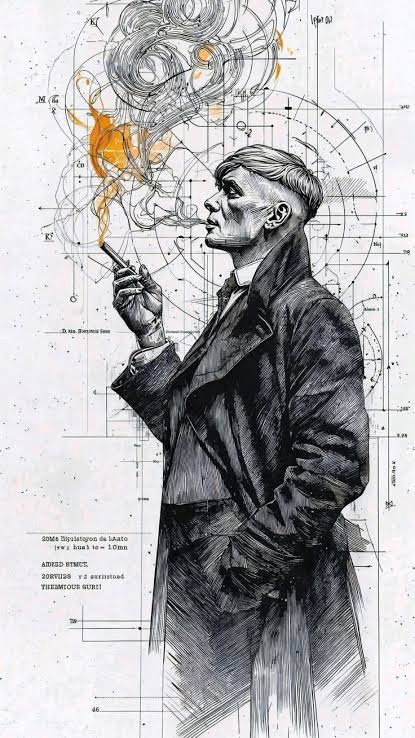
by M.K. Sudarshan
September 10, 2026: Chennai, India
Prologue: The Garrison Briefing
The air inside the private room of the Garrison is thick with the acrid stench of cut tobacco and cheap gin. At the head of the long oak table, Tommy sits perfectly still, the brim of his tweed flat cap tilted forward, casting a heavy shadow over eyes that have seen too many men die for a lie. He doesn’t look up when Arthur slams a heavy leather ledger onto the table, the pages stained with ink and grease.
“The papers in London are calling it a bloody disaster, Tommy,” Arthur spits, his voice raw, pacing the length of the floor. “They’re saying our ships are gone. Sunk in the canal. The public’s out in the streets screaming for blood, ready to march into another war before the week is out.”
Tommy draws slowly on his cigarette, the tip glowing a sharp, brief orange in the gloom. He exhales a long, thin stream of gray smoke toward the ceiling, watching it dissolve into the rafters.
“Let them scream, Arthur,” Tommy says, his voice a quiet, freezing calm that stops his brother mid-stride. “The ships are still afloat. I know it, the admirals know it, and the bastards who fired the guns know it.”
“Then why aren’t we telling the truth of it?” Arthur roars, leaning over the table, his knuckles turning white against the wood. “Why let them print the fiction?“
Tommy finally raises his head, his gaze cutting through the haze like a razor. A faint, humorless smile touches the corner of his mouth.
“Because the truth doesn’t pay the printers, Arthur. And it damn sure doesn’t keep the constables looking the other way. We don’t sell the truth in this house. We sell certainty. We give them a nice, bloody story to keep them terrified, and while they’re looking at the headline, they aren’t looking at our pockets.
“The media isn’t a newsroom, brother. It’s a protection racket. And it runs by order of the company.”
— A spoof on “The Peaky Blinders”:
Tommy Shelby (Peaky Blinders): Used as a metaphorical caricature for the modern, calculating media tycoon who treats public perception as a highly lucrative protection racket.

The Fiction of the Frontline
Just days ago, the night sky over Jordan lit up with the arcs of Iranian ballistic missiles, allegedly targeting U.S. Navy warships and regional airbases. Step onto social media or tune into state-backed Eastern channels, and you are presented with images of total devastation—U.S. guided-missile destroyers burning in the water and imperial outposts reduced to rubble.
Switch over to Western mainstream news networks, and the reality flips seamlessly: the attacks were total failures, air defense shields operated flawlessly, and the enemy’s reports are dismissed as wholesale fiction.
Yet, look closer at independent, unvetted visual data days later, and a third reality emerges—one of localized runway craters and damaged hangars that both sides initially chose to ignore or exaggerate.
What the public witnessed was not a standard documentation of military conflict, but the frontlines of a highly coordinated, multi-directional disinformation war. It is an indictment of a global information ecosystem where truth is the first casualty, long before the first missile is even fueled.
The Architecture of the Compromise
This ongoing spectacle exposes a deeper, structural rot within the global information architecture.
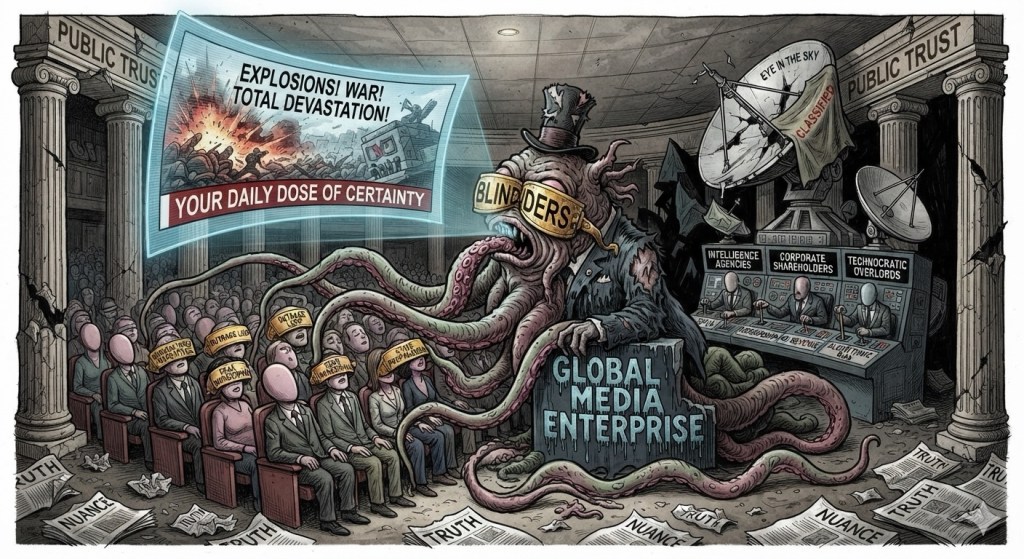
The general public operates under the comforting illusion that journalism is a civic service, funded by the masses to keep power accountable. The stark reality is that the global media industry—whether state-sanctioned or privately owned—is structurally incapable of truth.
For government-owned media networks, information is merely an extension of kinetic warfare. During active crises, state networks do not exist to inform; they exist to maintain regime survival, boost domestic morale, or project artificial psychological dominance. Broadcasts are carefully curated weapons designed to manage the strategic narrative.
Conversely, privately owned corporate networks operate under a different, though equally compromising, mandate: the maximization of shareholder value. To secure exclusive scoops, corporate journalists must engage in access journalism, routinely laundering unverified intelligence community press releases to maintain proximity to power. When national security imperatives or corporate survival collide with objective facts, the facts are quietly edited out.
The Playbook of Manufactured Bloodshed
This is not a new dysfunction; it is a time-tested playbook with a devastating body count.
Look no further than the run-up to the 2003 Iraq War, where the supposedly independent Western press functioned as the promotional wing of the pentagon. The American liberal press, breathless 24/7 cable news networks, and the sweeping global reach of Rupert Murdoch’s media empire in the UK and Australia did not question power—they amplified it. They took unverified, fabricated intelligence briefs regarding “weapons of mass destruction” and packaged them into a terrifying, non-stop spectacle that hoodwinked entire populations into backing an illegal invasion.
The media did not fail to see the truth; they actively chose to bury it because war is highly profitable, and challenging the state drumbeat was deemed a commercial suicide.
The Syndicate of Perpetual Conflict
Today, that exact same syndicate remains active, operating in the shadows of the world’s most volatile flashpoints. Intelligence agencies like the Mossad, MI6, and the CIA do not merely monitor conflicts; they feed them, working in tight tandem with major Western media houses to manipulate public perception.
In the fields of Ukraine and the waters of the Persian Gulf, the script remains unchanged. Media outlets act as the megaphone for intelligence briefs that are selectively leaked to justify endless military spending, stall diplomatic solutions, and keep the flames of war burning indefinitely. By controlling the narrative boundaries—labeling any call for de-escalation as enemy propaganda—the media-intelligence alliance ensures that peace never stands a chance against the lucrative machinery of perpetual war.
The Technocratic Enemies of the Open Society
If legacy media houses serve as the traditional megaphones for this cartel, the modern digital architecture has introduced a far more insidious threat to truth: the technocratic billionaire autocrat.
By weaponizing private infrastructure under the guise of absolute freedom, platforms like Elon Musk’s X (formerly Twitter) and satellite networks like Starlink have become active saboteurs of public reality.
In the Karl Popperian sense, these entities function as the ultimate enemies of the Open Society. Popper argued that an open, democratic society relies on rational public discourse and access to objective truth to self-correct. Instead, X defiles the public domain by replacing verified verification with an algorithm that financially rewards viral, inflammatory deception and boosts state-backed propaganda.
Simultaneously, the physical backbone of global connectivity is subjected to the geopolitical whims of a single contractor. Starlink’s arbitrary intervention in war zones—such as cutting off vital communications during military counteroffensives—proves that modern information warfare is no longer just managed by states, but gatekept by private corporate overlords. By choking off objective real-time data while flooding the digital square with algorithmic noise, this technological monopoly systematically destroys the possibility of an informed populace, fracturing the very foundation of public reason.
The Economy of the Outrage Loop
The economic rationale for peddling these false news cycles and manufactured narratives is baked directly into the modern media business model. In a digitized global marketplace, the public is rarely the consumer; they are the product. Media conglomerates survive on advertising revenue driven entirely by user attention, clicks, and prolonged screen time. The objective truth is frequently long, complex, and frustratingly nuanced—attributes that do not generate viral velocity. Outrage, tribalism, and manufactured fear, however, are highly lucrative commodities. By presenting international conflicts as binary, hyper-emotional dramas of absolute good versus absolute evil, media enterprises trigger the exact neurological responses needed to keep audiences hooked.
Sensationalised falsehoods and comforting illusions outperform the messy reality of geopolitics every single time. Truth is structurally bad for business, and the market rewards those who distort it most effectively.
The Blindness of the Orbital Spy
Even the technological marvels promised to break this information monopoly have been co-opted by the same venal incentives. The public is told to trust the “eyes in the sky”—the highly advanced reconnaissance satellite fleets operated by superpowers and private tech firms alike. But these eyes serve only the closed doors of national security networks and lucrative defense contracts.
Classified military satellite data is selectively leaked only when it serves a psychological warfare objective, weaponizing transparency to deceive. Meanwhile, private commercial satellite companies, heavily reliant on billions in government defense spending, routinely enforce imagery blackouts and distribution delays over active war zones. They choke public access to raw mapping data when the real-time physical reality threatens to contradict official state narratives, proving that even orbital technology is chained to the dictates of the defense establishment.
The Opium of the Captured Mind
The inescapable, cynical reality is that the modern news industry has devolved into a multi-billion-dollar hoodwinking enterprise—the ultimate opium of the masses. It operates not to document history, but to manage public behavior, selling manufactured certainty to an audience terrified of ambiguity. It gives the masses the profound illusion of being informed while actively rendering them passive, predictable, and profoundly distracted.
To look at the global press and expect unvarnished truth is to misunderstand the very plumbing of the machine. The game is rigged to hook emotions and manage consent, and the only modern form of intellectual resistance is a radical, unyielding skepticism that treats every breaking headline not as a factual record, but as a calculated act of deception.
(Concluded)