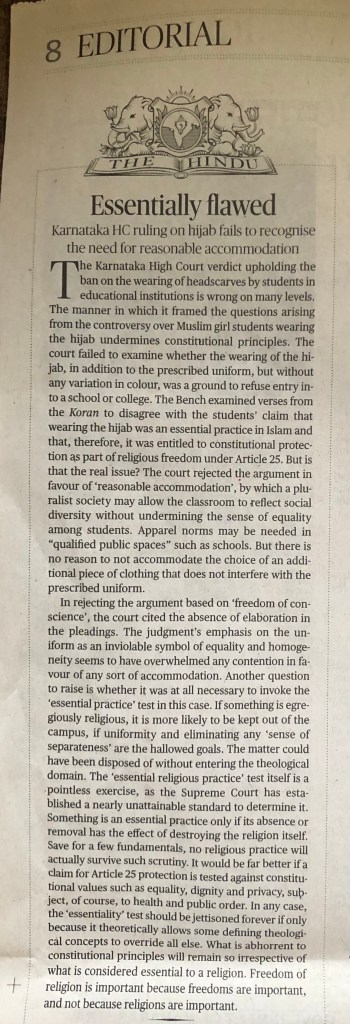
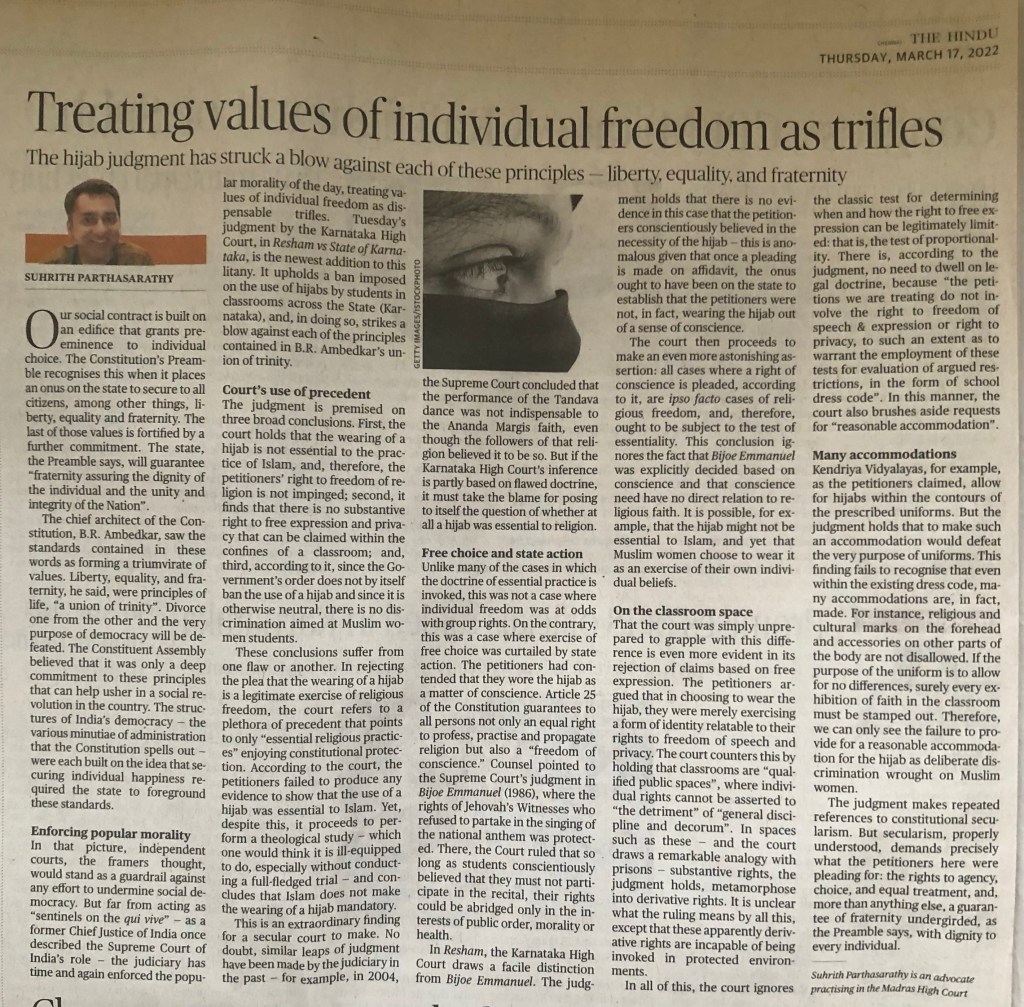
The HINDU editorial today (March 17, 2022) and an accompanying lead Op-Ed by Suhrith Parthasarathy (The Hindu’s in-house Constitutional Expert-Laureate) have both come out with all their “intellectual” guns blazing against the Karnataka High Court ruling on the Hijab case that has been roiling public opinion across the country in the last few months ever since the Campus Front of India and the People’s Front of India succeeded in turning the issue into a street-fight in Karnataka State and in a few places in the neighbouring state of Tamil Nadu too.
Reading both pieces above, one can’t help concluding that duo of Editor and learned Opinion-maker are straining every cerebral sinew to make out a doughty and persuasive case for transforming our country’s secular educational institutions like public schools, colleges, universities and other undertakings into madraasaas, veda paatashaalas and seminaries.
Both the newspaper and the brilliant young Constitutional lawyer (who BTW I’m otherwise rather fond of as a family friend, but then that’s quite beside the point) are known to be uncompromising champions of Indian Secularism and its values. And yet today both seem to have joined ranks together to defend the introduction of religiosity and its egregious sartorial symbolisms and deportment into the secular domains and space in our country. In the process of making their case, the duo has not hesitated to even decry the wisdom of the Court nor to cast a slur upon its motives: the Editorial has charged the Court of “undermining the Constitution” and Suhrith goes even a step further fulminating that the Court “treats” its values as “dispensable trifles”.
Not being a lawyer myself (God save me!) to be able to understand complex legalese and it’s clever-by-half mumbo-jumbo, I read both the Editorial and the Op-Ed twice to grasp the nub of their gravamen. This is about all that they are really saying:
Even if the Hijab is not an “essential religious practice” as the Court has held, schools and colleges etc. in the country cannot abridge or abrogate the right to wear it by students if they, as individuals, so wish it and despite any mandatory dress-code that may be prescribed by the institution.
To support their above position The HINDU and Suhrith rather fancifully invoke two cardinal concepts, doctrines or “values” in the Indian Constitution.By themselves they are indeed truly lofty and noble values to be cherished by all Indians. But they strike me as wholly irrelevant and misapplied to the present case under adjudication.
As is always the wont of “secular” champions in India, such as Suhrith and the HINDU profess proudly to be, they also invoke the ghost of the Archbishop of all Constitutionalism in India, the great B.R.Ambedkar to buttress their argument.
What are the two concepts?
1. Freedom of Conscience
2. Reasonable Accommodation
According to 1., Suhrith argues, the exercise of one’s conscience “need have no direct relation to religious faith” and thus even though “the hijab might not be essential to Islam”, Muslim women might still “choose to wear it” … “out of a sense of conscience” … and as “an exercise of their own individual beliefs”.
As an ordinary man of common sense, I find the application of the doctrine of conscience to a matter of mere sartorial choice in a secular social environment — and especially when it is admitted that such dress bears no “direct relation to religious faith” — to be more than a bit of stretch and exaggeratedly far-fetched. It is at best judicial grandstanding to maybe just win some applause from legal demagogues and luminaries in India and, at worst, just another attempt to bestow Constitutional legitimacy upon political encouragement of minority appeasement we all know is rife in India. For God’s sake, Mr Suhrith, what on earth or hell or heavens has Conscience got to do with wearing a plain uniform dress to school or college, Mr Suhrith?!! Don’t be ridiculous!
No. 2. Reasonable Accommodation: On this doctrine, both the HINDU Editor and Constitutional Expert-Laureate wax grandiloquent indeed.
The HINDU clearly wants the secular environment inside a school class-room and the sober environs of academia into a display showroom of religious sartorialism… That is truly the sense one gets reading the line — (quote): “… a pluralist society may allow the classroom to reflect social diversity without undermining the sense of equality among students” .. (unquote) .
In other words, the HINDU Editor would want you and me to enter a classroom in our child’s elementary school and be left bedazzled and awe-struck by the sight of a phantasmagoria of varied pieces of costumery competing with one another simply to “reflect” the “pluralistic society” of India!
Suhrith however (thankfully!) does not make such a ludicrous argument as the HINDU editorial.
The young man with a truly brilliant legal brain makes a very nuanced point about how “reasonable accommodation” can help promote and more firmly establish the Constitutional goal of “fraternity” amongst our countrymen and countrywomen that will “guarantee … the dignity of the individual and the unity and integrity of the Nation”.
No one can mount any kind of counter to an argument as Suhrith’s that is so well-intentioned. But I must remind him this: that “reasonable accommodation” is a 2-way Street and when he expects it to be granted by one of the parties in a Social Contract he must concede that the other party too has the equal right to entertain the very same expectation.
If a student insists upon wearing the hijab in class while flouting the uniform school dress-code in place , and also claims she is entitled to the comfort of resorting to the Constitutional doctrine called “reasonable accommodation” then it is only reasonable to invoke the principle of equitable reciprocity that good citizenry demands in a democratic society i.e. The school institution — which too is an equal citizen and a full-fledged individual in every sense under the Constitution and therefore — has equal and legitimate right to insist upon its prescribed school-uniform dress being strictly adhered to by one and all its students.
In other words, one can turn around and ask Suhrith Parthasarathy this: Does not the school institution too have the right to expect “reasonable accommodation” from hijab-wearing students? …. And especially when the hijab is held to be not “religiously essential”? Surely , what is sauce for the goose is sauce for the gander too?
A prickly Constitutional question therefore certainly arises here : Which Party to the Social Contract has the greater right to expect or claim “reasonable accommodation” from the other?
It is precisely to that very question that the eminent Judge of the Kerala High Court addressed himself (Justice A Muhamed Mustaque of the Kerala High Court on 4 December, 2018 in the case WP-C No. 35293/2018).
Quote: “I am of the considered view that the petitioners cannot seek imposition of their individual right as against the larger right of the institution. It is for the institution to decide whether the petitioners can be permitted to attend the classes with the headscarf and full sleeve shirt. It is purely within the domain of the institution to decide on the same. The court cannot even direct the institution to consider such a request”.
“The Constitution itself envisages a society where rights are balanced to subserve the larger interest of the society. In every human relationship, there evolves an interest. In the competing rights, if not resolved through the legislation, it is a matter for judicial adjudication …
“The court, therefore, has to balance those rights to uphold the interest of the dominant rather than the subservient interest. The dominant interest represents the larger interest and the subservient interest represents only individual interest. If the dominant interest is not allowed to prevail, subservient interest would march over the dominant interest, resulting in chaos. The dominant interest, in this case, is the management of the institution. If the management is not given free hand to administer and manage the institution, that would denude their fundamental right. The constitutional right is not intended to protect one right by annihilating the rights of others. The Constitution, in fact, intends to assimilate those plural interests within its scheme without any conflict or in priority. However, when there is a priority of interest, individual interest must yield to the larger interest. That is the essence of liberty”. Unquote
So, Mr Editor and Suhrith Parthasarathy, you will have to agree that the Judge of the Kerala High Court hardly ever considered the aspect of “essential religious practice”. He did pay due heed to the Constitutional tenet of Fundamental Right of Freedom. He also did give due weightage to the aspect of Pluralism in Indian society. And at the end he did wisely rule that what is paramount principle in the Constitution of India is this only and not any airy-fairy, wooly-headed, far-fetched notions of “Conscience” and “ Fraternity : “ If the dominant interest is not allowed to prevail, subservient interest would march over the dominant interest, resulting in chaos. The dominant interest, in this case, is the management of the institution. If the management is not given free hand to administer and manage the institution, that would denude their fundamental right. The constitutional right is not intended to protect one right by annihilating the rights of others.”
Both the HINDU and Suhrith Parthasarathy have always been loud and inveterate advocates of Indian Secularism. One only has to go back in time to the HINDU archives to know the innumerable times they have quoted, cited and espoused grave and majestic Constitutional law, precedent, doctrine, why even Ideals, to build sacred firewalls within society to keep Religion out and away from tainting social institutions in any manner.
I remember only too well how passionately both in the recent past made their their left-liberal-secularist case against the then popular sentiment that prevailed over the Sabarimala Temple case, the Ayodhya Ram Temple case, the freeing of temples in Tamil Nadu from the control of the HR&CE Commission case etc. They were then such vocal and uncompromising enemies against the intrusion of Religion into Temples . Now, they seem to be advocating the entry of Religion into children’s schools and colleges! This is patently, dear Mr. Editor and Mr. Opinion Maker, a case of wanting to eat the cake and having it too!
Sudarshan Madabushi