In the broad narrative of the Vadakalai sect, the events of 14th-16th century CE history that led to its claiming primacy, ownership, control, legitimacy — and of contributions made to the construction, maintenance and administration of the Kanchipuram Sri Varadaraja Perumal Temple — most prominently feature Sri Lakshmi Kumara Thathachariar, aka Sri Lakshmi Kumara Thatha Desikan, aka Acharya Thathachariar. (He will be referred to in the following pages using the initials “LKT” for convenience only).
Who was he?
The date of his birth and lifetime vary widely. According to Wikipedia, it is 1571–1643 CE (https://en.wikipedia.org/wiki/Lakshmi_Kumara_Thathachariar). But according to the website put up by an organization of his family-descendants (Thaatha Desikan vamshatthaar http://kanchithathacharsabha.com/# ) his date is 1456-1543 CE…. i.e. the date of his demise moved back by a 100 years!
There is no historical information available in the public domain that explains satisfactorily the large variance in dates. There is another website https://www.howold.co/person/lakshmi-kumara-thathachariar/biography which mentions his date again as 1571-1643 CE.
One thing therefore can be concluded: that LKT swami and AMJ swami were not contemporaries and their lifetimes were separated by at least a hundred years.
While the narrative of the Tenkalais traces the origination of their sect’s first contact with the Kanchipuram Temple to the visit made there by their Acharya, Sri Manavaala Maamuni in c. 1420 CE, and by the establishment thereafter of the hermitage (muttam) of Sri Azhagiya Manavaala Jiyar (AMJ), the narrative of the Vadakalais chronicles the origin of their own association with the Temple much farther into the past in history — by almost another 500 years!…. i.e. long, long before any schism as “Tenkalai versus Vadakalai” was perhaps even imagined or conceived by the Sri Vaishnava “ubaya-vedaantins” of those distant times.
The Vadakalai narrative of their involvement with the Kanchi temple is indeed a very nuanced if not complex one. It is being summarized below in a rather simplified form only for the sake of easy comprehension by readers who do not wish to get mind-boggled by too much details of historicity:
- Sri LTA’s association with the Kanchi Varadaraja temple is established and maintained mainly by virtue of a long, unbroken ancestral genealogy and lineage of preceptors dating back to the times of Sri Ramanuja (1017-1137 CE). That lineage through successive generations had held a pre-eminent position and presence in the conduct of religious services and affairs of the temple.
- The implications of the above fact is very significant to their whole historical narrative. The Vadakalais thus invoke what is called the “Achaarya paramaparai” of the “ubaya-vedaantins” — i.e. a lineage of preceptors — as it existed and flourished in the post-Ramanujacharya era and in the pre-Sri Manavaala Maamuni’s times. That “achaarya paramparai” is represented in the tree-diagram below:
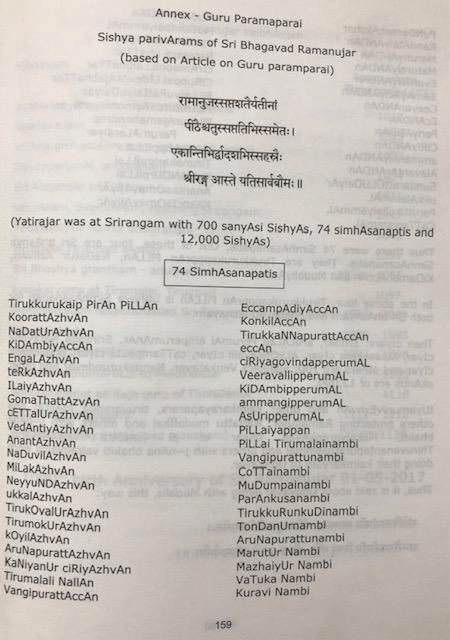
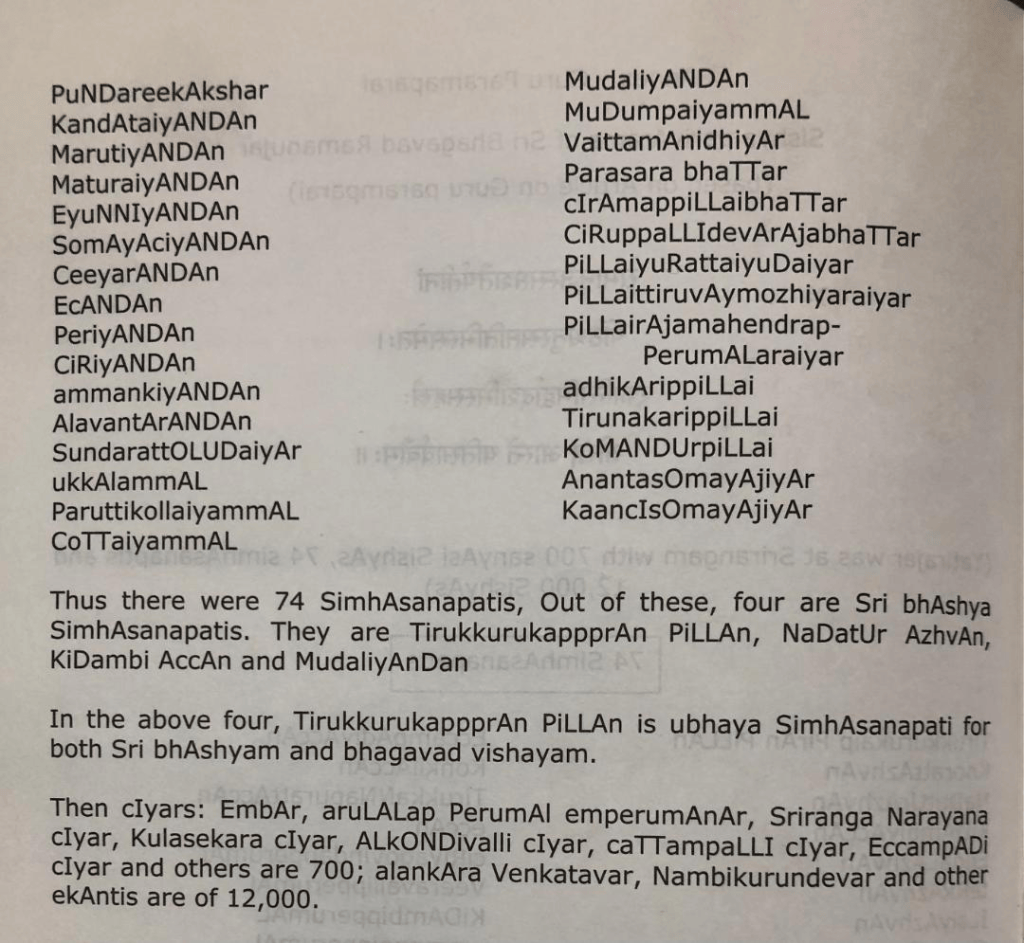
4. The great religious legacy that Sri Ramanujacharya left behind him was preserved, continued and propagated for posterity thanks to a Religious Order of seventy four of his own selected disciples that was established by him. They were anointed specially and came to be known and venerated in the future as the principal elder-preceptors of the “ubaya vedaanta sampradaayam”. They were designated as “74 simhaasanaadhipathi-s” — the 74 principal apostles — and they hailed from different far-flung parts of the Deccan region where the immense numbers of “ubaya-vedantins” lived and were faithfully following the tenets and teachings of Visishtaadvaita known as “raamaanuja darsana”.
5. The foremost of those 74 “simhaasanaadhipathi-s” — as can be seen from the listed tree-diagram above — was “Tirukurukaippiraan Pillaan” popularly known as “Pillaan“.
6. Pillaan was the son of Sri Tirumalai Nambi of Tirupati who was the maternal uncle and part-time guru of Sri Ramanujacharya. His had dedicated his entire life to the devoted service of the Deity in the great temple of Tirumala, the Sri Srinivaasa or Venkatachalapathi. He was thus known as “Thaatha” or “thaathaachaarya“— “grandsire” — which legend has it was a honorific conferred on him by the Deity himself.
7. Tirumalai Nambi was the grandson of Sri Yamunacharya aka Alavandaar, (c. early 10th century CE) one of the founders of Sri Vaishnavism along with his guru Sri Naathamuni (c. 823 CE–951 CE) one of the foremost preceptor of the “ubaya vedaantins” after Sri Nammaazhwaar.
8. When Sri Ramanujacharya ordained the 74 apostles of his, he conferred the special title of “sri ubaya vedaanta sri bhaashya simhaasanaapati-s” on Pillaan. It was in recognition of two of his greatest accomplishments in life. One was his commentary (the “aaraayirappadi” or “bhagavath vishayam“) that he wrote in wonderful Manipravaalam language on Nammaazhwaar’s mystic Tamizh hymn, the “Tiruvoimozhi“. The second was the consummate mastery he had achieved over the philosophical tract authored by Sri Ramanuja himself and which served as the principal exegetical scripture on the Brahma Sutras (of Sage Vyaasa) by which all Sri Vaishnavas swore allegiance to their faith. The twin-achievements of Pillaan made him the foremost exponent of the “ubhaya vedanta” which thereafter became a unique “sampradaaya” in itself. Like him, three other great Acharyas too continued the tradition. They were Naadathur Azhwaan, Kidaambi Acchaan and Mudaliya Andaan. The successive generations of descendants and families of these first “ubhaya vedaantins” came to be renowned as “Thaathaachaariars”, a moniker affectionately taken after their grandsire, Sri Tirumala Nambi.…. And thus, was established, the great and glorious tradition and legacy of the “ubaya vedaantins“!
9. Over the ensuing 3 centuries thereafter — c. 12th through 14th centuries CE — according to the Vadakalai narrative, several hundreds of branches of Thaathaachariar heirs, families, progeny and descendants fanned out and spread to various far-flung parts of the Tamil countryside in the South from Sri Rangam and Kumbakonam to the northern reaches of the Deccan region, up to Vijayanagara, the capital city of the great Vijayanagaram Empire. These far-flung settlers were pious clans renowned for their religiosity, deep scholarship in the Vedas and Vedanta, and other arts and sciences. Being what in modern parlance is known as “knowledge workers“, wherever they went they were warmly welcomed and became the cynosure of royal kings and noble patrons while winning both their trust and confidence. Very soon they rose high in ranks to positions such as royal advisors, court purohits, “raja guru-s” and administrators themselves. In Sri Rangam they came to be known as “Sri Rangam Thaathaachariars”; in Tirumala they are known even today as “Tirumalakumaara Thozhappa Thathaacharyas“; and in Kanchipuram these families came to be known as “Kanchipuram Thathaacharyas”.
10. The paternal lineage of Thaathachaaris held positions as the “Raja Gurus” for the rulers of Vijayanagar Empire including the dynasties of Saluva, Tuluva and Sangama. According to the Vadakalai narrative, even some records in epigraphical inscriptions of the empires of Hoysaala and Chaalukya show references to these great men with the title of “Thathacharya” having been the aacharyas of many kingly families and scions. And even after the fall of Vijayanagar Empire in the later part of the 16th century CE, the descendants of Thaathaacharis continued to be the Royal Preceptors for the Nayaka rulers who even appointed them as the Governors of various Vijayanagar vassal states and territories including Vilankuppam, Kanchipuram, Trichy, Madurai, Chandragiri and parts of modern days Tamil Nadu, Karnataka and Andhra Pradesh.
10. The Thaathaachaaryas were quintessential “ubaya vedaantins” adept in both Sanskrit and Tamizh and they excelled equally in the scriptural study of both the Sri Bhaasyam and Bhagavath Vishayam, allied texts and treatises. They affirmed their adherence to the post-Ramanujacharya “guru-paramparai” of Sri Vedanta Desikan (1268-1368CE) who hailed from the hamlet of Thoopul, a few miles from the Kanchi Varadaraja Temple. Their lineage is represented in the following tree-diagram:
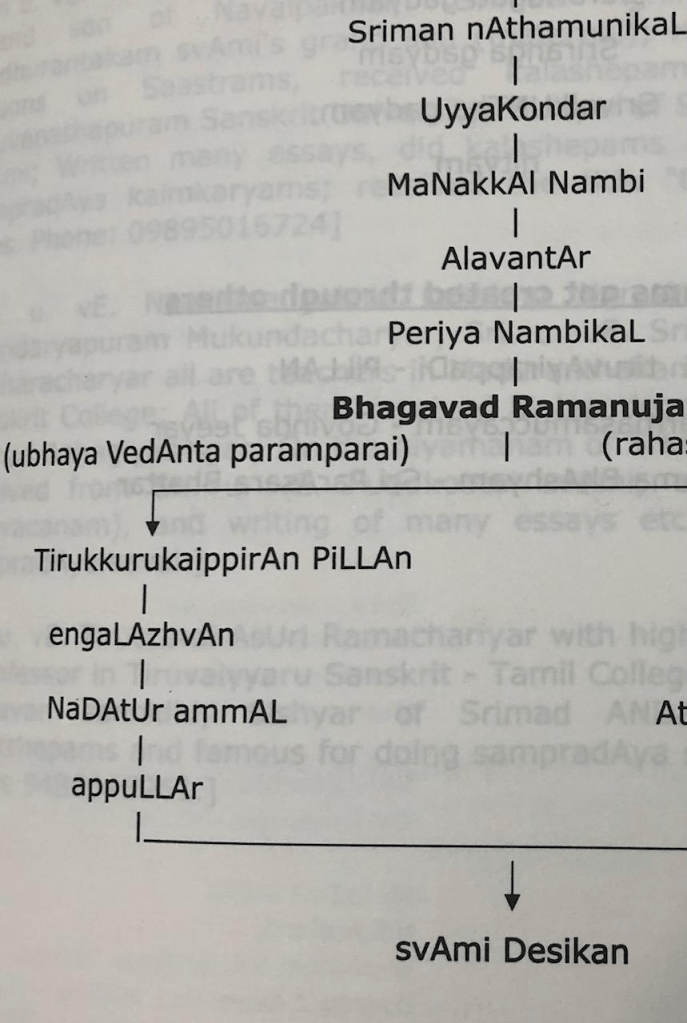
As descendants of the Pillaan and Apullaar lineage, generations of Kanchipuram Thathaachariar families came to render service to the Sri Devarajaswamy Perumal temple as a life vocation.
11. After Pillaan, one member of the Kanchi Thaathachariars by name Sri Tirumalai Srinivasacharya Thathachariar, in the fifth generation of Thathacharyas in the town, was installed by Sri Vedanta Desika himself as the “Sri Kaariyam” (Chief Custodian) of the Sri Varadharaja Perumal Temple of Kanchipuram. Since then the office of Sri Kaariyam got institutionalized as the hereditary patrimonial right of the Thathacharya family to the formal office of Sri Kaaryam attached to the Varadaraja Perumal temple in Kanchipuram.
12. Lakshmikumara Thatha Desikan swami — LKT — inherited the same official mantle from his ancestors. He was serving as the “Raja Guru” of the Vijayanagar king Venkatapathi Devaraya who granted him mandate as “Sri Kaarya Dhurandhara” — a Chief Executive Officer with plenipotentiary powers. LKT held dual positions as Raja guru and Sri Kaaryam of many Vishnu temples of the land from from his base at Kanchipuram. According to the Vadakalai narrative, he was simultaneously “Sri Kaaryam” (also known colloquially as “Dharmakartha-ship”) of Kanchipuram, Sriperumbudur and Kumbakonam temples. His ancestors in fact hailed from Kumbakonam.
“Even today the descendants of Sri Koti Kannikadhana Sri Lakshmi Kumara Thatha Desikan are living in various Divya Desams as the teachers of the Philosophical values and rich Indian Culture and are continuing many righteous deeds that are bound for them”.
13. The narrative of the Vadakalai sect goes on further to describe how Sri LKT during his regime brought a large army from Vijayanagar and drove away some “unrighteous people” (we just do not know who these unrighteous people were!) from the Divya Desams of Sri Rangam, Kanchipuram, Srivilliputtur, Thirumalirum Cholai. Kumbakonam and “many other places” (!) and restored the worship and conduct there in accordance with the “ubaya vedaanta sampradaayam” as laid down by Sri Ramanujacharya and Swamy Sri Nigamantha Maha Desikan .
14. It is said that Sri LKT appointed his heirs in these places and gave a lot of munificent royal grants to these Temple, to take special care of the Temple properties and assets.
15. Sri LKT, according to the Vadakalai narrative, arranged for the gold plating of the ‘Moolavar Vimanam‘ (the pyramidal structure over the sanctum sanctorum) of Tirumala Tirupati, Kanchipuram and renovated the parts of Srirangam Temple constructions too.
16. The Vadakalais claim it was LTK swami who constructed the “100 pillared mandapa” in Kanchipuram Sri Varadharaja Perumal Temple. It was he who also renovated various Shrines of the said temple. Around 15 stone epigraphical tablets with numerous inscriptions evidencing the same facts, it is said, are available in the “Alavandhar Thirumuttram” (the circumambulatory concourse circling the Sri Varadharaja Perumal Temple enclosure). A lot of historical evidence and archaeological proof is adduced by the Vadakalai sect from various other temple epigraphy besides the Kanchipuram Temple (such as the Tirumala Sri Venkateswara Temple, the Sri Rangam, temple at Srivilliputtur etc.) in support of their narrative claims.
17. LKT swami‘s compassion for the poor and their suffering is a matter of record. As an administrator he strove to ameliorate their plight and living conditions. He established a lot of “Anna Chatrams“ — “Feeding Halls to distribute free food” — and established the so-called “Desanthri Kattalai” the “Executive Order to serve Travelers” in various Temples to feed the pilgrims visiting those temples daily. He sponsored the wedding of hundreds of needy couples and hence was thus conferred the affectionate title of “Koti Kannikadhana”.
18. During his long and illustrious lifetime, Sri LKT swami of Kanchipuram was praised as “Ubhaya Vedantha Chariyar“, meaning “The master of both Sanskrit Sacred Texts:– Vedas and Upanishads and Tamil works of Alwars known as Prabandhams”
(to be continued)
Sudarshan Madabushi