It was during the period after the Vijayanagar Empire fell — and its vassal kingdoms in Tamil Nadu dissolved too and disappeared eventually– that the differences and distinctions between North/South, Kanchipuram/Sri Rangam, Sanskrit/Tamil and the Tenkalai/Vadakalai identities became increasingly pronounced in the “ubaya vedanta” fold.
In the SriRangam region, a galaxy of scholars from the Sri Vaishnavite priesthood had authored at least 50 major brilliant interpretations and expositions of Visisishtaadvaita theology of which 85%, one might say, were all in either pure Tamil or Manipravalam (Sanskritized Tamil). They were written for the edification of the large mostly Tamil-speaking populations in the Tamil hinterland.
From Kanchipuram, there was Sri Vedanta Desikan who singlehandedly authored about 120 major works of Visishtaadavaita dialectics, hermeneutics and soteriology of which c. 75% was in Sanskrit and the rest in Tamil and Manipravalam. These Sanskrit works of Desikan were written by him keeping only partly in mind the common readership of Kanchipuram. His intellectual adversaries from various Kanchi schools of Advaita, Buddhist, Jain and other Vedantic polemicists of Nyaya, Vaisesika and Meemaamsa philosophy were his main target audiences. There was no way he could have countered in Tamil language the formidable challenge they posed to the school of Vedanta called VisishtAdvaita . He therefore had to engage them only in the same elite language that they employed viz. Sanskrit.
Over time, the narratives of the Tenkalai and Vadakalai Achaaryas to propagate their respective brand of scriptural exegesis, hermeneutics and soteriology (H&S) became indeed more and more stylized. It also began assuming a distinctly sectarian posture. An American scholar of Sri Vaishnavism, Ms. Patricia Mumme described such postures in a well-known researched work (“The Śrī Vaiṣṇava Theological Dispute : Maṇavāḷamāmuni and Vedānta Deśika“) in this way below to succintly bring out difference in their styles:
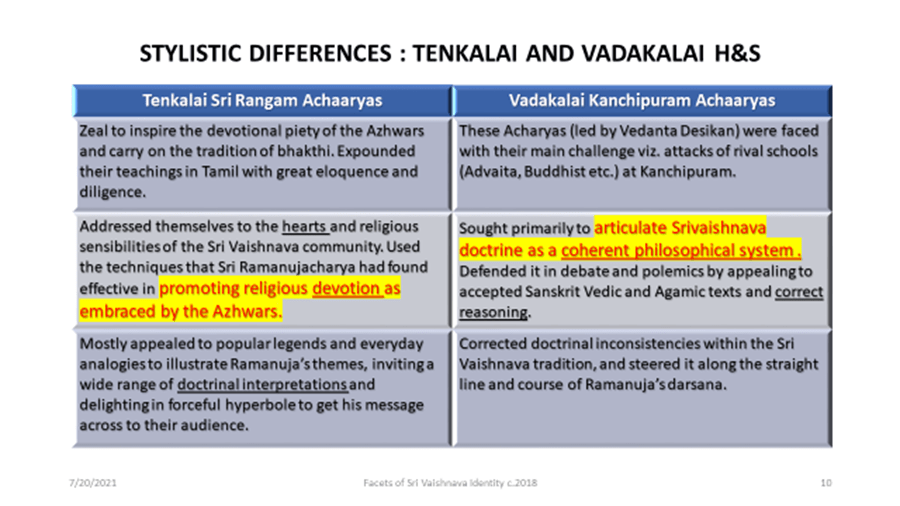
Prof. K.A.Nilakanta Sastri in his book “A History of South India” records further:
“The (late) 14th century century witnessed the rise of a schism among the followers of Ramanuja due to a difference in their interpretation of (the doctrine of) Prapatti. Some held that the devotee had to exert himself to win the grace of the Lord, while others thought that the Lord’s grace by itself conferred salvation on the soul that had entered into the path of surrender…… (Among several other minor) differences between the two schools, one of them (was) a decided preference for Tamil as against Sanskrit on the part of the Tenkalais.
“The southern school looked upon Pillai Lokaacharya (b.1213 CE) as its founder. He was the author of eighteen esoteric treatises (rahasyaas) … (which later in the 14th century) found an influential expositor in Manavaala Mahaamuni (b.circa 1370 CE).
“The leader of the northern school (Kanchipuram) was Vedanta Desika …. he was a poet, philosopher and man of affairs….(a veritable polymath too )…
The Acharya lineages of Sri Rangam and Kanchipuram thus began to gradually polarize their H&S works which assumed increasingly sectarian overtones in terms of doctrine and linguistic bias.
This polarization grew acute by the end of the 16th century CE when the great Mughal Empire expanded even as Hindu kingdoms fell one by one. The entire ecosystem of Vijyayanagar Empire that once had provided economic support and political patronage to the cohesive sub-cultural life of the “ubaya vedantins” for almost a century in the Tamil country – began to fray and eventually disintegrated.
Confronted by steep economic decline, political chaos and uncertainty, caused by Mohameddan invasion and rule, and by outbreak of social tensions rife everywhere in the country, the Sri Vaishnavas like all other Tamil communities also succumbed to intra-communal disunity and sectarian conflicts.
Temple commonwealth and temple-lands were the only assets they possessed, and these assets were under constant threat now of dispossession and depredation. Unable to face the onslaught of the great enemy outside, they unfortunately took to infighting, and to petty turf-war and feuds.
The main casualty for the “ubaya vedanta” community however was this:
Amid all the historical turmoil and meltdown happening in the country around it, its leaders – both in Sri Rangam and Kanchipuram — became helpless and powerless witnesses unable to arrest in any way the growing sectarian divide that overtook and fractured them.
The Tenkalais and Vadakalai began to forsake the “ubaya vedanta” tradition and rallied under the separate tutelage and camps of Achaaryas who began leading them into ever more Tenkalai Vs Vadakalai rifts. This started happening from around the end of the 15th century CE and continued to the very end of the 19th century CE.
Thereafter began also what one may call growing and rigid federalization of the Sri Vaishnava community into Tenkalai, Vadakalai and other sub-sectarian denominations. That churning process in history is represented in the following 2 diagrams for easy, quick understanding:
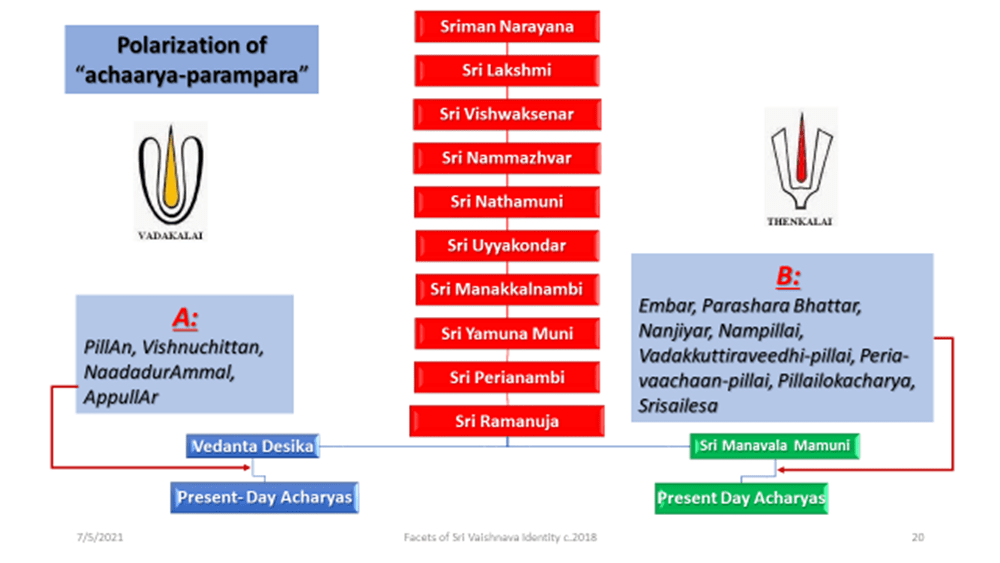

Why did the fault-lines between Tenkalai and Vadakalai — or, the two poles of the Sri Rangam/Kanchipuram, Sanskrit/Tamizh and Veda/Dravida Veda world of “ubaya vedanta” — fracture and widen to become, soon in time, the wide sectarian divide it is today?
The answer is not very simple or direct…. but a simple theory presented below might help in understanding the historical process as it unfolded. The theory cannot be dismissed altogether as unconvincing.
The answer can be found in a map of Tamil Nadu:

It can be seen above that the number of Sri Vaishnava temples or “divya desams” — which were built by several past Hindu dynasties in the South of India — clearly outnumbered those in the northern countryside by a margin of 3 to 1 i.e. 73 to 24.
It is logical therefore to infer that much of the economic wealth and material prosperity, and great social influence, held in their temples by the Sri Vaishnavas around the time when the British became the new rulers of India was significantly greater in and around the sub-cultural Tamil hinterland of Sri Rangam than it was in Kanchipuram’s Sanskrit-speaking belt.
Now, when British Imperialism came to and ruled India, throughout the 250 years of their suzerainty, they made it an effective policy of governance to “divide and rule” Indians. It was the only way to systematically weaken and subjugate them. Sri Vaishnava institutions, and mainly the temples with their commonwealth and great social influence, also fell victim to that insidious British colonial policy.
Having lost the political patronage of Hindu dynasties, the economic decline in prosperity and viability of Sri Vaishnava temples across Tamil Nadu, north and south, under Mughal rule thereafter became imminent. But despite temples being sacked, looted and plundered under Mohammedan rule, thanks to the deep faith people still reposed in temples, the Sri Vaishnavas yet managed, against severe odds, to salvage, to preserve and to hang on to the remnants of their vast commonwealth available in terms of temple jewelry, temple icons, temple treasuries and granaries, temple lands, property and revenue-generating real estate in hundreds of villages and small towns.
The British (i.e. the officers of the East India Company at first and thereafter Her Majesty’s viceroy and the governor-generals in the British provincial protectorates of India) who finally defeated and prevailed over the last vestiges of Mughal Rule towards the end of the 18th century were very well aware of such substantial wealth and revenues still possessed and earned by the great temples.
Rather than openly covet such great economic wealth, the Crown Administrators used it instead to further their devious policy of “divide and rule”. This they did by a stratagem of pitting local kings and princes against each other, and then them against the temples; turning the sub-culture of pan-Indian Sanskrit versus that of vernacular Tamil; then by sowing the seed of language discord; by aggravating geographical North-South divide; injecting caste consciousness and bigotry; taxing temples differently and arbitrarily, even demanding tribute (i.e. taking huge loans from temples never to be repaid) etc.,; and inciting disputes between landowning priestly communities around temples with rural peasantry ….
It was all done, of course, in the name of the British bringing about so-called social and land-reforms, social justice and empowerment etc. in India!
The British cared very little indeed for the long-term viability of temple institutions in the manner in which the old Hindu dynasties had done. It was the British who first invented and patented what we all know today has become in many Indian States the fine art of devious political interference in Hindu religious institutions.
How was it done?
The British did it by politely offering at first, and then eventually imposing English jurisprudence on Sri Vaishnavas as though it were the most impartial and equitable mechanism for settling disputes relating to Hindu community, property, marriage, religious belief, temples, modes of worship, customs and social practices.
The first thing they did was to systematically denigrate and degrade the centuries old institution and social order called Varnaashrama as codified in the set of “dharma saastras” that came to be known as the Laws of Manu, or the Manu Smriti, the seminal code book of Hindu Laws governing social and religious life of Hindu peoples.
Manu and Varnaashrama order were systematically vilified by the British as inherently evil and oppressive of lower castes by the higher castes. And the only way to redress iniquity and discrimination amongst the lower castes in India was, according to them, to reject dharma saastras and adopt instead modern European jurisprudence based on fundamental human principles of rights of equality and liberty.
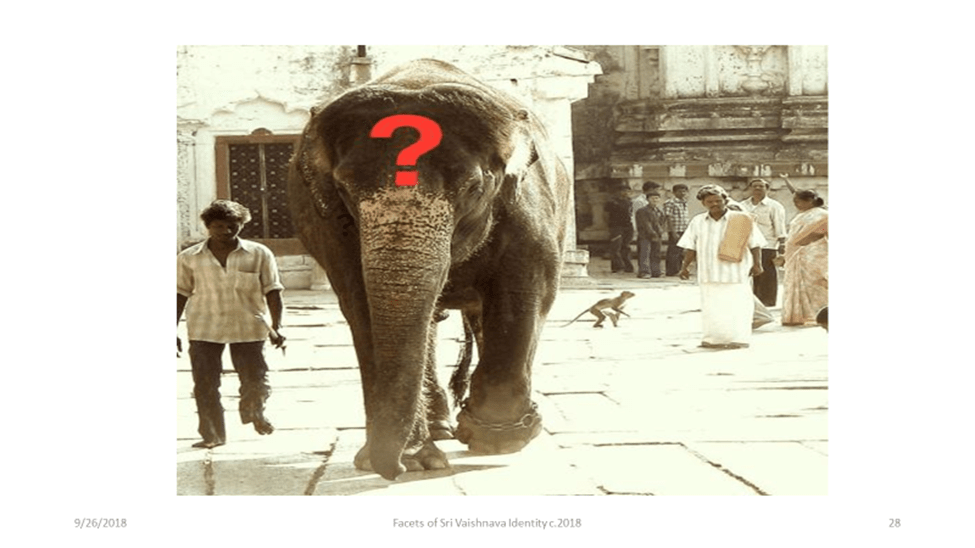
This very poisonous idea of resorting to civil litigation in British courts of law — forswearing the wisdom of the ancient codes of justice in the “dharma-sastraas” — to resolve even intra-communal religious matters of dispute or contention was first seeded into the Tenkalai and Vadakalai mindset back in 1792. It was a case relating to the Tenkalais of Kanchipuram attempting their first ever coup in what looked like a “hostile takeover” of the ownership and management of the Sri Devarajaswamy Perumal Temple from the hands of the Vadakalais. There arose, of course, at the same, another offshoot of a legal case that pertained to the dispute over elephants being led in procession as part of festive pageantry in the Kanchipuram temple: It was the infamous Queen’s Privy Council case of whether the elephant should bear Vadakalai or Tenkalai naamam!
Both cases dragged on bitterly in the courts until 1976!
In the following 200 years after 1792, the Tenkalai and Vadakalai sects went on to also fight numerous court battles over other arcane and obscurantist matters of only sectarian — and not any substantively religious or communal — significance….
The cases were agitated in the courts of Tamil Nadu and even the Supreme Court of India. Even today there are still a few such cases pending between the two sects! Most such cases relate to matters like which litany Vadakalai or Tenkalai, i.e. “saatrumarai” procedure has the right of precedence over the other at various shrines in Sri Rangam or Kanchipuram and other important divya desam temples, on festive days when idols of either the Deity or Acharyas are taken out in procession.
To anyone in the world outside the Sri Vaishnava community, it would come as a surprise to know that the Vadakalai and Tenkalai temple service called “saatrumarai sevai” and “vaazhi tirunaamam“” is really nothing more than singing a litany of “hallelujahs” (the use of Church parlance may please be pardoned!) to their respective “acharya parampara”. In spirit, they are both virtually the same… but in the letter they are, of course, mutually exclusive and bitterly antipathetic.
Behind such ostensibly sectarian disputes one cannot fail to see what most certainly is the raw reality of a power-struggle for absolute control over temple property and temple-influence.
Why must good and pious “ubaya vedaantins” fight for control in such a vicious fashion?
Control over a big temple like the Kanchipuram one secures the way for vested interests on both sides to pander to larger and more powerful political group-interests and to ingratiate patronage from the State. In Tami Nadu today it means also a way to remain socially relevant in a tense political milieu that is already riven by other more invidious forms of “identity-politics”, linguistic chauvinism, rabidly racist theories polluting social discourse and the evangelism of minority-religions... The nature of the social ecosystem in which Sri Vaishnavite temples survive today can hardly be ever compared to what prevailed during the times of the Pallava, Chola, Pandya or Viyayanagara empires.
A historical 200-year old sectarian squabble has thus finally led to the Sri Vaishnava identity getting severely fractured. Both the Vadakalai and Tenkalai sects, inebriated by “identity intoxication”, compete today to be different and exclusive from each other in many ways…. be it customs, weddings, modes of household worship such as tiruvaaradanam etc., or even sartorial attire and deportment. But most egregiously of all, they have each sworn never to amicably settle their differences in the matter of administering their temples — and especially the Kanchipuram Sri Devarajaswamy Perumal temple — certainly not in the old, united and broad-minded, “inclusive“, and “pluralistic” spirit of “ubaya vedaantam“.
Thus, to a very limited extent we are able at last to trace the historical roots and social context of this 500-year old sectarian fracture and to understand why and how it came about. But what is however not so clear is why the fracture has not got healed in time? Why were the temples not restored to the old glorious dignity of “ubaya vedaantam”? Why did it not happen? Why did the decline of the “ubaya-vedantins” not get arrested and saved from further free-fall?
The answer to that question is to be found in chronicles and narratives about certain events and incidents that happened locally, before and after 1792 CE, in the Kanchipuram temple of Sri Varadarajaswamy Perumal.
(to be continued)
Sudarshan Madabushi