The major dissonances amongst the Tenkalai and Vadakalai versions of the history of the Kanchi Sri Varadaraja Perumal temple are three in number:
A. Historicity or timeline
B. Power and Legitimacy:
C. Language as a cultural badge …. or baggage.
***********************************
HISTORICITY:
There is a significant difference in the way the Tenkalai and Vadakalai view the “ubaya-vedaantic” past.
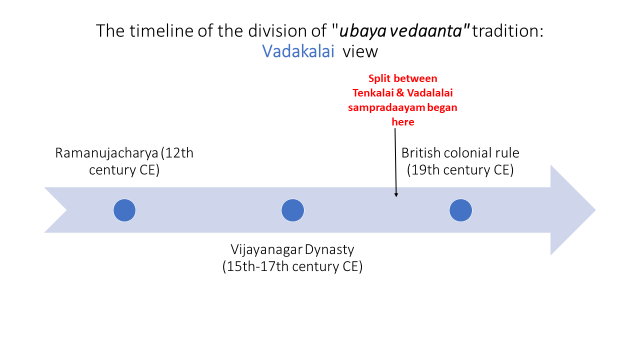
It is so significant in fact that it shapes and colors almost all facets of their respective identities — philosophical, religious, cultural, linguistic and provincial. It is the source of prejudice felt towards each other. That difference is best explained by the following two charts:
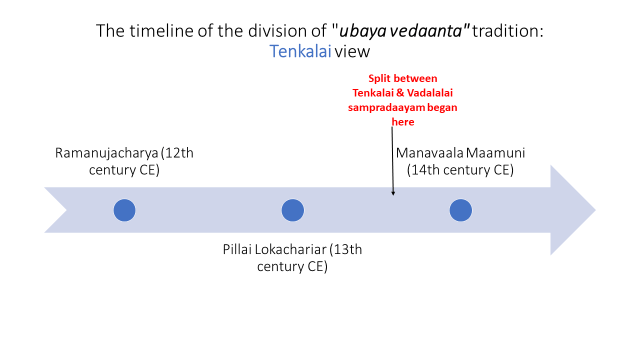
The Tenkalai narrative revolves around an unsubstantiated, under-researched theory that after Sri Ramanujacharya’s lifetime, about 200 years later, around the middle-to-late 14th century CE, the “ubaya vedaantin” community across the Tamil country began polarizing and coalescing rapidly into two distinct sub-cultural groups under two separate “Achaarya vamsham-s” — lineage of religious preceptors. (That “polarization” has been dealt with in Part-4 and hence requires no further elaboration here).
There was this so-called “southern” group of Achaaryas (or “thenn” in Tamil) centered around the hinterland of Sri Rangam and a so-called “northern” group of Achaaryas (or “vada“) anchored in the great temple city of Kanchipuram.
From the viewpoint of the Tenkalai narrative, the reasons for such growing polarization was partly theological, partly linguistic and partly ethno-cultural.
From the viewpoint of the Vadakalai narrative, however, the basis was no more than simply geographical.
On the suggested Tenkalai timeline in the first chart above, when the split between northern and southern achaarya-s is said to have happened, the Vadakalai view is that no substantive evidence at all exists to show there was such a schism within the larger community of “ubaya vedaantins“.
The Vadakalai narrative puts forth its own theory that the sectarian fracture in “ubaya vedaantham” began to show itself up — and thereafter rapidly grew into a bitter schism –only around the time of the early-to-mid -19th century. That was when the entire South of India came under British colonial rule. That is also exactly when (as shown in the Vadakalai timeline chart above) what was originally only a difference of geographical location of a common and united “achaarya vamsha-parampara” began to suddenly transmogrify into hitherto unheard-of, fabricated difference in theological tenets and practices ((i.e. hermeneutics, soteriology (H&S) and temple-worship)), and in language as a means of communication and exposition.
Such a dramatic and disruptive transformation shook the entire community of “ubaya vedaantins” to its roots. The schismatic thinking turned into bitter open rivalry thanks to the British policy of “dividing to rule” the Hindu religious ecosystem in the entire Deccan and Tamil country. (This too has been already explained in Part 4 earlier).
Inevitably, the rift started descending also into a weird kind of ethnocentric parochialism (i.e. so-called Dravidianism Vs Aryanism) that manifests itself in the mainstream political discourse of Tamil Nadu even today.
The above historical scenario of how the spiraling descent into sectarianism happened is vividly described in a few memorable passages in a very fine book on Sri Vaishnavism entitled “VAISHNAVISM: Its Philosophy, Theology and Religious Discipline” (Motilal Banarsidas Publishers – 1994) written by the noted scholar, Sri. S.M.Srinivasa Chari.
Even at the risk of making this Part in this series rather tedious reading, I propose to reproduce those passages verbatim below because I believe the reader will be enabled to gain a true appreciation of the issue of Historicity that created the fault-lines between the Vadakalai and Tenkalai sects.
In fact, every young Sri Vaishnava today who pleads virtuous ignorance and indifference towards his natal cultural identity and roots must read these passages to know what makes his “ubaya vedaantic” legacy unique.

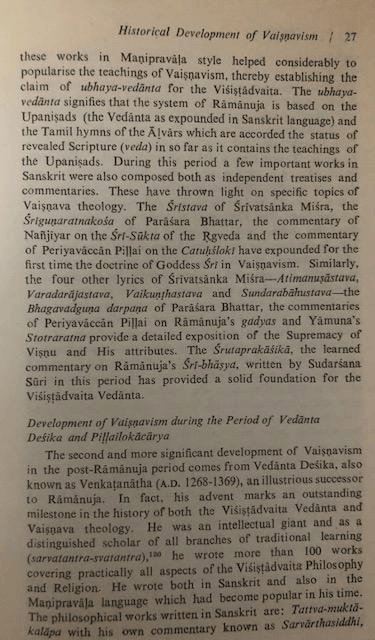


The above passages provide indeed a brief but panoramic glimpse of the dissonances that grew within the Tenkalai-Vadakalai fold.
They also provide a useful contextual backdrop for what are clearly vehement polemical exchanges between Sri Varada Thataachari and Dr. K.V.Raman with regard to the some of the averments made mutually in their respective books (referred in Part 10). The following quotes from Sri Varada Thaathachari’s book is a case in point. Referring to certain passages of Dr. K.V.Raman in his book, Sri Thaathachari reacts as follows:
QUOTE:
“Here also he has started a most controversial theory of “Sri Bhaashya” or the northern school and “Prabhandic” or southern school, implying a Vadakalai — Tenkalai cult. The very terms are fallacious and contradictory, since both the Vadakalais and Tenkalais even now take pride in styling themselves as ‘Ubaya-Vedantins’, meaning that they swear by both “Sri Bhaashyam” and “Bhagavad-vishayam” — (Prabhandams).
“It is only to misguide and confuse the uninformed and also the courts in the Tenkalai- Vadakalai disputes, that such theories were recently started by the ingenuity of the Tenkalai litigants. The Tenkalais claim themselves to belong to the southern cult or the Prabhandic school (Tamil) and the Vadakalais, they say belong to the northern cult or Sri Bhaashya school (Sanskrit). By representing that they are pro-Tamil, they attempt to earn the sympathy and backing of the public of these parts who are all almost Tamilians. In the same way they try to mislead the Courts also…..
“As said above both the sects revere Sri Satakopa (Nammalwar) and Sri Ramanuja (Bhaashyakaarar) and their works Divyaprabhandams and Sri Bhaashya respectively. The author will be contradicting himself if he is going to say that the Vadakalais are more, if not ‘solely interested in Sri Bhaashya and Tenkalais in Bhagavad- Vishaya, since the Tenkalais are equally vociferous in claiming to be the true followers of Sri Ramanuja (Emberumanar), the apostle of Visishtadvaita Siddanta. Specializing in a particular line of our Vaishnavite religion through certain scriptures by a person does not mean that the other scriptures are discarded by him or treated by him as against his cult.
“The author himself concedes that there was no sectarian rancor even until and after Vedanta Desika’s time between the two schools and they are of recent origin, and “it is untenable to say that Vedanta Desika did not know the Tamil Prabhandams”. The two schools, if schools they can be called, are not contradictory but complementary to each other. They do not prescribe or teach the distinctions of Tenkalai – Vadakalai sampradayas or practices as we observe in these days….
*******************************
How the issue of Historicity has indeed shaped, colored and distorted the perspectives and made inconsistent the narratives of the two sects of “ubaya-vedaantins” can be seen even today in the wider community of Sri Vaishnavas!
It is most evident when one comes across examples in the digital public-domain where individual members of the two sects discourse upon various matters of “sampradaaya” on several Sri Vaishnava cyber-group forums. Only one very striking instance is given below just to illustrate the fact:
There is this popular narrative about Sri Manavaala Maamuni, the foremost preceptor of the Tenakalai sect, visiting Kanchipuram around 1420 CE.
The Vadakalai version — premised on the belief that at that point in time in history, “ubaya vedaanta sampradaayam” remained undivided — is that he went there to undergo “kaalapshepam” of the Sri Bhaashyam — i.e. to learn Sri Bhaashyam philosophy in a one-on-one seminar — with the noted “ubyaya vedanta” scholar, Sri Kidambi Naayanar, a direct descendant of Sri Kidambi Appullar, the maternal uncle of Sri Vedanta Desika.
One Tenkalai version, in fact, tallies with the same narrative too: http://acharya.org/ac/smm/smmv1.html
But then there is also another Tenkalai narrative which holds that he went there for the sake of meeting his flock of Kanchi disciples and as a stellar expositor, not student, of Sri Bhaashyam! http://koyil.org/index.php/vadhikesariazhagiyamanavalajiyarmutt/
There is then another narrative found in the social media discourse, (http://www.ibiblio.org/sripedia/ramanuja/archives/oct02/msg00172.html) which only adds further confusion to the narrative by making this remarkable, barely substantiated revelation:
QUOTE:
“Sri MaNavALa MAmunigaL(MM) then moved to AzhvAr Thirunagari and took Thirumalai AzhvA, a prominent scholar of “ThiruvAymozhi”, as his AchArya.……..Thirumalai AzhvAn’s final advice to his foremost disciple Manavaala Maamuni was that he should spend his time teaching and discoursing on AzhvArs’ hymns especially ThiruvAymozhi (primary importance), and to give only secondary importance to samskrt sources and SriBhAShya…… “
UNQUOTE
Anyone reading the above narratives is bound to be confused and ask oneself:
“In 1420 CE, either Sri Manavaala Maamuni was an “ubaya vedaantin” devoted to study of both the Sanskrit “sri bhaashya” and the Tamizh “tiruvoimozhi” and hence went to Kanchi to learn the former scripture;
or, he was an inveterate Tenkalai of Sri Rangam who had been clearly advised by his guru to place a higher premium on the latter Tamizh scripture and to give short shrift to the Sanskrit scripture.... “
In the latter case, why at all did he travel to Kanchipuram?!!
******************************
Dissonance with regard to historicity found in such narrative-building exercises of the sects, as seen in the above example, thus has only deepened the prejudices mutually felt against each other in the last 200 years.
(to be continued)
Sudarshan Madabushi