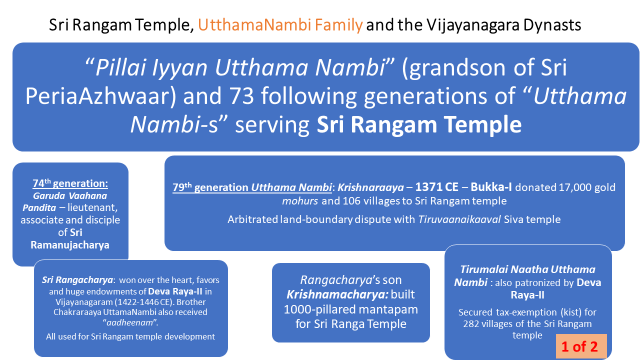

From a reading of the “Sri Rangam Koil ozhukku”, it is possible to glean quite a few snippets of 15th to 18th century CE history during which the enormous and legendary contributions successive generations of the noble “Utthama Nambi” family made to the expansion, care, maintenance and development of the Sri Rangam temple thanks in large to the patronage and munificence the Vijayanagar Dynasts bestowed upon it.
The “Utthama Nambi” family’s great work that was accomplished at the southern or “tenn” ends of the geographical and the spiritual domain of the “ubaya-vedantins” in Tamil regions at Sri Rangam is comparable indeed to that of magnificence of what the “Thaathachaarya” families themselves achieved in and around Kanchipuram, at the northern or “vadakku” ends.
It would be both impossible and unnecessary here (since this series is not intended at all to be any sort of academic dissertation) to launch into a detailed narrative of the “Utthama Nambi” history as recorded in the Sri Rangam “koil ozhukku”. Nonetheless, this ancient temple-chronicle of the “ubaya-vedaantins” does provide some vivid and valuable glimpses of the historical circumstances under which they lived and even a cursory reading of them helps us appreciate the complex social and psychological dynamics of the relationship that was developing and emerging slowly between the Tenkalai and Vadakalai sects.
With regard to the “utthama nambi” clan in Sri Rangam, I have tried to capture from the “koil ozhukku” and summarized in the above two simple charts — constructed in the form of several “visual snapshots” intended to reveal a few “very-high altitude satellite aerial-views” — of how almost ninety generations of the Utthama Nambi lineage engaged with the Raaya Kings of Vijayanagaram to procure enormus patronage, financial help and moral support for the Sri Rangam Temple through about 3-4 centuries.
To better understand the above 2 charts of mine than perhaps might be otherwise possible without them, they should be studied in conjunction or tandem with the few select extracts from the pages of the Sri Rangam “koil ozhukku” texts I have reproduced below.

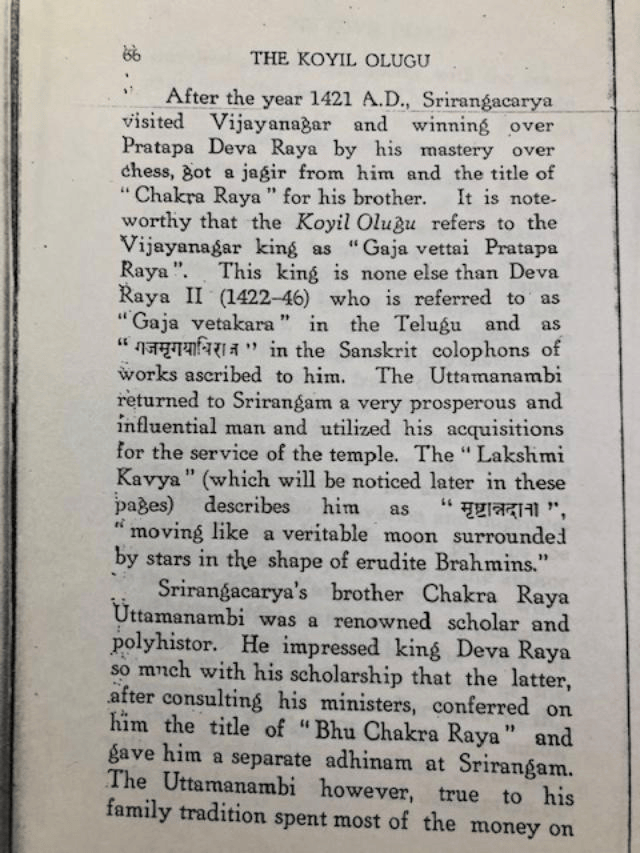
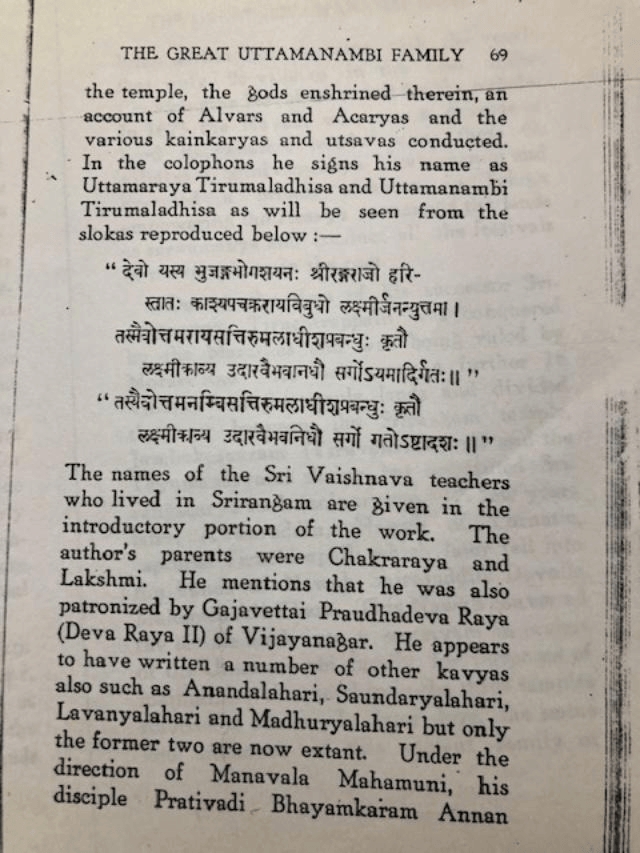

Reading the extracts above, along with the 2 charts provided by me at the beginning, should enable anyone to be able to imagine the massive scale and extent of contributions made by generation after generation of the “Utthama Nambi-s” and the “Thaathachaarya-s” to the flourishing glory and grandeur of one of the greatest cultural and anthropological social-groups ever found in the history of modern-day Tamil Nadu viz.: the tradition of the great Sri Vaishnava “ubaya-vedaantins” who lived through almost the entire first millennium of the common era in a tiny geographical corner of peninsular India — stretching no more than about 500 kms. in length and 200 kms. in breadth — between the Kanchipuram Sri Varadaraja Perumal Temple and the Sri Rangam Sri Ranganathan Perumal Temple.
************************************
Not many Sri Vaishnavas, of any age-group or from any walk of life today I have personally met and known, ever have I found themselves asking the question or wondering to themselves:
“Why and how did such a great and noble cultural tradition that once flourished and endured in South India begin to fray, decline and fall?!
“What made them turn on themselves and pull each other down?
“Why are they today only a pale, effete and washed-out image and poor imitation of their illustrious self as it once was since the time of Sri Ramanuja right up to the times when the British Colonial powers ruled all of Carnatic India and even today?
What happened to them….. those who belonged to the Sri Rangam “tennaachaarya sampradaayam” and those who began to identify themselves with what they had begun to see as “desika sampradaayam“? And why?
But then those are the very questions which modern-day Sri Vaishnavas perversely avoid confronting and they do so at their own peril. It is because they avoid introspecting amongst themselves by asking themselves such searing, penetrative questions that History itself seems to have chipped away slowly their common identity and common legacy as “ubaya-vedaatins” and now threatens to erase both completely.
(to be continued)
Sudarshan Madabushi