One of the commonest Tenkalai historical narratives that is dissonant from the Vadakalai one, is that the latter drew far greater legitimacy for power to control the Sri Kanchi Devarajaperumal Temple from the Vijayanagar Royal Court than from Sri Ramanujacharya himself. For well over 500 year, the Thaathaacharyas of Kanchi enjoyed the rights and privileges of stewardship of the Kanchipuram temple thanks more to the throne of the Raaya Kings than to the “tridandam” staff (holy scepter) of Sri Ramanujacharya.
In the Tenkalai narrative, the Thaathaacharyas, in a metaphoric sense, really owed their position and power to the legitimacy that the State, more than the Pope, had conferred on them.
The above narrative would have been quite credible if it was found that the Vijayanagara Kings had not bestowed upon Sri Rangam temple endowments of equal royal munificence and largesse as they had upon the Kanchipuram temple. But we find from evidence that the royal kings of the Vijayanagar Dynasty were impartial towards Kanchi and Sri Rangam, or for that matter Tirumala and Melkote even. It is probable that the Sri Rangam temple received maybe more royal patronage than the Kanchi temple.
One senses that in the period circa 15th-17th century CE, amidst the ongoing unacknowledged but nonetheless sprouting tensions between the southern “tennaachaarya sampradaayam” and “Desika sampradaayam” of Sri Rangam and Kanchipuram, the fact of both groups of “ubaya vedaantins” vying with each other — in unobtrusive but very active ways — to establish relationships with the Court of Vijayanagaram only added to their mutual tensions.
Both groups needed royal patronage and both therefore exerted their best efforts in trying to win positions of power and influence within the palace. In the ensuing jostle for power, influence and position in the Vijayanagara Court, the fact that the Kanchi “ubaya vedaantins” managed to outdo, outlast and outclass their Sri Rangam brethren might have caused no small degree of frustration, disappointment, pique and a certain sense of grievance amongst those who saw themselves as Tenkalai.
The Vijayanagara Kings showed really no marked partiality towards either Sri Rangam or Kanchipuram “ubaya vedantins” in the matter of generous support and patronage granted to both temples. However, in the matter of pure faith, adherence to “raamanuja siddhaatham” and general spiritual propensities, they made no secret of their preference for the spiritual mentorship of the Thaathaachaarya-s of the Kanchi rather than the Sri Rangam “ubaya vedaantins“.
We find dynast after dynast in the long line of succession in the Vijayanagar royal families, appoint as their “raaja gurus” only Thaathaachaaryas from Kanchi.
Normally, kings are notoriously fickle-minded and of mercurial temperament in the appointments they make of their Advisors. “Hire and Fire” at will (which is the modern corporate cultural norm) was not uncommon also in those ancient times of the kings of India. Raaja-guru of a king one day would find himself thrown out of the palace next day if the King happened to lose trust or confidence in him….
But in the case of the Kanchi Thaathaachaarya-s, it is truly most amazing, remarkable and uncanny that generations of their family-heirs were retained as “raaja-guru-s” and “royal advisors” by successive Vijayanagara Kings!
The chart below illustrates clearly the great hold on the minds, hearts and, most importantly, on the favors of the Vijayanagara dynasts which generation after generation of the Kanchi Thaathacharya families exercised and as result of which they succeeded in gaining enormous patronage and support for their own philanthropic programs for the development and expansion of the Kanchi Sri Devarajaswamy Temple for well over 3 centuries!
From the time of Virupaksha-II in the 15th century right down to King Ramadeva Raya in the early 17th century, the position of “raaja guru” at the palace of the Vijayanagar Palace was held by none other than a Thaathaacharya only!
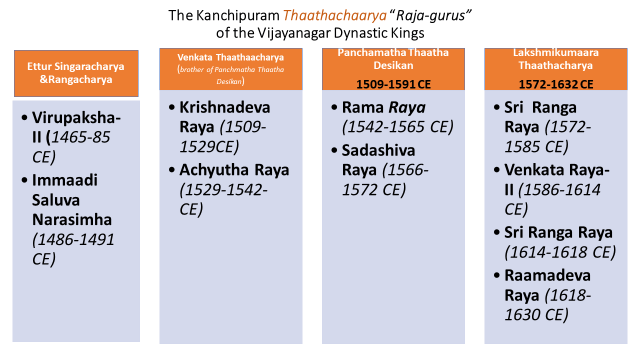
Below are a few extracts from Sri Varada Tathaachari book “A Critical Survey” (of Dr. K.V.Raman’s book on Kanchi temple quoted in earlier Parts) that illustrate and underscore the same point:
QUOTE:
“Panchamata Banjanam Tatadesika 1509-1591 A.D: One of the luminaries of the renowned Vaishnavite Acharyas in the line of Sriman Natamunikal was Sri Panchamatabanjanam Tatadesika, son of Kandanur Srinivasachariya who flourished at Kanchi in the sixteenth century, A.D. ….
He was named “Tatadesika” by his parents, after Sri Peria Tirumalai Nambikal, their illustrious ancestor and uncle of Sri Bashyakar.
He was a great scholar and a spiritual preceptor to the Vijayanagara rulers, Sadasiva, Ramaraya, Tirumala, Sri Ranga and Venkata. Ramaraya was completely under the influence of Sri Tatacharya, the Rajaguru.
With his immense power and wealth, he secured from the kings, Sri Tatacharya started many constructional works in our Temple many of which were later completed by his illustrious son, Sri Lakshmi Kumara Tatadesika.
Sri Lakshmi Kumara Tatadesika 1572-1632 aka Sri Koti-kannikadanam Lakshmikumara Tatadesika (1572-1632 A.D.) was the son of Sri Tirumalirumcholai Aiyangar and the adopted son of Sri Panchamatabanjanam Tatadesika.
“…..we find the major constructions and improvements that took place during the sixteenth century viz., the gopuras, prakaras, mantapas, like Abhisheka mantapa, Hundred-pillared Mantapa containing beautiful pieces of architecture, Vimaanas, etc. were all started, managed and completed by the Tatacharyas who had the full support, backing and patronage of the Vijayanagar Kings from Krisnadevaraya down to Venkatapati Deva Maharaya (Venkata I) and Venkata II. From the inscriptions of the Yatokthakari Temple, we are informed that in all the inscriptions of the King, Ettur Kumara Tatacharya also figures prominently”.
UNQUOTE
Sri Varada Thaathachari further has also written this below:
QUOTE:
“The next prominent King of the line, is Krishnadevaraya of the Tuluva Dynasty. He had also a Tatacharya as his guru.
Prof. K. A. Nilakanta Sastry describes the Sri Vaishnava leaders in the sixteenth century as “able leaders who were men of considerable learning. They were men of great tact and possessed much skill in carrying on religious propaganda. According to the Telugu literary tradition, a Sri Vaishnava teacher, called Tatacharya was the guru or spiritual advisor of Krishnadevaraya”.
This Tatacharya was Venkata Tatacharya the elder brother of Panchamata-banjanam Tatadesika.
Dr. B. A. Saletore describes “Venkata Tatarya in the following words.
Krishna Devaraya, the great, invested him with uncommon religious powers in A.D. 1523, was entitled to receive the first THIRTHA and PRASAADHA in all the great Vishnu Temples in Vijayanagra Ghanadri and all the 77 durgas, gutti durga, etc. in all the cities to the east and west of Vijayanagara as far as the sea; in all the durgas to the north and south as far as Madura and all the holy places such as Kanchi, Trisaila and Khadri excepting Srirangam, Ahobila and Ghatikagiri, privileged to get the first honours in the assemblies of the Sri Vaishnavas and authorised to make enquiries into the conduct of all castes owing allegiance to Ramanuja and to punish the delinquents in regard to religious and social matters”.
Krishnadevaraya was an ardent Vaishnavite as evidenced by his munificence to our Temple in gilding the Punyakoti Vimaana with gold and rendering several other acts of benevolence. In this he was chiefly guided and influenced by his Tatacharaya preceptor who was naturally interested in the Temple as its custodian.
UNQUOTE
The Kanchipuram Sri Varadaraja Perumal temple without any doubt enjoyed a truly “golden period” of prosperity and fame — in terms of expansion, development, innovation, cultural advancements of many kinds etc.. — during the Vijayanagar Rule thanks mainly to the great service and contributions of the Thaathaachaarya family lineage.
It would now be equally interesting to study how in comparison to the Kanchi “ubaya vedaantin” group, the Sri Rangam group fared too in its own relationships that were forged and maintained with the Vijayanagar Kings during more or less the same timeline.
Such a comparison is not possible without studying, at least in brief summary, a few details of the history of the great family of Sri Utthama Nambi of Sri Rangam …. a family that in terms of piety, scholarship, social recognition, steep spiritual credentials in Sri Ramanujacharya’s “sampradaayam”, political gravitas and extent of influence…. was no less the equal of the Kanchi Thaathaacharya clan.
(to be continued)
Sudarshan Madabushi