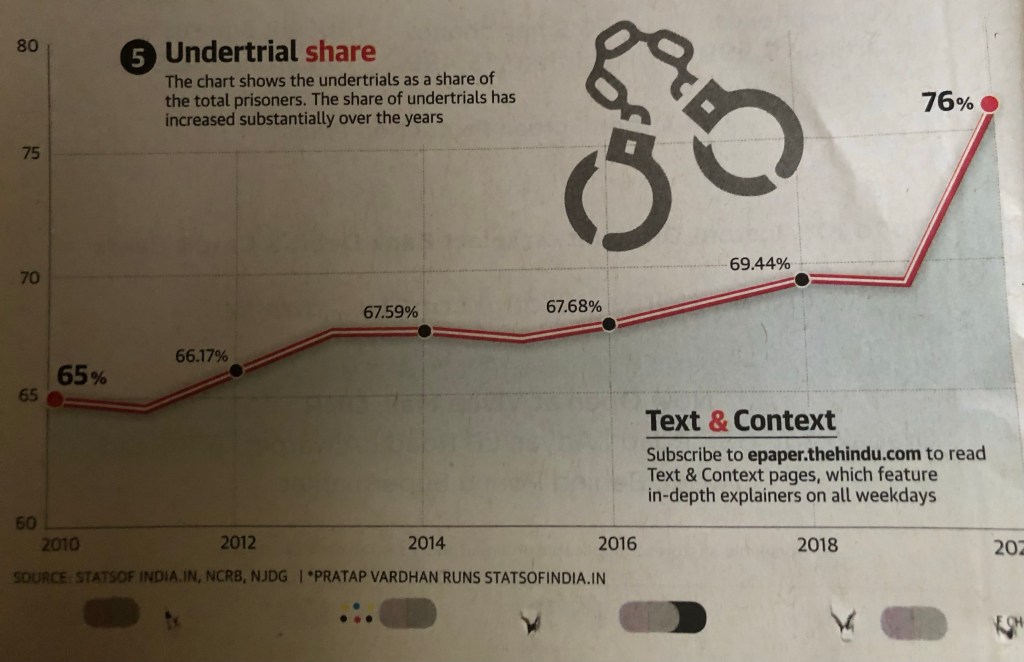
THE HINDU today (July 15, 2022) must be complimented indeed for publishing a most illuminating set of infographic charts and a succinct, stark high-level analysis, as well, of all the grave ills that plague the justice-delivery system in our vast country. Here below are those charts:



The first chart above is THE HINDU’s own summation of the charts and it is self-explanatory. I have nothing to add to it.
The next 5 charts present however an extremely grim picture of a creaking, groaning, dysfunctional organisation on the verge of imminent collapse which is the Indian judicial system today. It is beset by woeful deficiencies in terms of physical and human infrastructure that I choose to describe as the “5Ps” viz. Pendency, Personnel, Protraction, Prison-occupancy and Procrastination.
A justice-delivery organisation suffering from the above “5P syndrome” is certainly a national security threat if it’s going to be left unattended and unaddressed. It is a ticking time-bomb. It raises the grim spectre of deep and violent social unrest and large-scale criminality that is imminent ahead. On a war-footing the judicial system has got to be prevented right now from turning into a national internal-security threat.
THE HINDU analytical summary diagnoses the “5P syndrome” within the rather narrow, mechanistic (glib, in my view) framework of a simple “DEMAND vs SUPPLY gap for Justice” in the country. It assumes that if one throws more physical and Human Resourcess at it the problem will get somehow licked.
I beg to differ. This problem is not one of resource adequacy but structural inadequacy. The way the Constitution of India has structured the justice delivery system is outmoded and it is in urgent need of a drastic review of the whole philosophy underlying it. Here is why I think so.
QUOTE: “Because of the size of the country, the judiciary system is planned as per the requirement of the citizen of India with the location of courts as per status to serve the community of India with efficiency. India has a rich tradition of providing justice to the affected and the courts in various levels are there to serve the purpose of extending highest level of efficient juridical system all over the country.
“The court structure is set as per the judiciary system prevailing in India with differentiation of applicability as per the merit of the case. The normal trend of the judiciary system is to start any general dispute in the lower court which is being escalated as per the satisfaction of the parties to the higher courts.
“The hierarchical structure of court is being endorsed by the Constituency of India with the level of power exercised by the different level of courts. The judgments can be challenged in the higher courts if the parties to the cases are not satisfied. The process of escalation is systematic and thus the system of providing maximum level of satisfaction to the parties is sincerely tried by the judiciary system.”
“The feature Indian judiciary system is its hierarchical structure of courts. There are different levels of judiciary system in India empowered with distinct type of courts. The courts are structured with very strong judiciary and hierarchical system as per the powers bestowed upon them. This system is strong enough to make limitation of court with its jurisdiction and exercise of the power. (Oh really?!!) The Supreme Court of India is placed at the top of the hierarchical position followed by High Courts in the regional level and lower courts at micro level with the assignment of power and exercising of the same for the people of India….” UNQUOTE
Please read below link:
https://blog.ipleaders.in/courts-justice-system-india/?amp=1
Thus, it can be easily seen from the above that the Indian Judicial structure is based on the above fundamental philosophy of “ESCALATION”. The entire organisation and its hierarchy has been conceived, developed and constructed on it over the past several decades of Indian history.
Such a systemic structure is really old colonial-style architecture that was designed and employed to sub-serve British Rule excellently for 250-odd years. It was effective in helping the Crown to totally centralise all levers of justice with itself. Just as all Roads in the Roman Empire were meant to lead only to Rome, in colonial India all judicial processes and litigation were designed to ultimately grind their way along an escalatory labyrinth of legal jurisdiction up a slow spiral of appeals, until matters reached an apex body that was deified as the sole arbiter of the ultimate ends of all justice. The whose system was premised upon the philosophy of Escalation the following chart illustrates the fact.
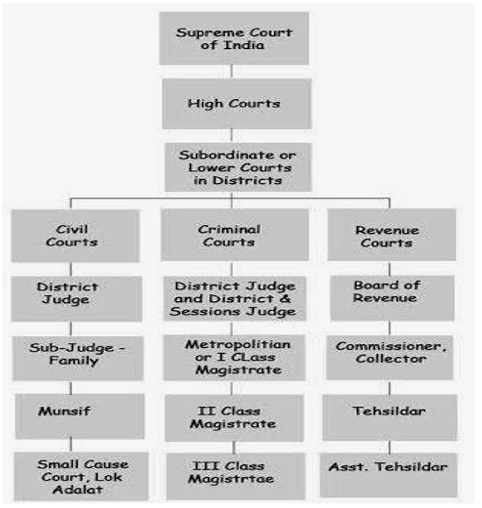
Endless Escalation through appeals of the lower court’s verdict to higher courts became the norm in India after Independence. This has led indeed to the burgeoning of pendency and arrears of case backlogs that today are clearly overburdening and will most certainly threaten tomorrow to swamp the entire judiciary.
The system of appeals through endless escalation to higher courts is, if one pauses to think of it deeply, a vote of no-confidence and no-trust in the competence and judgment of the lower courts. The assumption is that the decisions of the lower courts are always to be held suspect and must be always subject to review by superior courts until at last they are finally adjudicated upon by the Supreme Court.
Such fundamental assumption is what creates the Pygmalion Effect upon the judges of subordinate courts who exercise their minds always with the timid knowledge gnawing at the back of their mind that on appeal his or her verdict might get overturned by a superior judge sitting up the hierarchy. The office of the lower court judge is designed and set up, thus, to fail …. and so does indeed fail ….
Such a structural design only leads to miscarriages of justice which otherwise might not happen at all but for the unlimited scope being made indiscriminately available to litigants to go on escalating through appeals to higher courts.
The scope and opportunity for unlimited Escalation provided under the Constitution of India today through endless appeals, in my view, needs a thorough Constitutional review and revamp.
The system must now start placing more faith in the jurisdictional competence of subordinate courts. The hierarchy of Escalation must now get replaced by a hierarchy of legal and jurisdictional Merit.
If a case adjudged in a lower court does not really merit an appeal at all —- given all the facts, nature, merits, gravity and finality of the case — it should be deemed to have been granted final justice and no further litigation should be allowed except under rare show of exceptional cause . This way lower court judges will be forced to exercise their professional judgment and competence with even greater rigour and thoroughness than they do now. Greater judicial accountability will be demanded of them.
As for the litigants , they will come to realise that the wheels of justice will not go on grinding ever so slowly for years on end for their own advantage. There will be greater devolvement of judicial power throughout the lower courts of land leading to public expectations of speedy justice.
The higher courts with less decentralisation of judicial power in their hands will be forced to concentrate more on cases of far greater importance to society and nation and avoid getting bogged down by the less important, even frivolous ones like PILs and wasteful litigation. That would signal the beginning of a national program of larger reforms of the judiciary in this country.
Sudarshan Madabushi