The seismic social changes that overcame, rocked, overwhelmed and which utterly demoralized the Sri Vaishnava community towards the end of 19th century, and early part of the 2oth, under British Rule can be described under broad categories below:
A. Language
B. Education and Employment
C. Migration
D. Cultural alienation
E. Wealth dispossession
********************************
A. LANGUAGE:
When a language is destroyed — or, as in this case, a language is relentlessly sought to be destroyed — the people to whom it belongs also get destroyed. It is, in fact, a slow, imperceptible and bloodless process of cultural genocide that cannot however be held, under any writ of law, to be culpable by any court of justice or human-rights commission.
A Language, as is well known, is the deepest repository of a people’s earliest collective atavistic memories and pre-historic and historical experience. It is the medium through which the collective mind of generations of a community continues to grow, develop and nourish itself. A language is, in fact, the single most powerful creative and causal force that energizes a society’s customs, traditions, belief-systems, ideas, ideology, all spiritual and secular values and all aspirations…. (i.e. to say that in simple Sanskrit term – all “paaramaathikam” and “vyavahaarikam“).
The conquest of a people by military means is not even half as devastating or murderous as such cultural genocide perpetrated on them. When a relentless battle is fought against their Language with the aim of wiping it out…. or “cancel” it, as the modern-day expression goes…. the people of the language get diminished, impoverished and disempowered. They wither, crumble and then they fall.
Sanskrit is one such language that faced the onslaught of such terrible genocide throughout the 19th century CE under British Rule. Thereafter too, in the 20th century CE, it continued to suffer the same fate even after Indian Independence. And, in fact, Sanskrit reels under the impact of the genocidal aftermath to this very day.
The story of the silent yet deadly linguistic genocide carried out against Sanskrit under British Colonial Rule is a deeply researched and quite well-documented one. The story is told engagingly in a popular book written by Rajiv Malhotra titled “THE BATTLE FOR SANSKRIT” (2017: HarperCollins). I have tried to use the larger story told in Malhotra’s book to carefully map onto and superimpose it upon the story of the localized history of the Sri Vaishnava “ubaya-vedaantin-s“. I believe doing so is a very useful exercise in that when both histories are read together in conjunction and apposition, it provides us with a clear perspective and graphic understanding of why the “death of Sanskrit as a language” led also to the decline and fall of the “ubaya-vedaantins” of Tamil Nadu.
In the following pages, I shall take the liberty of reproducing several relevant and illuminating passages verbatim from the “Battle for Sanskrit” to explain how the destruction of a language, Sanskrit, also caused deep social upheaval in the society of Sri Vaishnavas and left behind a permanent and indelible scar upon its body, mind and spirit that remains unhealed to this day. When Sanskrit was torn away from the fabric of “ubaya-vedaantham”, its very spirit, thought, traditions, identity…. the very esprit de corps of its community…. also unraveled, went to seed and to pieces.
It is such a sad social upheaval that is very briefly being explained above.
***********************
Much of the book “Battle for Sanskrit” is a formidable academic debate between Rajiv Malhotra and the well-known and very influential academician, the American Orientalist and Sanskrit-scholar, Prof. Sheldon Pollack of Harvard University.

Pollock is a Sanskrit antagonist with a pronounced and unmistakable bias against the Vedic or Dhaarmic civilizational past of India. (He largely favors the Buddhist version of all ancient Indian history). His anti-Vedic, anti-Sanskrit theses and dissertations were first propounded in an academic paper he had circulated under the title, “The Death of Sanskrit” (2001), an extremely powerful and influential seminal work that made out the case for why modern India should consign Sanskrit to the dustbin of history if it aspired to become a modern progressive nation in the new millennium. When one reads Pollock’s broadsides against Sanskrit as a language, it is easy to understand what was the actual thinking and rationale behind the policies that British Colonialism pursued to break the spirit of India, and to rule it by destroying a language to advance the larger governance-principle of “divide and rule“. This below is what Prof. Pollock thought of Sanskrit:

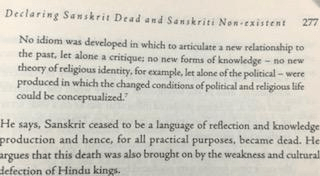

Sanskrit thus was portrayed by the colonialist intelligentsia and ruling-classes as “an instrument of domination” of “power” and “social oppression”.
The language was further given a strong coloring and flavoring of casteism by which Sanskrit was blamed for enabling the brahmin caste to exclude all other castes and confer upon the latter an inferior status in a rigidly hierarchic structure of society at the top of which the kingly/feudal and priestly communities ruled the roost unchallenged.
Sanskrit as pure language was demonized and castigated in the harshest terms possible as the below passage reveals:
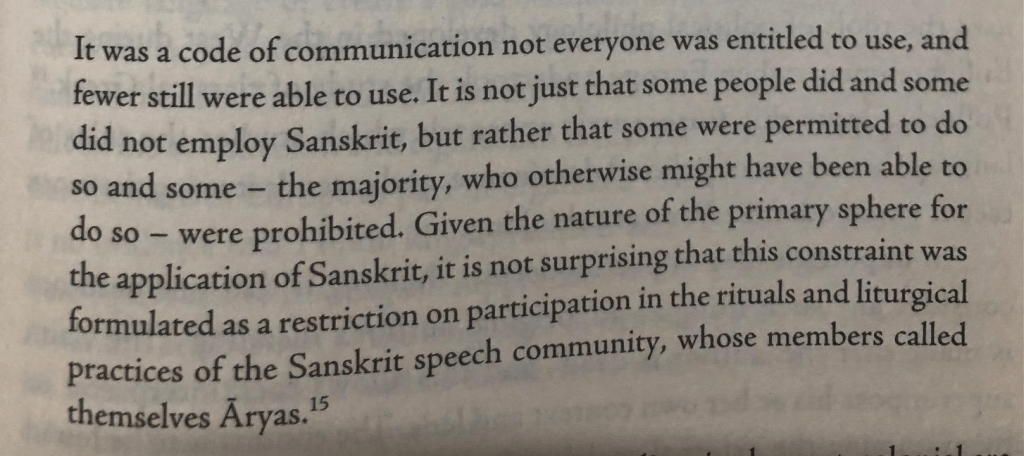
Prof. Pollock went on further to brand the Sanskrit language as fit for nothing else but the brahmin caste’s “sacerdotalism” which aided them in excluding every other caste in society. In the below passage Malhotra summarized what Pollock wrote in that vein:


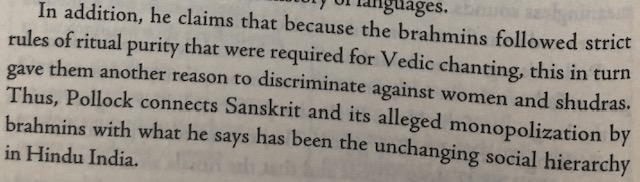
That the “hymnology” of the Sanskrit Veda was totally misunderstood and misrepresented by anti-Vedic orientalists by calling it as “mechanical parroting of hymns” and as “meaningless sounds” clearly exposed their absolute lack of knowledge and understanding of the unique two-faceted-ness the ancient language possessed. Sanskrit had both a “paramaathmika” and “vyavahaarika” aspect to it.

The nub of the matter to be grasped finally is that the British administrators of India during the period of their long rule, encouraged, aided and wholeheartedly abetted the colonial-era academia and cognoscenti of Western imperialism to mount a viciously calumnious battle against Sanskrit and succeeded slowly in killing the language.
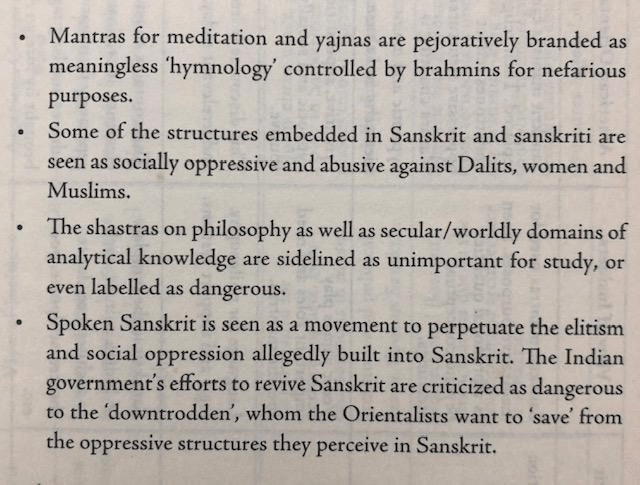
The success was realized in large measure when even large sections of the Indian populations, who by the 19th-20th century CE were increasingly getting bedazzled and awed by Western ideas of modernity and social progressiveness, and got brain-washed into believing that the systematic campaign of academic calumny launched by their English masters against Sanskrit language must be true…. According to Malhotra, that is how Pollack’s thesis is presented and he summarises it in the passage below:
********************************
Another tactic was also used against Sanskrit in the sustained and brutal battle to kill it by the British colonial orientalists as well as later by the modern American Orientalists such as Prof. Pollock. The tactic also aided the “divide and policy” of Imperial Britain in India.
The tactic consisted of driving a deep wedge between Sanskrit and the local vernacular languages of India. Sanskrit was portrayed as the language of the elite Brahmins and their temples, of the upper-ruling, kshatriya or kingly classes and their royal courts. Brahmin and ruling-classes were said to use Sanskrit to create social caste-barriers between themselves and the larger populations of lower castes whom they were able to rule and keep subjugated in servility. The principal language of the masses, however, had always been the local vernacular only…. And in the case of the Tamil provinces in which the “ubhaya-vedaantin-s” lived, the vernacular had always been native Tamizh.
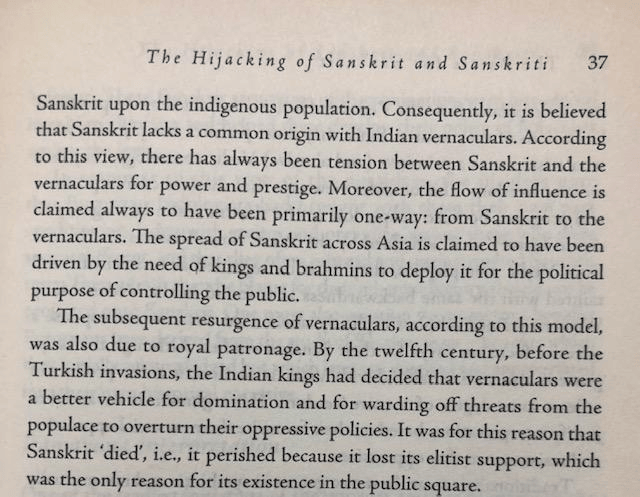
Around the above narrative, and heavily overlaying it, was then built the mischievous colonialist theory of how and why the Vernaculars in time came to replace Sanskrit and make it a “dead language“. This is how Malhotra describes the Sanskrit versus Vernacular narrative of Prof. Pollock:

********************************
Given the overall historical context characterised above as the vicious Battle against Sanskrit, it should not surprise at all any common but intelligent observer of the history of the Sri Vaishnavas that their rivalry and animosities, that had been steadily building up during the same period between the Tenkalai and Vadakalai sects of “ubaya-vedaantin-s”, intensified and became more rife in all their temples in the land between Sri Rangam and Kanchipuram.
It would not be far-fetched at all to reason too that the Tenkalai group within the community, commanding as it did the greater number of Sri Vaishava temples in the south, began most likely to see a clear and present opportunity to align themselves on the right and politically correct side of history…. if one were not to put it more crudely saying “to curry favor with the powers that be”.
Here is how such a reasoning might be credibly founded:
To preserve the narrow sectarian and material interests of their own temples and their temple-ecosystems, the Tenkalais found it perhaps both expedient and prudent to proactively demonstrate their communal loyalty to the powerful masters of the time. In other words, they thought it fit and advantageous to align themselves with the side of the pro-government, anti-Sanskrit, pro-Vernacular (Tamizh) ideological forces which they saw were formidably arrayed behind the Colonial masters. And with the intention of also displaying their broad, liberal and catholic outlook on matters of religious and social order, the Tenkalais also portrayed themselves to be unsupportive of the ancient Vedic tenet of “varnaashrama” and its hierarchical structures of social intercourse. They could also more openly than ever before express their own rejection of “sacerdotalism” of “Smriti” and “Agamic” practices to which the Vadakalais still gave due importance.
Furthermore, the Tenkalais also saw the general situation and circumstances of the period to be wholly in their favor in the matter that they were most hotly championing viz. the primacy of the Tamizh “dravida veda” of the Azhwaars over the Aryan scriptures of Vedic revelation in Sanskrit.
The Tenkalais thus were seen during that period in history to be clearly adopting a studied attitude of due deference, appeasement and conciliation… if not of kowtowing… towards the British rulers in the hope that that in showing tacit support to the English masters, in the Battle against Sanskrit, the masters would in return reward them somewhat i.e. allow them to preserve and retain their hold, entitlements and influence over their temples.
The Vadakalais, on the other hand — especially those who were perhaps stewards of the numerically fewer temples of Vishnu in northern Tamil province such as Kanchipuram, Tiruvellore, Tiruvaheendrapuram etc. — stood their ground. They took the opposite side in the Battle against Sanskrit even at the risk of landing up on the wrong and “politically improper side” of history.
The Vadakalais stood firm in their loyalty to the Vedic language, Sanskrit, since they believed that it was the only language in which Sri Ramanujacharya had discoursed upon entirely while propagating his system of philosophy or “darsanam“. They did not view Sanskrit as a dead language at all…. And nor did they see it as an implacable rival to the Tamizh vernacular. They remained firm in the belief that the Tamizh language in which the Azhwaars had sung their mystic hymns was “draavida veda”; it was the equal of the “apowrusheya Veda” but it could never be substitute for the latter ; not in the temples, not in liturgical practices, not in the “sacerdotalism” of “Smriti” or Agama rituals, not in the discourse of religion and faith either.
For the Vadakalai, the whole of “sanaatana dharma” had been handed down from the beginning of time only in the Sanskrit language and its twin-aspects of “paramaathmikam” and “vyavahaarikam” made it a unique and priceless legacy of heritage. The Vadakalai-s also did not wholly reject or condemn the ancient Vedic social order of “varnaashrama“, the caste-based structure that had preserved Hindu society as a cohesive and organic whole for several millennia of the past. They believed that the baby need not be thrown out along with the bath-water and that with needed reforms to the caste-system duly carried out to suit current times, “varnaashrama” could quite easily co-exist with the newly emerging social orders and structures.
*******************************
With Sanskrit coming to be increasingly regarded however as a dead language by the overwhelming majority of the Sri Vaishnavas in Tamil country, the numerically smaller minority of the Vadakalai sect began to feel marginalized, diminished and insecure in status within the community.
The Tenkalais, on the other hand, outnumbering the Vadakalais, felt vindicated to have been all along championing the narrow beliefs and the sectarian positions and convictions. They now felt even more emboldened to claim that it was their sect alone that was the torch-bearer of the true spirit of Sri Vaishnavism.
As for the British rulers of that time, they were only too gratified to have succeeded in dividing and enfeebling one of the most important native communities of Tamil society — the Vaishnavas who had been wielding enormous both spiritual influence and temporal sway over the minds of all peoples — right along deep linguistic and caste fault-lines.
The impact of the death of their language, Sanskrit, was devastating upon the Vadakalais. It led to a social upheaval in terms of Education and Employment, a subject which will be explained in the next Part.
(to be continued)
Sudarshan Madabushi