Given the enervating zeitgeist of the 19th century CE as it prevailed all over South India; given the conditions of material and spiritual impoverishment of all temples across the Tamil country; and given the slow but steady deterioration suffered by Sri Vaishnava temples especially as they passed into the grip of the iron fists of British administration, the two Sri Vaishnava sects, Tenkalai and Vadakalai, chose to respond to their circumstances in different ways.
The Tenkalai sect, by virtue of the fact that it had for very long held a firm, dominant position of power, command and control over far greater numbers of Vishnu temples in the Tamil provinces than the Vadakalai sect, was quick to realize which way the political winds in India in those times were blowing. They reconciled themselves to the deep social churning and many profound changes that were taking place all around them. They decided the most prudent course of action for them and their temples was to turn gradually accommodative towards such changes, make adjustments to hoary traditional attitudes of priesthood. In other words, they were willing to go along with the general mood of the times as it manifested itself in the many new forms it did, such as new-fangled ideas of social liberty and equality; as anti-“Varna-ashrama” movements triggered, stoked and inspired by British colonial academia and Christian evangelical missionaries (Anglicists); as growing anti-Sanskrit sentiments; as an upsurge in sentiments of Dravidian-Tamil jingoism; and as the dawning of a new hate-filled ideology emerging as anti-Brahminism alongside the incipient rise of a Dalit social consciousness.
The Vadakalai sect, however, remained stubbornly conservative. It failed to read fully the winds of change and the social implications that were overwhelming it as community. It still stood rooted in temple traditions and priestly occupations as die-hard adherents. It’s general response was therefore one of striving to preserve rigid orthodoxy. As a result of such resistance towards mainstream social transformations that were occurring all around it, the Vadakalai group of Sri Vaishnavas suffered the most grievous blow to its very identity in the form of Sanskrit being wholly uprooted out of it and consigned to oblivion by the colonial rulers.
In this regard, a few passages from Rajiv Malhotra’s “The Battle for Sanskrit” —wherein he exposes the real intent behind the colonial governance policies of the British by observing them through the lens worn by the eminent modern American Orientalist, Prof. Sheldon Pollack — are very noteworthy.
The intent of the British rulers was clearly to malign communities — such as the “ubaya-vedaantin-s“, “smaartha-s” and “advaitins” of Tamil country — who held Sanskrit to be both sacred and functional (in the sense of it being both “paramaatmikam” and “vyavahaarikam“) to be caste bigots, social reactionary and obscurantist elements that were resisting giving up the old order of “varnaashrama“. The intent was to portray Sanskrit being anti-vernacular and hence anti-social and anti-progress. This pernicious intent of the British rulers, in fact, (sadly far too late in independent India in 1957 CE when severe damage had already been done to the language), was exposed by the findings of a Sanskrit Commission Report. This is what the Report said:

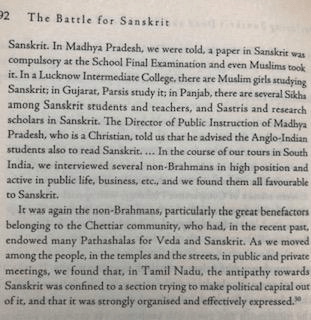
Thus, although it was well known that the anti-Sanskrit propaganda was but the handiwork of a “section trying to make political capital out of it”, the social broadcast of it by the British colonialists was so powerful and so influential that ill-resourced and thoroughly demoralized small communities like the Vadakalai “ubaya-vedaantin-s“, dependent wholly for survival upon the income from decrepit temple-institutions, could hardly come to the rescue of Sanskrit to save it from inevitable “death” as a language.
As the 19th century CE further progressed in British-ruled India, the English or Anglicist juggernaut became simply unstoppable as it road-rolled over all societies that dared to stand in its way. Here are a few passages from Malhotra’s book that tell the story very briefly:

Kapila Vatsyayan, modern India’s eminent scholar of art, once remarked that colleges Britain founded in India served their own needs for clerks and soldiers to help in the extraction of Indian wealth and to protect the Raj, with some effort thrown in to understand India’s past so that they could control it better. The fields that they left alone — art, music, dance and yoga — are the only ones that have maintained vitality. Indeed, people from all over the world travel to India to learn these fields. Behind these fields lies Indian philosophy, that remains sidelined in Indian academia as something provincial, fit only for those who are stuck in the past. (vide: https://subhashkak.medium.com/self-loathing-and-indias-anglophones-ccbd8194517)
For the “ubaya-vedaantin-s” of Tamil provinces the upshot, impact and social consequences of all the above historical events and circumstances, that happened during the 19th century CE and early 20th century CE, were not only disruptive but also permanent and they were most acutely experienced in life as Education, Employment and Migration.
**************************
(B) Education and Employment and (C) Migration
As seen above, (quote) “In 1844, the British Government passed a Resolution declaring for the first time that employment preference would be given to those educated in the British system. The education policy of the East Indian Company became aligned with the new ideal of Western knowledge through English”. (unquote)
That declaration sounded the death-knell of all traditional home-grown education in Sanskrit in India to which the “ubaya-vedaantin-s” had been accustomed and had been imbibing for many centuries. In one fell swoop their traditional ecosystem was uprooted and consigned instantly to desuetude and ultimately to death.
It also marked and triggered the beginning of an epochal shift in the society of Sri Vaishnavas. The 19th-20th century witnessed a silent, imperceptible mass-migration of “ubaya-vedaantin” families from the simple temple-village which had been social and spiritual habitat for innumerable past generations of them as priests and scholars dedicating their lives wholly to their temples, their philosophy, religion, and to related arts, music, poetry, scripture, hermeneutics and other vocations. They began migrating slowly but surely to the urban and semi-urban centers of British India. The migration began first as just a trickle in the middle of the 19th-century CE until it became, in numbers, steady and sizeable waves by the middle of the 20th century, and in fact, even well after India gained independence in 1947 CE.
Sri Vaishnava families left home and temple in their villages, abandoned Sanskrit and Sanskrit-based traditional education, sold their ancestral lands, homes and property and moved out of rural India to the semi-urban (“mofussil“) area and metropolitan spaces around great cities like Madras, Trichy, Chittoor etc. and even further north to British cantonment-cities like Nellore, Vijayawada, Bangalore, Mysore etc.
They went scrambling in search of educational and employment opportunities in the cities and mofussil towns. They clamored to get educated in Christian-Missionary schools and colleges that were newly set-up under the sponsorship and patronage of the British Raj.
A mere school-leaving certificate obtained from such academic institutions would assure them of secure and decently paying jobs as clerks and subordinate staff in the British government. And if higher Degrees of Universities were earned through Western curricula — such as B.A. M.A. or a degree in law such as B.L. , B.Sc. etc.– they could even aspire to be absorbed into the British Civil Service. The highest career-ambition in life of a bright young and intelligent Sri Vaishnava in the 19th and 20th century CE was to pass the examination of the British government in London and be inducted into the ICS. The Indian Civil Service ( ICS ), officially known as the Imperial Civil Service, was the higher civil service of the Empire in India during British rule in the period between 1858 and 1947 . Its members ruled over more than 300 million people in the Presidencies and provinces of British India and were ultimately responsible for overseeing all government activity in the 250 districts that comprised British India.
The best brains of the “ubaya-vedaantin” community that succeeded in acquiring a coveted English education for well over a hundred years thus gradually integrated itself into the imperial British establishment — as academicians in universities, teachers and headmasters in Christian missionary schools and colleges, as clerks and subalterns in colonial Collectorates, port-authorities or in the police force, as members of the British medical-corps, as lawyers, tahsildars, land revenue-collectors, as “munsiffs” or judges of the lower judiciary, Railways station-masters, accountants and comptrollers in various government offices and departments serving the British Crown….. etc. etc.
All of the “ubaya-vedaanta” community in South India was, within a span of one hundred-odd years, thus effectively dispossessed of its hoary, hallowed cultural legacies and traditions. Its identity stood dismantled and mangled.
From being scholars in high philosophy and theologists with refined intellects, from being the inheritors of brilliant Sanskrit poetic and literary riches…. within a span of just three or four generations, they became a community of clerks servile to an imperial ruling-power.
It was truly a decline, nay, a steep fall from the sublime status they held within Hindu society to a pale and bathetic caricature of themselves. They were now seen as obsequious courtiers and hand-maidens of the British masters. So completely did the colonialists succeed in co-opting the Sri Vaishnavas into their own imperial project in India.
To be fair to the Sri Vaishnava community, however, not all of them pursued the rat race. Some of them remained in their temple-villages to continue their priestly occupations. But they too soon became, being driven by their shabby, impecunious circumstances, a parody of their old proud selves . They were not “ubaya-vedaantins” in any authentic sense anymore since their standards of piety, high learning and scholasticism, fidelity to traditional values and ethics all fell by the waysides and by-lanes of history.
******************************
The British Government and even the post-Independence Governments of India conducted several nation-wide Census surveys of the vast populations of the country. Every eleven years, the Census machinery and field-workers would get to work, collect vast amounts of population, demographic and sociological data and information.
The Census of India prior to independence was conducted periodically from 1865 to 1941. Strangely, not one of the Census report sheds light on the actual numbers of people’s internal migrations — such as those of the “ubaya-vedaantin’s” — from the rural temple-environs to the bustling urban melting pots of modern India.
In the total absence of such relevant data or information, it makes it almost impossible for anyone to make any reasonable estimate how many thousands of Sri Vaishnava families over the 19th-20th century CE uprooted themselves away from their native temple-homesteads and their traditional ways of life to go and seek education, jobs and gainful employment in the rapidly changing world of Indian cities and semi-urban towns.
In the total absence of such empirical data that Census reports can provide, it would be impossible to answer one very important contextual question: In the great painful migration of Sri Vaishnavas that took place in the 19th-20th century CE, what were the numbers of those who belonged to the two sects of Tenkalais and Vadakalais?
In the absence of empirical data and information sourced from Population Census, the only other alternative means to try and address that question, albeit inaccurately and indeed inadequately, is to resort to what in statistical science is known as Sampling technique. It is indeed a very rough and over-simplistic way to arrive at least at some very rough estimate of the number and the characteristics of the total population based on observations of a small sample derived from the population. But crude Sampling method is however what I have been compelled to adopt in my attempt at answering the central question: “In the great painful migration of Sri Vaishnavas that took place in the 19th-20th century CE, what were the numbers of those who belonged to the two sects of Tenkalais and Vadakalais?“
My sample below consists of a list of a few of the most well-known Sri Vaishnavas, randomly picked, who lived and had achieved eminence and excellence in several respective fields of endeavor between 1850 and 2000 CE— i.e. in political life, law, public administration, military, pure and medical sciences, music, dance, art, religion, space technology, business and industry, diplomacy…. etc..
Here below is the list that I was able to generate. I admit that it is by no means exhaustive but I believe it is an illustrative one and is quite enough to serve the main objective of the exercise undertaken…. which is to at least reasonably “guesstimate” which of the two Sri Vaishnava sects, Tenkalai or Vadakalai, outnumbered the other in the migration that took place away from the temple-ecosystems of their common ancestry to the modern secular-ecosystem of post-modern independent India.
Here is the random sample list:
(1) C. Rajagopalachari, (2) M.Gopalaswamy Ayyangar, (3) C. Doraiswamy Iyengar, (4) Salem C. Vijayaraghavachari, (5) H.V.Iyengar, (6) Kasturi Ranga Iyengar, (7) S. Srinivasa Iyengar, (8) M.Ananthasayanam Iyengar, (9) T. T. Krishnamachari, (10) T. V. Sundaram Iyengar and about 30+ sons and heirs, (11) Srirangam Thathachariars, (12) Dr. Soundram, (13) Smt. Ambujammal, (14) Smt. Savithri Vaithy, (15) Dr Rangachari, (16) Dr Rajam, (17) Dr. Raghavachari, (18) V. Bashyam Iyengar and the Vembakkam family, (19) S. Varadachari, (20) N. Rajagopala Iyengar, (21) V. K. Thiruvenkatachari, (22) V.K.Narasimhan (journalist), (23) V.T. Rangaswami Iyengar, (24) K. Parasaran and 3 of his eminent prior generations, (25) S. Ranganathan, (26) G. Parthasarathy, (27) Gen. Krishnaswamy Sundarji, (28) Srinivasa Ramanujam (brilliant mathematician of international fame), (29) Prathivadi Bhayankaram Annangaraghavachariar of Kanchipuram, (30) Tirukudanthai Andavan Swami of the Andavan Ashram, (31) Sri Injimettu Azhagiyasingar, (32) the 44th Jeer of the Sri Ahobila Mutt, (33) Agnihotram Ramanuja Thathachariar, (34) Raghava Iyengar, (35) K. S. Krishnan (scientist who worked with Nobel Physics Laureate Sir C V Raman), (36) Srinivasa, (37) S R Varadan (NYU), (38) C S Seshadri (mathematician), (39) M S Narasimhan (mathematician), (40) Raja Ramanna, (41) V.Kasturirangan, (42) Ariyakudi Ramanuja Iyengar, (43) Mysore, Doraiswamy Iyengar, (44) Smt. Vyjayanthimala Bali, (45) C.V. Narasimhan, (46) K.R. Srinivasa Iyengar, (47) K.R. Rangaswami Iyengar . . . and many more.
From the above sample list, it can be seen that an overwhelming majority of the eminent personalities hails from the Vadakalai sect only.
It is therefore, I believe, neither wholly inaccurate nor implausible to opine that far fewer members of the Tenkalai sect than the Vadakalai chose indeed to migrate away from their ancestral roots and traditional vocations in life, seeking education and employment in the wider secularized world of modern India. It would not be unkind or very uncharitable to say then that more than the Tenkalais, it was the Vadakalais to whom fitted more aptly the description of the Indian archetype that Lord Macaulay wished to fashion with his own hands through the education policy he caused to be introduced in all of India: “Indian in blood and color, but English in taste, in opinions, in morals, and in intellect.”
Thus, was felt the great and seismic social impact on the “ubaya-vedaantins” in 19th-century colonial India.
***********************************
The “ubaya-vedaantins” suffered yet two more social upheavals: (D) Social Alienation and (E) Wealth dispossession in the 19th-20th century CE under British colonialism. That will be explained in the next Part.
(to be continued)
Sudarshan Madabushi