(D) Social Alienation and (E) Wealth dispossession
As explained earlier in Part-27, throughout the 19th century CE under British Rule, the temples of the Hindus in South India were systematically drained off their wealth and revenues by the English administrators. It has been estimated that British colonial rule, with its destruction of Indian industry and education, cost India $45 trillion in today’s dollars. But how much of the amount was drained or sucked out of the enormous wealth and revenues of Hindu temples — let alone Sri Vaishnava temples — is unknown to this day. No historian, past or present, old or young, has ever even tried to estimate the same based on research. As for the Sri Vaishnava community itself, whether Tenkalai or Vadakalai, the matter seems to have little interest to it. The fact of matter as discussed in Part-27 needs no further belaboring but then it does need to be briefly examined again from a little different angle and perspective.
**********************
The example of how the famous temple of Tirupati-Tirumala that had for centuries been stewarded by generations of “ubaya-vedaantins” (viz. Sri TIrumala Nambi, Sri Ramanujacharya and his long and unbroken chain of hereditarily ordained order of Tirumala Jeeyars/Ekaangis) had been deprived of its huge revenues and wealth was highlighted earlier. But then the example was used only to underscore the point that what the British Administration was able to carry out in a temple as large and famous as Tirumala, was much more easily accomplished, and in the same ruthless manner, in scores of smaller, lesser-known temples of the 100-odd others of the Sri Vaishnavas.
What the British administrators went about doing to effectively dismantle and “reform” age-old traditional order and practices in the temple at Tirumala, and how such so-called “reforms” amounted to nothing more than rampant “asset-stripping” and “revenue-gouging” had been recorded by the British historians and journalists, although not without much obfuscation and bias, quite unabashedly. References to their own rapacity in destroying the net-worth of the temples were more in the nature of footnotes to history rather than history told as it truly was. It was all glossed over very often as no more than minor aberrations that had occurred in the normal course of administering a vast country and population as India’s.
Be that all as it may, one of those most striking and intriguing questions and facets of the history of temples in South India is why similar documentation of such large-scale “robber-barony” of the British Colonial rulers in other less-famous Sri Vaishnava temples than Tirumala or Sri Rangam is hardly to be ever found in any of the historical records of native origin pertaining to temples popularly known as “sthala-puraanaa” .
What are temple “sthala puraana-s”? They are what one might call a third-legendary, a third-authentic history and a third-mythological account (mostly in Sanskrit but partly in local or regional vernacular too in some cases) written by the local community-elders and guardians of a temple.
The venerable Acharya of the Sankara Muttam, Kanchipuram, Pujyasri Chandrasekharendra Saraswati said this about temple “sthala puraana” (vide.; “HINDU DHARMA” – a series of his lectures published by the Bharathi Vidya Bhavan: https://www.kamakoti.org/hindudharma/part14/chap18.htm):
QUOTE: “In my opinion, the Sthala Puranas not only enables us to have an insight into history but also enrich our knowledge of local culture and local customs. It seems to me that if they are read together in a connected manner they will throe more light on our history than even the 18 major Puranas and Upapuranas. In fact, they fill the gaps in the major Puranas.
Local legends do help in a proper understanding of history.
In teaching us lessons in dharma also the Sthala Puranas are in no way inferior to the major Puranas. It is in fact these local Puranas which are a few hundred in number that throw light on the finer points of dharma. Unfortunately, even the religious-minded among the educated class today think poorly of them. But, until recently, these Puranas were treated with respect by learned men in Tamil Nadu. Distinguished Tamil scholars have written Puranas after those existing in the name of great sages and also a number of Sthala Puranas. There are works in Tamil describing the importance and significance of places and temples – they are known variously as Sthala Puranas, manmiyam, kalambagam, ula, etc. (In Sanskrit, “Mahima” means greatness or glory; manmiyam is its Tamil form). UNQUOTE
From time to time, and as it was originally conceived, a “sthala puraana” was expected to have gotten updated from generation to generation. Sadly, the “ubaya-vedaantins” never seemed to have been bothered by the need to update the “sthala-puraana” of their respective 100-odd temples through the centuries. As a community they displayed utter lack of foresight and any sense of responsibility towards posterity.
They were also utterly mistaken and apathetic in their pious but totally false and naïve sense of historicity. They believed that the “sthala-puraana” of a temple was some kind of Vedic scripture which would never allow of any updating from time to time. That would be blasphemous tampering with the sanctity of the “sthala-puraana“. They thus ended up preserving “sthala-puraanaas” that possibly had been authored by Sri Vaishnavas of a generation dating back to the times of the Azhwaars, or perhaps of Sri Nathamuni or Sri Ramanujacharya’s… or who knows even earlier. They held its sacrosanctity to be cast in stone and hence they kept it virtually mummified in frozen time.
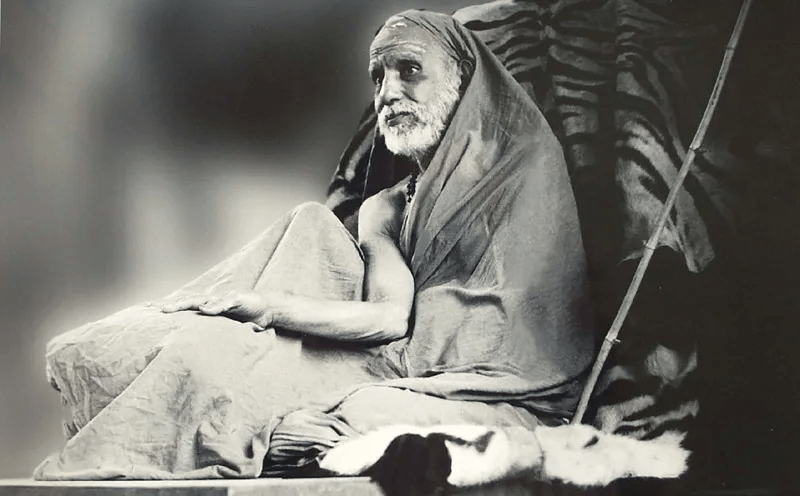
The Kanchi Acharya has however reminded us of how even (Quote): “In recent times there was Mahavidvan Minaksisundaram Pillai who was the guru of U. V. Svaminatha Ayyar. He has written a number of Sthala Puranas. We learn from this that Sthala Puranas have a place of honour in the Tamil religious tradition and literature. A distinguished Sanskrit scholar and authority on the “saastraas“, Karungulam Krsna Sastri, has written a Tamil work called Vedaranya Mahatmyam. Tamil rulers gave their support to Sthala Puranas and their propagation. More than four and half centuries ago, the Puranas relating to Pancanadaksetra (Tiruvaiyaaru, Tanjavur) was translated into Tamil. The translator mentions that he undertook the work as desired by Govinda Diksita who was responsible for the founding of the Nayaka kingdom of Tanjavur.” (Unquote)
If only, like some of the Saivite temple-keepers, the Sri Vaishnavas too had possessed a more sensible, practical attitude towards, and a more mature understanding of the real purpose for which temple “sthala-puraanaas” had been first and originally intended and authored, every major and epochal event, every significant occurrence in history that had significantly impacted the fate of their 100-odd temples could have certainly have ended up serving as a gold-mine of historical records and chronicles. Such documentation in the form of periodically updated “sthala-puraana” could have thus provided an alternative source of history as well as an alternative perspective on what exactly had happened to Sri Vaishnava temples all through the Second Millennia CE when they suffered the greatest ravage and damage — both materially and morally — under Afghan invaders, the Turkish Sultans, the Portuguese buccaneers, the French and Dutch mercantile-robbers, the Persian Bahmani Sultans, the Mughal dynasties and finally the British Imperialists.
Even if such Sri Vaishnava temple “sthala-puraanaa-s” had gone about chronicling mostly only religious events — or events that related only to the life and times of Sri Vaishnava Acharyaas, preceptors and priestly personages — and had perhaps only scantily or patchily recorded larger parallel history, or political movements and social upheavals that had been happening during their times, and had gravely impacted their temples, at least such “sthala‘ chronicles would have served some useful purpose for future historians who might then have been enabled to compare and cross-verify them with the rather far too one-sided, lop-sided, biased and wholly Western-constructed versions of what we today see the British colonialist-historians themselves had been recording according to them whatever was the one and only “authentic history” of important Sri Vaishnava temples, usurped and controlled under their regimes.
Since the “ubaya-vedaantins” had been utterly remiss in writing their own temple “sthala-puranaa-s” of the 19th century CE British colonial era, they simply conceded and yielded space to their imperialist-masters who then were happy to write down their own English “sthala-puraanaas” for the temples that they controlled.
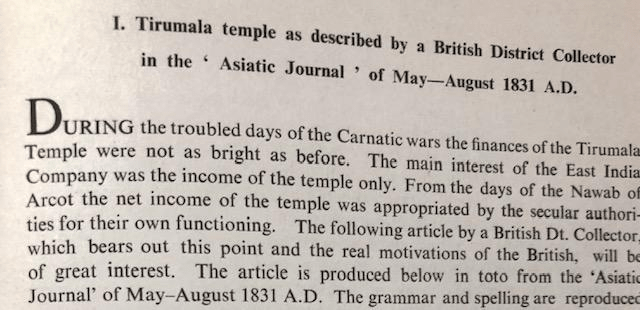
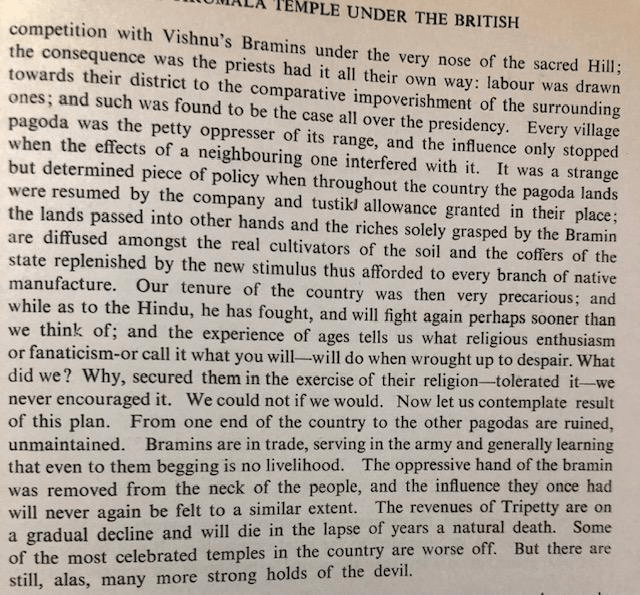
A sampling of the most easily accessible of such English-authored “sthala-purana” of the Tirumala Temple is reproduced below only to serve as an example. But it is quite enough to prove the real agenda behind such historical documentation the British studiously prepared and archived for the benefit of posterity. It was simply to cover-up and obfuscate their own misdeeds of commandeering and systematically thieving the wealth of the temples by making it appear as though it was part of “reforming” the temples, removing the “oppression and tyranny” of the “Brahmin devils” who had lived off the largesse and gravy train that these temples had been providing for long centuries as sustenance for generations of priests, priesthood and for the vast byzantine ecosystems that they had been able to build as their spiritual empire.
The English “sthala-puraanas” thus served as extremely effective British Colonial propaganda that enabled the glossing over and cover-up of imperialist loot and plunder of Sri Vaishnava temples. Instead they actually served to effectively project the image that British Administrators were carrying out a program of progressive reforms of temples that the East India Company was slowly but successfully implementing under their regime.
It was all, in the end, truly another masterpiece of the Englishman’s stratagem of imperialism being executed in the most skillful and unobtrusive manner which consisted of (a) Dispossessing the temples of their wealth, and (b) Socially alienating the elite, dominant Brahmin community of priests ,who had hitherto controlled the temples, by projecting them as the real long-term usurpers of temple wealth.
The “Englishman’s “sthala-puraanas” thus prevailed over all other native ones put together… such as the “sthala-mahaatmiams, manmiyam, kalambagams, ula–s” or even the “kovil ozhukku-s”!
*******************************

(to be continued)
Sudarshan Madabushi