The clash over Power and Legitimacy had always been what lay at the very heart of the Tenkalai and Vadakalai tussle in Kanchipuram. The tussle has already been explained in Part-12, and how it had always been over rights of ownership and oversight and the right to direct and manage all affairs and vast commonwealth of the Sri Varadarajaswamy temple. The other differences between the two sects that were of theological, liturgical or sacerdotal nature, although profound, in time however came to serve more as convenient, pretextual smokescreens that camouflaged the real proprietary stakes over which their continual feuding took place.
The southern Tenkalai sectarian establishment had succeeded in asserting and establishing its “sampradaaya” at Sri Rangam, Tirupati, Tirunaaraayanapuram (Melkote) and scores of other Vishnu temples all over Tamil country. It similarly sought to enforce its writ upon perhaps the only other great Sri Vaishnava temple that continued, since the times of the Vijayanagara Empire, to elude their grasp and control. The “ubaya-vedaantins” of the Kanchipuram temple, stoutly upheld what came to be later distinguished as “desika sampradaayam”. They stood out as a sore thumb — an exception to the “tennaachaarya sampradaaya” that prevailed over most other Sri Vaishnava temples in South India.
In the 19th and 20th century CE , however, everything began to change. The ground shifted seismically under the very feet of the Sri Vaishnavas although, in the temple-town of Kanchipuram itself, the camps of Tenkalais and Vadakalais themselves hardly seemed to be aware of the large-scale socio-political upheavals happening around them in the rest of the country and the implications they would all have for their respective communities. Whether it was out of sheer naivete or lack of a sense of history, or both, they simply continued their petty feuding, utterly unmindful….
********************************
In the history of medieval times right across India, monarchs had sought and obtained Legitimacy for their rule by keeping the priests and holy men (Popes, Caliphs, Rajagurus etc…) onside and happy or humoured at all times since it was the latter who held sacred scepters (“ekadandam” or “tridandam“) in their hands. These scepters were emblems signifying the formidable influence the Achaaryas and Jeeyars wielded on the State in their capacity as “moral authoritarian-centers”, sage advisors and administrative mentors/consultants. Even though they personally posed no challenge to the King’s power, these religious heads of temple-institutions, or “raaja-gurus”, however, did possess the stature and capacity to act as both check and balance to State power. It was for that reason that the Vijayanagar dynasts had invested such a lot— both in terms of massive physical and financial resources as well as moral and regal support — in the Sri Vaishnava and Saiva temples and “Muttams” of the land.
Under the Vijayanagara Kingdom, the Sri Vaishnavas enjoyed Power and Legitimacy in full measure entrusted to them by Hindu kings. Under British Rule, they substantially lost all that Power and control over their temples. And they found that increasingly they now had to struggle hard to establish their own Legitimacy as carriers of age-old temple legacy at a time and place in history marked by tumultuous social upheavals happening around them: i.e. the migration to urbanity, the death of Sanskrit, modern western education and the quest for jobs, livelihood and secular professions and vocations, (all explained in Part-28 through Part 31).
Under British colonial rule, the roles above thus suddenly got entirely reversed. The British East India Company did not need the Hindu temple priestly-classes, nor did it have to curry favor with them to try and gain any bit of their great social influence and standing over the common people.
The Hindu temples were not a source from which the British derived any real or great power or religious legitimacy to rule India. The British looked upon Hindu temples simply as revenue generating machines (akin to modern ATMs!). The EIC expropriated at will whatever it wanted from the temples and at any time it wanted— be it tribute, land-revenues, levy of taxes or gold, jewelry or agricultural produce etc.
The shoe was, well and truly, thus on the other foot! It was the temple and the temple-establishments, instead, whose power and legitimacy was now under threat and in danger of being upended by the British rulers (this was briefly explained in Part-27 too).
It was the temple-keepers and stewards of both Saiva and Vaishnava temples — i.e. the Sivaachaaryas, the Deekshithars, the Jeeyars, Ekaangis, Bhattars, Kovil sthalataars, aadheenams, muttams, mirasidars, sri karyams etc. whom the English patronizingly called “church-wardens” — who now needed the backing, support and imprimatur of British Rulers, of their administrative and judicial authorities. Without keeping the British onside, happy and humoured, it was not possible for them to continue in their roles and functions as traditional or hereditary trustees or legitimate executors of their respective temples.
The old order had changed! It was a sea change for all of the temples of the “ubaya-vedaantins”! And it was rapidly yielding place to new: from Ramanujacharya’s “kovil ozhukku”, the 11th century CE detailed manual on how to run the Sri Rangam, to the likes of the 19th century CE manual called the “Bruce’s Code” for Tirumala-Tirupati, the wheel of history for the Sri Vaishnavas had indeed turned a full 180 degrees!
*****************************
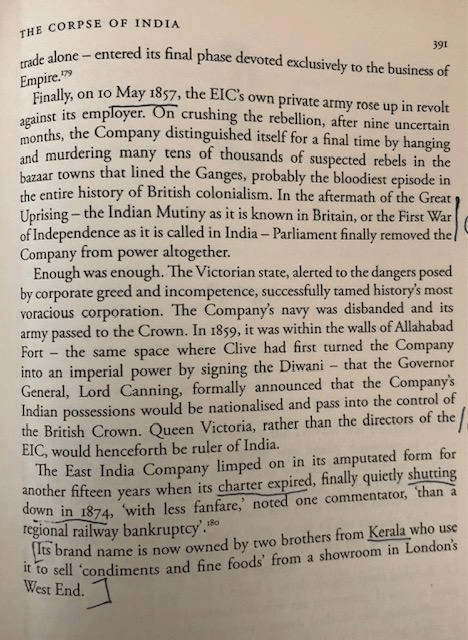
Then came another devastating wave of upheavals in the middle of the 19th century CE which in one fell swoop swept away the East India Company into extinction!
The EIC became the victim of a vicious political maelstrom in London, the seat of British Imperial power. It became the target of a nationwide scandal and a witch-hunt.
By the middle of the 19th century CE, “even as the East India Company grew daily stronger and more invincible than it had ever been in India, it became ever more closely overseen and restricted by the British State; and the idea that a corporation should be running what had now become the country’s most important colony began to be seen as more and more of an anomaly”. The British Parliament suddenly woke up to the fact that the East India Company had in fact been ruling the vast colony of India for well over a century as its very own private fiefdom.
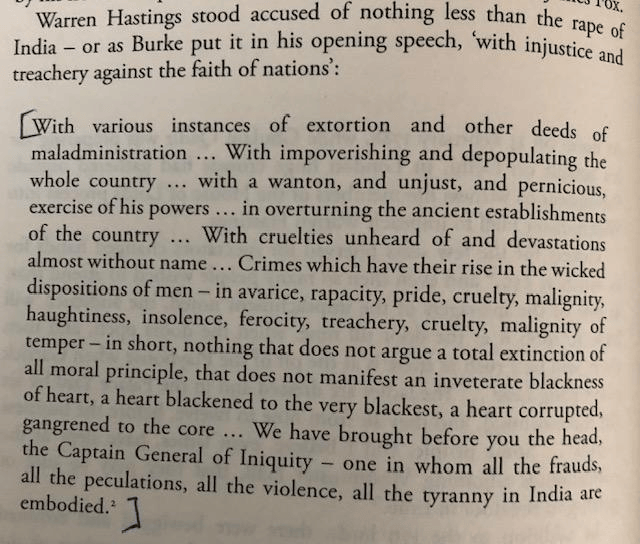
The true rapacious and venal nature of East India Company’s rule across all India, –following its military successes against the Nawabs of Awadh, the stump Mughal Empire as well as the Marathas — all came tumbling like skeletons out of a closet in the open in England, occasioned by the impeachment of Warren Hastings, the then Governor-General of India, in 1788 CE.
The 200-member powerful British Parliament witnessed stunning and shocking exposés of the atrocities of the East India Company’s rule in India which left the public aghast. Just a few quotes below from William Dalrymple’s “ANARCHY” tells us the whole story in a few paragraphs of how the British Parliament in publicly indicting Warren Hastings also confessed to the British State’s very own complicity in the rape and pillage of India:
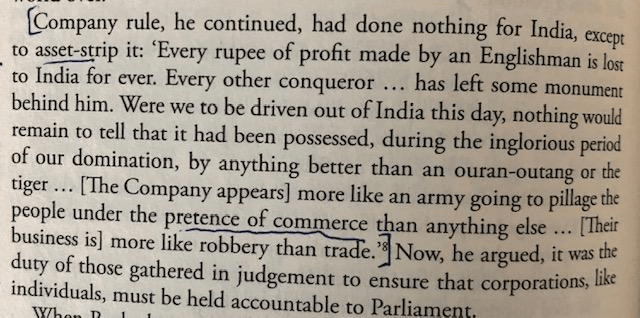
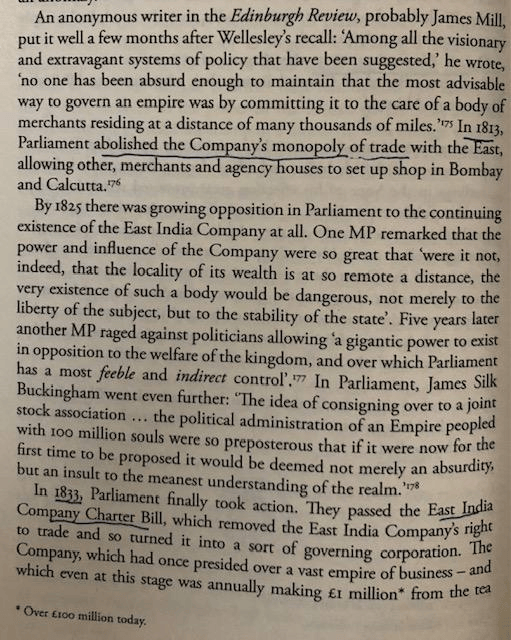
Between 1813 and 1833 CE, the entire corporate edifice of the mighty British East India Company crumbled under the constant attack of the British Parliament which soon began to put into motion enactments under law for the effective nationalization of the Company which, in the end, led to its eventual liquidation shortly thereafter.
(to be continued)
Sudarshan Madabushi