Fifty long years after Warren Hastings was sought to be impeached by the British Parliament in 1788 CE, the Royal Decree of 1833 of Queen Victoria in England, was passed to cut the East India Company to size. In the interregnum, the Napoleonic wars in Europe and the wars in India between the British and Tipu Sultan had delayed it. But finally when the Queen’s decree did come, it rang the bell that finally sounded the death-knell of the East India Company in India (EIC)!
EIC was ordered to relinquish control over all governance in the country and to limit itself to activities in trade and commerce only. It was a mortal body-blow to the entire administration of the English Governors of the Company in all the provinces as the long and painful process of their withdrawal from their role as active rulers of the peoples began in earnest.
The East India Company quite early in the 19th Century CE saw the writing on the wall and so began proactively withdrawing from the control and regulation of all Temples too in South India which hitherto had served as the most fecund and reliable source of revenues for the British…. In today’s rupee terms, the revenues totaled something close to Rs. 150-200 crores annually on an average (see below).
It was therefore no surprise at all that the withdrawal from the administration of Hindu temples by the British East India Company became a very messy, bitter and tumultuous but, nonetheless, thoroughgoing affair.
On the one hand, it greatly benefited the Christian missionary movement in India which had been afoot in the country for the previous two centuries. The Christian missionaries were thus greatly relieved that in their own evangelical work of religious conversion, the British Administration would no longer be seen to be compromised i.e. not in any way anymore aligned, if not allied with the heathen religions of Hinduism that they were engaged in fighting on the subcontinent.
On the other hand, it also badly affected several native stakeholders and vested interest-groups who themselves had, for long centuries hitherto, been drawing their sustenance from the same temple ecosystems. They were all now abruptly left high and dry in a state of suspended animation or limbo by the British withdrawal from temples.
The large-scale disruption in most of Sri Vaishnava temples in Tamil country that the EIC withdrawal caused is perhaps best illustrated in the example of the Tirupati temples as the relevant references, quoted below from the book “THE TIRUMALA TEMPLE” by Dr. N.Ramesan (TTD publication), reveal:


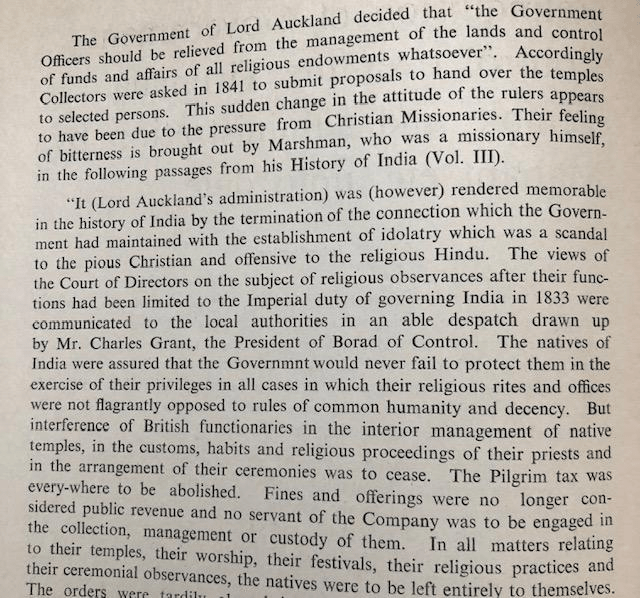

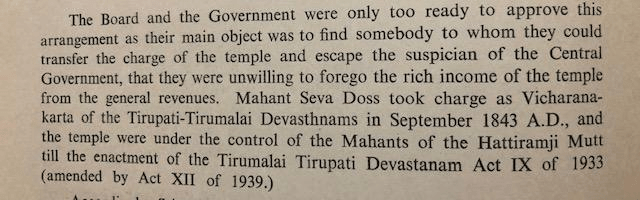
In more or less the same manner as or the same modus operandi through which the British East India Company governors went about withdrawing from the Tirumala-Tirupati temple, so did they similarly put into motion their gradual disengagement with temple-administrations in all other major and minor Sri Vaishnava temples. The process was slow, torturous, acrimonious and, in the end, it left the community of “ubaya-vedaantins” even more bitterly divided amongst themselves than before — as Tenkalai and Vadakalai sects.
The process that lasted for well over most part of the mid-19th century CE by which the management and supervision of the temples of the “ubaya-vedaantins” underwent a profound change was a stylistic one, not a structural one. Nonetheless, after they had changed hands, the Hindu temples in the Tamil country were never again the same ever thereafter.
The strictly tradition-bound ways of the manuals of the “kovil ozhukku” began to give way to much accommodation and compromise that were necessitated, nay, demanded by the adoption of modern hybrid-forms of the “Bruce Code”-like temple manuals. Naturally, that signaled the beginning of the transformation of the Sri Vaishnava-temple from being the purely theistic institution of ritual (Agamic) worship or cloistered, spiritual quest that it was originally purported to be, into a new-fangled institution of religion that was to be democratized by turning it into a mercantilist place of mass worship catering to the fast emerging secular ethos of the times.
Such a profound transformation that was, at once, both glacial and electric, began to take place in almost all Sri Vaishnava temples but the historic template in which it was both first staged and witnessed, is perhaps best revealed in the details of what happened at two of the largest, richest and most important of the temples of the “ubaya-vedaantins” viz. the Temple for the Deity of Sri Venkateshwara at Tirumala-Tirupati and then at the temple of Sri Varadarajaswamy Temple, Kanchipuram.
(to be continued)
Sudarshan Madabushi