Following a decree of the British Crown in London and an act of the Parliament there, the withdrawal of the East India Company from India began in the late 18th century CE and ended in 1859 CE when it was formally wound up. Consequently, the Company was forced to reverse and retreat from its policies of intervention and direct administration of Hindu temples in India.
It was precisely the moment that should have been seized by the “ubaya-vedaantins” of South India to seize, reassert and re-establish their traditional authority and control of their temples. Unthinkingly, and thanks to their narrow worldview, they let slip away the golden opportunity.
The Tenkalais and Vadakalais, if they had had a good sense of world history, and of how precarious the state of affairs were a that time in Britain and Europe in the period after the post-Napoleonic wars, they would have realized that colonial rule in India too was consequently going through a period of inner turmoil and disarray. The Sri Vaishnavas would thus have seized the moment and made sure to press home their own advantage. If only they had correctly read which way the political winds in India in those decades were blowing, the “ubaya-vedaantins” would have quickly set aside all their sectarian differences, all real or pretentious “north-south” schisms and all bickering for power and legitimacy to control temple-wealth and property, and instead would have closed ranks and presented a common united front against the British administrators and EIC officials who were overseeing the complex and protracted process of transferring, transitioning and restoring the rights of ownership and control of Sri Vaishnava temples back to the community.
In the 10th century CE, at the height of the Chola Dynasty’s rule over Tamil country, the great preceptor, Yaamunacharya, aka “Aalavandaar” who was the community leader of the Sri Vaishnavas, lived and worked tirelessly for the propagation of Vaishnavism in Sri Rangam. He had to compete with and resist the constant onslaughts of rival religious faiths such as Saivism and Buddhism under the rule of the Chola king, Kulothunga, who although of a benign secular outlook, nonetheless, was known to clearly favor Saivism. The Vaishnavas were accorded thus only a secondary status in Tamil country, from Sri Rangam to Kanchipuram and beyond, and they indeed did face Saivite bigotry and animus. Besides, the Advaitin and Smaartha Brahmin communities in the region also shared with the Saivities a common and general resentment towards Sri Vaishnavism.
Alavandaar and the leaders of the Sri Rangam Vaishnava religious community were however very astute and foresighted observers of the political landscape in which they lived. In Sri Rangam, he and other leaders of the Sri Vaishnavas, sensed that the Chola Empire too, like their predecessors, the Pallavas and Pandavas, would in time decline and lose power and glory. And when that eventually began to happen, they had hoped that Vaishnavism would be better prepared and positioned to advance and extend its footprint and religious influence all over the Tamil country and the Deccan too.
Alavandaar who had already by mid-11th century CE become very aged, was looking around for a worthy successor to take over the helmsman-ship of the Sri Vaishnava “sampradaaya” from him. Finding none suitable in and around Sri Rangam, he traveled all the way up north to Kanchipuram and there, in the Sri Varadarajaswamy Temple, his friend, Sri Tirukacchi Nambi, a devout Sri Vaishnava, pointed him out to Sri Ramanuja, then a young man who was pursuing advanced Vedantic studies as student as well as doing duty as a devoted daily servitor in the temple. After getting know everything about the personality and brilliant accomplishments of the young Sri Ramanuja, Alavandaar at once made up his mind that the future of Sri Vaishnavism must be entrusted to the able hands of the young man hailing from Sri Perumbudur who showed extraordinary promise of dynamism.
Thereafter, Ramanujacharya was persuaded by Periya Nambi, another principal disciple of Alavandaar, to take “sannyaasa“, permanently relocate from Kanchipuram to Sri Rangam and assume the mantle of leadership of the Sri Vaishnava community and custodianship of the great temple of Sri Ranganathaswamy. As it happened, after Alavandaar’s demise, Ramanuja emerged as the undisputed leader of the Sri Vaishnavas. Having to face aggressive persecution from Saivites, and having to defend their school of Vedanta as well as their traditions, the Sri Vaishnavites of Sri Rangam all gradually rallied behind him, stood united as one “sampradaaya” across the length and breadth of Chola country, right from Sri Rangam and Sri Villiputtur in the south all the way north to Kanchipuram and beyond Tirupati too.
By the mid-12th century CE, when the reign of the Cholas finally did begin to crumble, and the influence of Saivism and Smaarta-Advaita in the empire began to wane, the Sri Vaishnavas of southern India, with their religious capital now firmly established in Sri Rangam, were able to attain great pre-eminence if not complete religious dominance in the Tamil region. It was thanks to the leadership and foresight that Alavandaar and other leaders in Sri Rangam had shown earlier in deciding to enlist Ramanujacharya, a “northerner“, as it were, from Kanchipuram and appoint him to lead their movement and mission.
Nothing however of any similar sort of popular move towards common and undivided solidarity amongst Sri Vaishnavas happened when the withdrawal of the East India Company from temple administration in the mid-19th century CE was precipitated by the British Crown banishing the Company from India.
The leaders of the Sri Vaishnava communities in Sri Rangam and Kanchipuram exhibited none of the qualities of far-sighted leadership or sagacity as their great Acharya of the past, Sri Alavandaar had done! On the contrary, the withdrawal of the East India Company from the temples of the “ubhaya-vedaantins” only exacerbated the bitterness and mutual sniping that already for long had been plaguing relations between the Tenkalai and Vadakalai sects, manifesting itself very often in petty and not-so-petty disputes over ownership of temples, temple-wealth and property and and conflicts over who had the rights to administer their 100-odd historical temples dotted all over south India.
After Alavandaar and Ramanuja, the community of “ubhaya-vedaantins” never again had or saw leadership with the same stature, qualities or charisma that could also bring the entire flock together.
**************************************
In the dozens of years that it took the East India Company to oversee and complete the long-drawn and tortuous process of transferring ownership and control of their 100-odd temples in south India to them, the rivalry and sectarian squabbling between the Tenkalais Vs Vadakalais only intensified. The deterioration of relations between the two descended thereafter into only ever deeper mutual mistrust and recrimination.
There are two very vivid examples of how the East India Company-instituted process of transferring the ownership of their temples to the Sri Vaishnavas worsened the relations between Tenkalai and Vadakalai groups and permanently soured and scarred it. Such a sad situation came about not so much because of any serious failings on the part of the Company as it was primarily due to the intransigence, implacability and cupidity of both group of Sri Vaishnavas.
The first example is that of the transfer of ownership of the famous Tirumala Temple over which the Tenkalai sect had always traditionally retained control. And the other example is the equally famous temple of the Vadakalai temple at Kanchipuram of Sri Devarajaswamy.
The example of Tirumala temple has been well described in the pages of the very well researched book “The TIRUMALA TEMPLE” authored by Dr. Ramesam IAS (published by TTD) and the relevant incidents narrated therein are being reproduced verbatim below to enable easy understanding of how complex and torturous indeed was the transfer-process from the East India Company to the Sri Vaishnava community.
A British Collector was appointed to manage the process:
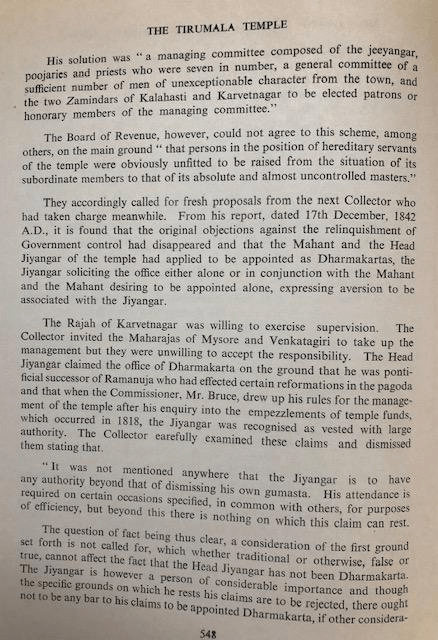
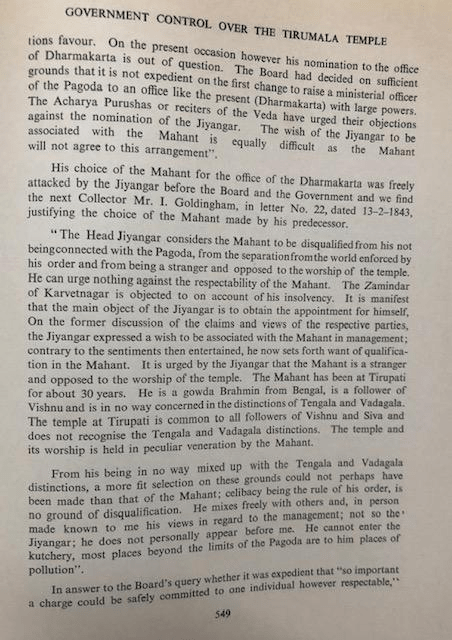

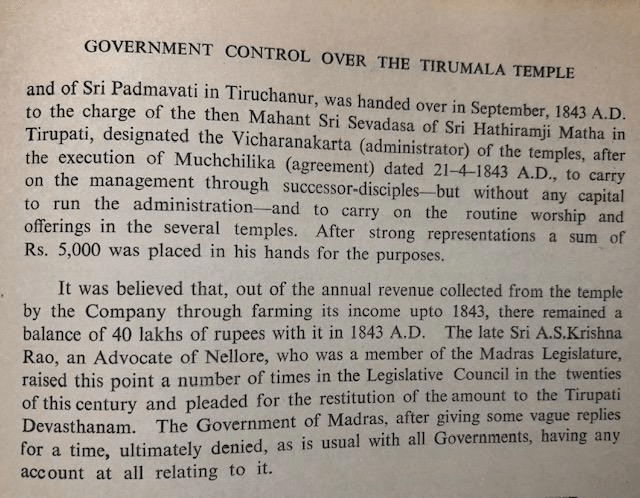
At the end of the process of transfer, the Tenkalai had of course succeeded in preventing the Vadakalai group from gaining any foothold in the control of the Tirumala Temple. But then neither did they succeed, through their representatives, the Jeeyangars, in seizing absolute control themselves over the temple affairs. It was only a Phyrric victory thus that the Tenkalais had won in having been forced by the British rulers, to concede administration of the temple to a rank outsider, the Mahant of the Hathiramji Muttam, an obscure religious monastic order from north India.
***************************************
The second example is the story of what happened in the Kanchipuram Sri Varadaraja Perumal Temple and how the East Indian Company Administration managed the transfer of the temple to the “ubhaya-vedaantins“. That story follows in the next Part-35.
(to be continued)
Sudarshan Madabushi