A popular film-star and film-director in Tamil Nadu both got on to a stage and said publicly that Rajaraja Chola (the 9th century King of most of present day Tamil Nadu) was not a Hindu King at all since his religion allegiance was to Saivism . And Saivism is not really part of what today goes by the name of Hinduism.
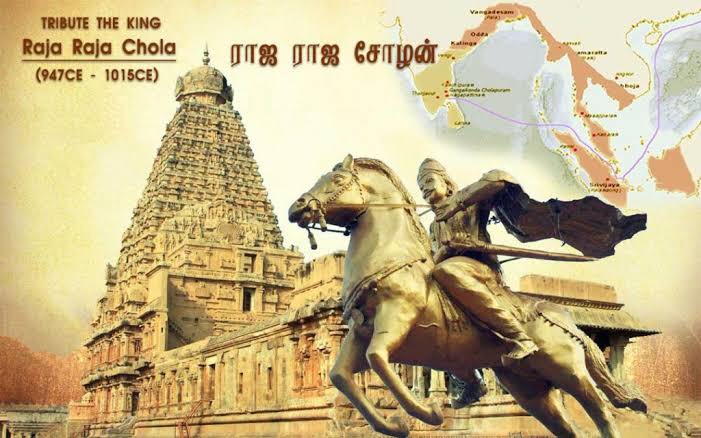
The statement has created a furore and outcry from Hindus of the country with the scholar-ex-maharaja-heir of the erstwhile Kashmir Kingdom, Dr. Karan Singh (ex-Minister in the Union Government of India) trashing all such claims of the actor and attributing such views about the Chola King to ignorance of history.
The debate now will rage on for a few more days or weeks amongst historians, political ideologues, TV-talk show panellists, journalists, academicians and all and sundry who have anything to do with religion and the Hindu religious establishments in the country.
To a disinterested observer, however, the ongoing battle to rewrite or re-narrate some parts of the history of Tamil Nadu is really nothing but political paying-back in the same coin by the Tamil/Dravidian forces to what they perceive as similar efforts by the protagonists of the Hindutva ideology to saffronise (also called Sanskritize or Aryanise) much of Indian history or what was for long was regarded as authentic written Indian history and remained written since Indian Independence and colonial times before Independence. So, this is in truth more a “culture war” rather than any serious dispute about finding facts of history.
The name Hinduism is a gross misnomer… The colonialists coined that name to suit their own imperialist policy of Divide and Rule India . Today our politicians use it to divide and rule over the electorates of India.
Our religion has really no name … as the Kanchi Acharya of Sankara Mattam has himself stated. Since it has no name , we all see it is getting increasingly prone to being defined and determined in as many different ways as there are scores of denominations, sects, sub-sects and “Darsanas”. And today the Dravidianism being spouted in Tamil Nadu is sought to be given the status of a separate “Darsana” !
Our religion can also be given other various names… none of them that can be said to be totally apposite, accurate or definitive. And it can also be easily repudiated and renounced too at anyone’s whim and fancy with absolute impunity. For, how can anyone really be guilty of apostasy, heresy or blasphemy in a religion that is nameless ? Our religion in that sense is true will o’the wisp! That is why perhaps it has come to be known and christened as the Perennial Philosophy … It’s actually more a fluid, malleable philosophy than any kind of rigid religion in the most popular sense of the word.
I for one find it always so ironical and intriguing that in our sacred Sahasranaamams, we give 1000 names for our Gods: Vishnu, Shiva and Devi … but then the religion itself that has conceived them has really no name!
In the ongoing debate in Tamil Nadu and the country today, the definition of Hinduism is being called into question through clever-by-half arguments that employ sophistry and wooly semantics.
The historicity of Hinduism is being disputed through unabashed distortion and exaggerations of selective facts.
Hinduism as an uniquely overarching and organic amalgam of numerous centuries-old sub-faiths and denominations is being sought to be deconstructed and disaggregated, with the ultimate aim to disintegrate and dismantle it.
Who is to be blamed for this audacious assault on Hinduism?
I would lay the blame on Hindus of India themselves … through their many sins of commissions and omissions of the past .
We Hindus are notorious for our artful dodgy-ness and shifty allegiance to our own faith. It is such notoriety for religious dissembling and treacherous apostasy that keeps the Hindus of India a disunited and fractious motley lot .
Rajaraja Chola’s Hindu-ness has today come under a shadow of doubt because the Hindu-ness of Saivism itself is now under a shadow of doubt. And that should not surprise any Hindu because it’s not atypical of an odd Hindu denomination anywhere in India to want to claim that it has nothing to do with Hinduism at all and owes nothing by way of origination to it.
This is not the first time in history that a clever narrative is being spun about a religious denomination of Hinduism: denying that it is only a breakaway offshoot of the same vast ancient Dhaarmic religion of India; but that it is only too willing and ready to denounce its single common root : the Vedas.
So when Hindus themselves cast themselves as un-Hindu. why shouldn’t non-Hindu or anti-Hindu forces say pretty much the same thing about Hinduism ?
Just two instances from recent Indian history are enough to highlight and prove the point being made above .
The first example was the case of the Sri Ramakrishna Mutt in West Bengal which for 15 years had been seeking the status of a non-Hindu “minority religion” in India through court litigations. On July 2nd, 1995, the Supreme Court of India finally declared that neither Sri Ramakrishna Mutt nor Swami Vivekananda founded any independent, non-Hindu religion. But during the course of the labyrinthine court proceedings , the Ramakrishna Mutt spared no efforts and went to all possible lengths to try and establish its case of being an “original religion” which had nothing to do with Hinduism.
The following are quotes from the documents submitted by RK Mission to the courts in West Bengal in their attempt to establish that Swami Vivekananda in fact had founded a new religion different from Hinduism.
“Thus the religion of Sri Ramakrishna is the religion separate and different from the religion of the Hindus. Ramakrishnaism has its separate God, separate name, separate church, separate worship, separate community, separate organization and, above all, separate philosophy. It is claimed to be a separate religion by its own followers, and it was declared so by its founder–Swami Vivekananda.”
“An attempt to equate religion of Ramakrishna with the Hindu religion as professed and practiced will be to defeat the very object of Ramakrishnaism and to deny his gospel. Ramakrishnaism includes the basic virtues of Hinduism and particularly the Hindu spirit but does not exhaust itself in the Hindu religion.”
“Ramakrishnaism itself carries its own marks and separate identity, and its propounder Swamiji [Vivekananda] had always proclaimed himself and his brother disciples to be the followers of a different religion. The universality of Ramakrishnaism had no doubt its genesis in ancient Indian philosophy, but he gave it a turn and twist of his own.”
“Ramakrishnaism was no doubt born out of Hinduism but for that reason it need not be buried in it.”
“Other religions (including Hinduism) do not believe that all religions are different paths leading to the same goal, but claim absolute authority in all matters to the exclusion of all others.”
“A Hindu has no respect for the scriptures of other religions.”
“Swami Vivekananda was an aggressive Hindu monk when he went to Chicago Parliament of Religions. After returning from the West, he had become a preacher of a religion basically different from Hinduism.”
“Ramakrishnaism has a philosophy of its own, different from that of Hindu religion. It has a unique concept of ‘Jiva-Siva.’ God is both with and without form, Sri Ramakrishna said.”
“Through Swami, spiritualism ceases to be a mere pursuit of the saint; spiritualism became a movement of the masses. The spiritualism lost its other worldliness and became this world–it acquired a meaning and purpose in human life. Liberation of the self through the service of mankind; the ideal was confirmed into a Law of action. Work is worship. Life itself is religion.”
The second example is an even more recent one — 2015. It’s the Lingayats of Karnataka State claiming that their Lingayat religion has nothing to do with Hinduism and was in fact a separate religion.
“Lingayat is an independent religion with its own culture, tradition and a sacred book, said Vishwa Lingayat Mahasabha national president Sanjay Makal.
Addressing a convention on ‘Lingayat an independent religion’ at Sanskrutik Bhavan on Sunday, he said Lingayats are not Hindus. Lingayats believe in non-vedic culture and the religion was born out of the practices of Jagajyoti Basveshwara, who instituted it as he was dejected with the ‘varna system.’ Makal said if Lingayat becomes an independent religion, it would get Central government aid up to `300 crore, which can be used to uplift the community and the religion would get global recognition.
Expressing anguish over the status of Lingayats in Hinduism, he said: “Hindus consider us as shudras even though we follow Brahminic tradition.” He called upon Lingayats not to visit places like Dharmasthala and Tirupati, but instead go to Ulavi, Basava Kalyana and Kodalasangam which are considered holy places of the community.
So, as seen from the two glaring examples above that show clearly what artful-dodgers we Hindus are in the matter of professing , practising and embracing our ageless Vedic faith, and given how easily and unconscionably we and our denominational self-interests or narrow sectarian allegiances can make us shamelessly renounce our historical origins , or even recant from our ancestral Dhaarmic faith and ethos , why then should we all act so outraged by the stray, drivelling comments of a washed-out actor and a nondescript film-director from the tinsel-town film-studios of Chennai on the great Chola King Rajaraja and his un-Hindu Saivitism?
Sudarshan Madabushi
PS: not many people I see who are debating hotly this issue are quoting what the Kanchi Sankara Mutt pontiff Sri Chandrasekhaendra Saraswathi (Kanchi Paramaachaarya) once wrote on this very subject of Hinduism having a name !
Please read below :
THE KANCHI PARAMACHARYA ON WHY HINDUISM IS ACTUALLY A NAMELESS RELIGION
Ramesh Venkatraman
What is the name of the religion that is practiced in the land of Bharatha? Some call it Hinduism, some Sanatana Dharma – but isn’t Sanatana Dharma an overarching term that refers to all the religions that are Indic in origin? And, is Hinduism really the name of this ancient religion. The Paramacharya of Kanchi Sri Chandrasekarendra Saraswathi calls it the nameless religion. Why? Because it is the most ancient religion – the mother ship, the fountainhead of all other religions. The Paramacharya asks – “If there was only one religion that existed all over the world, why would anyone need to give it a name?” Below, is a summary of the Paramacharya’s views on this question.
Our religion which predates all these (other religions) had spread all over the world. Since there was no other religion to speak about then, it was not necessary to give it a name. When I recognised this fact I felt at once that there was no need to be ashamed of the fact that our religion had no name in the past. On the contrary, I felt proud about it.
All religions barring our own were established by single individuals. “Buddhism” means the religion founded by Gautama Buddha. Jainism was founded by the Jina called Mahavira. So does Christianity owe its origin to Jesus Christ.
In none of our ancient sastras does the term “Hindu religion” occur. The name “Hindu” was given to us by foreigners. People from the West came to our land across the Sindhu river which they called “Indus” or “Hind” and the land adjacent to it by the name “India”. The religion of this land came to be called “Hindu”. The name of a neighbouring country is sometimes applied to the land adjacent to it. Let me tell you an interesting story in this connection. In the North people readily give alms to anybody calling himself a bairagi. These bairagis have a grievance against Southerners because they do not follow the same practice. “Illai po po kahe Telungi” is one of their ditties. “Telugus do not say “po, po” but “vellu” for “go, go”.”Po” is a Tamil word.
Then how would you explain the line quoted above? During their journey to the South, the bairagis had first to pass through the Telugu country (Andhra); so they thought that the land further south also belonged to the Telugus. There is the same logic behind the Telugus themselves referring to Tamil Nadu as “Arava Nadu” from the fact that a small area south of Andhra Pradesh is called “Arva”. Similarly, foreigners who came to the land of the Sindhu called all Bharata beyond also by the same name.
However it be, “Hinduism” was not the name of our religion in the distant past. Nor was it known as “Vaidika Mata” (Vedic religion or as “sanatana dharma” (the ancient or timeless religion). Our basic texts do not refer to our faith by any name.
That is why I say: “SINCE THERE WAS NO OTHER RELIGION TO SPEAK ABOUT THEN IT WAS NOT NECESSARY TO GIVE IT A NAME”
https://rameshvenkatram.wordpress.com/2017/10/03/the-kanchi-paramacharya-on-why-hinduism-is-actually-a-nameless-religion/#:~:text=And%2C%20is%20Hinduism%20really%20the,fountainhead%20of%20all%20other%20religions.