Three significant historical movements both catalyzed and exacerbated a great social churning and upheaval in Tamil Nadu — gradually at first but later increasingly during the course of decades following end-19th and beginning of the 20th century CE. Each of them left a deep and acute sense of impoverishment and disenfranchisement within the community of “ubaya-vedantins”. The resulting trauma drove the community into even deeper, internecine sectarian squabbling. The three events are very briefly described below:
- The enactment of laws by the State enabling its governments to intrude into the administration of temples at will, political whim and fancy. The British enacted the laws at first so that it provided them legitimate leverage or pretexts to deal with temple administrations from whom much-needed revenues were extracted by them to fund government budgets. After the British Rule came to an end, the same State laws were retained by newly elected democratic governments in Independent India. The laws provided them the same leverage too to legitimately exploit and extract (at times extort) temple-revenues and to secure means of official intrusion and interference in the general affairs of the temples — all in the name of “ushering social justice”, “eliminating caste discrimination” and “ensuring that temples were regulated and managed in accordance with norms of transparency and financial integrity“.
- The rise of the Brahmins as part of the Tamil Nadu ruling-classes, in which the Class-B Sri Vaishnavas (referred earlier in Part-36) too began occupying very influential if not all-powerful positions and placements.
- The advent of the Dravidian social reform movement spearheaded in Tamil Nadu by the anti-Brahmin iconoclast and revolutionary, E.V.Ramaswamy Naicker, aka “Periyaar“. The Periyaar movement was principally a movement of the non-Brahmin castes against the Brahmin castes of Tamil Nadu.
The above causes are explained in a little more detail below:
*********************************
Enactment of laws of the State that enabled it to intrude into the administration of temples at will, political whim and fancy:
After the East India Company began transferring its control of the temples in Tamil Nadu back to local custodians and trustees — be they Saivite, Vaishnavite or Sakta temples — the process however did not succeed. When the British Crown took over the rule of India from the Company, the temples fell right back into the hands of the ruling-classes of those times once again. In the 19th and early 20th century CE, the history of the temples of South India witnessed great social transformations which ultimately caused control of temples in South India — Sri Vaishnava temples included — to change hands at first from East India Company to local community leaders or trustees and then back again to the provincial governments of the British Raj. Thereafter, again later in 1947, after Indian Independence, the control increasingly reverted into the hands of the elected Governments of the State! It is a rather strange and complex story full of twists and turns and of rising and ebbing tides.
T.R.Ramesh, who is a Chennai-based lawyer, is an indomitable present-day crusader who fights for the cause of restoring temples of Tamil Nadu back to local communities and trustees and for stoutly resisting government intrusion into the religious domain of temples. In a blog posted onto the webpage of his organization (The Temple Worshippers Society) http://templeworshippers.in/ T.R.Ramesh has provided very useful perspectives on the history of this recent period:
QUOTE:
“There is no mention of temples in the ancient Vedic Collection of Hymns and Prayers. When a Vedic fire was lit, oblations were said to be made into it in the very place there.
The concept of a temple as a sacred space for ritual worship was born in Post-Vedic Agama period in history.
In the later Brahmana periods of “agama” and “puraana”, temples were constructed for accommodation of images of gods and consecrating them for public worship in congregations and assemblies.
Thus, began religious charitable institutions which began to flourish. They provided valuable endowments such as landed properties for pious purposes. Thereafter, in later periods when several more forms of cult of religious worship developed, the gift-giving for religious and charitable purposes or “daana” was impelled by the desire to acquire religious merit. Thus did, over the centuries past, the Hindu temples begin to be founded and were endowed and maintained generally for the benefit of general Hindu public.
“Around 1840 CE, the then British Government started gradually giving up administration of temples. They asked some of the prominent mutts (i.e. Saiva, Vaishnava, Sakta and others) in Tamil Nadu to look after some of the important temples and endowments. The then Heads of the Mutts were happy to takeover the administration of these temples in the hope that they can be run as they ought to be run, and were thus careful enough to get written documents or “muchalikas” (ordinances) from the British Government, which assured them that they would not take back the temples from the Mutts.
Thus some very important temples in Tamilnadu came under the complete control and ownership of these Mutts which ran them ably and efficiently for several years. That the primary purposes of public worship and the utilization of funds contributed by them was meant for the upkeep of temples and conduct of rituals were never lost sight of by the Heads of Mutts or their priestly appointees. While a few large and rich temples were thus well administered by the Mutts, thousands of other smaller and less resourceful temples in the then Madras Presidency were also similarly handed over to respective trustees of the local communities with the then Government playing little or no role in supervising them.“
UNQUOTE
******************************
It was thus during this period that the proliferation and/or expansion of a great number of religious muttams — i.e. Hindu monasteries — was witnessed. Many muttams either came forward to shoulder the responsibility of administering temples or, in the cases where they were already in control of their temples, they consolidated or entrenched their positions in them. A few examples: the Kanchi Sankara Mutt controlled the Sri Kamakshi Amman temple in Kanchipuram; the Madurai Aadheenams took control of several Saiva and Devi temples down in Southern Tamil Nadu; the “podhu Deekshitars” retained control of the Chidambaram temple; the Sri Ahobila Muttam took control of the Sri Veeraraghava Perumal Temple in Tiruvellore and Ahobilam; the Sringeri Sankaracharya Muttam firmly entrenched itself in Sri Sarada Devi temple at Sringeri and in many other temples in Karnataka, Andhra Pradesh and Tamil Nadu.
Hindu religious muttams which were once upon a time conceived and established as cloistered centers devoted exclusively to spiritual study and practices, and whose efforts were solely concentrated upon propagating Sanatana Dharma, soon re-invented themselves as premier religious and charitable institutes owning, controlling, curating and administering large temples, their huge revenues and vast assets. Having access to such substantial economic wealth, the muttams gradually began to purvey not only religious but also political influence. And that was how several muttams of the Sri Vaishnavas too came into the spotlight of prominence and began attracting large followers and laity. It should be recalled here that earlier in Part-4, the proliferation of the muttams of the “ubaya-vedantins” was briefly essayed upon while calling it the “federalization of “acharya parampara”.

Temples wherein the muttams did not seek control came under the administration of either statutory special-purpose vehicles set up for the purpose (e.g. Tirumala-Tirupati Devasthanam) or specially instituted Boards of Trustees appointed by the local state governments (e.g. Palani Sri Dhandaayudhapaani Swamy Temple). They immediately became subject to government oversight and whose administration was empowered by legislative enactments. In the Kanchipuram Sri Devarajaswamy temple, the management of the Thaathacharyas immediately came under government scrutiny and blatant interference. In Sri Rangam, the administration of the Sri Ranganatha Swamy temple too began slipping away from the priestly classes there and into the hands of the State.
The slow but inevitable process of devolution of power to control temples upon various muttams, local bodies of trustees and to the government departments itself led steadily and surely to the decay or degradation of the temples themselves. T.R.Ramesh explains the process as follows:
QUOTE:
In earliest periods of ancient history, religious charity to temples was a private affair. But in later centuries, when the temples became inspiring centers of social and cultural life of the community, centers for promotion and patronage of art, literature, architecture, and other fine arts in general, and began also to serve as epicenters of learning, fostering and growth of religious piety and spiritual learning they also slowly expanded their public role so as to become public institutions acting as social-nets for the welfare of the poorest of society — providing food, shelter, employment and livelihoods. Temples thus became public-affair and socio-religious institutions. Thereafter temple rituals funded by public endowments also started to become instrumentalities of general public utility too. And that is when temples, religion and politics started cohabiting with each other in an uneasy relationship.
Hence began the accumulation assets by temples beyond what could be imagined. And thus slowly began mismanagement, venality, and maladministration creeping into the temple administration to keep it within the domain of persons with ulterior motive.
The avaricious and venal ones amongst the communities began to rule the roost of temple affairs, which invited the intervention of the Government to the administration of religious institutions but — as the objectives of various enactments of the yesteryears mention — only as an effort to put an end to the greed of the power mongers, whose quarrelsome contest to grab the flourishing assets of even the almighty, and to protect and make due upkeep of the temple and properties attached thereto, from anti-social elements for its eternal existence.
UNQUOTE
There is a long history indeed that spanned the early decades of the 20th century — both pre- and post-Independence — when several successive legislative enactments duly passed as law by newly elected democratic governments sought to wrest control of the vast revenues and assets of the temples of Tamil Nadu, be they Saivite, Vaishnavite or Sakta. That history is captured in a snap-shot by T.R.Ramesh in this chart below:
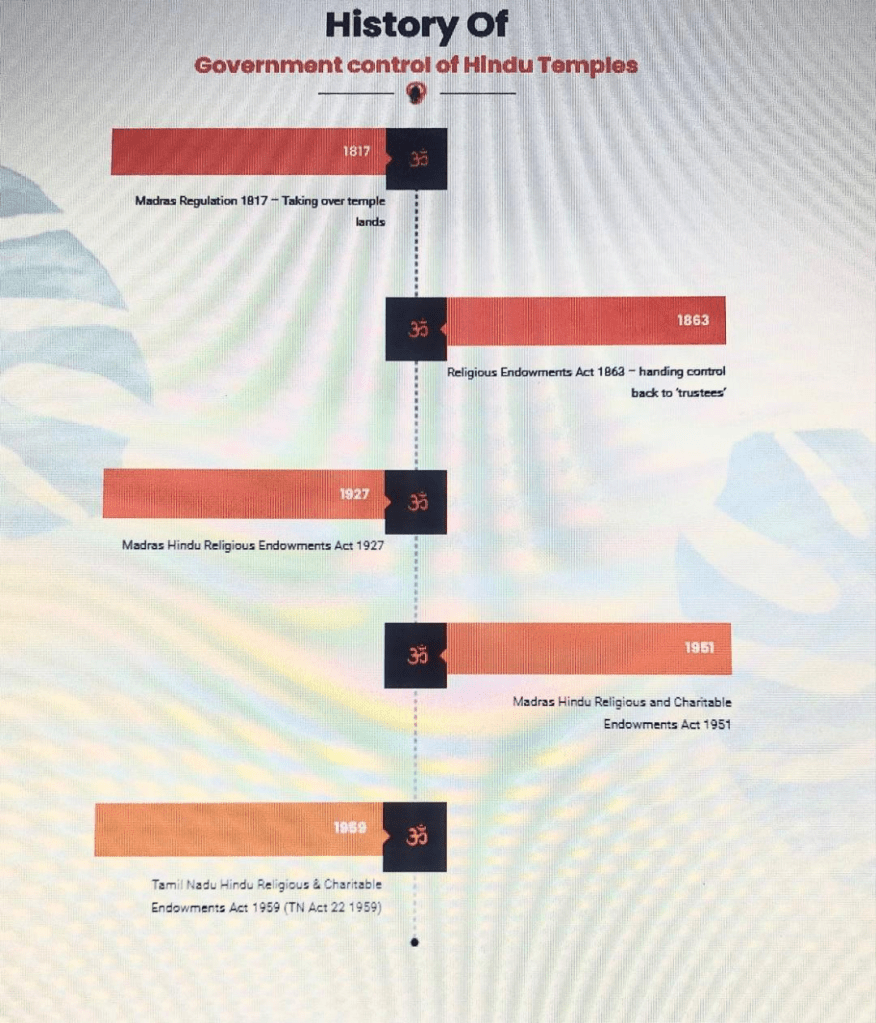
In very brief summary, what the above chart tells us is the following:
- In 1925, the Madras Hindu Religious Endowments Act, 1923 (Act I of 1925) was passed by the local Legislature with the object of providing for better governance and administration of certain religious endowments. The Act divided temples into what are known as Excepted and Non-excepted temples. Immediately after the Act came into force, its validity was challenged on the ground that the Act was not validly passed. For this reason, the legislature enacted the Madras Hindu Religious Endowments Act, 1926, Act II of 1927 repealing Act I of 1925.
2. This Act was amended from time to time. It is unnecessary to refer to the changes introduced later. Suffice it to say that the Act was amended by 1946 by as many as ten Acts I of 1928, V of 1929, IV of 1930, XI of 1931, XI of 1934, XII Of 1935, XX of 1938, XXII of 1939, V of 1944 and X of 1946. A radical change was introduced, however, by Act XII of 1935. The Government was not satisfied with the powers of the Board then existing and they clothed the Board with an important and drastic power by introducing a new Chapter, Ch. VI-A, by which jurisdiction was given to the Board to notify a temple for reasons to be given by it.
Thus, it can be seen that even in the pre-independence era, the Board had systematically consolidated its powers to take over and administer temples. - A new Hindu Religious Act was passed by the Madras Government, known as the Hindu Religious and Charitable Endowments Act, 1951. The Board was now replaced by the Hindu Religious & Charitable Endowments Department, headed by a Commissioner who was given vast (executive) powers under the Act.
- As such the object of the legislation of the Madras Hindu Religious & Charitable Endowment Act 1951, as indicated in the preamble was only “to amend and consolidate the law relating to the administration and governance of Hindu Religious & Charitable Endowment”. So the Hindu Religious & Charitable Endowment Act exists for better administration, protection and preservation of temples and the endowed properties attached thereto, and for fulfillment of the objects, with reasonable restrictions“.
In 1959, another Act was passed by the Government under which the government effectively arrogated to itself untrammeled, sweeping powers to intrude into the affairs and management of all temples in the State through Boards of Trustees who were de facto appointed by it although they ostensibly were elected de jure through democratic processes that were plainly sham.
Pointing out the fraud committed by the Tamil Nadu government by enacting the Tamil Nadu Hindu Religious and Charitable Endowments Act, 1959 (Tamilnadu Act 22 of 1959), T.R.Ramesh wrote:
QUOTE:
“The Government of Madras introduced a new section [section 45] in the 1959 Act which was even more arbitrary and draconian than Sec. 56 of the 1951 Act. It also retained the Sections 63-68 in the new Act which now carried the numbers 71-76. The only section relating to appointment of Executive Officer that was upheld by the Hon’ble Supreme Court was not carried in the new Act.” UNQUOTE
T.R. Ramesh further added, QUOTE: “More intriguing is the fact that this rogue department continues to appoint executive officers (in temples) under Sec. 64 of the 1959 Act (the equivalent of Sec. 58 in the 1951 Act) without any power to do so. But this would not seem strange if we understand that the intention of the Government and the Department was that no appeal safeguards should be provided to the Trustees of Hindu Institutions against the Department’s illegal and arbitrary orders. Sec. 58(3)(b) of the 1951 Act had earlier afforded such safeguards—it was therefore removed by the Government.” https://bharatabharati.in/2011/10/07/hr-ce-act-a-fraud-on-the-constitution-b-r-haran/ UNQUOTE
By its own account the HR & CE Dept. thus came to administer in the state of Tamil Nadu:
•36,425 temples
•56 Mutts
•47 temples belonging to Mutts
•1721 Specific endowments and 189 Trusts
The greatest two temples of the Tenkalais and Vadakalais viz. the Sri Rangam Ranganatha Perumal Swamy temple and the Kanchipuram Sri Devaraja Perumal Swamy temple are also included in the above.
***************************************
The rise of the Brahmins as part of the Tamil Nadu ruling-classes:
With millions of people of all castes and social classes flooding into it, in waves and waves of mass migration, the populations in the urban social milieu in the Tamil provinces began swelling in very great numbers. And that was precisely the point of time when the great Caste-Divide of Tamil demography first took its roots within the life and land of the “ubaya-vedaantins” too.
It was a social revolution that was imperceptible at first but soon assumed dimensions that were were so large and multi-faceted that it had far-reaching consequences for the Brahmins of Tamil Nadu in general and for Sri Vaishnavas in particular. The origin of the revolution dating back to that tumultuous historic period has been succinctly described by G. Sudarshan Reddy (ibid) and his thesis is once again worth reproducing:
QUOTE
“In the urban, public life of south India the division between the relative positions of these two groups (i.e. Brahmin and non-Brahmin) at the beginning of the twentieth century was strikingly apparent. Brahmans, as priests, had a long tradition of learning and quickly took advantage of the educational opportunities offered by the British presence in India. In the natural course, many Brahmans were recruited into the government services. The British administration, fearing nepotism and loss of power, sought to control the Brahman preponderance in government service. Non-Brahmans, envious of the Brahmans, made full use of the British predilections. They argued that most non-Brahmans in Madras were backward educationally and were therefore precluded from prestigious government employment”.
“…..in the distribution of occupations demanding literate skills, and particularly government jobs, that the relative positions of Brahmans and non-Brahmans can be seen most clearly. In 1921, banks and other money establishments employed Telugu and Tamil Brahmans, Komatis (Telugu Vaisyas), and Vellalas; these four groups held almost two-thirds of the available positions. In public administration there was a marked preponderance of Tamil Brahmans, with Vellalas and Telugu Brahmans occupying second place, followed by Nairs and Balija Naidus. In positions concerned with law, instruction, and letters, the pattern was similar.
“….In government service, figures compiled by the Madras government in 1912, illustrate the consistently strong domination of the Brahmans in many upper levels of government service. The distribution of appointments among Deputy Collectors, Sub-Judges, and District Munsifs (all high positions so far as Indian employment was concerned) show that Brahmans in 1912 held 55, 82.3, and 72.6 percent of the posts then available to Indians. By contrast, non-Brahman Hindus (probably Vellalas, Balija Naidus, Nairs, and a sprinkling of Kammas and Reddis) held only 21.5, 16.7, and 19.5 percent of the total appointments. The Indian Christians and Muslims were well behind.
UNQUOTE
The advent of the Dravidian social reform movement:
The rise of the Tamil Brahmins (including Sri Vaishnavas) and their occupation of key positions of power and pelf amongst the ruling-classes soon gave rise to deep resentment bordering on hatred for them amongst the non-Brahmin, less-privileged majority castes in the state of Tamil Nadu. The animosity towards Brahmins — and towards their culture, language, literature, religious institutions and their even their fundamental beliefs and way of life –was the main political plank upon the Tamil Dravidian movement that was begun by E.V.Ramaswamy Naicker and which later became the political mainstay of his legatees, C.N. Annadurai and M.Karunanidhi of the DMK Party (Dravaida Munnetra Kazhagam) which ruled the State of Tamilnadu for more than half-a-century after Indian Independence and happens to run, in fact, the government of the day too in 2022.

The ideological fundamentals of the Dravidian Movement were enunciated by Periyaar in his own words in 1941 in an editorial he wrote for his propaganda organ, “Viduthalai” (liberation). https://theperiyarproject.com/tag/aryans/ . His words are worth quoting verbatim below:
QUOTE: By anthropological studies, Indians can be broadly divided into three categories – Aryans, Mongoloids, and Dravidians. Among these, the Dravidians are the oldest tribes of India. The Aryans came from outside to settle here.
The languages of the Dravidians are Tamil, Telugu, Kannada and Malayalam and a few other tribal languages. The languages of the Aryans are Sanskrit, Hindi etc.
The Dravidians did not have any caste discrimination among them and they worshipped a single god.
The Aryans have caste differences and they worship many gods. The Aryans believe in heaven, family deities, rituals etc. The Dravidians worship warriors, respect and adore great persons who work for the good of the society, feed the poor who cannot earn a living, and build lodges for travellers.
The Aryans teach that we should offer gifts to the Brahmins in order to attain salvation and anything else that we do is useless.
The Dravidians believe that helping the poor and offering them a livelihood is a duty for those in privileged positions.
There are many such differences between the Aryans and Dravidians. A condition is imposed that if the Aryans and the Dravidians are to live together, it can happen only when we accept that the Aryans are superior upper castes while the Dravidians are inferior lower castes. However, if we claim equal rights, we are called as Aryan haters and Brahmin haters. This is why we have protests and fights between the Aryans and the Dravidians in the Dravidian land. As the struggle intensifies, the Dravidians are forced to demand that the Dravidian land be separated from the Aryan land and that the Dravidians must establish their own rule.
Whether the British accept or not to the idea of a separate Dravidian land, the Dravidians have decided that they will uphold this demand to live on their own.
Ireland which has a population of about 75 lakh people was part of Great Britain but they are now a separate country. And the British have accepted that. They even allowed Burma to become independent.
If Britain does not permit Tamil Nadu that has a population of about 4 crore Dravidians to separate from the Aryan land and live as a British protectorate, it is a loss only to them, but it doesn’t mean that the Dravidians will not get their Dravidian land. UNQUOTE
So deep-rooted and visceral was Periyaar’s parochial animus for the Brahmin that it drove him to even take an openly anti-India, anti-national and secessionist position in the overall political discourse of pre-Independence India. A very percipient present-day political commentator, Sandeep Balakrishnan writes: https://www.firstpost.com/opinion-news-expert-views-news-analysis-firstpost-viewpoint/dear-dmk-leader-brahmin-genocide-of-a-different-order-has-already-occurred-in-tamil-nadu-11573041.html/amp :
QUOTE: “The Collected Works of Periyar E.V.R., compiled by the ferocious Dravidian ideologue, K Veeramani (son of Periyaar) is a primary source of EVR’s Brahmin-hatred. Putting it mildly, the work, in EVR’s own words, is a chilling treatise of xenophobia. There’s nothing that EVR does not hate about Brahmins. He hates the Manusmriti. He hates the Ramayana. He hates the Mahabharata. He hates the Puranas. He hates the Tamil Periyapuranam. He hates both the Shaivaite and Vaishnavaite sacred literature. He hates the Alwars and the Nayanmars. He hates the Swaraj movement. He hates Gandhi. He hates Rajagopalachari (then Chief Minister of the State of Tamil Nadu). He hates the Indian National Congress. He hates the communists. He hates Hindi.
In his eyes, all these are components deliberately assembled by Brahmins into a gigantic oppression-machine.
His solution: burn all the books that Hindus regard as sacred. Destroy every symbol and belief and practice and tradition and structure that Hindus have worshipped since time immemorial. And EVR did not disappoint. He garlanded a picture of Sri Rama with footwear and took it out in a public procession. He later burned his pictures. In 1952, he launched a statewide campaign in which murtis (idols) of Ganesha were publicly broken across Tamil Nadu. The less said about his other derogatory actions against Hindu deities, the better.
Every real or imagined setback that EVR faced was naturally a Brahmin conspiracy and every victory was equally a vindication of his hate-Brahmin formula. UNQUOTE
The Dravidian Movement also very adroitly introduced into public political discourse and the public psyche, the pernicious and toxic politics of Language. It became standard oft-repeated propaganda of the DMK and Periyaar’s own social-activist organization, the Dravida Kazhagam (DK), that the languages of the Dravidians, notably Tamizh, were all sought to be made totally extinct by “Aryan imposition” descending from the North of India through Sanskrit and Hindi.
“Periyar was worried about the cultural invasion- intrusion of words from other languages particularly Sanskrit, and wanted to save Tamil from this cultural invasion. Till Periyar’s ideas reformed the Tamil language, Sanskrit words were used profusely in Tamil Nadu. Periyar wanted not only self respect for Tamil people but also for Tamil language. He described Tamil language as a “war weapon” in the hands of Tamils to compete in the world. He was enraged when people said that Tamil language had the power to open temple gates . It was an irony that Tamil, which is said to have opened the closed temple gates when sung in the form of Devarams, is not allowed as a language of worship in temples…… https://www.thehindu.com/news/cities/Tiruchirapalli/Periyar-envisioned-Tamil-to-attune-itself-with-change-Veeramani/article15453657.ece/amp/
The binary construct viz. that the Brahmins of Tamil Nadu were Sanskrit-philiac and Tamizh-phobic, became an integral part of the anti-Brahmin propaganda weaponry in the hands of the Dravidian stock. The facts on the ground however did not support the canard since “the contribution of Tamizh brahmins to Tamizh can only reasonably be compared to all the other castes put together…… You can see the Tamizh world eagerly reads and enjoys the works of Tamizh Brahmins like Bharatiyar, Kalki of Ponniyin Selvan fame, Chandilyan, Vaali the cinema poet, or writers Ashokamitran, Thi Janakiraman, Balakumaran, or doyens like U.Ve.Saminatha Aiyar, grammarians T.V.Gopal Ayyar and so on. I am not even counting the ancient ones like Parimelalakar, Sampanthar etc.” So wrote a present-day commentator on Tamil Nadu politics……(https://realitycheck.wordpress.com/2021/05/15/how-dravidian-ideology-copes-with-contributions/).
Thus, in spite of the love of the Tamizh language that the brahmins of Tamil Nadu cherished deeply — especially the Sri Vaishnavas for whom the Tamil devotional literature of the Azhwaars was an integral part of their very identity and culture — the Dravidian die-hards never relented from their aim of “othering” them. Brahmins thus were excluded from all of Tamil society and the basis of such a rabidly bigoted stand was enunciated by Mr Pazha Karuppiah (an actor, film producer, politician of the present day who recently emerged as a major Dravidian-culture advocate and ideologue) as follows:
- They Dravidians (in this sense non-brahmin) are the owners of this country (Tamilnadu).
- The Tamizh Brahmins have no claim to the soil.
- They have come to this place and become Tamilians.
- Some Tamizh Brahmins like Parithimal Kalaignar repudiated their origins discarded their Sanskritised names (His name was Surya (Pariti) Narayana (Maal) Sastri (Kalaignar).
- Because of this the “we” (the natives) celebrate them.
- Similar to how we celebrate Bishop Caldwell who has also done research and worked for Tamizh.
- Hence by playing the Tamizh card , Tamizh Brahmins can hope to attain the status of a Caldwell if all other things check out.
This is not the opinion of Mr Karuppiah alone. It is the fundamental position of the whole Dravidian ecosystem. This positioning of the Tamizh Brahmin as an “outside contributor” is seen in so many places right across the State. It is the set position of the entire Dravidian Movement.
*******************************
How did all the above historical developments and events in the decades before and after Indian Independence affect the ongoing sectarian tensions of the “ubaya-vedantins” in Kanchipuram and Sri Rangam? Were the Tenkalais and Vadakalais unaffected? Or were they blithely indifferent? Did the larger social movements and churnings outside in the state and country not have any impact on their relations and upon their temples?
The question will be explored in the following Part-38.
********************************
(to be continued)
Sudarshan Madabushi