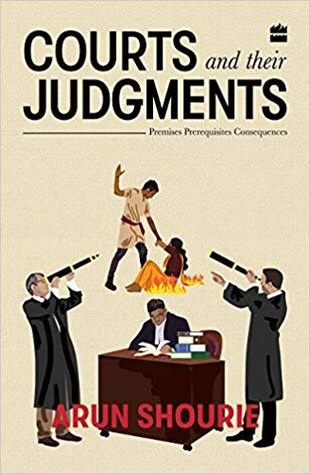
First published in 2001, Courts and Their Judgments soon became a pioneering work on the subject. It raised important questions on the functioning of our judiciary— questions that continue to be as relevant today.
Do judges merely enforce and interpret the law? Or do they at times interpolate words into statutes, even into the Constitution? Where does interpretation end and rewriting commence? How is it that in one judgment a court declares that it is the right of ministers to determine how far and in what direction a criminal investigation shall be carried, and in another the same court, indeed the same judge, decides to as good as monitor an investigation? How is it that in some cases a court delves into detailed facts that do not just bear on the case, but on why a law was passed, and in another the same court lays it down as a principle that facts need not be considered once the legislature has passed a law?
The failure of other institutions to discharge their duties has compelled the courts to step far outside their traditional role. In doing so, have they stretched the law and Constitution too far? Has the intervention been effective? Courts and Their Judgments looks at judicial activism through some brilliantly argued cases and at the need for and pitfalls of such overreach. With its searing answers, evidence, dissection of judgments on these and other issues, the book remains a must-read for strengthening the country.
*************
Okay! Now here below is my own short take on what Arun Shourie has had to say on the power of the judges of the Supreme Court of India to have the last word on how the Law should prevail in this country.
Arun Shourie is undoubtedly a very deep scholar and very persuasive intellectual and he does indeed pose very pertinent questions about judges in this piece … But then all that he accuses the judges of is equally applicable across the board to all professionals … So I for one don’t see what’s new or so unusual about the matter?
You go to specialist doctors these days , no two medical opinions are ever the same and no two lines of treatment recommended are of the same pattern.
You go to a panel of 5 top economists to seek assessment of a fiscal or monetary situation or on an issue of public policy , you’ll come away confounded by 7 or 8 differently nuanced opinions.
In my own profession, as a CA I know that no two qualified accountants or auditors can ever draw up a set of financial statements with the same or identical determination of profit or loss or balance-sheet net-worth or valuation. They’ll attribute it to different accounting standards or principles or to “appropriate case assumptions” made!
You go to 2 hotshot lawyers and give them a brief on a tricky legal issue and ask them for a legal opinion they’ll each offer you one that can be as delightfully vague as “either this or that” depending upon “on the one hand this … but then on the other hand that ”…. !
You go to a certified investment-analyst and ask him for advice on buying or selling a stock , he’ll preface everything he says with first a long recital of inscrutably worded professional disclaimers …
It all ultimately boils down to the fundamental challenge of applying one’s professional mind to an issue and making a humanly “judgment call” … and every judgment call on earth is fraught with risks of uncertainty and indeterminacy… The writ of law pronounced by the grave arbiters of the Bench may be. majestic but is never infallible.
Judges of the Supreme Court are human … They after all too are only professional gods with .. er …umm… feet of clay. Their hearts are not always in the right place and their heads most often are up there somewhere above the clouds in ivory towers they’ve built themselves …
Every profession is a priesthood. And as Bernard Shaw wrote in one of his plays “every profession is a conspiracy against the laity” . The judges of the Indian Supreme Court are frocked high-priests. Ordinary mortals like you and me from outside the court room cannot dare to ever call into question their pronouncements or their interpretations on doctrines so abstruse and ethereal as the “basic structure of the Indian Constitution”. The judges one may say have built “green belts” or zones around themselves to jealously guard and protect their turf, remit and wages … None other than the elite few chosen collegially from amongst their own ecclesiastical order and tribe will be admitted into their own sacred space.
Tim Harford showed a bit of his renegade true-colours when he exposed professionals with these traitorous words in his 2006 book The Undercover Economist: “doctors, actuaries, accountants and lawyers manage to maintain high wages through… erecting virtual ‘green belts’ to make it hard for competitors to set up shop. Typical virtual green belts will include very long qualification periods and professional bodies that give their approval only to a certain number of candidates per year. Many of the organisations that are put forth to protect us from ‘unqualified’ professionals in fact serve to maintain the high rates of the ‘qualified’ to whom we are directed.”
Now, let not the sense of the word “high wages” be mistaken to be merely or only pecuniary… for, the high wage commanded by the lofty judicial office of the Supreme Court is absolute Constitutional power.
Sudarshan Madabushi