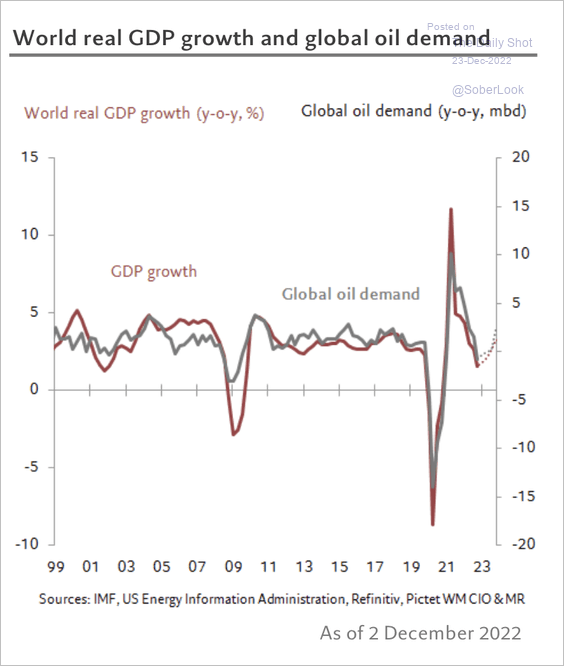
This Infograph above tells me a sad story which I know to be so true and yet of which, alas, Climate-Change warriors of the whole, wide world are in utter denial.
If you look closely at the chart above you’ll see that all the best years of robust economic activity in the last 20 years has been fuelled only by energy derived from oil. No oil demand , no GDP growth. Mankind today surely owes much of its material prosperity to “dirty oil”.
The planet cannot be saved from the perils of carbonisation that results from its aggregate demand for Dirty Oil as fuel for economic growth. You can have GDP growth or you can have no-oil-use energy-policy. It is foolish to hope that you can go on having both at the same time.
The real and more substantive debate that must inform people’s’ minds today is not about the “Supply Side” issue of switching from Fossil Fuel to Renewable Energy sources to keep GDP growth somehow sustained … i.e. how high the rich nations must be carbon-taxed and how much the emerging economies of the world should be carbon-incentivised to curb their ravenous appetite for oil. The real debate ought to be instead on the “Demand Side” i.e. how much of GDP growth the rich nations ought to voluntarily choose to forego or sacrifice and how much some of the largest emerging economies of the world should temper down their vaulting GDP growth ambitions.
In other words, the terms of reference of the great debate on how to fight the global climate-change war ought to be totally changed and re-written. It ought not to be so much on fixing time bound-targets for countries to commit to emission-cuts in the future as it ought to be otherwise on how they should be rationalising wholesale their target GDP growth-rates. The advanced nations should be asking : what level of contentment can we all live with if we were to voluntarily limit GDP growth to rates nearly zero or to even negative-points in the foreseeable future. And the emerging nations, on the other hand, should be asking themselves how they could get rid of the obsession with trying to achieve GDP growth-rates that they hope will enable them to “catch-up” with advanced economies of the world.
It’s of course going to be very, very painful to do it … a paradigm shift in the way the world’s economists think is never going to be achieved easily but then it is worth remembering that one of their own eminent kind did so in fact about 50 years ago.
E. F. Schumacher was so right in the radical thesis he put forward in his celebrated 1973 book “Small is Beautiful”: that capitalism brought higher living standards at the cost of deteriorating culture. His belief that natural resources should be conserved led him to conclude that bigness—in particular, large industries and large cities … i.e. ever faster GDP growth-rates —would lead to the depletion of those resources.
QUOTE : “……. …that economic growth, which viewed from the point of view of economics, physics, chemistry, and technology, has no discernable limit must necessary run into decisive bottlenecks when viewed from the point of view of the environmental sciences. An attitude to life which seeks fulfilment in the single-minded pursuit of wealth – in short, materialism – does not fit into this world, because it contains within itself no limiting principle, while the environment in which it is placed is strictly limited.”
“… …the effort needed to sustain a way of life which seeks to attain the optimal pattern of consumption is likely to be much smaller than the effort needed to sustain a drive for maximum consumption.
“The conventional wisdom of what is now taught as economics bypasses the poor, the very people for whom development is really needed. The economics of giantism and automation is a leftover of nineteenth-century conditions and nineteenth-century thinking and it is totally incapable of solving any of the real problems of today. An entirely new system of thought is needed, a system based on attention to people, and not primarily attention to goods—(the goods will look after themselves!). It could be summed up in the phrase, “production by the masses, rather than mass production.”
“… Since there is now increasing evidence of environmental deterioration, particularly in living nature, the entire outlook and methodology of economics is being called into question. The study of economics is too narrow and too fragmentary to lead to valid insights, unless complemented and completed by a study of meta-economics.”
UNQUOTE
Without meta-economics, the whole discipline of modern-day Economics is going to be doomed to descend to utter irrelevance. And without it all talk of the global fight for Climate Change is going to be … well … just that: mere talk that’s nothing more than blather and bluster.
Sudarshan Madabushi