
Trust is the first thing we surrender—and the last thing we learn to rebuild.
From Eden’s broken trust to today’s trust deficit in governments, banks, media, and technology: nine dialogues on betrayal, entropy, and the possibility of resurrection through mahāviśvāsam.
Category Archives: philosophy
In God We Trust: The Mother of All Trust Deficits — and the Death and Resurrection of Trust

Is “In God We Trust” a prayer—or a confession?
We print trust on currency, promise it in elections, demand it from banks, courts, doctors, journalists, and algorithms—then watch it thin beneath the winds of betrayal, spin, and institutional failure.
Beginning tomorrow: “In God We Trust: The Mother of All Trust Deficits—and the Death and Resurrection of Trust.”
Nine dialogues between two students of a Vedic university in South India—Ānanda, the restless sceptic, and Madhava, the contemplative Vedāntin—move from Eden’s first broken trust to the modern crisis of credibility, media, democracy, and institutional entropy.
At the centre lies a Sri Vaishnava question: when every earthly refuge trembles, can the soul find its final shelter in mahāviśvāsam—unshakeable trust in the Lord’s grace?
Nine days. Nine dialogues. One question: can Trust rise again?
Narayana! Narayana! Narayana!
Medhā Sūktam: The Goddess Who Makes Speech Sacred

In the auspicious fortnight of Navarathri and on the sacred day of observance of the Mahasamadhi Day of Her Holiness Sathguru Gnananda Saraswathi, the VishnuMohan Foundation held a special religious event at the Ashram of Sri Sriharidas Swami-ji by conducting Vedic Homam and Devi Puja. The event was attended by a large gathering of Swami-Ji’s devotees who participated in the Guru puja, Devi puja and Homam.
At the kind invitation of Sri Sriharidas Swami-ji and with His Blessings, I delivered a talk on the occasion on “MEDHA SUKTAM”. The full transcript of the talk is reproduced here.
Beyond the Sanctum: Preserving Sanatana in an Age of Too Many Temples

Beyond the Sanctum: Preserving Sanatana in an Age of Too Many Temples
Temples and consecrated murtis have long been at the heart of Hindu devotion. But when temple-building becomes a measure of faith, do we risk forgetting what the murti was meant to awaken?
Nammazhvar begins the Tiruvaymozhi not by pointing to a shrine, but by telling the mind to rise: “O my mind, worship the radiant feet that end sorrow.”
This essay is not a case against archa murthy aradhana. It is a quiet plea to restore balance: to honour the visible Divine, while remembering that the highest sanctuary is consciousness itself.
“The King Who Must First Know Himself”: Plato, Dharma, and the Elusive Philosopher-Kings of India

Plato wanted philosopher-kings. India dreamed of the rājarṣi. From Ashoka’s dhamma to modern democracy, the search for a ruler wise enough to wield power remains unfinished.
“What is Faith?”: The Last Straw — Decentered Minds and the Shore of Salvation
by M.K. Sudarshan October 6, 2026: Chennai, India Faith is not a composite of human faculties like thought, emotion, or principle; it is an existential posture that begins precisely where the mind, intellect, and cerebration completely run out. We often treat faith as if it were a psychological Swiss Army knife—a neat combination of human faculties.Continue reading ““What is Faith?”: The Last Straw — Decentered Minds and the Shore of Salvation”
Claude Must Not Make Advaita the Ventriloquist of All Vedānta
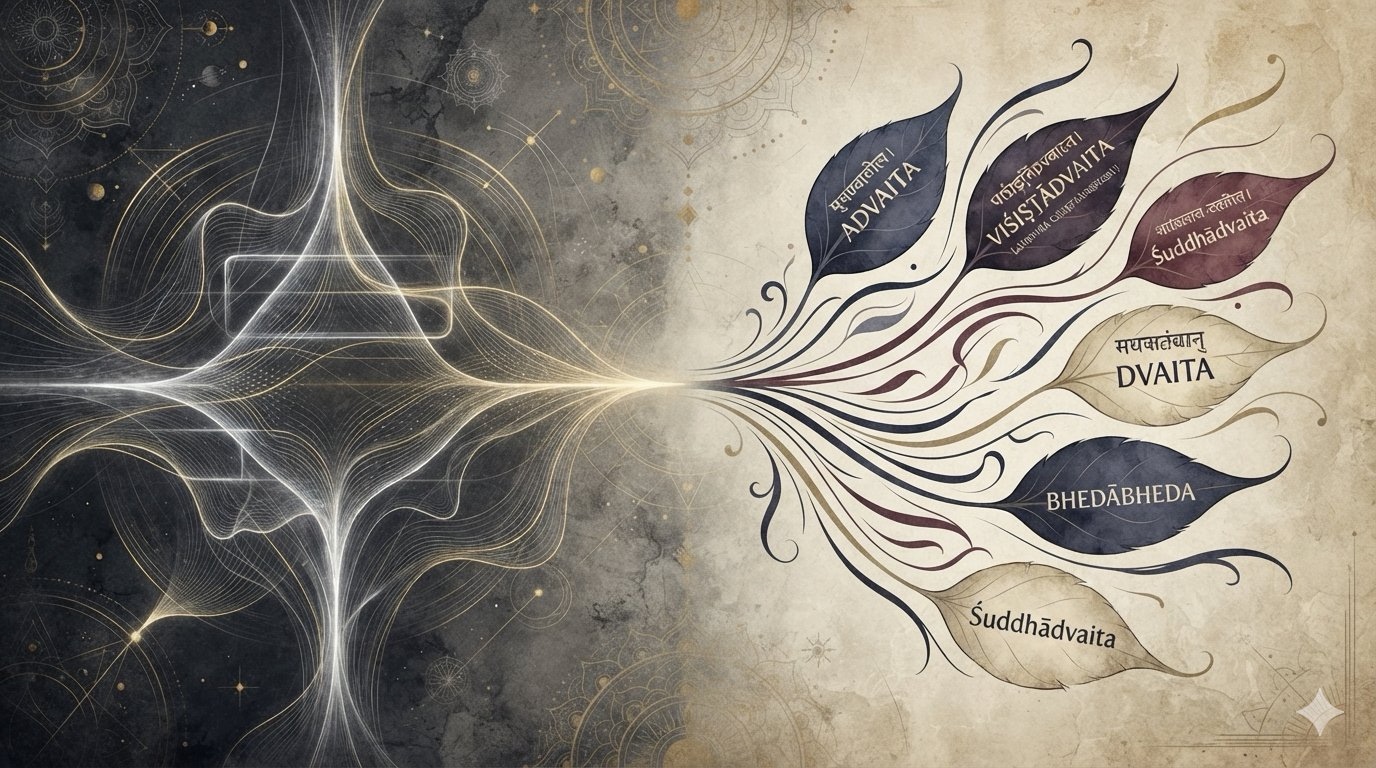
Anthropic’s engagement with Indian philosophical traditions is welcome—but it must not mistake one influential Vedāntic school for the entire intellectual inheritance of India.
Sound as the Beginning—and End—of Vedic Metaphysics: A Modern Recapitulation offered by Sundar Sarukkai

The Veda calls itself the breath of the Veda-Puruṣa, creation a continuum of sound—yet the Upaniṣad says, “from which words turn back with the mind.”
Is this a contradiction?
This essay moves from Sundar Sarukkai’s modern restatement to the Gītā, Taittirīya Śikṣā and Ānanda Valli, and the Viṣṇu Sūkta, showing how Advaita reads the end as silent awareness and Viśiṣṭādvaita as eternal praise in Vaikuṇṭha.
Bypassing the Tyrant: The 6th Mode of Transcending Workplace Friction — a Visishtadvaita therapy

Ever feel trapped in a cycle of silent resentment toward a toxic manager or a flawed institutional system? 💼
Standard advice tells us to “set boundaries” or “exit,” but modern clinical psychology often struggles to heal the underlying friction.
What if the solution isn’t to build higher walls around your ego, but to change the very source of authority you answer to?In our latest piece, we explore a fascinating dialogue between a practicing psychiatrist and a Vedantic philosopher.
Together, they map a revolutionary “Sixth Mode” of human behaviour derived from ancient Vishishtadvaita Vedanta—showing how true mental liberation in the workplace comes from an unexpected, vertical shift in perspective.
Read the full conversation here.
When Footnotes Pretend to Be History:
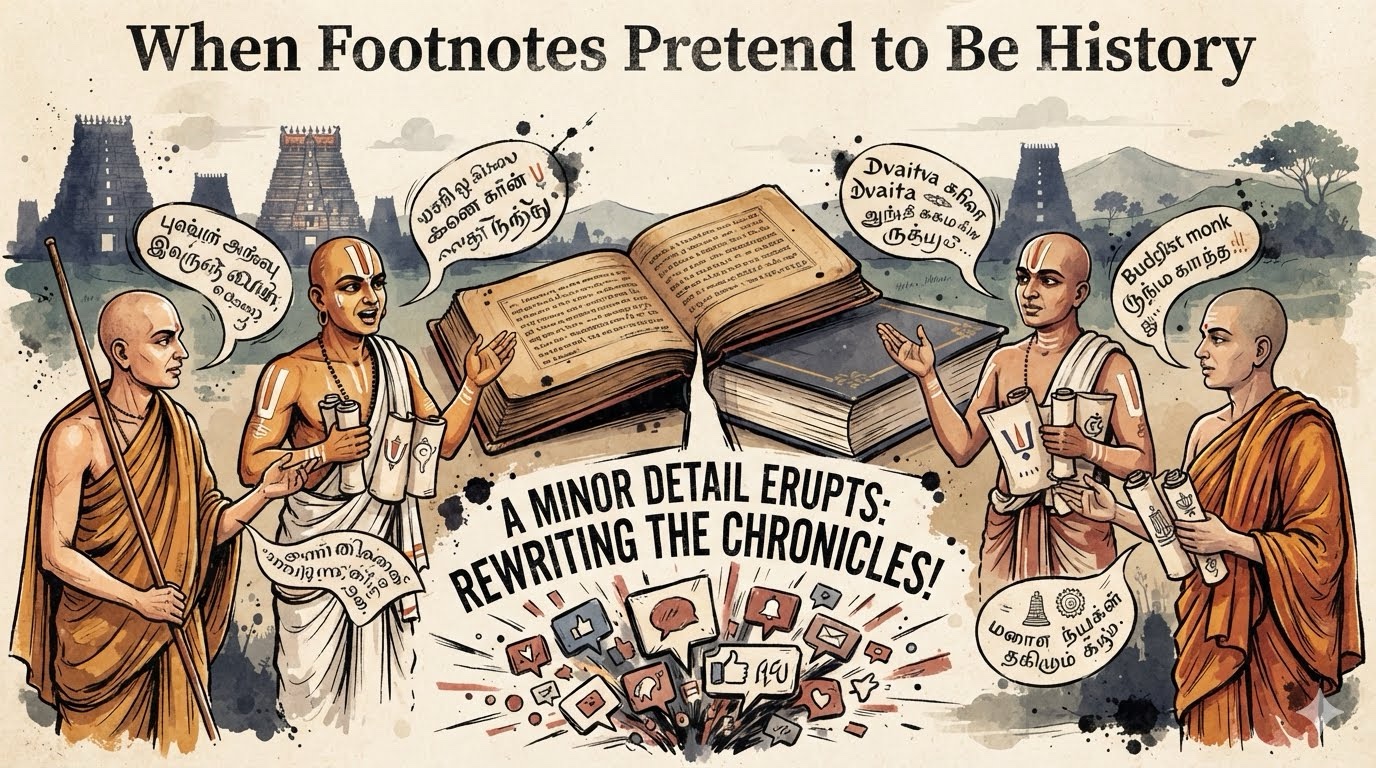
When Footnotes Pretend to Be History
Hindu philosophical traditions did not develop in a climate of uninterrupted harmony. Advaitins, Viśiṣṭādvaitins, Dvaitins, Buddhists, Jains, Śaivas, and Mīmāṃsakas often engaged in fierce—and sometimes deeply personal—polemics.
But a sectarian insult is not the whole history of a philosopher. A hostile hagiography is not a neutral biography. And a provocative footnote should not be presented as though it were a major chapter in the history of Indian thought.
From Śaṅkara and Rāmānuja to Vedānta Deśika and Madhva, the record reveals both acrimonious conflict and extraordinary intellectual creativity.
The real danger today is not that these old polemics are discussed. It is that social media detaches them from context, magnifies them, and turns historical trivia into historical truth.
When does a footnote become a distortion of history?