C. The deliberate assault on the most sacred institution of Hindu personal law: the wedding ritual solemnized by Brahmin priest
If the father and Party patriarch, M.Karunanidhi, towards the fag end of his lifetime attempted “salami-slicing” the Sri Vaishnava cultural identity by subtly glorifying Ramanujacharya with the chief aim of appropriating the great 11th century CE Acharya into a Dravidian icon of “social justice“, his son and heir and the new supremo of the DMK who became successor went about the same task with far less nuance and suavity. The father had scripted a TV soap-opera to be used as scalpel in the skilled hands of a surgeon. The son however was not averse to use a bludgeon for the same purpose. His thinking was that the success the Dravidianist ideology had already gained in dispossessing the Brahmin community of its hereditary hold over control of temples in Tamil Nadu had to be extended. His effort therefore was to alienate the Brahmin priesthood from not only the institution of Hindu temples but to effectively also marginalize it if not entirely eliminate the Brahmin priest from the other institutions of the Hindu community viz. its customs, rites and religious practices…. and the most important of all such: the Hindu Marriage Rite.
Sometime in the year 2017, speaking at a public event (the wedding of a party cadre) MK Stalin was video-graphed taking the stage to make a speech that was rather unbecoming of him. He chose to slur the very institution of Hindu wedding rites. Stalin, who had attended the marriage — which was conducted as per the Dravidian self-respect movement customs — addressed the guests at the venue after the ceremony and characterized the mantras chanted in a traditional Hindu wedding as ‘disgusting‘.
Two years later in 2019, on the eve of a major State election, the video-clip of his speech went instantly viral even as Stalin was campaigning. It sparked an outrage on social media in all of Tamil Nadu.
In the video that was abruptly cut to one minute and forty seconds, the DMK chief is heard saying this:
QUOTE: “You know how a Vaideeka marriage happens. The bride and groom will not be sitting on chairs when the marriage is being conducted. They will be made to sit on the floor and next to them the priest or Iyer will be seated and he will conduct the marriage. And how will he do it? He stokes a fire between the couple, there will be thick smoke billowing endlessly from that pyre. The smoke will assault the eyes of the couple and then they will cry a little…. on an occasion when they ought to be smiling in happiness! Not just their eyes, the guests will also tear up. It is such a sad situation and spectacle. Then the priest will say some mantras. He will call out to spirits “kinnarars”, “Dhevars” and “330 million” other minor “Dhevars”. He will call “ishta avathars” (godly incarnations) and some “extra avathars” to conduct the wedding. What is he saying?! The couple won’t know. The people who have come to bless the couple won’t know and maybe if you take the priest aside, he will also say he doesn’t know. But if you think about the inner meaning of the mantra – our whole body will shake. The mantras will be so disgusting.” UNQUOTE
In the video, the part of Stalin’s speech most people found objectionable was the one wherein he repeats a Dravidian urban legend that the Sanskrit mantras chanted during the ceremony are in a language that none amongst the wedding guests understood, nor did the couple understand but which only the Brahmin understood!”. This part of the mantra, is in fact, full of obscenity. “If you take the priest aside and inquire, he will reveal the meaning and you will find that they are unimaginably obscene”, he had said.
The comment created an outrageous furor amongst all sections of Hindu society in Tamil Nadu. But very soon, apologists and spinmeisters for the Dravidian ideology went into over gear to defend Stalin’s statements. R Kannan — a noted biographer of the Dravidian leader Annadurai — pointed out that the DMK leader’s rhetoric was no different from what had been voiced many years ago since the time of Periyar himself and it was all really much ado about nothing and simply being staged by anti-Dravidian forces for electioneering purposes.
QUOTE: “Mr Stalin has reiterated what the Dravidian movement had always said that the wedding couple nor those who had come to bless the couple understand these mantras, which are in Sanskrit,” said Kannan. “Besides, the intermediary – a priest, that too a Brahmin, who believed in the inequality of birth and that he was the highest in the caste order, was required to sanctify it – was looked upon as a lack of self-respect; hence the self-respect marriages eschewing the rituals introduced by Brahmins was introduced by EV Ramasamy Periyar, the founder of the self-respect movement. Periyar and his rationalist followers have always pointed to the inequitable, distasteful and controversial messages contained in some of the Hindu texts and the demeaning nature of some of the mantras and myths. Mr Stalin could have explained in a line for the benefit of the younger generation why the mantras or the message contained are “shameful‘! UNQUOTE
The well-known historian and journalist, Arvindan Neelakandan, however wrote a blistering article in the Swarajya magazine to counter both Stalin and Kannan:
QUOTE:
“What (this) betrays is that the present supremo of the DMK is no different from the previous one; his father, who took a perverse pleasure in hurting the religious sentiments of the Hindus. This specific urban legend is part of the anti-Sanskrit narrative that was nurtured by the British colonialists. It is part of the Protestant stereotyping that sees Brahmins as spiritual despots cheating the masses.
“It is interesting to see that not all but a significant number of ‘social reformers’ of the colonial period had accepted the evangelical stereotyping of Brahmins. The concept of ‘tyranny of priest-craft’ which was effectively used by Protestant propagandists against the Catholic church was unleashed in India against the Brahmins, who were seen as the chief obstacle to Christian proselytization.
“So let us now look at the so-called obscene wedding mantra alluded to by the current DMK supremo. The verses said by the purohit and repeated by the bridegroom, which the latter is made to say to the bride, are hymns from Rig Veda — mandala 10, hymn 85. Here are the verses in context :
… Happy be thou and prosper with thy children here:
be vigilant to rule thy household in this home.
Closely unite thy body with this man, thy lord;
So shall ye, full of years, address your company. [27] …
Agni hath given the bride again with splendour and with ample life.
Long lived be he who is her lord; a hundred autumns let him live.[39]
Soma obtained her first of all; next the Gandharva was her lord.
Agni was thy third husband: now one born of woman is thy fourth.[40]
Soma to the Gandharva, and to Agni the Gandharva gave:
And Agni hath bestowed on me riches and sons and this my spouse.[41]
Be ye not parted; dwell ye here reach the full time of human life.
With sons and grandsons sport and play, rejoicing in your own abode.[42]
So may Prajapati bring children forth to us;
May Aryaman adorn us till old age come nigh.[43] …
O Bounteous Indra, make this bride blest in her sons and fortunate.
Vouchsafe to her ten sons, and make her husband the eleventh man.[45]
Over thy husband’s father and thy husband’s mother bear full sway.
Over the sister of thy lord, over his brothers rule supreme.[46]
So may the Universal Gods, so may the Waters join our hearts.
May Matarisvan, Dhatar, and Destri together bind us close.[47]
“In the Dravidian urban legend, the verses 40 and 41 are highlighted as proof for the obscenity of priestcraft cunningly created by diabolic Aryans to humiliate and subjugate the native Dravidians. In truth, what do these verses mean?
“In Hindu traditional science of commentaries their meaning is well defined. The Smriti of Atri Maharishi, Atri-Smriti explains this verse so beautifully: “(The god) Soma gives the women purity; Gandharva bestows sweet speech: and Agni gives her Sarvamedhatva (well-rounded intelligence)— genius or innate intelligence in all domains (of knowledge). So the woman is always in possession of purity and in-depth insightful intelligence (sarvamedhatva).” One can see that this gels well with the Bhagavad Gita verse 10:35, which ascribes to women the qualities of fame (kirtihi), auspicious wealth (sri), sweet speech that proclaims truth and is beneficial to all (vaak), memory (smritihi), insightful intelligence (medha), strength of resolve (dhrithi) and forgiveness (kshama).
“The flow of the verses indicates that when a girl becomes a wife she also assumes the role of the queen of the house. She becomes a ruler. She gets the right to command over the in-laws. And she is also reminded of the biological dimension of marriage and meta-biological dimension considering the husband himself as a child.
“More importantly, the hymn reminds the husband the greatness of the wife. She has been nurtured by the celestial and that he himself is born of a woman (now one born of woman is the fourth). That the woman nurtured by Agni has in her the same fire. This has become part of collective psyche of Hindu civilization”.
“Apologists for the DMK try to justify the statement of Stalin by saying that this had been the stand of the Dravidian movement for the last 100 years. It may be true. But then, the Dravidian movement should refrain from calling itself ‘rationalist’. This is not rationalism. This is pure irrational prejudice and hatred — a disease of the mind.
https://swarajyamag.com/culture/what-the-dmk-chief-doesnt-get-about-vedic-marriage-mantras
Irrespective of any strata or walk of life in Hindu society from where they came — i.e. “varna“, caste or wealth, income or occupation — , the people of Tamil Nadu had always relied upon Brahmin priesthood to solemnize and officiate at community weddings. Since ancient times, the rites of holy matrimony — what in Sanskrit is otherwise known as “vivaaha vaideeka samskaara” i.e. the Vedic sacrament of nuptial union — had been always conducted by Brahmin priests… yes, and by Smaartha and Sri Vaishnava priests… in accordance with rules, codes and practices of hoary customs laid down in the ancient sruti and smriti manuals of yore in which the Brahmins were well-versed. The unwritten stratagem underlying Stalin’s “salami-slicing” was simple and direct: if the Brahmin priest’s role as high-priest within the institution of a Hindu temple could be subordinated even if not totally degraded, why should his similar role in the institution of the Hindu wedding also not be similarly cut down to size?
***********************************
D. The attempt to de-Brahminize the classical music traditions of Tamil Nadu
Aravindan Nilakandan’s account of the “salami-slicing” of Tamil Brahmin identity, first by European colonialists and later by the Dravidianists in the post-Independence period, was both telling and accurate indeed. Firstly, the Brahmin priesthood and orthodoxy were projected to be “spiritual despots cheating the masses”. And then later in the post-colonial period, as Neelakandan explained, “the concept of ‘tyranny of priest-craft’ which was effectively used by Protestant propagandists against the Catholic church was unleashed in India against the Brahmins, who were seen as the chief obstacle to Christian proselytization”. Nasty as the forms of “salami-slicing” that the Dravidian Father, the Son and the Holy Ghost-ideologues had carried out against the community might seem, nothing however could probably compare with or match the “unkindest cut of all” — i.e. the “salami slicing” that a young, extremely talented and well-heeled Sri Vaishnava began zealously engaging himself in sometime around the second decade of the 21st century CE.
The name of the young man was T.M.Krishna. https://www.thehindu.com/society/tm-kr
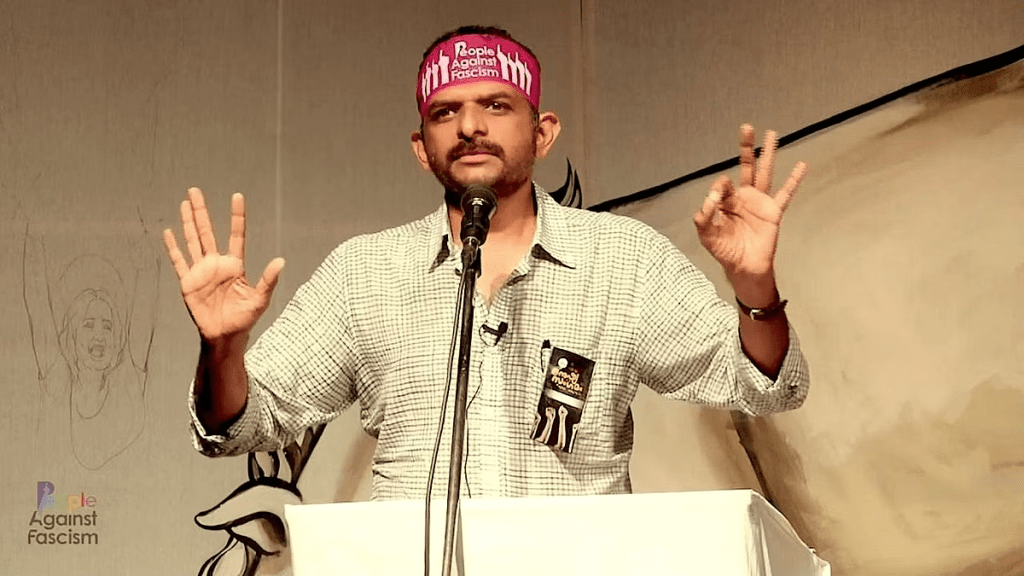
Krishna was a highly accomplished and popular public performing artiste who suddenly turned against his all-Brahmin, true-blue Sri Vaishnava antecedents and heritage. He morphed into an “angry young man”, considering it to be virtually his personal mission in life to eviscerate the Sri Vaishnava-Brahmin identity in which he himself as well as the cultural environment of classical Carnatic Music of Tamil Nadu was steeped. The story of his life and career is indeed so rich in Freudian leitmotifs.
Metamorphizing himself from stage (kutcheri) classical music performer into an indefatigable “culture warrior” against “Brahmin domination” of the cultural landscape of Dravidian Tamil Nadu, Krishna began making common cause with both Left-Liberal and/or Periyar-inspired ideology and ideologues in the rest of the country too — in other words, with whoever would listen to him and his ideas.
Krishna wrote and published a book A Southern Music. It was his personal manifesto as a Carnatic music exponent turned social-activist. In the book he wrote that “he did feel hurt whenever he met with a non-Brahmin musician. They have been treated shabbily and still carry the bruises.” Krishna also said that many of them even told him that it was their caste that had shut the doors on them. Some had even shifted to performing for lesser occupations (such as singing for Bharatanatyam dancers) because they couldn’t break into the concert circuit. Krishna was particularly referring to the cultural scene in Chennai, which he described as the “fulcrum” of karnatic music. Without getting recognition in Chennai, you are a nobody in karnatic music. The aficionados that controlled the “fulcrum“, according to Krishna, were Brahmin.
In a series of articles and blogs published on social media over several years that followed, T.M.Krishna suddenly attained stardom as the Sri Vaishnava Mylapore Brahmin who had turned a stormy rebel with a cause and an anti-Brahmin agenda that was really no different from that of the Dravidianists of Tamil Nadu.
Krishna soon with a high social-profile became a darling of the DMK and his public pronouncements were music to their ears. In a feature article he wrote for The Hindu newspaper (which patronized him unstintingly) he caustically satirized the Brahmin community’s stranglehold of the entire cultural ecosystem of Tamil Nadu through the old bastion of classical Carnatic music, the Madras Music Academy (which, in fact, had earlier enormously piqued him by delaying, not, denying him the conferment upon him its much coveted, prestigious and globally acknowledged annual award for performing excellence, the grand title of “sangeetha kalanidhi“). It was the “Brahmin mafia of Mylapore”, so to say, which had always arrogated to itself the power to define and decide what constituted Tamizh Iyal, Isai and Natakam.… the three principal arts which together made up the cultural aesthetics of all Tamil Nadu’s Literature, Music and Performing Arts. “Who gave them the power? What gave them the right to hold it?” began asking T.M.Krishna, the enfant terrible of the Madras Carnatic Music world.
ishna-traces-the-history-of-the-fabled-mylapore-male-music-connoisseur/article22384095.ece
QUOTE: “No assortment of names can deny that karnatic music is still almost entirely Brahmanical. There have been a few names here and there — a handful of vocalists and mostly accompanists — who were non-Brahmin, but all the major names have been Brahmin. And what’s worst is that there’s been hardly any Dalit….”
“Whether it’s been inadvertent or not, this is a social anomaly; a disgrace. How’s it possible that an art form is almost entirely practised and patronised only by Brahmins? Is it that they don’t part with their expertise acquired over generations or is it because others are not simply interested? Since this has never gotten to the realm of policy (social justice or affirmative action) nobody seemed to have looked for a final answer“. UNQUOTE
Throughout much of the years in the second decade of the 21st century CE, T.M.Krishna continued his “social activist” tirades against the Brahmin establishmentarianism of Tamil culture. Krishna rose then like a meteor to “Urban Naxal stardom” in India thanks largely to the launch of his book titled A Southern Music at the hands of the Nobel Laureate and Economist, Dr. Amartya Sen in December 2013. No one ever had any clue as to whether the Professor’s knowledge of Music was as profound as Economics, but Dr. Amartya Sen flattered T.M.Krishna by giving a clarion call of wholehearted support to the mission to “make classical music accessible to the masses”. Krishna knew then in that very moment that he had arrived and was, front and center, right under the national spotlight! He knew now the ball that had been just lobbed into his hand by a Nobel Laureate of world renown had to be grabbed and embraced with both hands…. and he knew exactly how to run with it!
Krishna personal missionary work thereafter became fully based on the premise that the Brahminism of karnatic music, particularly in Chennai or Tamil Nadu, was also a proxy for a certain social order. Without dismantling it, he would not succeed. So he went about loudly proclaiming that the fight for his social cause had been impelled mainly by the fact that even the “social reforms movement in Tamil Nadu” (i.e. the Dravidian Movement!) had never paid much attention to this phenomenally-sophisticated art form of Carnatic Music in the State of Tamil Nadu, or to its practitioners and patrons. The case-narrative Krishna thus went about creating publicly was this:
“It’s hard for non-Brahmins to even learn karnatic music, particularly in Chennai or Tamil Nadu, because the repository of knowledge and expertise is not accessible to them. Karnatic music requires sound basics, years of high-quality training and careful mentorship by experts. But there’s a steep caste barrier. How does one break it? By taking the art beyond its classist and casteist confines…”
In other words, T.M.Krishna, the blue-blooded Sri Vaishnava of Chennai, was inviting Dravidianism to come and ally with him in a battle against Brahminism on a new front that hitherto even Periyar, Annadurai or Karunanidhi had scarcely ever paid much attention to! He was telling the whole world that he indeed was the best man with the right credentials and the best talent — a true-blue Mylaporean Sri Vaishnava Brahmin who was a top-notch Carnatic music kutcheri-performer — who could nonetheless execute the “inside job” of dismantling Brahmin cultural hegemony in the state of Tamil Nadu.
Krishna began thus mocking the hallowed traditions of Carnatic music. He broke performance kutcheri conventions. He appeared in outrageous attire on stage (wearing garish “lungi” instead of the conventional dignified “white veshti and jubba“). He began composing and singing Carnatic music in praise of Christianity and Islam. He went into the slums of Chennai city to give concerts to slum-dwellers and squatters/settlers on encroached no-man’s land (“poromboke“). He called for “gaana music” and “theru koothu” (Tamil pop music and Tamil discotheque dance) to be encouraged by the Madras Music Academy! He joined candle-light marches and made fiery speeches at universities for leftist causes and issues…
T.M.Krishna, much to his chagrin, had failed to win the ultimate accolade of the Madras Music Academy. But then who cared! Hadn’t he gone on to win the famous Magsaysay Award in recognition of his work of taking “music to the masses“?! It seemed then as though — to him at least — that the Tamil cultural world had at last been forced to sit up and listen to his constant refrain: “Take Carnatic Classical Music to the Dalits, to the slums,” and his pet theme, to “de-Brahminize it”, whatever that might have meant!
While T.M.Krishna, a scion of an ultra-orthodox, wealthy Sri Vaishnavite family, successfully navigated the “cross-cultural journey” from Brahmin classicism to Urban Naxalism inside the world of Carnatic music, he made many new famous and powerful friends across the political and cultural spectrum of both Tamil and Indian society at large. The liberal-Lutyens Delhi media loved him. He became the cynosure of political leaders in the DMK and also in the Congress Party. He became networked into the company of the high and mighty of the land such as with Rahul Gandhi, Arvind Kejriwal (of the Aaadmi Party) and many others who belonged to the so-called anti-Hindutva, secular fold within the country. As far as Krishna himself was concerned he had well and truly arrived in his career-journey as a formidable “culture warrior”.
Many Brahmins and Sri Vaishnavas in Tamil Nadu and in the world of classical Carnatic Music however had nothing but feelings and words of extreme outrage for him. In their eyes, he was nothing short of a “traitor to his people”… a Sri Vaishnava “trojan horse” within the Brahmin ranks, out to sabotage and diminish its culture, its musical heritage… and its very identity too. As a pained but irate blogger wrote in his broadside, T.M.Krishna had simply crossed the line in the wholesale denigration of Tamil Brahminhood:
https://www.dharmadispatch.in/culture/t-m-krishna-the-musical-urban-naxal
QUOTE:
“T M Krishna repeatedly stresses on M S Subbulakshmi’s (a Carnatic Music iconic diva of yesteryears almost deified by die-hard legions of her fans) origins as a Devadaasi who became “Brahminised” to gain “social acceptance.” This disgusting approach shows two things: one, that although T M Krishna has learned Classical Music, he never imbibed the “Samskaara” that it brings, which in turn adds effulgence to its performer; two, by invoking her origins, this great Musical Messiah of the Masses has actually slandered the “low classes” he claims to “liberate” with his music. A qualified shrink needs to tell him he needs to liberate him from himself.
“Here’s a wealthy, well-connected and mediocrely talented Carnatic classical musician who has today morphed into a poster boy and mouthpiece of the nation-wrecking, rogue, Radical Left-Liberal ecosystem. Also known as an Urban Naxal…..he is among the landed gentry of Mylapore, being the grand nephew of India’s former Finance Minister and industrialist … T T Krishnamachari …. who was also one of the founding members of the Madras Music Academy. The kind of clout that T M Krishna enjoys in this circuit is anybody’s guess. a Magsaysay Award followed in 2016 for his efforts at promoting “social inclusiveness in culture.” This award drew widespread condemnation as well, with culture and music aficionados writing stinging reproofs calling out T M Krishna’s credentials as a “pop sociologist.”
“Over the past decade or so, his reverse Darwinism from being a practitioner of one of the most sublime and evolved forms of music into an unabashed and crude political propagandist has been as swift as it has been soulless. Especially over the last five or six years, he has converted the sacred podium of Classical Music into a pedestal for spewing dark propaganda than providing joy for the “Rasikas”.
UNQUOTE
********************************
In any history of the Sri Vaishnavas, it might perhaps rightly be said that T.M.Krishna, the Vadakalai Sri Vaishnava Iyengar from Chennai, would be no more than an insignificant footnote. True, but then he would be a footnote that cannot be ignored for, his presence and his work indeed do signal something of a fin de siècle for the entire community of “ubaya-vedantins”, the end of an era in their history, a termination-point…. As much of India’s long, troubled history through the ages teaches us, the enemy outside can be the cause of Decline, but it is the enemy within who alone can cause the Fall….
************************
(to be continued)
Sudarshan Madabushi