The most daring effort at “salami slicing” the Sri Vaishnava identity was carried out by none other than the octogenarian patriarch of the DMK Party, the man the Dravidianists worshipped as “Kalaignar Karunanidhi”. In April 2015 he decided to move to appropriate the most venerated icon of the Sri Vaishnavas and assimilate it into the template of Dravidian politics in the State of Tamil Nadu. He made a bid to appropriate Sri Ramanujacharya, the very first and most venerated Acharya of the Sri Vaishnavas.
M. Karunanidhi said the Dravidian movement accepted the ideas of Vaishnavite philosopher-saint Ramanuja because he transcended religion and caste, and wanted all communities to be treated equally. Therefore, he announced publicly that he would be penning the script for a television opera-series on the life of Ramanuja. It would be screened weekly through several episodes on a TV channel owned by himself, Kalaignar TV. In an interview to The Hindu , he said the saint was a revolutionary who took religion to the masses. “He showed through his life that the oppressed and backward communities were not those to be hated and sidelined”.
It simply defied the imagination of the common Sri Vaishnava that an inveterate atheist like Karunanidhi, committed as he was to the ideals of Dravidianism as first propounded by Periyar and then Annadurai, would want to co-opt Ramanujacharya of all persons as endorsing Dravidian ideals of social justice, self-respect and rationalism. Karunanidhi’s anti-Brahmin feelings were well known and he himself had made no secret of them. Some of his infamous and most controversial remarks were echoes indeed of the nasty tirades his mentors, Periyaar and Annadurai themselves had often in the past directed at Brahmins and the Hindu religion. He had once mockingly asked in the context of the Ramayana episode wherein Rama builds a causeway (sethu) across the ocean to Lanka: “From which University did Rama take a degree in Engineering to build Rama Sethu?” He had relished often the quote of Periyar who had said, “Rama is a Myth propagated by Brahmin Aryans and it has to be burnt”. He had also never once thought it fit to condemn what Periyar had said, “If you see a Brahmin and a snake at once, let the snake go but kill the Brahmin” (பாப்பானையும் பாம்பையும் பார்த்தால் பாப்பானை அடி”). Karunanidhi’s hero and political guru, Annadurai too had mocked the Ramayana in a book of his titled, “Kambarasam” in which he had asked, “Sita stayed in Ravana’s custody for 10 months, what is the guarantee she was a chaste woman?” Another question of his in the book cast doubts on the virtue and fair name of a Mahabharata character, Kunti-Devi, the unwed mother of Karna: “How did Kunti beget children?”. The character of Hanuman, the simian Rama-bhakth too was ridiculed as a caricature when it was asked “Kurangu Mukathil Oru Kadavul?” or “We have a god now in the face of a monkey!”. Such a man was now penning a TV-serial script for Ramanujacharya’s life accomplishments!
In The Hindu interview Karunanidhi was asked:
You have said you came to know about Ramanuja at a very young age and was attracted to his social reforms. Why did you not write about him earlier?
I know that Ramanuja is one among the great men who engineered revolutions in religion. When a request was made that I narrate those incidents, which sowed the seeds of change, to the people to nourish their thinking, I came forward and took it up. But because I am writing about a part of his life, it does not mean I have accepted his theistic ideas or given up my atheistic, self-respect ideology.
Strangely, the HINDU interviewer did not press Karunanidhi to explain who it was that had “made a request” to him to pen a TV serial opera on Ramanujacharya! Was it someone from within the Sri Vaishnava community itself? Or was it the Dravidian ideologues in his own Party? Karunanidhi too did not reveal at whose bequest he had undertaken the creative task he was announcing with such fanfare. The interview went on to query him further thus: https://www.thehindu.com/news/national/Interview-with-DMK-chief-M.-Karunanidhi/article60153833.ece:
QUOTE:
As a senior leader of the DMK, could you tell us how the Dravidian movement views Ramanuja? Despite his Brahminical roots, why did leaders like Periyar hold a high opinion about him?
It is true that Ramanuja professed spirituality every day. At the same time, he transcended religion and lived by the higher value of treating all faiths equally. More specifically, he showed through his life that the oppressed and backward communities were not those to be hated and sidelined. As someone who grew up with the Dravidian movement, I have no agreement or compromise with Ramanuja’s theism. But I do have the culture to appreciate his secular ways. This is why we do not consider his spiritual, Brahminical background as his foremost traits and worry about it.
Among the social reforms he ushered in, which one do you think was the most important?
Those reforms have not led to wide changes that Ramanuja himself and the Dravidian movement desired. But we cannot deny that in the epoch he lived in, it did create awareness to an extent. Whether a majority of his followers have given a practical shape to his ideas is something only time can judge.
Why did the DMK not recognize Ramanuja or his reforms when it was in power? For example, his efforts to introduce Tamil in temple worship.
It is true we did not recognize him individually when we were in power. But we did function in a manner that recognized his social reforms. For example, the Government Order allowing persons of all communities to become priests; release of several books such as Tamil “Aagama Noolgal”, “Tamilil Vazhipadu”, “Tamilil velvi”, “Tamil Potri”; coaching centres for training in “Divya Prabhandam” (Vaishnavite bhakthi poems) in areas where Dalits, Tribals and Backward Class people lived etc. There is a long list of such achievements under the DMK’s rule.
UNQUOTE
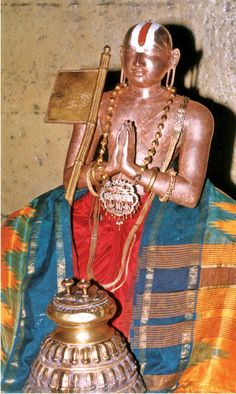
To many Sri Vaishnavas the very thought of a man like Karunanidhi attempting to appropriate the iconic status of Sri Ramanujacharya — a giant of a religious leader — and convert it into a sort of electoral mascot for the DMK and Dravidianian ethos came as both rude shock and puzzle. They did not quite know what to make of a TV-opera script on the life of Ramanujacharya written by a self-avowed lifelong atheist who prided himself on having embraced the ideals of Periyar and Annadurai, both well known for their anti-Brahmin and anti-religious rhetoric.
When Karunanidhi’s serial was filmed and aired in 2015 through 2016 on the private TV channel that he himself owned (Kalaignar TV), it did enjoy great popularity for a while. Many people after watching the serial for months on end, began to smirk saying that “Kalaignar K. Karunanidhi hereafter maybe referred to as an Iyengar!” The script that he had written was appreciated so widely that even the conservatives within the Sri Vaishnava community for a while were glued to their TV sets watching the serial. The script and small-screenplay were so endearing that it was difficult to believe that an inveterate atheist had actually penned them. Many people even within the DMK party too began to silently wonder if Karunanidhi was perhaps reneging from his long-espoused and outright atheism and was quietly turning to a mild, anodyne form of agnosticism and also if he was otherwise not flirting with outright theism! Ramanujacharya was, after all, beyond any doubt an exponent of Qualified Theistic Monism at its very best. So was Dravidianism coming full circle in its ideological journeying from the days of Periyar and Annadurai?
Karunanidhi’s attempt to turn Ramanuja into an electoral mascot for Dravidianism “salami-sliced” and also effectively left the the ranks of Sri Vaishnavas divided.
A very clever Dravidian historical narrative was being built around the idea that the 12th century CE social reform movement of Ramanuja ought to be perceived as being a precursor to the social justice reforms of Periyar and Annadurai of the modern era. This narrative was expressed in fact in a widely read published article https://www.firstpost.com/india/ramanuja-periyar-re-integrating-brahmins-dravidian-narrative-2194535.html
QUOTE: “Ramanujacharya was so moved by the same adharma in society that he decided to defy the then contemporary social norms and made it his life’s mission to show the downtrodden the path to salvation. He may perhaps have well been the first person to use a variant of the Harijan, Thiru Kullathar, for the oppressed castes.
More recently, in the 20th century, when our land was again plunged in the dark ages, when man became reduced to the level of a leech living off the blood of fellow human beings, rose another great saint. His name was Periyar E Ramasamy Naicker and he was no less than the Shankaracharya. His teachings are a perfect synthesis of Shankara’s non-duality and Charvaka principles. It is, therefore, best suited for our times.
Periyar espoused the same message of rationality and human dignity that the avatars of previous ages did before him. He saw that religion was being exploited to deceive innocent people and, therefore, he fought against superstitions till his last breath. Through his participation in the Vaikom Satyagraha and through his self-respect movement he crusaded for the truth that all men are equal.
If Periyar was Aristotle, Annadurai, the first DMK Chief Minister of Tamil Nadu, was his Alexander. Annadurai interpreted Dravidian philosophy to influence statecraft. It is because of him that Tamil Nadu leapfrogged into the league of the most advanced states of India. He gave clarity to Periyar’s views on god. “Onre Kulam, Oruvanae Devan“, he declared, mirroring the highest truth of non-duality.
Periyar’s action of breaking clay images of deities is comparable to the story of Guru Nanak, founder of Sikhism, who was alleged to have shown disrespect to the Kaaba in Mecca because he had his feet in the direction of the stone. The guru retorted and asked to be shown a direction which was godless.” UNQUOTE
The Vadakalai sect in Tamil Nadu was aghast that a blatantly Dravidianist narrative could be so audaciously constructed as to seek to equate Ramanujacharya’s philosophy with Dravidian ideology through the prism of specious historiography. It frowned severely upon Karunanidhi’s TV serial as gross misrepresentation of Ramanujacharya’s philosophy of life and social ethics and its surreptitious attempt to somehow equate Ramanujacharya with Dravidian icons, Periyar and Annadurai. While Ramanujacharya had indeed worked for reforming Hindu society in his time, and did indeed champion inclusion of all castes, both the backwards and tribal too into mainstream society, he was never known to have repudiated the central Vedic social order of “varna-ashrama”. But the Ramanujacharya that they now saw being depicted in the TV serial seemed to suggest the great preceptor was being subtly projected to be made more in Karunanidhi’s or Periyar’s own image as caste-iconoclast of the modern era than as a genuine socio-religious reformer in his own time and in his own right.
Writing in her popular blog on the internet https://jayasreesaranathan.blogspot.com/2015/08/karunanidhis-ramanuja-distortion-of.html , a well known Vadakalai religious scholar and writer, Jayashree Saranathan echoed the Vadakalai angst over Karunanidhi’s bid to appropriate Ramanuja:
QUOTE: “Karunanidhi – who mouthed the infamous dialogue on Lord Rama asking in which Engineering college Rama studied stands disqualified at the very outset to even utter the name of the Lord. In the very 2nd verse of Tirupallandu Hymn, we know the saint Periya Azhwar wants only those who have not abused Rama for 21 generations to sing in praise of Him (Vishnu)!” she wrote with great indignation.
She went on to then further fulminate: “There is a …. category of people. They would not have known about God. They would have led a very despicable life of causing harm to others. They could have been robbers. But even then, if they had repented for what they had been all along and wanted to change by worshiping God, then they are very much welcome to sing “Namo Narayana”. Thirumangai Azhwar discovered the pleasure and utility of uttering this name after having lived as a robber and reformed later. His famous verses starting as “Vaadineen, vaadi varinthinen”( வாடினேன் வாடி வருந்தினேன்) show that repentance comes first in leading the person to understand the glory of God. Karunanidhi has no thought of repentance for what he had done in misleading generations of people.“ UNQUOTE
Quite opposed to the Vadakalai stand on Karunanidhi’s bid to appropriate Ramanujacharya, the Tenkalai sect seemed rather unconcerned or agnostic about it. They perceived the TV opera-serial to be more a glorification of Ramanujacharya’s personality rather than as a disruption of Sri Vaishnavism. The stand of the Tenkalai by contrast with that of the Vadakalai seemed very nuanced and politically correct too.
Nowhere was the ambivalence of the Tenkalai position more pronounced than in the words of the noted Tenkalai Sri Vaishnava academic and pundit, Dr M.A. Venkatakrishnan who at a public event organized to commemorate the 1000th birth anniversary of Sri Ramanujacharya, openly welcomed Karunanidhi’s TV serial on Ramanujacharya. Due to the ageing Karunanidhi’s condition of illness and debility, the TV serial had been forced to abruptly and midway cease being telecast. But M.A. Venkatakrishnan, speaking on the occasion for Tenkalai’s, made an ardent appeal for resumption of the serial on air:
QUOTE: The abrupt “discontinuance” of Karunanidhi’s Tamil serial on Sri Ramanuja, since the DMK patriarch’s indisposition, was seen as “unfortunate” by many Vaishnavites, particularly, “when we are in the midst of celebrating the great revolutionary saint’s millennium year”, and efforts should be made to complete the tele-serial,” Prof M.A. Venkatakrishnan, renowned scholar who had headed the Department of Vaishnavism at the Madras University, urged.
His plea was also strongly backed by another budding young scholar of Vaishnavism, Sri Akkarakanni Srinidhi Swami, at the daylong celebrations of the ‘Bhagavath Ramanujar 1000th Thirunatchathira Peruvizha’, in the presence of Dr S Jagathrakshakan (a former Union minister and founder-president of ‘Aazhwargal Aaivu Maiyam’ which had organized the celebrations along with Bharath University).
Prof. Venkatakrishnan, said television being a powerful medium, a serial like the one on Sri Ramanuja should not be left incomplete, as people then would not get the full message about the saint’s life: “There may be several Vaishnavites including me who may not agree with all that the tele-serial penned by Karunanidhi sought to convey, but to leave a project like this unfinished is quite painful too,” Prof Venkatakrishnan said. “We will be only too happy if Mr. Karunanidhi himself could, on regaining his health, come back and pen the rest of the great saint’s life; but if his health does not permit, people like Jagathrakshakan should make efforts to ensure that the remaining part of the script for ‘Sri Ramanujar’ is written, filming of the tele-serial completed and broadcast for the benefit of people at large.” This would be a special tribute to the great saint in his millennium year, he added.” UNQUOTE
The nub of the whole matter however as it stands today is that while the Tenkalais are willing to view with a certain amount of studied indulgence the “salami slicing” tactics of the Dravidian ideologues aiming to appropriate piecemeal the Sri Vaishnava identity, the Vadakalai sect remains unmoved by any Dravidian overtures to coopt any part or element of the Sri Vaishnava identity into the Dravidian ethos.
**********************************
B. The attempted de-apotheosizing of Sri Andal
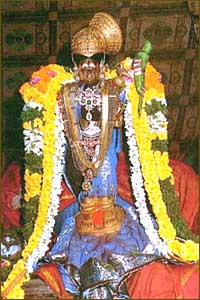
If Karunanidhi, the Dravidian playwright, penned a TV serial-opera to “salami-slice” the Sri Vaishnava identity in attempted appropriation of Ramanujacharya’s 12th century CE social reformations for the Dravidian political cause in the 21st century CE, it was next the popular Tamil poet, Vairamuthu, to follow suit in the footsteps of his mentor and patron, Karunanidhi himself, and who sought to appropriate the exquisite 8-9th century CE Tamizh poetry of Sri Andal through a rather crass and clumsy effort to subsume it, along with her persona, into present-day literary mold and socio-cultural structure of Dravidian Tamil Nadu.
Who is Vairamuthu? Vairamuthu Ramasamy was born on July 13, 1953. As an Indian lyricist, poet and novelist working in the Tamil cinema industry, he is a stalwart personality in the Tamil literary movement. After securing a master’s graduate degree from the Pachaiyappa’s College in Chennai, he first worked as a translator, while also being a published poet. He entered the Tamil cinema industry in the year 1980. During the course of his 40-year successful tinsel-town career, he has written over 7,500 songs and poems which have won him seven National Awards, the most for any Indian lyricist. He has also been honored with a Padma Shri, a Padma Bhushan and a Sahitya Akademi Award, for his abundant literary output.
Vairamuthu found himself embroiled in a controversy after a speech he gave was published under the title ‘Tamizhai Aandal’ in the daily Tamil newspaper, “Dinamani“. He gave the speech at the famous temple of Sri Andal at Srivilliputhur during a discussion on Andal as an Azhwar saint.
Vairamuthu was accused later of having crossed the line during his speech while quoting from a book that had referred to Andal rather callously as a “Devadaasi” — an expression denoting the class and community of royal concubines who in historical times used to serve temples as courtesans adept in the fine arts of music, dance, drama and poesy. In his speech, Vairamuthu had said that Andal herself had been a “Devadasi who lived and died in the Sri Rangam Temple”. To cloak the scurrilous remark and to try and make it sound politically correct and woke-ist, Vairamuthu had said that “While devotees will not accept this, but those who oppose patriarchy, and those who are against an unequal society, will ponder this.” In other words, Vairamuthu sought to convert Andal from the religious icon she was of the Sri Vaishnavas into a post-modern icon of feminist rights and freedoms espoused by Dravidianism.
For the Sri Vaishnavites of Tamil Nadu, Vairamuthu’s public speech blew up into a massive controversy…. “It is a habit of people like Vairamuthu to conduct planned attacks on the feelings of Hindus. It is unfortunate that the newspaper Dinamani has provided a platform for this”, some thundered. Other political leaders added indignantly, “It is condemnable for anyone to talk about or write about Andal and taint her divinity, as she is worshipped by lakhs and lakhs of devotees; that too in a holy month like Margazhi (Dec-Jan), that too within temple premises.”
There was no doubt that Vairamuthu’s faux pas grievously hurt and outraged the sacred sentiments of Sri Vaishnavas when he had referred to the revered Saint Sri Andal, a divine deity as a “Devadaasi”. He did not expect the backlash from Sri Vaishnavas to be as intense it turned out to be. He had to somewhat retract his position although he insisted there was nothing he had to apologize about. https://www.republicworld.com/entertainment-news/regional-indian-cinema/vairumuthu-ready-to-face-trial-in-andal-controversy-withdraws-plea-in-hc-to-quash-case.html
Following the furor, Vairamuthu took to Twitter to express regret. The poet said that he was only quoting the research done by an Indiana University researcher in the USA. “In my essay called ‘Tamizhai Aandal’ I had only quoted a line from a book that had come from Indiana University. It is not my opinion. It is that researcher’s personal opinion. The aim of literature is to maximise personas and not to minimize them. There is no need for literature (to minimize personas). Everybody knows that my views on Andal are only to praise her and my intention is not to hurt anyone. I regret it if anyone has been hurt,” Vairamuthu said.
Vairumuthu however succeeded in also putting a clever spin on what was clearly blasphemy on his part by turning it into some sort of a defense of modern gender equality. He expatiated on how “Andal in the 8th century challenged tradition by singing for Perumal (the Deity) in the temple when traditionally women were never expected to leave the home. “Andal has always crossed the line that social mores of the time had drawn for her. A young girl who grew up listening to praises sung for Perumal by her father Periya Azhwar, got involved in divine love,” he said trying to explain what he had meant really by referring to Andal as a Devadaasi..
For the Sri Vaishnava laity, however, Vairamuthu’s protestations were nothing more than utterly lame and unconvincing exercise in damage-control. Andal in the Sri Vaishnava tradition did not at all represent feminism or gender-freedom as is understood in the modern sense. As a religious icon she only represented the fundamental Vedantic and Sri Vaishnavite concept of a liberal philosophy: that which upholds the truth that the human soul has no gender, and therefore all “jeevatmas”, possessed of either male or female bodily form, can aspire and be equally qualified to seek union with Godhead.
Although the effort of Vairamuthu to appropriate Andal for the Tamil Dravidian cause came a cropper, the damage to the Sri Vaishnava icon was unfortunately already done. Andal in the eyes of the world had been subtly de-apotheosized if not cavalierly desecrated by Dravidianist ideologues. The “salami-slicing” that had been carried out was not an outright success… but then neither was it an outright failure.
*********************************
(to be continued)
Sudarshan Madabushi
Fine article and I enjoyed
Thank
You 🙏