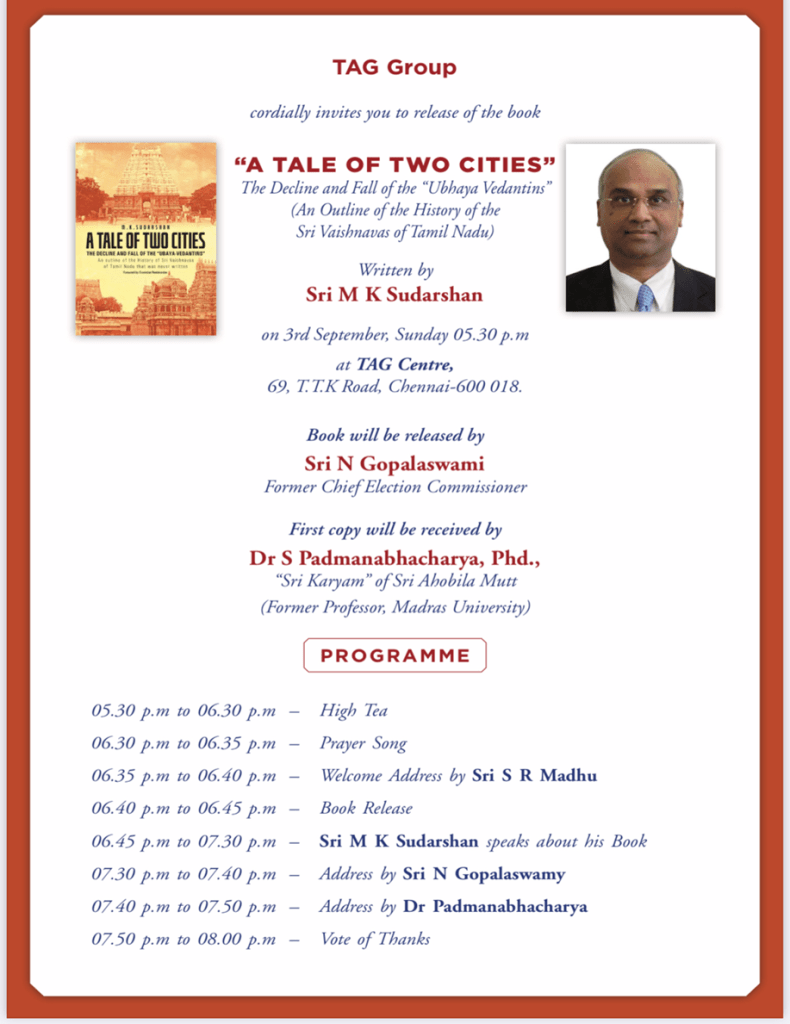
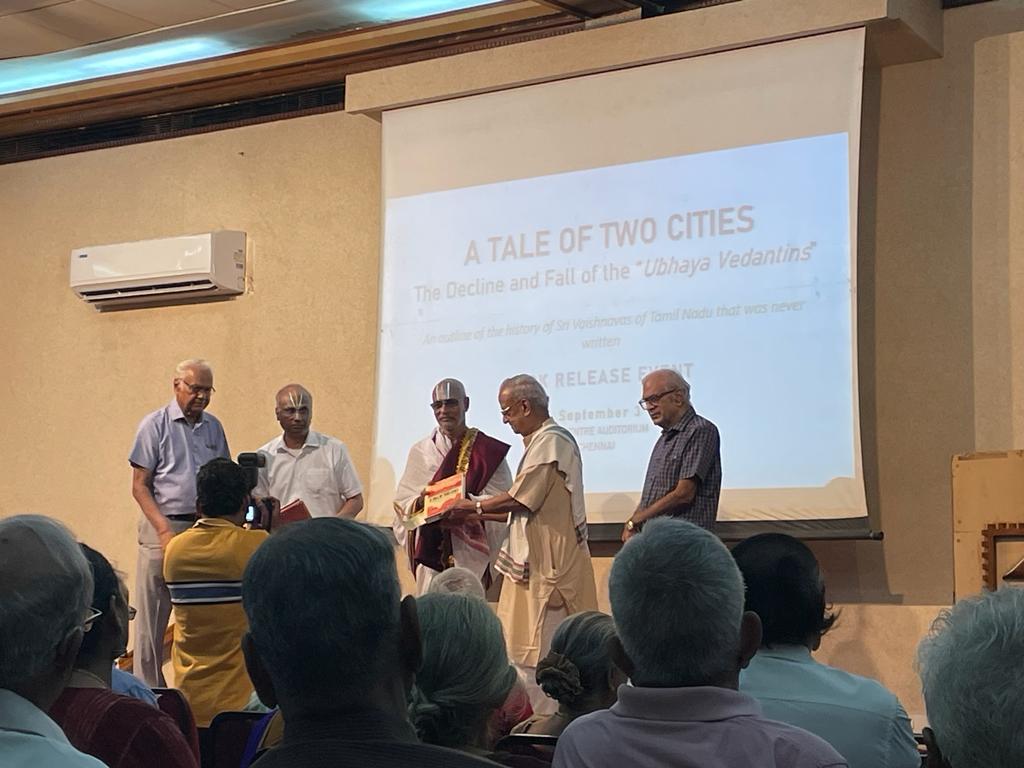
At an event held in the TAG CENTRE Auditorium at 6.30 PM on September 3, 2023, the first copy of the book authored by M.K.Sudarshan, “A Tale of Two Cities: the decline and fall of the “ubhaya vedantins”- A history of the Sri Vaishnavas of Tamil Nadu that was never written” was released by Dr. N.Gopalaswami, former Chief Election Commissioner and received by Dr. S.Padmanabhacharya, former Professor, Department of Sanskrit, Madras University, and now “Sri Karyam” of Sri Ahobila Mutt, both of whom also spoke briefly to felicitate the book.
The event was hosted by noted Industrialist, Philanthropist and Patron of Arts and Culture in Chennai, Sri. R.T.Chari. The program was compered by Sri.S.R.Madhu.
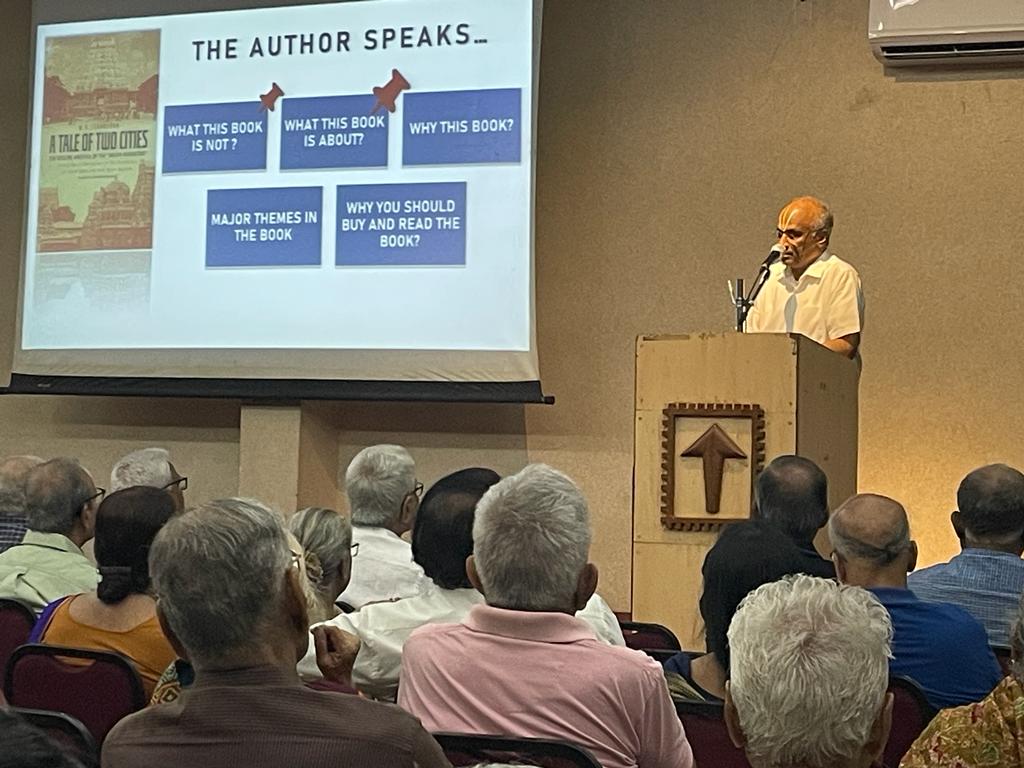
The Author, M.K.Sudarshan spoke on the occasion about his book to an august audience of about 200 invited guests.


FULL TEXT OF SPEECH OF M. K. SUDARSHAN DELIVERED AT THE EVENT HELD ON SEPTEMBER 3, 2023 AT TAG CENTRE AUDITORIUM, ALWARPET, CHENNAI, TO LAUNCH HIS NEWLY PUBLISHED BOOK, “A TALE OF TWO CITIES, The Decline and Fall of the “Ubhaya Vedantins”” (Westwood Book Publishing, Atlanta, USA, 2023)

____________________________________________________________
- Good evening, ladies and gentlemen, my warm greetings to you all! Thank you so much for taking time out this evening to be present here at this event. I see many of my family, relatives and very good personal friends here! You have no idea how much your presence means to me!
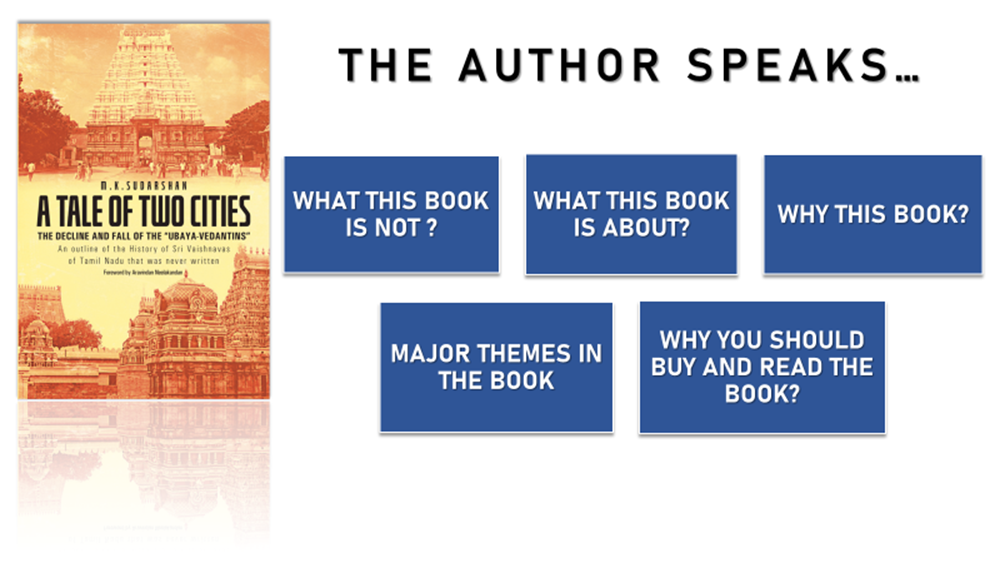
My presentation will take about 45 minutes. This is what I am going to talk about:
A general Disclaimer first. Let me begin by first telling you what this book is not.
WHAT THIS BOOK IS NOT
The main title of this book is “A tale of two cities”.
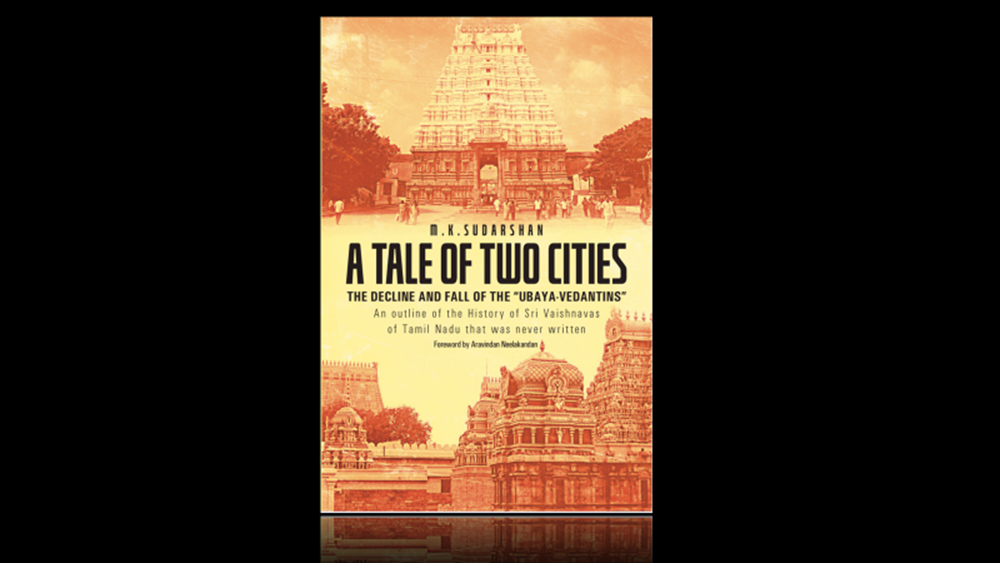
- For those of you who are English Literature buffs, please don’t be disappointed because this book has nothing to do with Charles Dickens. The two cities here are Kanchipuram and Sri Rangam of the last 1000 years, not London and Paris during the French Revolution of the 19th century CE.
- The sub-title of the book is “The Decline and Fall of the “ubaya-vedantins”. At first glance I know it sounds grim and foreboding, just like Edward Gibbon’s title for his grand, classic work of historiography, “The Decline and Fall of the Roman Empire”. But let me hasten to assure you this book is not all gloom and doom. It has a happy ending, in fact.
- The second subtitle of the book is: “An outline of the History of Sri Vaishnavas of Tamil Nadu that was never written”. Again, some of you might wonder why such a long and verbose sub-title for a book? … A few might even think it sounds a tad conceited or arrogant? In a little while, I will explain to you why I chose this sub-title for my book … and why I am not conceited or arrogant.
- This book has nothing to do whatsoever with Sri Vaishnava philosophy, theology, scriptural literature, customs or practices of sampradaya.
- This book is about 500 pages long but it is not a history text-book, certainly not in the strict sense in which a university professor of history might have written it. It is really more of an outline of history. To use a metaphor, the history is drawn upon a giant IMAX-screen sized canvas. Although not a history-text book, it is still my fond hope that the book will get accepted in the world of academia. Perhaps it will even get prescribed as suggested essential reading for all students pursuing post-graduate degree in Sri Vaishnavism or Tamil History in universities – let’s say, Madras University, Sastra University, Sri Venkateshwara University or the Banaras Hindu University.
- This book is also not a work of original research. Research-data already available has been culled and collected from the public domain viz. libraries, the Internet, other academic papers and dissertations and the book strings together relevant information into a cogent historical account that connects all the dots.
- On the back-cover of the book, there is a tantalizing blurb. Please do not get misled by it into believing that this book isjust another one of those about the polemics of the great Tenkalai-Vadakalai sectarian turf-war of nearly three centuries. The book’s central theme is actually much more than that. I will explain it later in my talk.
However, yes, the historical narrative in this book is indeed woven around a “tale of two cities” i.e., Sri Rangam and Kanchipuram, because all that happened in history in the landscape that lies between these two temple-cities is what formed and shaped the Sri Vaishnava identity since Sri Ramanuja’s time.
***************************
Next, let me tell you in a nutshell what this book is all about.To do that I must digress a bit and tell you a little bit about my personal journey in the last 5 years.
What this book is about?
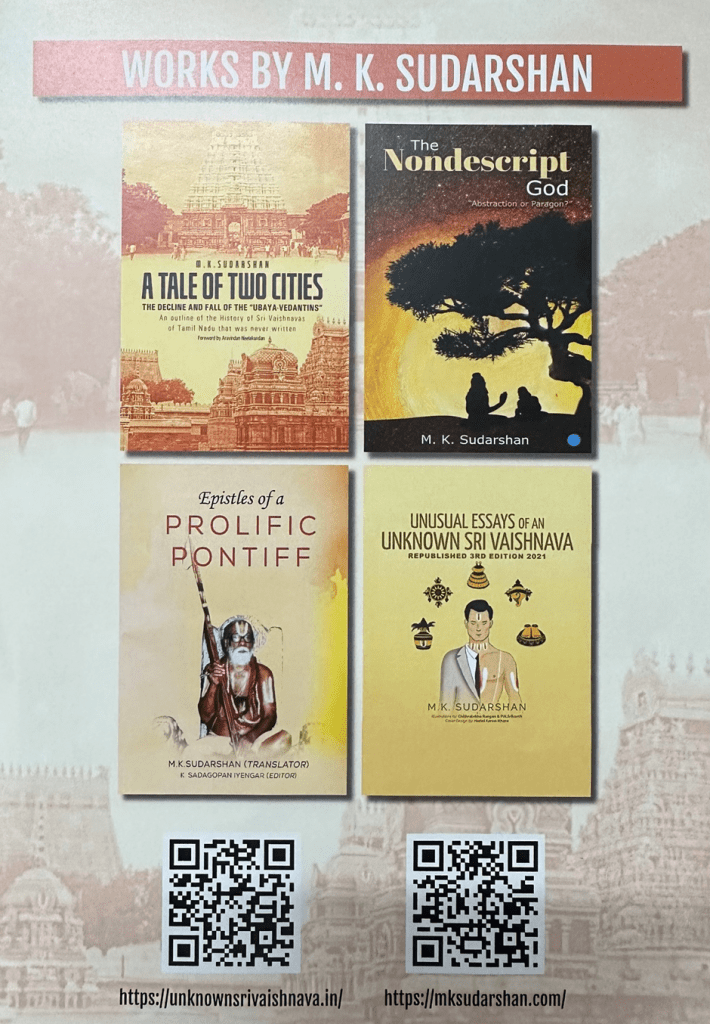
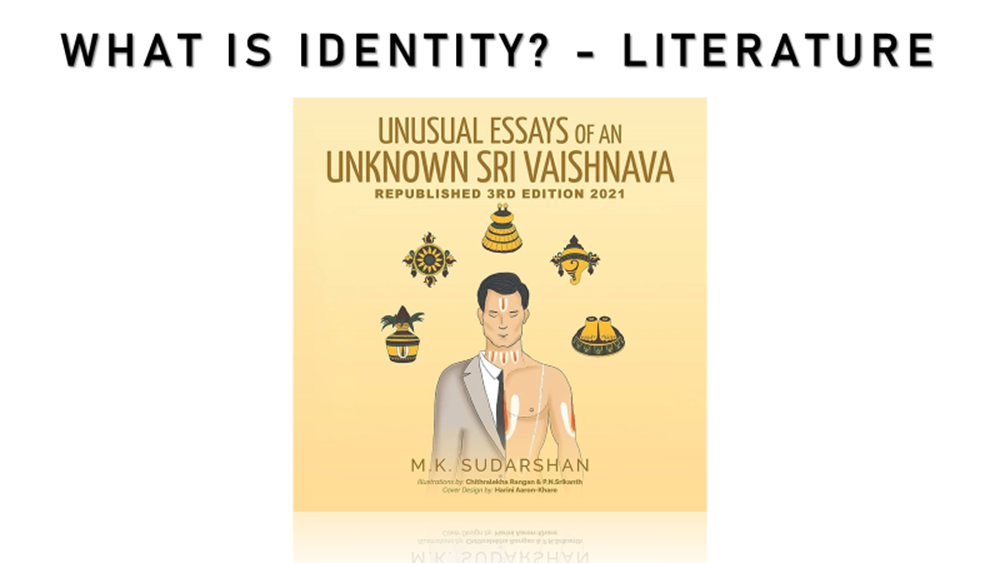
- In the year 2017, the 1000th birth anniversary of the great Sri Vaishnava Acharya and preceptor of Visishtadvaita Vedanta, Sri Ramanuja was celebrated worldwide by all Sri Vaishnavas. I wanted to pay a personal tribute to his memory in my own way. So, I wrote and published in that year my first book titled, “The Unusual Essays of an Unknown Sri Vaishnava”.
- That book had about 70-odd chapters. Each chapter contained an English essay — written in my own “unusual” way and style. All the essays were a personal appreciation of several splendid gems found in the ancient religious literature of Sri Vaishnavism that had enriched my life. The essays were on Vedas and Vedanta, Itihasas, Puranas, Upanishads, Divya Prabhandham, Gadyams, the Paasurams and the mystic poetry of saints and gurus written in Sanskrit and Tamizh.
- In June 2017, thanks to Sri R.T. Chari, “The Unusual Essays of an Unknown Sri Vaishnava” was launched from this very stage here in the TAG Centre. My second career in life as a writer also got launched at the same time!
- That experience of publishing my first book and the modest success it achieved later triggered inside me an obsessive fascination with a very strange subject called “Sri Vaishnava Identity”. In the years thereafter, I started observing and interacting with modern-day, young Sri Vaishnavas — within my own extended family here in India, as well as in the Sri Vaishnava-diaspora living in America, Europe or Australia. The more I observed them the deeper and more obsessive my fascination grew for this subject.
- In November 2018, Sri R.T. Chari once again invited me to this stage here to deliver a talk entitled, “A Few Facets of the Sri Vaishnava Identity”.That presentationraised fundamental questions about Sri Vaishnava Identity viz.:
- “Who is a Sri Vaishnava? What defines the modern Sri Vaishnava identity? Is it the mark of “tiruman” and “sri churnam”? Is it the holy rites of “pancha-samskaaram” or “samaashrayanam”? Is identity defined only by allegiance to a particular sect or to a particular Muttam or Ashram? Or, is a Sri Vaishnava to be identified by the native roots to which he belongs – i.e., in a temple-village situated around any one of the 100-odd temples known as Vaishnava Divya Desams?
- As a writer, I began seriously seeking answers for such questions.
- After a few years of searching for answers, I finally came to my own firm conclusion: The modern identity of this tiny Tamil community can be objectively defined in terms of only one outstanding characteristic: i.e., Adherence to ideals which Sri Ramanuja himself pursued in his lifetime. Those ideals are collectively and commonly known today as “Sri Ramanuja sampradaya”.
- Identification with this “sampradaya” is at two different levels”. At one level is involved adherence to all of its prescribed external, tradition-bound symbolisms and sacraments — e.g., “urdhva pundhram”, “pancha samskaram”, “bharannyaasam”, “anushtaanams” or disciplines, and other “yamam-s and “niyamam-s”, ethical do-s and don’t-s in life.
- At yet another level, perhaps a slightly higher level, is the identity of the “ubhaya-Vedantins”. The difference in the two levels of Identity is explained at length in my book in Chapter 3 read together with Chapter 48. The two chapters delve into what we all consciously know is the idea of Personal Identity.
- Let me give a brief summary of those 2 chapters.
- Personal or individual identity is a matter of complex psychology. It is also problematic, philosophically speaking. There is an old story of Greek mythology that helps us to understand this complex problem. It is called “The Ship of Theseus”.
- In ancient Greece, there was a legendary king named Theseus who supposedly founded the city of Athens. Since he fought and won many naval battles, the people of Athens dedicated a memorial in his honour by preserving his ship in the port for public view. This “Ship of Theseus” stayed there for hundreds of years.
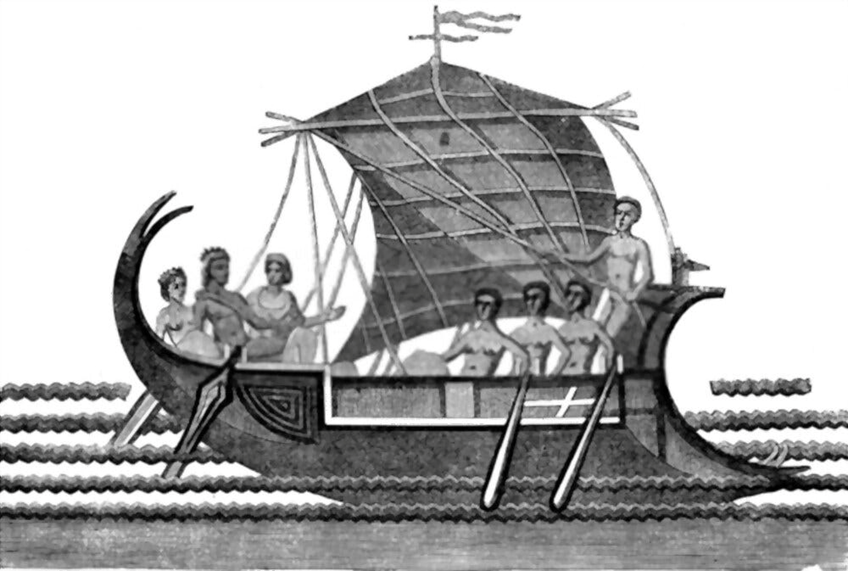
- As time went on, some of the wooden planks of Theseus’ ship started rotting away. To keep the ship nice and complete, the rotting planks were from time to time replaced with new planks made of the same material.
- Let’s say the ship consisted of 100 planks. From time to time 49 got changed? Then 75 and eventually 99 of the hundred planks.
- The key philosophical question about Identity is this: If you replace even one of the planks, is it still the same ship of Theseus? After changing 99 of the planks, is the single plank at the bottom of the ship enough to maintain the original lofty status of the ship? Is the Ship of Theseus still the same?
- The same questions relating to the ship of Theseus could be asked, in a metaphorical way, about Sri Ramanuja also if his “sampradaya” can be conceived as a ship. What happens if you change two or more elements or distinctive features of Ramanuja’s “sampradaya”? Would that make it somehow less of the original ship?
- If the change is gradual, does the ship still maintain its status as the ship of Theseus? And, how gradual must the change of planks be so as not to the change the ship’s original character?
- And what happens if the old wooden planks are switched with modern plastic planks?
- Another question: Does it matter who is making all these changes to the ship—that is, whether one group of workers does it or another? In the case of Ramanuja’s legacy ship and the modern-day Sri Vaishnava identity, would it matter or not who makes the changes, the Tenkalais of Sri Rangam or the Vadakalais of Kanchipuram?
- If the ship is to be preserved for hundreds of years, we can be sure many different people are definitely going to be making the changes. What if they make so many changes to the boat that it can no longer float out to sea? Can we still call it the ship of mighty Theseus — or the ship of Ramanuja — if it cannot perform the same function as the original one did?
- Identity is thus always a philosophical problem. And the identity of the modern “ubhaya-Vedantin” is no exception.
- Now, as a write I thought about it. I tried to simplify the study of the complex problem. And I did it by recognizing that the idea of Identity has 3 main dimensions:
- The first dimension of Sri Vaishnava identity is the vast body of rich and ancient religious literature found in Sri Vaishnava sampradayam – in Sanskrit and Tamizh.
- My first published book, “The Unusual Essays of an Unknown Sri Vaishnava” was really all about this first dimension only.
The second dimension is Philosophy. If a Sri Vaishnava of the modern-day has no proper and firm grounding in Ramanuja’s Visishtadvaita Siddhaantam, then identification with the “sampradaaya” becomes problematic. I came to this firm personal conclusion in the year 2022 while writing my second book which I published.
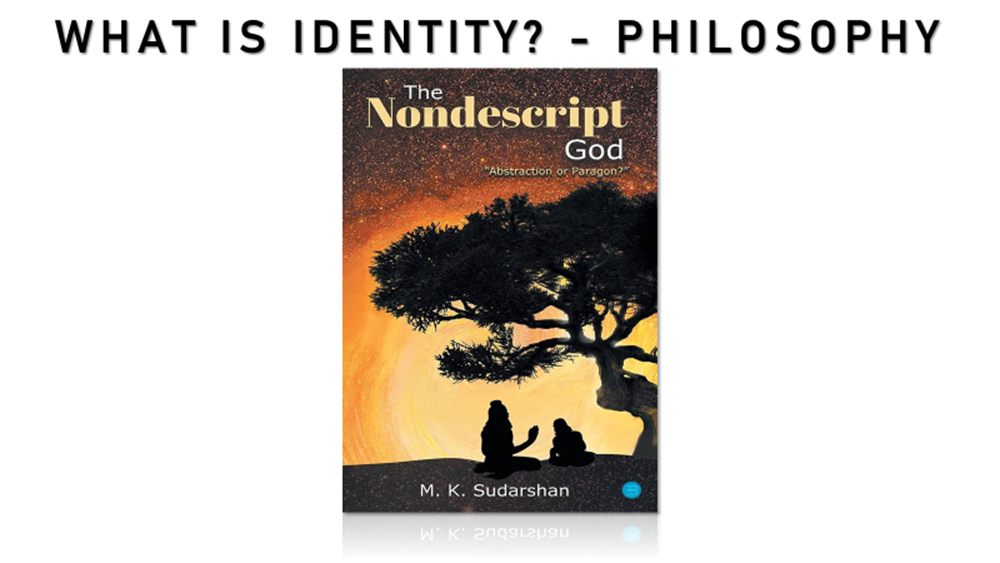
- It is titled “The Nondescript God: Abstraction or Paragon?”. In writing this book, I wasmentored by none else than our chief-guest here on stage, respected scholar and theologian, Prof. Dr. S. Padmanabhacharya.
- The book is slim, only 150 pages long. It is a mini-treatise on just one of the many principles and doctrines of Vishishtadvaita Philosophy. But the purpose of the book was to drive home only one point: Nothing can be stronger than good, basic grounding in Philosophy to serve as the sheet-anchor of a Sri Vaishnava’s sense of personal identity. Without the anchor, the ship of one’s own Sri Vaishnava self-identity will simply be all adrift in the sea of life, tossed about aimlessly.
The third dimension of the modern Sri Vaishnava Identity, is History.

- This new book “A TALE OF TWO CITIES”, ladies and gentlemen, is devoted entirely to an in-depth exploration of the History of the Sri Vaishnava community.
****************************
I must tell you why I wrote this book.
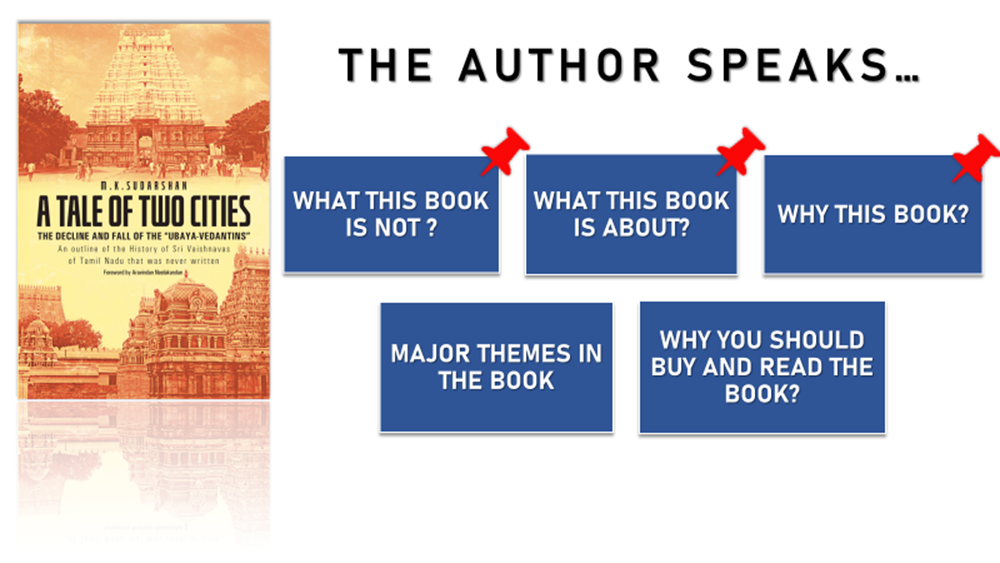
WHY THIS BOOK?
- My main reason for writing this book can be summed in just one line borrowed from the well-known Black-American writer, Toni Morrison:

- Sri Vaishnavas have a glorious past. They were renowned for deep religiosity, scholarship in philosophy and theology and of being mystic poets and outstanding litterateurs in Sanskrit and Tamil languages. They were also builders of great cultural traditions and institutions. Given the tiny size of their population, Sri Vaishnavas were by nature very self-effacing. Outside of South India, their long history even today is relatively unknown to historians or universities.
- Whatever historiography on Sri Vaishnavas is available it cannot be separated, extricated or clearly distinguished from the 1000-year- history of their Acharya “parampara”. Nor from the “sthala puranas” of their “divya-desam” temples.
- If “sthala purana” and hagiography are both removed, there not much of modern historiography about Sri Vaishnavas is left. There is nothing like a plain, straightforward historical account of the Sri Vaishnavas i.e., as just a people… as a simple human community!
- I took Toni Morrison’s advice: I decided to write the book myself that I always wanted to read but found had never been written.
- “A Tale of Two Cities” thus is a book which tries to view the history of the Sri Vaishnavas differently. It does not look at Sri Vaishnava history through the lens of the aggregated narratives of hagiography and legendary temple sthala-puranas. Rather, my book aims to relate or connect those narratives with much larger, epochal developments and undercurrents of Indian history, political movements and societal change which were happening in the background all the time. It spans History between 11th century CE and the year 2023 CE today.
- So, it is only in that precise sense that this book claims to be an “outline of the history of Sri Vaishnavas that was never written”. None of you should therefore hold me guilty of self-conceit or arrogance in making tall claims.
In the time still left for me to finish my presentation, let me quickly run through the major themes of the book.


- The “tale of two cities” is a historical narrative about loss of religious legacy, about debility of cultural identity. It is about decline of economic wealth arising from political alienation and social upheaval… It is also a tale of common human failings…. of ambition, greed, deceit, envy, malice and betrayal.
- In ten Chapters from Chapter 4 through Chapter 14, you will get to read about the post-Ramanuja era of “ubaya-vedantins”, their lives, lifestyles and livelihoods.
- In Chapters 15 through Chapter 21, you will find accounts about the halcyon era the Sri Vaishnavas enjoyed — in both Sri Rangam and Kanchipuram — during the rule of the Vijayanagar Dynasty in 15th/16th century CE; and how generations of the Thathachari and Uttama Nambi families at Kanchi and Sri Rangam built their great spiritual and cultural empires.
- In Chapter 22 is about Islamic depredations of the Khilji, Tughlaq, Bahmani and Moghul dynasties upon the Sri Vaishnava temple-ecosystem and how they stripped it of temple commonwealth, traumatized the community and degraded its cultural and political pre-eminence it had held and enjoyed under the Vijayanagar, Pandya, Nayak, and Wodeyar rule.
- IN Chapters 24 through 28, is a blow-by-blow account of the devastating impact that the very first infiltrations of Christian Evangelism and missionary movements across India in late 18th century had upon the Sri Vaishnava community … And how the slow destruction and decay of their identity began with the death of their mother tongue, Sanskrit. In Chapter 27, the book deals with the period when the British East India Company commandeered many of the largest Sri Vaishnava temples – notably the Tirumala Temple, Tirupati — and systematically impoverished and corrupted them.
- Chapters 30 through Chapter 34 describe how under the British Crown Rule, the “Divide and Rule” policies of the colonial British Government created mass-migration, mass rapid urbanization, mass-secularization of several successive generations of Sri Vaishnavas all across Tamil Nadu; and how that social churning rudely uprooted millions of families from native roots and alienated them from cultural vocations.
- Chapters 35 through 37 deals with the severe culture-shocks the Sri Vaishnava community experienced during the Pre-Independence period in the first few decades of the 20th century after the (a) rise of the Dravidian Anti-Brahmin Movement, and (b) the enactment of many new legislations which enabled elected governments to interfere and even takeover Sri Vaishnava temples.
- Through Chapters 38 through 40, is described the post-Independence “culture war” that rages even today between Sanskrit Vs Tamil, Dravidian Vs Aryan and Brahmin Vs Anti-Brahmin. The narrow sectarian in-fighting between Tenkalai and Vadakalai is very much part of the same culture-war. It has really much more to do with the larger socio-political and ethnological caste-dynamics in Tamil Nadu than anything to do with “Sri Vaishnava sampradaya”.
- In Chapters 41 through 44 is explained how the judicial system of India has impacted the identity of the Sri Vaishnava community. The Constitution of India and judicial pronouncements of various Courts across the country have not always been very protective of the interests of the Hindu religion, its temple ecosystem and institutions. At least 4 major landmark judicial verdicts have profoundly disturbed if not disrupted the way control and administration of temples in Kerala, Tamil Nadu and Andhra Pradesh were regulated by tradition in the past. They are the Shirur Mutt case, the Tirumala temple archaka case, the Chidambaram Sabhanayakam temple case and the Sabarimala temple case.
- In Chapter 45, a brief account is given of how Tenkalai and Vadakalai have gone on to “salami slice” themselves i.e., how they caused their own splintering into many smaller autonomous “sampradaya” units, each styling itself as separate “muttam”, “ashram”, “peetam” “samasthaanam” etc.
- Chapters 46 and 47 describe how under the onslaught of anti-Brahmin Dravidian ideological propaganda and culture-war, the identity of Sri Vaishnavas got chipped away if not wholly stripped away. Four such incidents are briefly narrated involving 4 well-known celebrities: the late Chief Minister M. Karunanidhi; (b) the Tamil-cinema lyricist, Vairamuthu (c) the Sri Vaishnava Carnatic musician T.M. Krishna and (d) and present Chief Minister, Thiru. M.K. Stalin.
- Chapters 49 to 54 describes how a few bold and well-meaning Sri Vaishnava scholars and observers came out in public to deeply introspect about the present decline in the stature and relevance of the Sri Vaishnava community. The Sri community leadership unfortunately dismissed them as mere mavericks and publicity-seekers.
- Chapter 55 contains my own personal views on how to salvage if not save the broken Sri Vaishnava identity. They are radical, even provocative. They can potentially stir up a bit of controversy. Therefore, I will not divulge them here today. You must buy the book and read it all for yourself. After reading this chapter, whether you want to throw bouquets or brickbats at me, is really up to you. I will accept both gracefully.
- The final two chapters, 56 and 57 and the Epilogue retell two happy and inspiring stories. They will surely go into modern Sri Vaishnava history — if and when a future historian writes it. One story is about how a Sri Vaishnava Acharya from near-Kanchipuram, at the age of 90, built a world-famous temple-tower, the colossal “raja gopuram” of Sri Rangam temple. And then there is also the story of how the present Jeeyar of Sri Ahobila Mutt won his case in the Supreme Court of India to wrest back effective control of the Ahobilam Sri Narasimha Swamy Temple Devasthanam from the clutches of the Government of Andhra Pradesh.
**********************
WHY SHOULD YOU BUY AND READ THE BOOK?
- “Can I give you all one good reason why you should buy and read my 500-page book?”
- The answer, ladies and gentlemen, is given by Sri Aravindan Neelakandan, scholar, historian and journalist (he is the Contributing Editor of SWARAJYA magazine, and co-author of the best-selling book of Rajiv Malhotra, “BREAKING INDIA”) in his Foreword to my book:

I must now place on record here my sincere gratitude to Sri R T Chari, Sri S R Madhu and the TAG Centre team. I am also deeply grateful to Sri N. Gopalaswami and Dr. S. Padmanabhacharya, our honoured guests. They so readily accepted to grace this occasion. I am just as eager as all of you to hear their speech.
I wish to express my sincere appreciation of the great assistance my wife Smt. Divya Sudarshan so diligently gave me in proofing the manuscript of the book before it went to print. I also thank my publishers, M/s Westwood Publishing, Atlanta USA.
Thank you all!
“Sarva mangalaani bhavanthu”!
M.K. Sudarshan